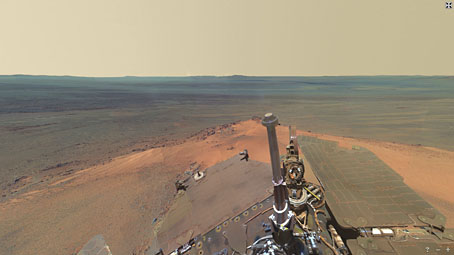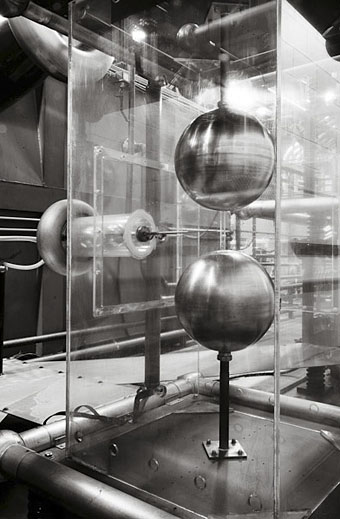
Transmitter Crowbar Discharge Unit, Bates Linear Accelerator. Photo by Daniel Jackson from his Dark Machines series.
The language we use for writing about art is oddly pornographic: We know it when we see it. No one would deny its distinctiveness. Yet efforts to define it inevitably produce squeamishness, as if describing the object too precisely might reveal one’s particular, perhaps peculiar, investments in it. Let us now break that unspoken rule and describe the linguistic features of IAE in some detail.
IAE has a distinctive lexicon: aporia, radically, space, proposition, biopolitical, tension, transversal, autonomy. An artist’s work inevitably interrogates, questions, encodes, transforms, subverts, imbricates, displaces—though often it doesn’t do these things so much as it serves to, functions to, or seems to (or might seem to) do these things. IAE rebukes English for its lack of nouns: Visual becomes visuality, global becomes globality, potential becomes potentiality, experience becomes…experiencability. […] Whatever the content, the aim is to sound to the art world like someone worth listening to, by adopting an approximation of its elite language.
International Art English by Alix Rule & David Levine
For years I’ve been calling it Artspeak: the frequently disingenuous, misleading or merely confused jargon that passes for descriptive writing in the art world. Alix Rule and David Levine apply the more neutral label of International Art English. In a lengthy essay at Triplecanopy they reveal the origins of IAE’s terminology and show why the stuff has spread like semantic kudzu.
• “What a bizarre focal point Anish Kapoor’s spiral callipers are: a Laocoönian observation platform strangled in red steel at a cost of many millions, while electricity pylons, with their austere elegance, once hymned by the poets of the 1930s, have been removed, at enormous cost, from the same site to be buried in the radioactive tilth of landfill dumps and industrial detritus.” Iain Sinclair reports on the Olympics.
• Alfred Kubin in…Nottingham! The Other Side, an exhibition of “haunting drawings of death, trauma and fantastical creatures inhabiting imaginary worlds”, running to the end of September.
• Francis Ford Coppola and Stewart Copeland discuss the making of Rumble Fish (1982). Over at The Rumpus there’s Coppola talking about his career and his latest film, TWIXT.
• Eraserhead: The Making of a Cult Classic. In the 1980s Kenneth George Godwin interviewed everyone responsible for making David Lynch’s film. Fascinating reading.
• Skin Job, the debut poetry collection by Evan J. Peterson, is twenty-one poems about monsters, horror, and science fiction. Evan made a trailer.
• Wood, brass and “the latest advances in nanotechnology”: Teka, an OLED lamp by Aldo Cibic and Tommaso Corà.
• Tonite Let’s All Make Love in London (1967): Peter Whitehead’s film of the capital at its swinging height.
• “Beam Us Up, Mr. Scott!”: Why Misquotations Catch On by Maria Konnikova.
• Hari Kunzru‘s ten favourite books about underground London.
• The Periodic Table of Heavy Metals.
• Alan Garner: A life in books.
• Fuck yeah, manuscripts!
• (HR) Giger Counter.
• This week was all about Vangelis in the 1970s: Creation du Monde (1973) | Spiral (1977) | Himalaya / Summit (1979).