Phantom Cities by The Sodality of the Shadows

phantom.jpg

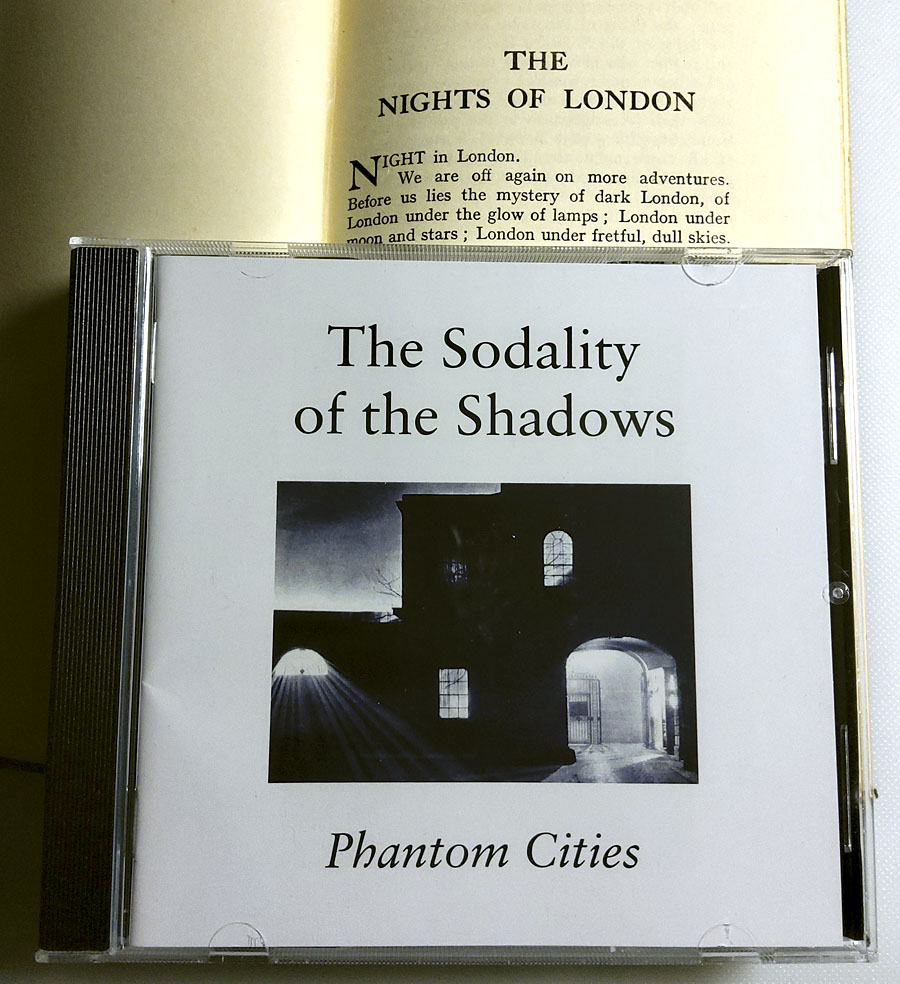
Book by HV Morton (1926) not included.

I like night music, any kind of night music, whether it be the shimmering sonorities of Béla Bartók and George Crumb, Julee Cruise exploring the dark, or the rumbling atmospheres of Thomas Köner. Phantom Cities by The Sodality of the Shadows is night music of another kind, more musically determined than the numerous purveyors of post-Köner dark ambience, with a character defined by weird fiction. The latter quality is perhaps inevitable given the people who comprise the group: Ray Russell and Rosalie Parker have been running Tartarus Press for the past 30 years; Mark Valentine is an author and editor (and occasional publisher) of many story collections, and Jon Mueller’s name has appeared here in the past via the soundtrack CD for the Swan River Press edition of The House on the Borderland that I illustrated. Phantom Cities sidesteps Robbe-Grillet’s Topology of a Phantom City for an older lineage, looking back to Arthur Machen (the group’s name is borrowed from a secret society formed by Machen and AE Waite) and the spectral metropolis of pre-war London photographed by Harold Burdekin in London Night (1934). The music is slow, sombre and reverberant; guitars pluck notes from the embracing dark while Mueller’s drums maintain a funereal pace; sporadic squalls of feedback suggest a deeper darkness, the latent possibilities of unpeopled streets. Mark Valentine had an earlier musical persona as The Mystic Umbrellas but his contribution here is textual accompaniment in the form of 12 fictional pieces, some of which are read by Rosalie Parker over and between the music. This isn’t a collection of readings, however, the album may be taken either as illustration of Burdekin’s photos and the texts or as a work that stands alone. A soundtrack for the longer nights of encroaching autumn.

Phantom Cities
Strange Houses Of Sleep

Previously on { feuilleton }
The Smoke
Two albums
Thomas Köner

Weekend links 532

ashmole.jpg

An alchemical illustration from Theatrum Chemicum Britannicum (1652) by Elias Ashmole.

• “Originally the idea was to do four parallel feuilleton stories, linked at the beginning of each episode by still shots connecting with the other episodes, rather like the old serials.” Jacques Rivette mentions a familiar word during a 1974 discussion with Carlos Clarens and Edgardo Cozarinsky about Out 1 and Céline and Julie Go Boating. I watched all 775 minutes of Out 1 last year, followed by a re-viewing of Céline and Julie, so this was good to read. Elsewhere: “The dizzying Céline and Julie Go Boating is apt viewing for a chaotic present,” says Phillipa Snow.

Away is a wordless feature-length animated film in which a boy is pursued by a lumbering monster after parachuting from a crashing aircraft. It was directed, written, edited, animated and scored by Gints Zilbalodis. Christopher Machell reviewed the film here. Watch the trailer.

• Jean Lorrain’s novel of Decadent dandyism, Monsieur Bougrelon, receives a new English translation by Brian Stableford for Side Real Press. (The Spurl translation by Eva Richter was reviewed here a few years ago.) The new edition includes illustrations by Etienne Drian (1885–1961).

El Topo again, among other things: Mike Soto on the anti-Western genre set in America’s surreal borderlands. Cormac McCarthy is a surprising absence from Soto’s lists despite almost all of his later work being concerned with the border region.

• “Whatever their pursuits, they were extremists who created literature that wasn’t so much great as it was relentless. Even now they make passive reading impossible.” Chris R. Morgan on Swift, Sade and the art of upsetting people.

• The best batch yet? Sean Kitching talks to Gary Lucas and Eric Drew Feldman about the recording of Captain Beefheart’s Doc At The Radar Station.

• Malkovich, Malkovich, Malkovich… Photographer Sandro Miller persuaded John Malkovich to recreate 41 famous photographic portraits.

• An extract from Rated SavX in which Edwin Pouncey/Savage Pencil talks with Timothy d’Arch Smith about his artistic evolution.

• At Dennis Cooper’s: Pat O’Neill Day.

Siavash Amini‘s favourite music.

Get Away (1970) by Ry Cooder | Running Away (2002) by Radar | Fly Me Away (2005) by Goldfrapp

Weekend links 530

yoshino.jpg

Kami #58 -bloom- (2019) by Momo Yoshino.

• “Set amid the countryside and the beaches of coastal Sussex, They depicts a world in which plundering bands of philistines prowl England destroying art, books, sculpture, musical instruments and scores, punishing those artistically and intellectually inclined outliers who refuse to abide by this new mob rule.” Lucy Scholes on They: A Sequence of Unease (1977) by Kay Dick, which she calls “a lost dystopian masterpiece”. This is revelatory in a minor way since for years I’ve remembered seeing a slim volume with the title They in a bookshop, and which I later thought might have been a Rudyard Kipling book (there’s a Kipling story with the same title). The timing is right, the sighting would have been in 1977 or 78. The combination of that short, one-word title with a stark cover image and a sinister description on the rear was hard to forget but I didn’t take note of the author’s name. (I also didn’t buy the book, opting instead for some inferior work.) A shame that it seems to be resolutely out of print.

• “The threat to civil liberties goes way beyond ‘cancel culture’,” says Leigh Phillips. It makes a change seeing this coming from Jacobin when so much of the left today can find nothing wrong with censorship so long as it’s in a good cause. (Every censor that ever lived believed they were acting in a good cause, were on “the right side of history”, etc, etc.) The piece includes a dismissal of the increasingly common riposte that “only the state can censor”: this would be news to my colleagues at Savoy Books who endured years of police harassment including the seizure and destruction of printed material; the same with the long history of police action against UK rap artists. Related: “Work that’s cancelled for being ‘of its time’ was probably objected to, at the time.” Dorian Lynskey on chronocentrism and “the narcissism of the present”.

• “Cruising baths, bars, and subway toilets, snorting poppers and ‘fist fucking with 40 guys for 14 hours’ (as he recalled in You Got to Burn to Shine, his 1993 collection of prose and poems), he found meaning in a religion of radical eros whose sacrament was anonymous sex.” Mark Dery reviewing Great Demon Kings: A Memoir of Poetry, Sex, Art, Death, and Enlightenment by John Giorno.

Aubrey Powell says his best photograph is the burning man from the cover of Wish You Were Here by Pink Floyd.

• Mixes of the week: Fact mix 770 by Lyra Pramuk, and mr.K’s Kooky Kuts Vol.4 by radioShirley & mr.K.

• The Alchemical Brothers: Brian Eno & Roger Eno interviewed by Wyndham Wallace.

• Origami-inspired optical illusion oil paintings by Momo Yoshino.

Alexander Larman on the demise of the second-hand bookshop.

• New music: Follow The Road by Yumah, and Röschen by Pole.

• At Dennis Cooper’s: Lighting.

• RIP Linda Manz.

My Boyfriend’s Back (1963) by The Angels | Carnival of the Animals, R. 125: VII. The Aquarium (Camille Saint-Saëns) (1975) by the Württemberg Chamber Orchestra, Heilbronn with Marylene Dosse & Anne Petit, conducted by Jörg Faerber | Kill All Hippies (2000) by Primal Scream

Weekend links 526

colquhoun.jpg

La Cathédrale Engloutie (1952) by Ithell Colquhoun.

• Many of the recent lists of “where to start with the music of [x]” aren’t filling an urgent requirement, but in the case of Sun Ra—whose discography runs to 95 albums—any guide is a useful one: Sean Kitching chooses 10 recordings from the Ra galaxy. I’m not unacquainted with Sun Ra’s music but there’s so much of it that almost all these suggestions are news. Related: Namwali Serpell on the life and work of a cosmic visionary.

• Coming soon from Strange Attractor, Ithell Colquhoun: Genius of The Fern Loved Gulley by Amy Hale, the first book-length study of the life and work of the British Surrealist and occult artist.

• I doubt I’ll get to see it but I’m pleased to know that the prematurely shuttered Aubrey Beardsley exhibition is returning to Tate Britain. You’ll need a Decadent face-mask.

• And speaking of music lists, Alexis Petridis compiles a ranking of all the songs by a little-known post-punk band from Manchester.

The Last Arcadian (Process Mix): more psychotropic nougat from Moon Wiring Club.

• Kill Me Again… Ken Hollings on Ennio Morricone and the music of the future.

Mervyn Peake‘s visual archive has been acquired by the British Library.

Anitra Pavlico on the fantastic world (and music) of Maurice Ravel.

Stanley Stellar‘s photos of the New York gay scene in the 1980s.

• At Dennis Cooper’s: Fetish.

• RIP Judy Dyble.

Wikidelia

Chelsea Morning (1968) by Fairport Convention | I Talk To The Wind (1968) by Giles, Giles & Fripp feat. Judy Dyble | Morning Way (1970) by Trader Horne