The recurrent pose 41

seeley.jpg

Nude – The Pool (1910) by George Seeley.

Having spotted this Flandrinesque photogravure print by George Seeley (1880–1955) on a couple of sites I was wondering where there might be a decent collection of the photographer’s other work. “Photogravure” proved to be the key word since The Art of the Photogravure has a selection of Seeley prints. Like his contemporary Fred Holland Day, Seeley created very painterly results with his camera; like Day he was also prepared to pose unclothed young men in natural settings for a “Classical” effect.

Elsewhere on { feuilleton }
The recurrent pose archive

Previously on { feuilleton }
Fred Holland Day revisited

Weekend links 49

ceranic1.jpg

Star City by Tomislav Ceranic.

• Noted in the blogosphere this week: A Journey Round My Skull underwent a transmutation into 50 Watts; a blog devoted to artist, designer & illustrator Jessie M King; “The arts and musicks of the supranatural” at Secret Lexicon; From the Farm, Railroads, Sewing Machines & Beyond, lengthy reminiscences from a long life in America.

Barney Bubbles in Wonderland, in which the designer and his chums indulge in some Carrollian shenanigans somewhere in the 1960s. The resulting footage is now a promo video for Balloon Race by Bear Driver.

HP Lovecraft’s favourite words, the desert island books of Jorge Luis Borges, a profile of Christopher Isherwood, and Edward Gorey again.

[Arthur] Machen explicitly talks about the strength of London, as opposed to Paris, in that London is more chaotic. Although he doesn’t put it in these words, I think what partly draws him to London is this notion that, in the absence of a kind of unifying vision, like Haussmann’s Boulevards, and in a city that’s become much more syncretic and messy over time, you have more room to insert your own aestheticizing vision.

China Miéville in a great interview at BLDGBLOG.

Matryomin is “the unique, original erectronic [sic] musical instrument invented by Masami Takeuchi in 2000”. Yes, a theremin inside a Russian doll. The Mable ensemble playing Duke Ellington’s Caravan is, well…I’m still speechless. And there’s also this.

Conductor turns the New York subway system into an interactive string instrument.

ceranic2.jpg

Discordia by Tomislav Ceranic.

Amazingly enough, prostitution was legal during the Victorian period. There were tons of brothels all over the major cities of England, and of all different kinds. There were lots of flagellation brothels; these were places where primarily men would go to be whipped by women or by men. There were also gay male brothels. You could go to a park in London at night, pick up what were called the “park whores” and give them a very small amount of money to have sex openly in the park. I also write about gay “cruising,” which was quite common. If you knew the right place to go and knew the right signals, you could pick up a man on the street and have sex in an alley.

Deborah Lutz is interviewed about her book Pleasure Bound: Victorian Sex Rebels and the New Eroticism.

Cult-ure: Ideas can be dangerous, a book by Rian Hughes.

Chernobyl: Europe’s strangest wildlife refuge.

The Eadweard Muybridge Online Archive.

Aubrey Beardsley at Tumblr.

Caravan (1959) by Martin Denny | Caravan (1961) by 80 Drums Around The World | Caravan (1962) by Sir Julian | Caravan (1965) by The Ventures | Caravan (1973) by Enoch Light & The Light Brigade | Caravan (1997) by Jimi Tenor (I could go on and on, yes I could…)

Ludwig’s Winter Garden

munich1.jpg

Another monarch, and another glass-canopied hothouse. The extravagances of Ludwig II of Bavaria have featured here before but I’d overlooked the Winter Garden he had built in 1871 on the roof of the Munich Residenz, the home of the Bavarian royal family when they were in the capital. The views here are by court photographer Joseph Albert, and there isn’t much else online apart from this page at the palace website where we can see another Albert photo, and a painting by Julius Lange showing the idealised vision the king would have had in mind. With its painted scenery, “Moorish” tent, and artificial lighting—including rainbow and moonlight effects—Ludwig’s garden looks back to the exotica of the Royal Pavilion at Brighton, and also ahead to our current crop of theme parks and fantasy worlds. The Winter Garden was demolished after Ludwig’s death but the Residenz still contains other splendours, not least the jaw-dropping excess of the Antiquarium.

munich2.jpg

Previously on { feuilleton }
The Schönbrunn Palm House
The Royal Greenhouses of Laeken
Arcades panoramas
Arcades
Schloss Falkenstein
Schloss Linderhof
Schloss Neuschwanstein
Passage des Panoramas
Passages 2
Passages

The Schönbrunn Palm House

palmenhaus1.jpg

Photo by Roberto Verzo.

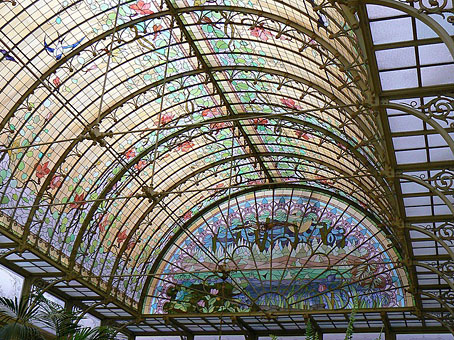
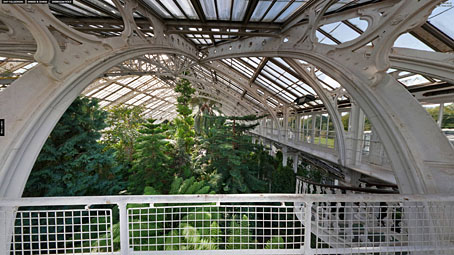
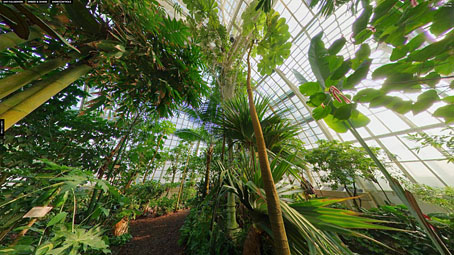
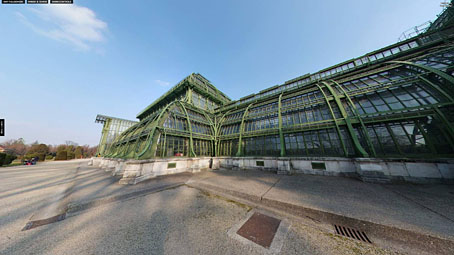
If the Schönbrunn Palm House, Vienna, lacks the elegance of Alphonse Balat’s beautiful Winter Garden in Brussels, the structure does have a distinct style of its own. Roberto Verzo’s Flickr views manage to hide the visitors and background details, giving the impression that the building might be larger than it is. Much as I’d love these places to have a Piranesian grandeur à la Schuiten the reality is somewhat diminished. The Palm House was built in the 1880s from a design by Franz Xaver Segenschmids, and is another royal palace adjunct. According to the Schönbrunn palace website this one is more visitor-friendly than the Laeken greenhouses, being open to the public all year round.

• The Schönbrunn Palm House at Wikimedia Commons
• The Schönbrunn Palm House at Flickr

palmenhaus2.jpg

Photo by RobertG.

palmenhaus3.jpg

Photo by Friedrich Böhringer.

Previously on { feuilleton }
The Royal Greenhouses of Laeken
Arcades panoramas
Arcades
The art of François Schuiten
Passage des Panoramas
Passages 2
Passages

Weekend links 48

niteflights.jpg

Nite Flights (1978) by The Walker Brothers. Cover design by Hipgnosis.

something attacked the earth last nite
with a kick that man habit-eye
cut the sleep tight boys who dreamed and dreamed
of a city like the sky

Scott Walker quotes Brion Gysin (and who knows what else) in Shutout (see below), one of the four remarkable songs he wrote for the final Walker Brothers album, Nite Flights. That album cast a shadow over David Bowie’s Lodger a year later, and led Bowie to try his hand at a cover of the title track in 1993.

• Frédéric Chaubin’s photographs of what he calls Cosmic Communist Constructions. Also a new book from Taschen, and an exhibition at the Karlsruhe Museum of Contemporary Art. PingMag interviewed Chaubin back in 2006.

chirnoaga.jpg

From Disparate works by Romanian artist Marcel Chirnoaga (1930–2008). See also the Virtual Museum of Marcel Chirnoaga.

The immense size of modern databases gives us a feeling of meaninglessness. Information in such quantities reminds us of Borges’s library extending infinitely in all directions. It is our task as humans to bring meaning back into this wasteland.

Freeman Dyson on The Information: A History, a Theory, a Flood by James Gleick.

• In the Tumblr labyrinth this week: Mr Rossignol, the Elephant House for Edward Gorey, and Brion Gysin.

• Related to the last, Mutate or Die is “a bioart project being conceived of and executed by Tony Allard and Adam Zaretsky”.

• Barry Miles’s top 10 counterculture books. Related: Rick Poynor on Richard Neville’s Playpower.

“The sooner literary fiction recognises & accepts its generic identity, the sooner it can get help.”

• Is YouTube user “Kosinski” the ever-elusive Chris Marker? “All signs point to yes.”

• The Internet Archive is making its books available to US libraries.

• The Castle of Shadows at BLDGBLOG.

• The Light Painting Pool at Flickr.

• Scott Walker (with the Walker Brothers): Shutout |Nite Flights | The Electrician.