Midsummer

midsummer8.jpg

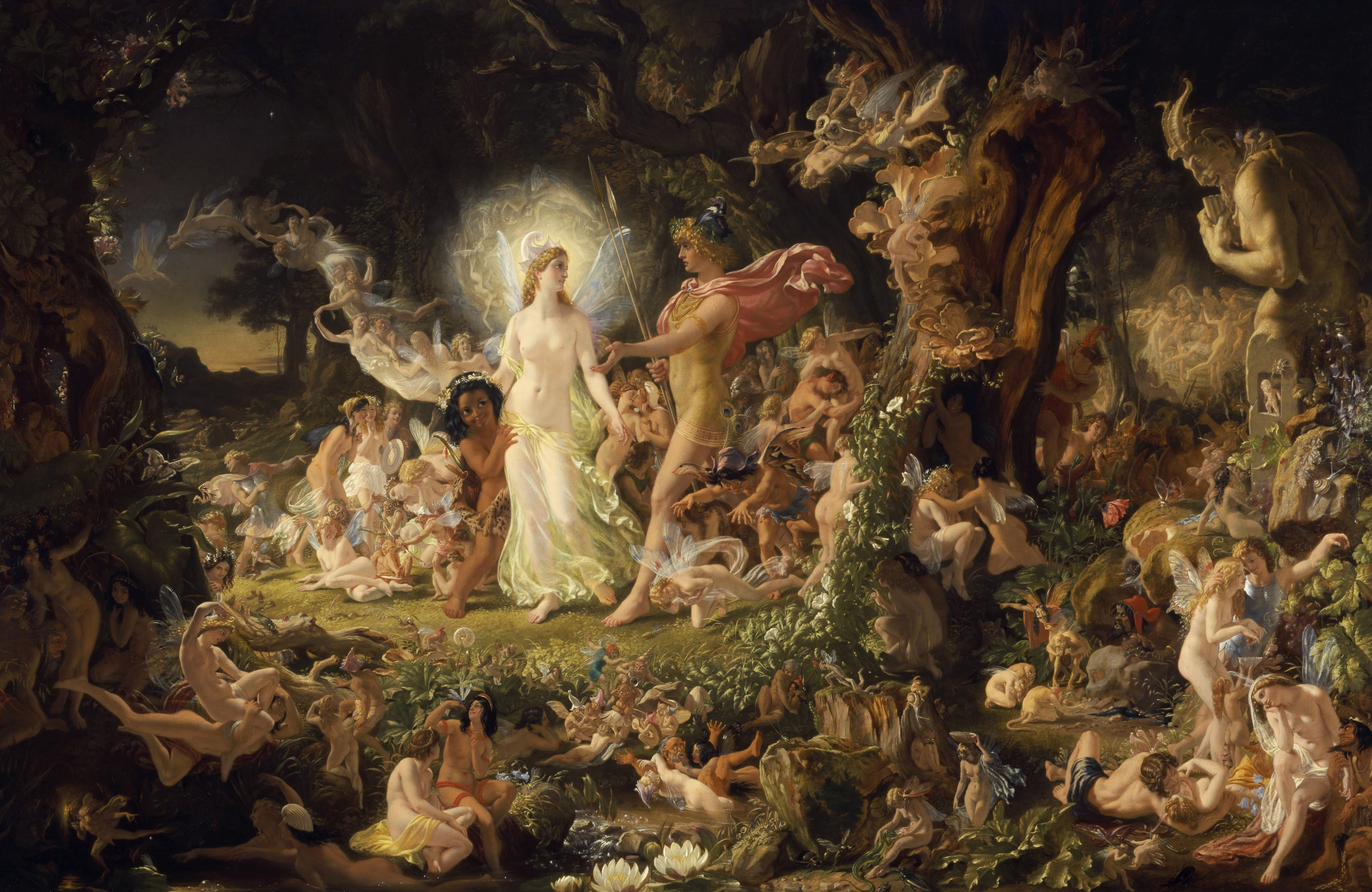
A statue of the Great God Pan looks down on the teeming chaos of Joseph Noel Paton’s The Quarrel of Oberon and Titania (1849), one of many 19th-century paintings based on A Midsummer Night’s Dream. Paton’s canvas gives Richard Dadd a run for his money in its wealth of incident and grotesque detail (see the big version at Wikipedia), and the artist returned to the theme a few years later with the equally excessive Fairy Raid (below). The later painting presumably depicts the kidnapping of the Changeling which Oberon and Titania quarrel over.

While we’re on the subject, a couple of years ago I wanted to link to the amazing fairy scene in William Dieterle’s 1935 film (which supposedly features Kenneth Anger as the Changeling) but it wasn’t on YouTube. Now you can watch it here.

midsummer7.jpg

The Midsummer Night’s Fairies (detail, 1847) by Robert Huskisson.

midsummer1.jpg

The Quarrel of Oberon and Titania (1849) by Joseph Noel Paton.

midsummer4.jpg

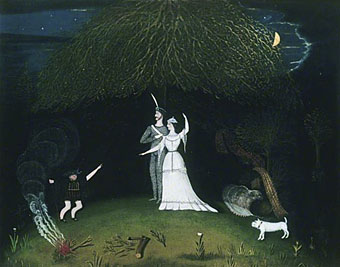
A Midsummer Night’s Dream (c. 1860) by W. Balls.

midsummer2.jpg

The Fairy Raid: Carrying Off a Changeling, Midsummer Eve (1867) by Joseph Noel Paton.

midsummer5.jpg

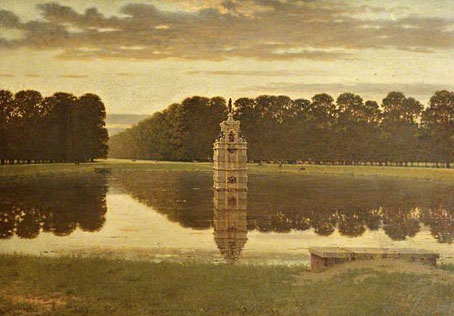
Midsummer Morn, Bushy Park (1905) by George Dunlop Leslie.

midsummer3.jpg

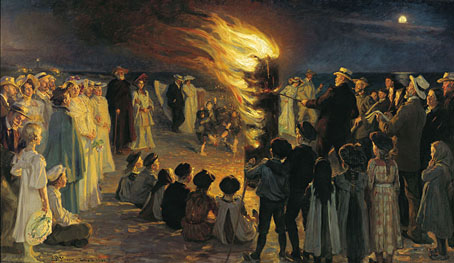
Midsummer’s Eve Bonfire on Skagen’s Beach (1906) by PS Krøyer.

midsummer6.jpg

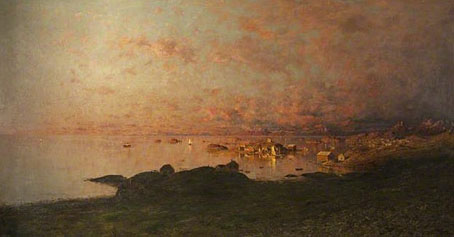
Midsummer Night, Lofoten, Norway (no date) by Adelsteen Normann.

Previously on { feuilleton }
Max Reinhardt’s Dream
The Midsummer Chronophage
Another Midsummer Night
A Midsummer Night’s Dadd
William Heath Robinson’s Midsummer Night’s Dream

More hypercubes

hypercube1.jpg

A few more extensions of the idea, not all of which have much to do with Hinton’s concepts beyond the name.

hypercube2.jpg

hypercube3.jpg

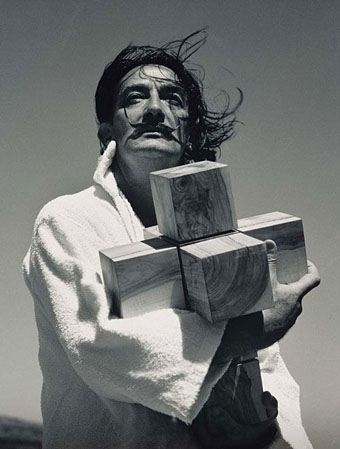
Salvador Dalí with hypercube (1952). Photo by Francesc Català-Roca.

hypercube4.jpg

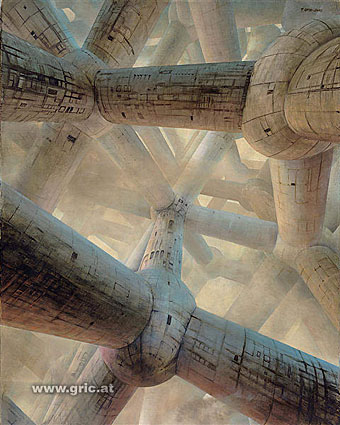
Hypercubic Metropolis (2002) by Peter Gric.

hypercube5.jpg

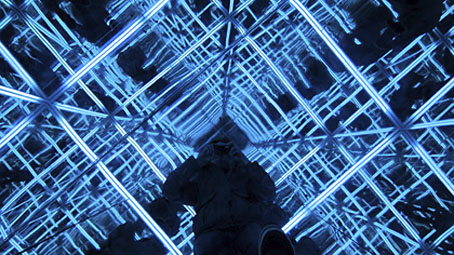
HyperCube (2012) is an installation by artist Jaap van den Elzen and sound composer Augusto Meijer which combines the mirror room familiar from the work of Yayoi Kusama with changeable lighting and sound effects. See also Cube 2: Hypercube (2002) which concerns a group of people imprisoned in a tesseract.

Previously on { feuilleton }
Hinton’s hypercubes
Infinite reflections

Hinton’s hypercubes

hinton.jpg

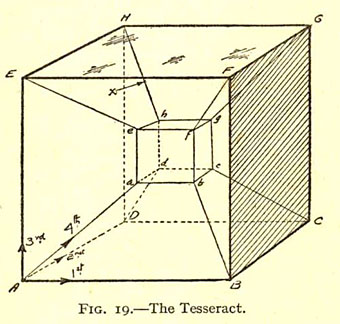
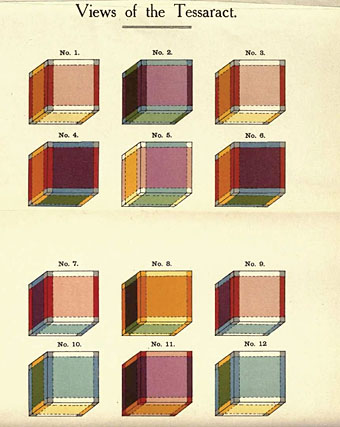
Illustration from The Fourth Dimension (1906) by Charles Howard Hinton.

A slight return to the worlds of Borges. I happened to be re-reading some of the stories in The Book of Sand (1975), one of the later collections which includes the story Borges dedicated to HP Lovecraft, There are more things. Borges’ writings are nothing if not filled with references to other works of literature, philosophies, religions, and ideas in general; following up the less-familiar references would preoccupy a reader to the detriment of the writing so there’s a tendency when reading a Borges piece to take for granted many of those nuggets of esoteric information. I’ve read There are more things many times—it’s a favourite in part for having the additional thrill of Borges going Lovecraftian—but only realised with this reading that I can now fully appreciate the following:

Years later, he was to lend me Hinton’s treatises which attempt to demonstrate the reality of four-dimensional space by means of complicated exercises with multicoloured cubes. I shall never forget the prisms and pyramids that we erected on the floor of his study.

Prior to reading this I did know that Hinton was Charles Howard Hinton (1853–1907), the British mathematician and dimensional theorist. Hinton’s name tends to turn up in discussions of the work of his mystical contemporaries, notably the Theosophists who were more taken with his theories than those in the scientific fields. (A conviction for bigamy didn’t help his reputation.) But those multicoloured cubes were a mystery until the publication of (fittingly) the fourth number of Strange Attractor Journal. Among the usual selection of fascinating articles the book contains a piece by Mark Blacklock about Hinton’s ideas including those mysterious cubes. Drawings of the cubes first appeared in A New Era of Thought (1888) where Hinton proposes using them as aids to a series of mental exercises with which the reader may visualise the higher dimensions of space. Hinton invented the word “tesseract” to describe the four-dimensional structure projected from the faces of his three-dimensional cubes.
dali.jpg

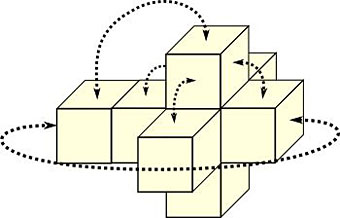
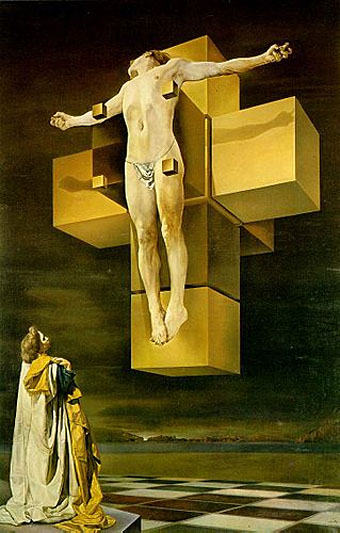
Crucifixion (Corpus Hypercubus, 1954) by Salvador Dalí.

Hinton may not have impressed his mathematical colleagues as much as he hoped but his ideas have an understandable attraction, as the Borges story demonstrates. The story concerns the refashioning of a Buenos Aires house for an unusual resident; thirty years earlier Robert Heinlein wrote “—And He Built a Crooked House—” in which an architect builds a house in the form of a four-dimensional hypercube: only the lowest cube attached to the ground is visible from the exterior. I read that story when I was a teenager, and was already acquainted with tesseracts thanks to school-friends who were maths whizzes; I was the arts whizz, and I think I was probably the first of us Dalí enthusiasts to discover the artist’s own take on the hypercube, Crucifixion (Corpus Hypercubus) from 1954. Borges and Heinlein in those stories were both writing their own forms of science fiction, and Dalí’s painting finds itself co-opted into another story with sf connections, The University of Death (1968) by JG Ballard, one of the chapters in The Atrocity Exhibition (1970):

He lit a gold-tipped cigarette, noticing that a photograph of Talbot had been cleverly montaged over a reproduction of Dalí’s ‘Hypercubic Christ’. Even the film festival had been devised as part of the scenario’s calculated psychodrama.

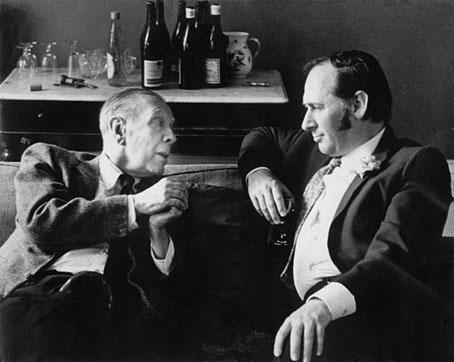
If we seem to have strayed a little then it’s worth noting that Borges was familiar with Ballard’s work: he included The Drowned Giant in the later editions of The Book of Fantasy, the anthology he edited with Adolfo Bioy Casares and Silvina Ocampo. The two writers also met on at least one occasion.
jlb-jgb.jpg

JLB and JGB, circa 1970. Photo by Sophie Baker.

Charles Hinton’s coloured cubes and tesseracts are described in detail in The Fourth Dimension (1906), a reworking of the ideas from A New Era of Thought, and also the source of the colour illustration that everyone reproduces. Mark Blacklock has his own multi-dimensional website where you can read about his construction of a set of three-dimensional Hinton cubes. As for the mental exercises, Blacklock’s piece in Strange Attractor contains an anecdotal warning that the auto-hypnotic system required to fully visualise Hinton’s dimensions can result in a degree of obsession dangerous to the balance of mind. Proceed with caution.

Previously on { feuilleton }
Borges and the cats
Invasion, a film by Hugo Santiago
Spiderweb, a film by Paul Miller
Books Borges never wrote
Borges and I
Borges documentary
Borges in Performance
Weekend links 212

non-format.jpg

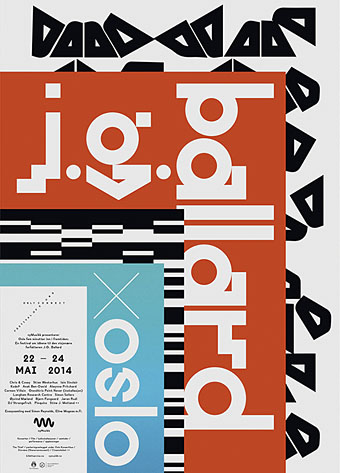
Poster for the recent Ballard-themed Only Connect Festival of Sound in Oslo. Design by Non-Format.

Bulldozer by Laird Barron was my favourite piece in Lovecraft’s Monsters, the recent Tachyon anthology edited by Ellen Datlow that I designed and illustrated. So it’s good to hear that Nic Pizzolato, writer of the justly-acclaimed HBO series True Detective, is among Barron’s readers. True Detective, of course, created a stir for referencing Robert Chambers’ weird fiction in a police procedural. The series is out now on DVD and Blu-ray, and I can’t recommend it too highly.

• Citation-obsessed Wikipedians don’t believe Hauntology is a genuine musical genre, a sentiment which will probably surprise some of its practitioners. Whatever the merits of the argument, I rather like the idea of a musical form that resists strict definition.

• “This year, in order to do things differently, I will make a conscious effort to separate the man from his writing.” Giovanna Calvino, daughter of Italo Calvino, remembers her father.

With ideology masquerading as pragmatism, profit is now the sole yardstick against which all our institutions must be measured, a policy that comes not from experience but from assumptions – false assumptions – about human nature, with greed and self-interest taken to be its only reliable attributes. In pursuit of profit, the state and all that goes with it is sold from under us who are its rightful owners and with a frenzy and dedication that call up memories of an earlier iconoclasm.

Alan Bennett delivers a sermon.

Zarina Rimbaud-Kadirbaks, aka Dutch Girl In London, reviews the Chris Marker exhibition that’s currently running at the Whitechapel Gallery, London.

• Exteriorizing the Inner Realms: Christopher Laursen talks to Phantasmaphile and Abraxas magazine‘s Pam Grossman about occult art, past and present.

• The Beast is back: Erik Davis talks to Gary Lachman about his new book, Aleister Crowley: Magick, Rock and Roll, and the Wickedest Man in the World.

• The body as factory: anatomy of a New Scientist cover image. Rick Poynor on the recurrent use of a familiar visual metaphor.

• Mix of the week without a doubt is FACT Mix 445 by Stephen O’Malley, a three-hour behemoth.

• Jennifer in paradise: Photoshop developer John Knoll on the story of the first Photoshopped image.

• The trailer for Grandfather of Gay Porn, a documentary about Peter de Rome by Ethan Reid.

Giorgio’s Theme is a new piece of electronic music by Giorgio Moroder.

Agender, a series of androgynous photo-portraits by Chloe Aftel.

• RIP Little Jimmy Scott

Evil Spirits

Chase (1978) by Giorgio Moroder | Call Me (1980) by Blondie | The Apartment (1980) by Giorgio Moroder

June

june10.jpg

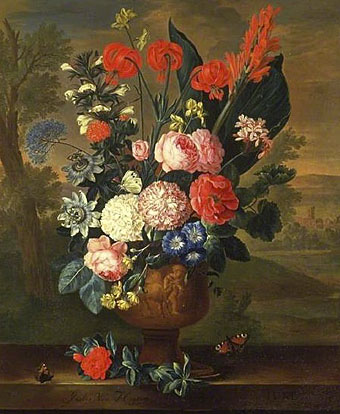
Twelve Months of Flowers: June (no date) by Jacob van Huysum.

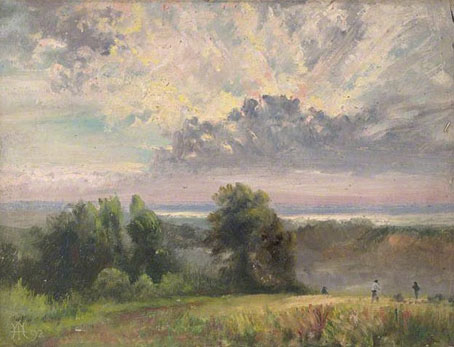
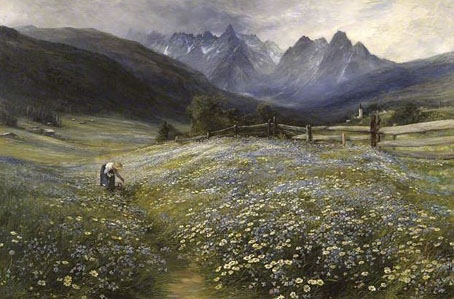
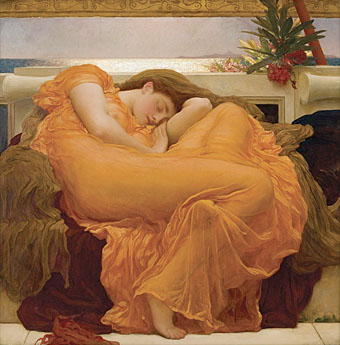
The month of June in paintings is overburdened by bland pastoral scenes and views of battles, the summer months being favourable ones for warfare. Pastoral content is still present in the following selection albeit with an attempt to show some variety. Leighton’s Flaming June is the most famous picture here. It’s also the most popular of the artist’s paintings, understandably so given its radiating an atmosphere of luscious (and possibly inadvertent) eroticism that he seldom achieved elsewhere.

june03.jpg

From Croham Fields, Croydon, Surrey, Just before the First Thunderstorm, Tuesday 28 June 1892 (1892) by William Henry Hope.

june07.jpg

June in the Austrian Tyrol (1892) by John MacWhirter.

june02.jpg

Flaming June (1895) by Frederic Leighton.

Continue reading “June”