Weekend links 612

remps.jpg

Cabinet of Curiosities (c. 1690s) by Domenico Remps.

• “…the human voice is an astonishing landscape”. Jeremy Allen on Desert Equations: Azax Attra (1986) by Sussan Deyhim & Richard Horowitz, an album which is being reissued by Crammed Discs with bonus tracks and an inexplicably rearranged track list. Good as it is, their follow-up release from 1996, Majoun, is even better, and might be better known if it hadn’t been so thoroughly abandoned by Sony Classical.

• “On view through May 29, By Her Hand: Artemisia Gentileschi and Women Artists in Italy, 1500–1800 showcases masterpieces done by 17 Italian women to make the case for a broader view of women’s participation in the Italian Renaissance.” Nora McGreevy reports.

• “We had a far more profound effect on society than we really understood, and some of us paid for that”: Jane Lapiner and David Simpson of the San Francisco Diggers talking to Jay Babcock in another installment of Jay’s verbal history of the hippie anarchists.

• “Close your eyes and you could almost imagine it’s the muffled screams of a ghost trapped in a bottle.” Daryl Worthington on 25 years of The Ballasted Orchestra by Stars Of The Lid.

• More Dangerous Visions and New Worlds: Mike Stax talks with Michael Moorcock about music, science fiction, politics, and their intersections in the 1960s.

• “Cormac McCarthy to publish two new novels.” Oboy oboy.

• At Dennis Cooper’s: Larry Gottheim Day.

Metal Machine Music For Airports

Marginalia Search

Music For Meditation I (1973) by Eberhard Schoener | Music For Evenings (1980) by Young Marble Giants | Music for Twin Peaks Episode #30 (Part I) (1996) by Stars Of The Lid

Weekend links 611

ltpf.jpg

Let The Power Fall (1981) by Robert Fripp. A postcard included with the original vinyl release of the Let The Power Fall album.

Exposures 1977–1983 is the title of another wallet-busting CD/DVD/blu-ray box which will be released by DGM at the end of May. Unlike the previous King Crimson sets this one will be devoted to Robert Fripp’s first run of solo releases, covering the albums that emerged from the artistic campaign he described at the time as “The Drive to 1981”: Exposure (1979), God Save The Queen/Under Heavy Manners (1980), The League Of Gentlemen (1981), and Let The Power Fall (1981). If you’re as interested as I am in this period of Fripp’s career then this is all very exciting. Exposure has been reissued several times over the years, and exists in three different “editions” featuring alternate mixes and song variations, but the other albums have been unavailable in any form for decades, possibly as a result of the turmoil caused by the mismanagement and eventual collapse of the EG label. In addition to the reissues the box will include live recordings, a League Of Gentlemen Peel session plus a substantial quantity of Frippertronics material, including the loops that were recorded for Eno & Byrne’s My Life In The Bush Of Ghosts. Fripp retained a credit for his contribution to Regiment but the results are so far down in the mix that they’re easy to miss. Related: The Drive to 1981: Robert Fripp’s Art-Rock Classic Exposure.

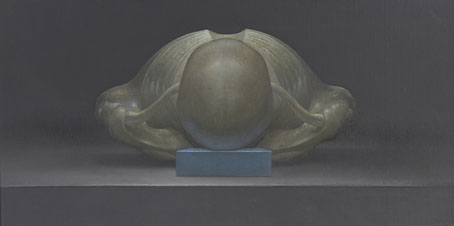
• Galerie Georges-Philippe & Nathalie Valloisin, Paris, is currently creeping out visitors to Strange Aeons—We will meet you there, an exhibition by Peybak (Peyman Barabadi and Babak Alebrahim Dehkordi) that borrows its title from HP Lovecraft and includes a number of creatures, “neither embryos nor chimeras”, which may be found prostrate and breathing on the gallery floor.

• New music: Sub Zero, in which Kevin Richard Martin returns to the subterranean/subaqueous/subarctic zones he charted on his Isolationism and Driftworks compilations in the 1990s; plus The Carrier by Large Plants, an album of “psych rock belters” coming soon on the Ghost Box label.

• Science fiction as revolution: Joe Banks talks to Iain McIntyre, co-editor of Dangerous Visions and New Worlds—Radical Science Fiction, 1950–1985, about the flourishing of the New Wave of SF in the 1960s and 70s.

• “We know from his letters that Joyce sent a Greek flag to Nutting for him to colour-match. So, he was aiming for ‘Greek’ blue.” It’s that book again. Cleo Hanaway-Oakley on Ulysses, blindness and blue.

• Intermittent Eyeball Fodder: More visual delights gathered by S. Elizabeth.

• Steven Heller’s font of the month is Nicholas.

• Galerie Dennis Cooper presents…Liz Larner.

Let The Power Fall (1971) by Max Romeo | Minor Man (1981) by The League Of Gentlemen ft. Danielle Dax | Heptaparapashinokh (1981) by The League Of Gentlemen

Weekend links 608

timlin.jpg

The Temple, an illustration from The Ship that Sailed to Mars (1923) by William Timlin.

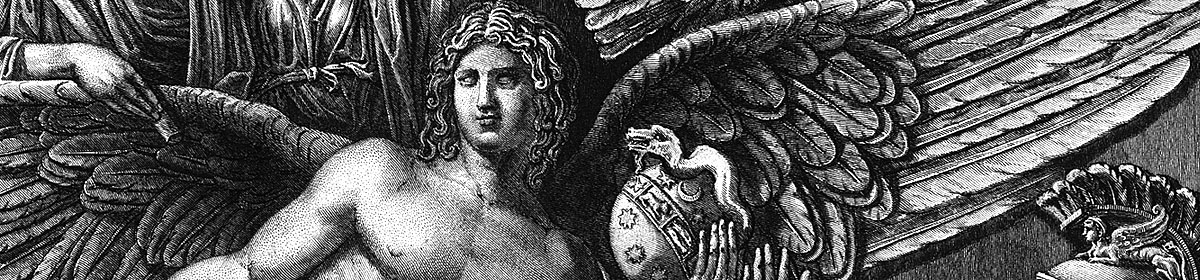
• “With the grotteschi, Piranesi produced hybrid forms of ornament juxtaposed in an array without regard to single-point perspective. With his capricci, he brought disparate structures into a landscape that existed only within the borders of the plate. Perhaps because of his early fidelity to accuracy and the long tradition of printmaking as a medium for the measured representation of antique forms, Piranesi’s capricci take on a particularly fantastic aura.” Susan Stewart on the ruinous fantasias of Giovanni Battista Piranesi, one of whose etchings happens to be providing the page header this month.

• At Dangerous Minds: 23rd Century Giants, the incredible true story of Renaldo & The Loaf! Oliver Hall conducts a long and very informative interview with two of Britain’s strangest music makers.

• New music: Nightcrawler by Kevin Richard Martin, recommended to anyone who enjoys the nocturnal doom of Bohren & Der Club Of Gore; and Murmurations by Lea Bertucci & Ben Vida.

“Throughout the book, McCarthy writes as if he knows something that more conventional historians aren’t always keen to accept: that the past doesn’t always make sense, that it’s often cruel and irrational, and that some things aren’t so explainable. History is not a book waiting to be opened so much as a Pandora’s box that might curse us and leave us chastened by what we find inside.”

Bennett Parten on Cormac McCarthy’s baleful masterpiece, Blood Meridian

• “Inside me are two wolves and they are both paintings by Kazimierz Stabrowski.” S. Elizabeth‘s latest art discoveries.

• At Wormwoodiana: Mark Valentine on Arthur Machen and the mysteries of the Grail.

• RIP Betty Davis and Douglas Trumbull.

• At Dennis Cooper’s: Tobe Hooper Day.

Temple Bells (1959) by Frank Hunter And His Orchestra | Temple Of Gold (1960) by Les Baxter | Temple (2018) by Jóhann Jóhannsson

Félicien Rops et Son Oeuvre

rops01.jpg

More Belgian Symbolism of a kind, although it’s debatable the degree to which Félicien Rops should be regarded as a Symbolist even though his work is generally listed as such. Decadent, certainly, and he did touch on popular Symbolist themes such as the temptation of St. Anthony, but only as part of his persistent obsession with that very fin-de-siècle icon, the Bad Woman. In Rops’ work this manifests as a succession of hollow-eyed femmes damnées—erotomanes, seducers and addicts—all of whom resemble each other.

rops02.jpg

Félicien Rops et Son Oeuvre (1900) is a short monograph by Gustave Kahn which is is mostly of interest for the self-portraits and minor pieces, those drawings and prints that you’d only find now in a comprehensive examination of the artist’s career. In 1900 Rops’ overtly erotic drawings wouldn’t have been available outside private publications whereas today, in a reversal of fortune that might have surprised the artist, these are the works of his that everyone likes to see. The Internet Archive has a later study by Gustave Kahn which includes some of the more erotic pieces seen here, none of which are too explicit but there’s enough that his book might have encountered legal disapproval if anyone had tried to sell a copy in England.

rops05.jpg

rops03.jpg

rops04.jpg

Continue reading “Félicien Rops et Son Oeuvre”

Bruges-la-Morte, 1978

blm1.jpg

What we have here is a very creditable 67-minute film adaptation of the Symbolist novel by Georges Rodenbach. Ronald Chase directed, co-wrote the screenplay with Pier Luigi Farri, and also photographed the production with a small company of English actors in the city of Bruges. The film has recently been given a high-definition restoration and made available on the director’s Vimeo page. Chase describes his adaptation as a low-budget affair, the footage being originally intended for screening during performances of Die Tode Stadt by Eric Korngold, but it doesn’t come across as cheap or amateurish thanks to a professional cast and authentic locations. Rodenbach’s novel is distinguished by its early use of photographic illustrations, most of which are views of the canals of Bruges. Here we get to see the church steeples and crow-step gables from the viewpoint of a camera drifting along the same swan-filled waterways.

It’s a long time since I read Rodenbach’s novel so I can’t judge this version in any detail although my memories are of a dreamier narrative than the one the film delivers. Chase credits the story as being “suggested” by the novel but the broad outline follows Rodenbach, with a grieving widower (Richard Easton, whose character is unnamed in the film) meeting a dancer (Kristin Milward) who seems to be the double of his recently deceased wife. The dancer works with a troupe of performers who stage a nocturnal masque for the tormented man, an event which fails to alleviate his confusion or his anguish.

blm2.jpg

Chase’s film resembles one of the literary adaptations the BBC used to make throughout 1970s and 80s, modest and serious, and certainly of a quality that it could have been broadcast as a part of the Omnibus arts strand or in a late slot on BBC 2. Among the performers are a Pierrot character played by Anthony Daniels, an actor most people will know for his role as a gold robot in a space opera, and Nickolas Grace, who appeared as Oscar Wilde a decade later in Ken Russell’s Salomé’s Last Dance. There’s a touch of the diabolical Russell (and James Ensor) in the later masque scenes when the performers don papier-mâché masks, and a nun gets chased around a church. The mask-making is credited–very surprisingly–to Winston Tong, an artist and musician best known for his association with Tuxedomoon. I was hoping we might see more of the gloomy canals and equally gloomy architecture but the buildings and bridges that we do see look just as they would have done in Rodenbach’s day. If you want more there’s always the paintings and drawings of Fernand Khopff and Lucien Lévy-Dhurmer, or the photographs in the novel itself.

Previously on { feuilleton }
Bruges in photochrom
Bruges panoramas
Bruges-la-Morte