Weekend links 774

jakuchu.jpg

Fish and Octopus (Colourful Realm of Living Beings) (circa 1765) by Ito Jakuchu.

• At Aeon: “Could extraterrestrial technology be lurking in our backyard—on the Moon, Mars or in the asteroid belt? We think it’s worth a look.” Ravi Kopparapu and Jacob Haqq Misra explain.

• At Smithsonian magazine: The first confirmed footage of the Colossal Squid. Only a baby one, however, so not very colossal.

• The eighth installment of Smoky Man’s exploration of The Bumper Book of Magic has been posted (in Italian) at (quasi).

Less than six months later, Lindsay signed an executive order that effectively turned the city into a movie set. The new Mayor’s Office of Film, Theatre, and Broadcasting was designed to cut through existing red tape and facilitate location filming. Script approval was centralized in a single agency. A production now needed but a single permit to shoot on the streets; a specific police unit would remain with the filmmakers as they moved from location to location. Thus, Lindsay created the necessary conditions for the tough cop films, bleak social comedies, and gritty urban fables that captured the feel of New York in the late sixties and early seventies—the cinema of Fun City.

J. Hoberman explores New York City’s popularity as a film location

• Mixes of the week: A mix for The Wire by John King; and DreamScenes – April 2025 at Ambientblog.

• At Colossal: Water droplets cling to fluorescent plant spines in Tom Leighton’s alluring photos.

• At the BFI: Alex Barrett on Carl Theodor Dreyer’s unmade film about Jesus.

• Anne Billson ranks 20 films starring Julie Christie.

Voyage To The Bottom Of The Sea (1964) by Paul Sawtell | Das Boot (1981) by Klaus Doldinger | Ambient Block (Sequenchill/Mission Control #2/Lost In The Sea) (1993) by Sequential

Minotaure, 1933–1939

minotaure35.jpg

Art by Diego Rivera for the Mexican supplement in Minotaure no. 13.

I was tempted to title this one Minotaure! since I’ve been searching for copies of the magazine in question for many years. I’m certain I went looking in all the usual sources last year in the run-up to the Surrealist centenary, without success. Anyway, here they all are at last, a complete run of one of the major Surrealist periodicals.

Minotaure was notable for a number of reasons, first among them the publisher, Albert Skira, whose resources enabled the production of a very desirable item, with good design, colour prints in each issue, and plenty of photos and other artwork throughout. The Surrealist publications of the 1920s had been historically important but all of them were monochrome documents with few pictures and few pages. Minotaure had the production values of a quality magazine and an impressive roster of artists and writers to fill each issue. Skira and editor E. Tériade originally intended their periodical to cover a wide range of art, past and present, but with most of the early contributors being members of André Breton’s Surrealist circle the magazine quickly became a showcase for Surrealist art and theorising. The first issue featured a cover by Pablo Picasso, with more Picasso artwork inside. Subsequent issues had covers by leading Surrealist artists–Dalí, Ernst, Magritte, Masson–which captured the movement at a time before Breton’s persistent expulsions hollowed out the original group. Breton writes in nearly all the issues but was forbidden from using Minotaure as a political platform (the previous Surrealist journal had been the very political Le Surréalisme au service de la révolution), a restriction he kept to. His manner was often dictatorial but he always had an eye for the main chance, or the bonne chance in this case.

The written contents of Minotaure are mostly in French but the pictorial matter is worth seeing even if much of it is very familiar today. Among the written highlights are two essays by Salvador Dalí, the first on the “edible” nature of Art Nouveau architecture, with an emphasis on the work of Gaudí; the second about Pre-Raphaelite painting. It’s understandable that Dalí would be attracted by the meticulous realism of early Millais and William Holman Hunt but I didn’t know his essay included an analysis of Hunt’s The Hireling Shepherd, a painting I look at every time I’m in the Manchester Art Gallery. Elsewhere there are articles about automatism, mediumship, the decalcomania technique in painting, the esoteric symbolism of the alchemists, naive or untutored art, and plenty of single-page items and visual novelties. Photography by Man Ray and Brassaï is a recurrent feature. Skira’s magazine established a template which the two American Surrealist periodicals of the 1940s, View and VVV, did their best to follow. Now that Minotaure is freely available I’ll be waiting impatiently for complete runs of its followers to turn up somewhere.

(Note: some of the copies linked below have had their colour prints removed.)


Minotaure no. 1 (1933)

minotaure01.jpg

Cover art by Pablo Picasso.

minotaure02.jpg

minotaure03.jpg


Minotaure no. 2 (1933)

minotaure04.jpg

Cover art by Gaston-Louis Roux.

Continue reading “Minotaure, 1933–1939”

Weekend links 772

barbarella.jpg

Barbarella (1968) by Robert McGinnis. Not one of his best (see below) but the film is a cult item round here.

• At the Bureau of Lost Culture: Alan Moore on Magic, a recording of the three-way talk between Alan Moore, Gary Lachman and myself for last year’s launch of the Moon and Serpent Bumper Book of Magic.

• At Colossal: “Daniel Martin Diaz encodes cosmic questions into geometric paintings and prints.” And is heavily influenced by Paul Laffoley by the looks of things.

• RIP Robert McGinnis, illustrator and poster artist. Related: The Artwork Of Robert McGinnis, Part 1 | The Artwork Of Robert McGinnis, Part 2.

• At Public Domain Review: “The Form of a Demon and the Heart of a Person”: Kitagawa Utamaro’s Prints of Yamauba and Kintaro (ca. 1800).

• Coming soon from Ten Acre Films: The Quatermass Experiment: The Making of TV’s First Sci-Fi Classic by Toby Hadoke.

• New music: Lost Communications by An-Ting; UPIC Diffusion Session #23 by Haswell & Hecker.

Anti-Gravity Holiday Every Month by Robert Beatty.

Barbarella (Extended Main Title) (1968) by Bob Crewe And The Glitterhouse | Barbarella (1991) by The 69 Eyes | My Name Is Barbarella (1992) by Barbarella

Weekend links 768

glitch.jpg

The Mona Lisa as it looks run through the Random Pixelate setting in Glitch Lab.

• “We don’t have enough Dada in this world of too much data. Something is needed to break-through the over-curated simulacrum that is the online world in order to let in a bit of non-artificial light. One way to make a break is through the deliberate cultivation of the glitch.” Justin Patrick Moore on circuit-bending, glitch music and Surrealist composition.

• The seventh installment of Smoky Man’s exploration of The Bumper Book of Magic has been posted (in Italian) at (quasi). There’s an extract in English at Alan Moore World.

• New music: Remember The Clouds by Philippe Deschamp, and Requiem For The Ontario Science Centre by Tony Price.

• Michael Brooke offers suggestions for where to begin with Polish film director Wojciech Has

• At Printmag: A new book shares the artistic odyssey of Iranian designer Farshid Mesghali.

The Letraset Graphic Materials Handbook for the year 1987.

• Steven Heller’s font of the month is Cubo.

• Yet more Polish film posters.

A cat’s eye view of Japan.

• RIP Roy Ayers.

Glitch (1993) by Moody Boyz | Glitch (1994) by Autechre | Glitch (2011) by Brian Eno And The Words Of Rick Holland

Weekend links 766

steam.jpg

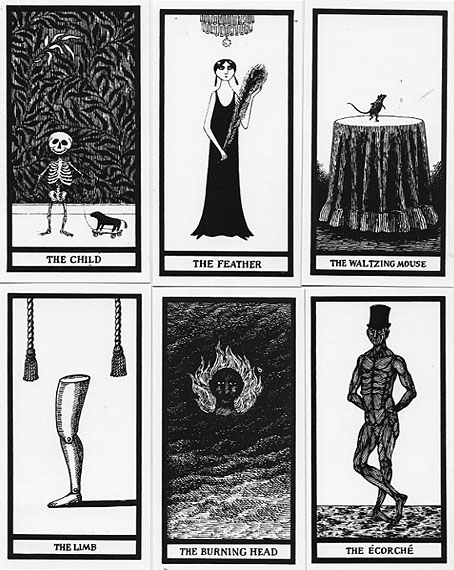
The Fantod Pack (1995): a Gorey take on the Tarot deck.

• A happy 100th birthday to Edward Gorey. I was hoping to link once again to Gorey’s appearance on the Dick Cavett Show from 1977 (a rare TV interview) but it’s one of those things that’s no longer available at YouTube. You can always browse Goreyana instead. Meanwhile, there’s this in Scotland: In Gorey Detail: Celebrating An American Friend At Custom House, Leith. A tribute exhibition which is running in Edinburgh for this week only.

• “A blisteringly frank and triple X-rated chat with Peter Berlin”. A blisteringly hyperbolic headline for a discussion between Ted Stansfield and Peter Berlin, the self-invented sex object of the 1970s.

• This week in the Bumper Book of Magic: Smoky Man posts my replies to his questions about the creation of the book’s Rainy Day and Kabbalah sections.

• Tricky’s Maxinquaye was released 30 years ago this month. David Bennun revisited the album five years ago.

• At Colossal: Felines evoke ‘A Floating World’ in Tùng Nâm’s whimsical illustrations.

• New music: Gloam by Emptyset, and The Mount Hibiki Tapes by Mount Shrine.

• Mix of the week: A mix for The Wire by Polonius.

• Steven Heller’s font of the month is Steam.

Last Of The Steam Powered Trains (1968) by The Kinks | Steam Megawatt (1979) by Tod Dockstader | Building Steam With A Grain Of Salt (1996) by DJ Shadow