The weekend artists, 2017

images.jpg

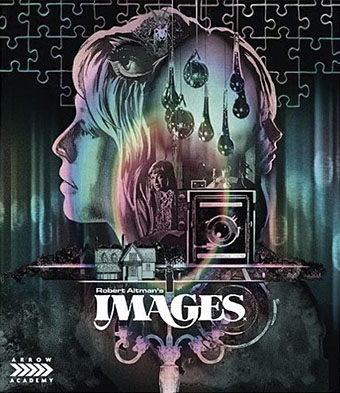
Art by Twins of Evil for the forthcoming blu-ray from Arrow Academy.

The laziest post of the year is invariably a review of the artists/designers/photographers featured on the weekend posts, so here’s another end-of-year list for you. Scroll down to see what caught my attention over the past twelve months.

mueck.jpg

Mass by Ron Mueck at the National Gallery of Victoria Triennial. Photo by Tom Ross.

possession.jpg

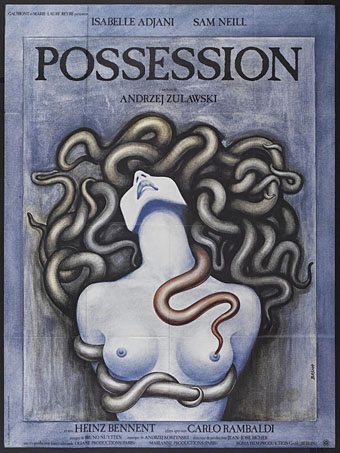
French poster by Basha (Barbara Baranowska) for Andrzej Żuławski’s extraordinary Possession (1981).

adam.jpg

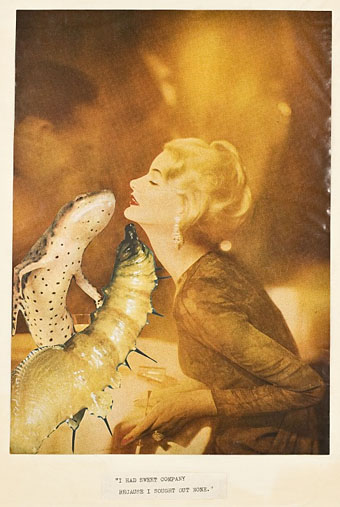
I Had Sweet Company Because I Sought Out None. Collage by Helen Adam.

nakayama.jpg

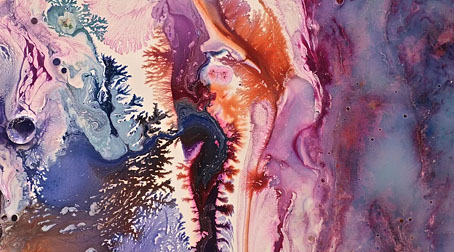
Still of an Alive Painting by Akiko Nakayama.

Continue reading “The weekend artists, 2017”

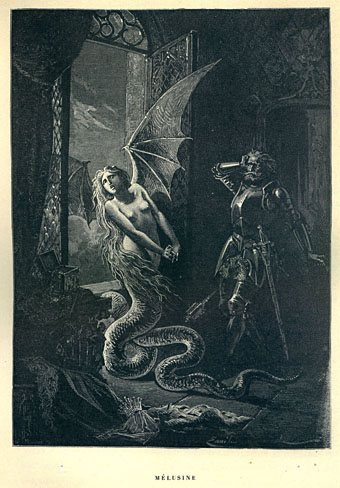
Émile Bayard’s Histoire de la Magie

bayard11.jpg

Regular readers may have noticed my persistent urge to trace the provenance of certain images or designs. The latest candidate is the above illustration of a witches sabbat, a picture familiar to readers of occult histories in addition to appearing on at least two album covers. It’s the use in occult books which no doubt drew it to the attention of composer John Zorn who used it as a cover image in 2004 for his Magick album, one of a series of occult-themed recordings. The album credits the artwork to Gustave Doré, a plausible candidate given the engraving style but I’m familiar enough with Doré’s work to doubt that it was one of his.

bayard01.jpg

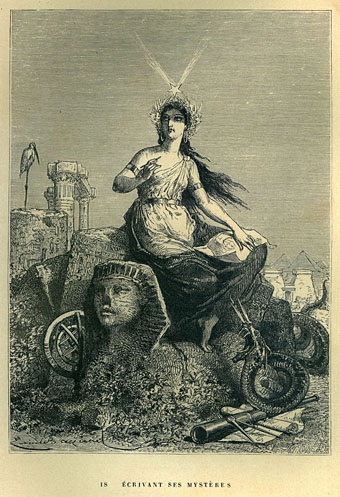
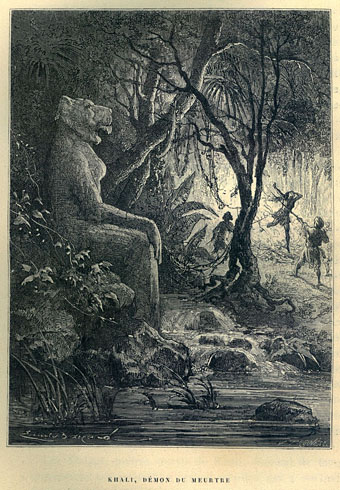
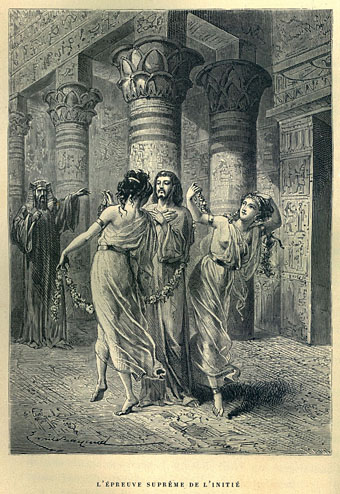
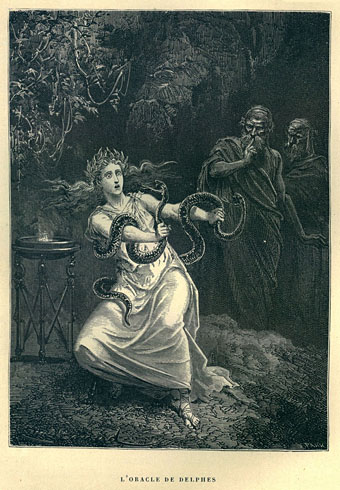
Earlier this week I was looking for more occult-related imagery so finally conducted a proper search for the sabbat picture. The origin is a French volume by Paul Christian, Histoire de la Magie, Du Monde Surnaturel Et de la Fatalite a Travers Les Temps (1870), and the full-page illustrations are by Émile Bayard (1837–1891). The Doré identification was partially correct since Bayard was a contemporary of Doré’s, and the drawings were engraved by François Pannemaker, an engraver who worked on many of Doré’s books as well as the Hertzel editions of Jules Verne. Émile Bayard is one of those artists whose name is unknown today even though people throughout the world would recognise one of his drawings; his illustration of Cosette from Victor Hugo’s Les Miserables provided the face seen on all those posters and hoardings promoting the popular musical.

bayard02.jpg

“Paul Christian” was the nom de plume of Jean-Baptiste Pitois (1811–1877), and his study of occult history was a popular book when it first appeared. I can’t say much about its contents but the illustrations (of which these are a selection via this page) show a range that encompasses various myths and religions as well as the expected variants of Western occultism. I’d seen several of Bayard’s other illustrations in a more recent French history of the occult, where the pictures are uncredited. I’ve suspected for years that they might be by the same artist responsible for the sabbat picture so this discovery has laid another nagging question to rest.

bayard03.jpg

Histoire de la Magie isn’t among the scanned books at the Internet Archive, unfortunately, but a copy may be viewed at Gallica. It’s a shame this is one of Gallica’s older scans which spoils the artwork but you can at least seen the book in full. An English translation was published in the US in 1969, containing notes and additions by living occult experts, but I’ve yet to discover whether this edition retained Bayard’s pictures.

bayard04.jpg

bayard05.jpg

Continue reading “Émile Bayard’s Histoire de la Magie”

Weekend links 386

ward.jpg

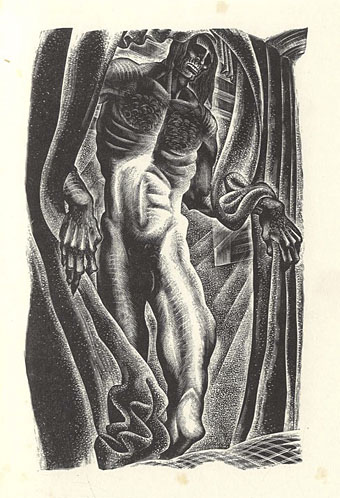
Lynd Ward again, and one of his illustrations for Frankenstein (1934).

• “Julio Mario Santo Domingo was a collector and visionary who filled his homes and warehouses with the world’s greatest private collection related to the subjects of drugs, sex, magic, and rock and roll: a library of more than 50,000 items…” Altered States: The Library of Julio Santo Domingo by Peter Watts catalogues some of the artefacts.

• “His vision of Gay Liberation was deeply, and uniquely, inflected by his study of, and belief, in anarchism.” More on the late Charles Shively: Michael Bronski remembers a pivotal figure in the gay liberation movement.

• William Friedkin’s Sorcerer was released on region-free blu-ray a couple of years ago but it’s being reissued again in the UK for its fortieth anniversary. Julian House has created a series of designs for the insert.

• Electronic musician and podcaster Marc Kate talks to Erik Davis about nihilism, horror movies, New Age music, and transmuting Nazi black metal into the ambient soundscapes of his latest album, Deface.

• “Beware the polished little man“: an extract from The Guesthouse at the Sign of the Teetering Globe by Franziska zu Reventlow which is available now from Rixdorf Editions.

• Another welcome blu-ray release, Sergei Parajanov’s The Colour of Pomegranates appears later this month in a special edition from Second Sight.

• Mixes of the week: FACT mix 626 by Sharp Veins, XLR8R Podcast 515 by Sammy Dee, and Secret Thirteen Mix 236 by Beta Evers.

The Witch Wave with Pam Grossman is a podcast for bewitching conversation about magic, creativity, and culture.

• Call me by the wrong name: Benjamin Lee on Hollywood’s perennial attempts to straight-wash gay films.

• At Dennis Cooper’s: Spotlight on…Ronald Firbank Concerning the Eccentricities of Cardinal Pirelli (1926).

• Zoë Lescaze reviews Frankenstein: The First Two Hundred Years by Christopher Frayling.

• Angry Optimism in a Drowned World: A Conversation with Kim Stanley Robinson.

• Stewart Smith on The Strange World of…Linda Sharrock.

Colors (1969) by Pharoah Sanders | Frankenstein (1972) by The Edgar Winter Group | Pomegranate (2001) by Transglobal Underground

Weekend links 384

muljat.jpg

Sultans of Swing by Samantha Muljat.

• Pain & Pleasure, Indivisible: Mat Colegate talks to Stephen Thrower (Coil, Cyclobe) about the meeting between Coil and Clive Barker that would have led to Coil scoring Barker’s Hellraiser if the studio hadn’t rejected the music.

• “From Arsedestroyer to Zoogz Rift: 50 underground albums you’ve never heard of” The usual presumption—I’ve been listening to The Groundhogs since the mid-1980s—but it’s a good list.

• More magazines at the Internet Archive: an incomplete run of British science-fiction monthly Interzone; and a complete (?) run of the film magazine for horror (and gore) obsessives, Fangoria.

• “…it’s background music, is what it is. But there’s nothing wrong with that. I’m very proud of it.” John Carpenter discussing his soundtrack music and his new album, Anthology.

• Mixes of the week: Aral Mix 05 by Ellen Arkbro, Secret Thirteen Mix 234 by FOQL, and Samhain Séance Six: Triffid Witch by The Ephemeral Man.

• Dallas Killers Club: Nicholson Baker reads a stack of books about the Kennedy assassinations then draws his own conclusions.

Michael Flanagan on searching for LGB histories of Neopaganism, the paranormal and the occult in San Francisco.

• At Lounge Books: author Amelia Mangan on horror, old and new, and her favourite things.

• At Monoskop: the (almost) complete works of James Joyce in one convenient epub.

Jillian Steinhauer on Duchamp’s last riddle.

Hell Raiser (1973) by Sweet | Hell’s Bells (1989) by Rhythm Devils | Hell’s Winter (2011) by Earth

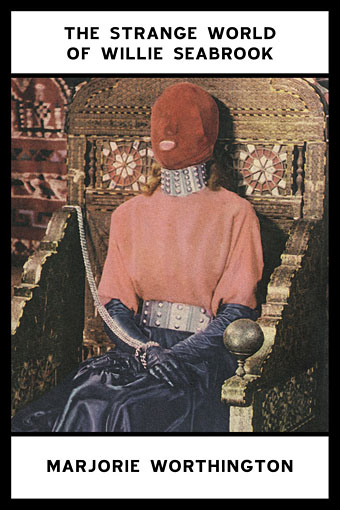
The Strange World of Willie Seabrook by Marjorie Worthington

worthington.jpg

This is a curious book. Marjorie Worthington (1900–1976) was the second wife of William Seabrook, an obscure figure today, known—if at all—as much for the lurid details of his life as for his books. In the 1920s and 1930s Seabrook was a well-regarded and very popular writer, delivering to the American public reports of his travels in the dangerous and exotic parts of the globe. Worthington was a writer herself, the author of novels, short stories and biographies, in addition to this memoir, her final major work. By the time The Strange World of Willie Seabrook appeared in 1966 Worthington’s subject was largely forgotten, his exploits eclipsed by wilder figures, while the “unexplored” areas of the world whose exotic lure had fuelled much of his writing were no longer so distant or so strange in a world of continental travel. Seabrook wasn’t completely forgotten at this time; I knew his name, if little else, from a paperback of Voodoo Island that my parents owned. This was a retitled reprint of The Magic Island (1929), a best-selling study of Haiti and its voodoo culture which, among other things, popularised the concept of the zombie.

Seabrook’s name is hard to avoid if you’re reading about witchcraft or the occult in the first half of the 20th century. Aleister Crowley knew him and mentions him in his autobiography, while Crowley is discussed in Seabrook’s Witchcraft: Its Power in the World Today (1940). Crowley’s attitude towards Seabrook seems to have soured in later years, possibly because of some perceived slight or betrayal. The two men have a lot in common: both were the same generation (Crowley was born in 1875; Seabrook in 1884), both were addicts (Seabrook’s demon was alcohol), and both were fascinated by the outer limits of human experience. In Seabrook’s case this famously extended to eating human flesh, an experience he recounted in the follow-up to The Magic Island, Jungle Ways (1930). Marjorie Worthington gives a detailed account of this episode which was much more mundane than Seabrook’s printed version. When the African feast failed to materialise Seabrook decided to keep the incident in the book even if it meant staging a cannibal meal in Paris. One of the fascinating things about Worthington’s memoir is the frequent lurches of tone when Seabrook disrupts their generally placid domesticity with a hare-brained inspiration. If this makes him sound like an Jazz Age Hunter S. Thompson he wasn’t quite as mercurial, but the cannibal episode has a trace of the gonzo as the pair race around Paris one evening, looking for a convenient stove where Seabrook can cook the “rare goat meat” a friend has procured from a Paris hospital.

Worthington logs these and similar exploits with dismay, and one of the many curious aspects of her memoir is the unexamined nature of the attraction between herself and “Willie” as she calls him. Their relationship was an unusual one from the outset. Seabrook and Worthington were both married to other partners before they met; Worthington fell in love almost immediately but rather than go through the usual adulterous games the four people simply swapped partners and went on their way, all still married but now living with their opposite numbers. Worthington remained in love with Seabrook even though they were sexually incompatible, Seabrook having an obsession with bondage games whose outlet was provided by compliant women hired for the purpose. Worthington tried to be understanding but Seabrook’s fetishes and recurrent alcoholism strained their relationship, despite their mutual dependence. One of the ironies of the book is that Worthington recounts her abhorrence each time Seabrook retires to the barn for an endurance session with one of his new women but offers little detail as to what took place. This has the effect of stoking the reader’s curiosity which could hardly have been her intention. Seabrook told her he was interested in the mental effects caused by his bondage experiments—we see a photograph of one session on the cover of the new edition from Spurl—but the sexual dimension remains undiscussed.

The Strange World of Willie Seabrook isn’t an account of continual torment, however. Seabrook had many successful years, and the pair were friends with Jean Cocteau, Man Ray, Aldous Huxley, the Astors and others. One of the best parts of the book concerns a journey by plane from Paris to Timbuktu at a time when international air travel was still a difficult and dangerous business. Worthington’s account of a noisy flight across the Sahara in a cramped aircraft that could only fly during the day makes contemporary moans about air travel seem like the whining of spoiled children. Her narrative comes alive when it assumes the character of travel writing, and she writes evocatively about her experience of the Sahara Desert. I’d have preferred more along these lines but for this it may be necessary to turn to Seabrook’s own works of the period, Air Adventure (1933) and The White Monk of Timbuctoo (1934).

The Strange World of Willie Seabrook is published by Spurl Editions on 25th October.