Weekend links 665

schwimbeck.jpg

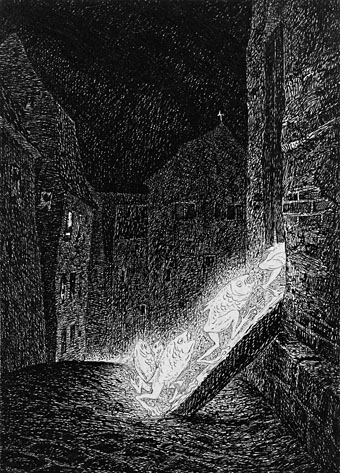
Entrance of the Fish Frogs (1919) by Fritz Schwimbeck. Via.

• “This bold chunk of fiction comes garlanded with the promise that it is written in Polari, the historical cant of British gay male society. This turns out to be not quite true—Polari was only ever a vocabulary, rather than a full language—but it certainly indicates where we’re heading; back to the late 1960s, when Polari had its heyday, and far out into the choppy waters of linguistic transgression. The largest part of the book is taken up with what purports to be a typescript of the ‘anarcho-surrealist’ memoirs of one Raymond Novak. The tersest summary of Novak’s literary stylings might be to say that Julian and Sandy, those Polari-dishing stars of Round the Horne, meet Bataille and Breton—and lose.” Neil Bartlett reviewing Man-Eating Typewriter by Richard Milward. • Related: You’ve got male: British beefcake photos from the 1940s to the 1970s.

• Among the new titles at Standard Ebooks, the home of free, high-quality, public-domain texts: Can Such Things Be? (1893) by Ambrose Bierce, a collection of weird fiction that includes the story that gave the world the name “Carcosa”. Also The Hashish Eater (1857), Fitz Hugh Ludlow’s account of his drug experiences.

• “…despite the book’s title, there is very little explicitly sexual here.” Hunter Dukes on Cultus Arborum: A Descriptive Account of Phallic Tree Worship (1890), a privately-printed volume believed to be the work of Hargrave Jennings.

• New music: Tenere Den by Tinariwen, Offworld Radiation Therapy by Memnon Sa, and Die Untergründigen by Alva Noto.

• At Spoon & Tamago: Japanese buildings that are shaped like the things they sell.

• At Unquiet Things: The papercut art of Ivonne Garcia.

• Mix of the week: DreamScenes – March 2023.

Hashish (1968) by West Coast Natural Gas | The Hashishins (1970) by Ry Cooder & Buffy Sainte-Marie | Hassan I Sahba (1977) by Hawkwind
Weekend links 664

warburton.jpg

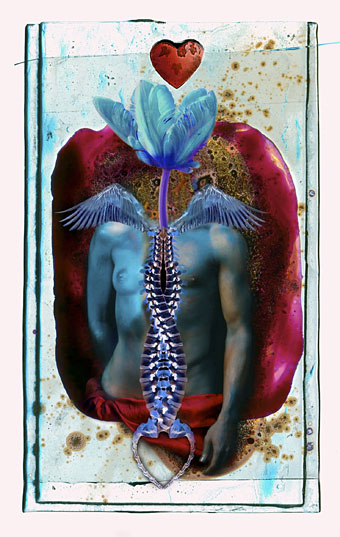
Caduceus: Tarot Card Study – Love by Holly Warburton.

• The week in stage magic: Ken Carbone, writing about playing cards and graphic design, points the way to an hour of Ricky Jay demonstrating his miraculous abilities with a pack of cards. Elsewhere, Erik Ofgang asks “Who was Mr. Electrico, the sideshow magician who inspired Ray Bradbury—then vanished?”

The 1980 Floor Show – Uncut / Unedited: 8 Hours of David Bowie in Ziggy Stardust guise performing for American TV cameras at The Marquee, London, in October 1973. That’s more Bowie than most people would want—there’s a lot of repetition—but it’s good to know things like this can still surface.

• “A supernova has gone out,” says David Grundy about the late Wayne Shorter. Also this: “Sci-fi fan Shorter suggested the title to [Weather Report’s] second album I Sing The Body Electric, taken from Walt Whitman via Ray Bradbury.”

• “We need to get away from thinking of ourselves as machines… That metaphor is getting in the way of understanding living, wild cognition.” A long read by Amanda Gefter about the secret life of plants, and “4E” cognitive science.

• “…why take a soft approach to safety when you can scare the sensible into the next generation with some of the most effective horror shorts of all time?” Ryan Finnegan on the notorious PIFs (public information films) of the 1970s.

• “I am increasingly of the Lynchian mindset of ‘never explain’…” Lynda E. Rucker talking to Steven Duffy about her latest story collection, Now It’s Dark.

• James Balmont presents a brief introduction to the mind-altering cinema of Sogo Ishii.

• At Spoon & Tamago: Hidari: An epic wooden puppet samurai stop-motion film.

• Old music: Musique De Notre Temps (1976) by Éliane Radigue.

• Steven Heller’s font of the month is Juma.

Body Electric (1982) by The Sisters Of Mercy | Super-Electric (1991) by Stereolab | Electric Garden (Deep Jazz In The Garden Mix) (2013) by Juan Atkins & Moritz von Oswald

Weekend links 663

wt.jpg

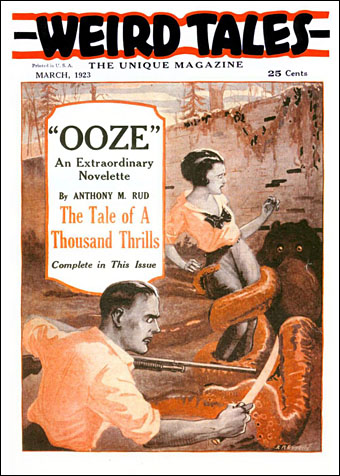
Weird Tales celebrates its centenary this month (although the first issue was on the shelves in February, 1923). Thirty years later, one of the last issues from the initial run had Slime by Joseph Payne Brennan as the story featured on its cover. The magazine maintained a viscous consistency if nothing else. Tentacular art by RR Epperly.

• A big surprise in yesterday’s Bandcamp Friday was the announcement of Singularity, a new album by synth ensemble Node. Or new-ish since the previously unreleased recording is almost 30 years old:

Singularity is the legendary “lost” Node album. Recorded at the same time as their original sessions in 1994 this has DiN stalwart Dave Bessell join Buller & Flood alongside original member Gary Stout who was later replaced by Mel Wesson for the two DiN releases. Presented here for the first time, mastered to modern standards but otherwise untouched and in its original form and recorded to two track with no overdubs.

Node have never been very prolific—two decades separate their first album from their second—so this was very welcome. The new release includes a bonus addition of the 16-minute version of Terminus, one of their best pieces which has only been available previously on a scarce CD-single.

• Steven Watson at Print Mag on skeuomorphic magazine design that turns print into play. Now I want to design a book that fits inside a cassette box.

• RIP jazz giant Wayne Shorter, and David Lindley, co-founder of one of my favourite psychedelic groups, the incredible Kaleidoscope.

• S. Elizabeth at Unquiet Things on The Sensitive Plant, a poem by Percy Shelley illustrated by Charles Robinson.

• Christopher Parker at Smithsonian Magazine asks “Did Salvador Dalí paint this enigmatic artwork?” Yes, he did.

Tangerine Dream in 1973 playing Atem live (with pre-recorded drums) on Spotlight, an Austrian TV show.

• New music: Mohanam by Shakti, and Area Code 601 by William Tyler & The Impossible Truth.

• At Spoon & Tamago: Bento boxes inspired by notable Japanese architecture.

• At Tentaclii: Ian Miller cover art for metal albums.

Northern lights seen across the UK.

New Blue Ooze (1970) by Kaleidoscope | Ooze Out And Away, Onehow (1986) by Harold Budd/Simon Raymonde/Robin Guthrie/Elizabeth Fraser | Ooze (1986) by 23 Skidoo

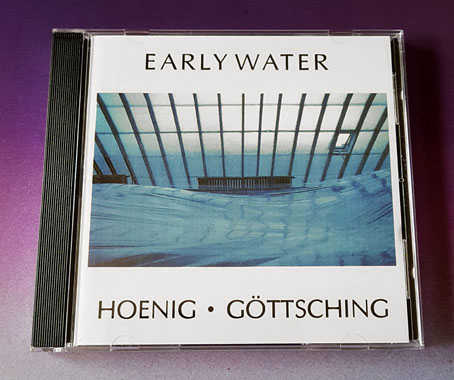
Early Water

early.jpg

Good to have this rare album reissued at last. A surprise too, as I only spotted it by chance at Bleep.com. I still haven’t seen it mentioned as a news item in any of the expected places.

Early Water is a one-off collaboration between Michael Hoenig and the late Manuel Göttsching, a recording of an improvised rehearsal session from 1976 which was shelved until the pair decided to release a CD in 1995. The album has been out of print since 1997 so the reissue is very welcome, especially when secondhand discs had become stupidly expensive. It’s also being released for the first time on vinyl although doing this requires splitting its one long track into two parts.

This is one of those albums that might be better known if it hadn’t been so hard to find. Musically, it’s a like a heavier forerunner of Göttsching’s E2-E4: 45 minutes of Hoenig’s keyboards and undulating sequencer rhythms over which Göttsching’s guitar weaves its patterns. The sequencers and synthesizers are of the type familiar from Tangerine Dream’s Rubycon and many Klaus Schulze albums from the same decade; the “Berlin School”, in other words, although it’s also the school of “Let’s switch on the machines and see what happens”. Göttsching’s guitar had already imitated synthesizers and sequencers on Inventions For Electric Guitar, while a later release, New Age Of Earth (which was mixed by Michael Hoenig) blends guitar and keyboards to create as good an electronic album as anything else being produced in the mid-70s. The guitar on Early Water is treated in a similar manner to complement the keyboards, and for the most part stays low in the mix. There’s a lot of soloing here but no histrionics. This isn’t a rock album.

hoenig.jpg

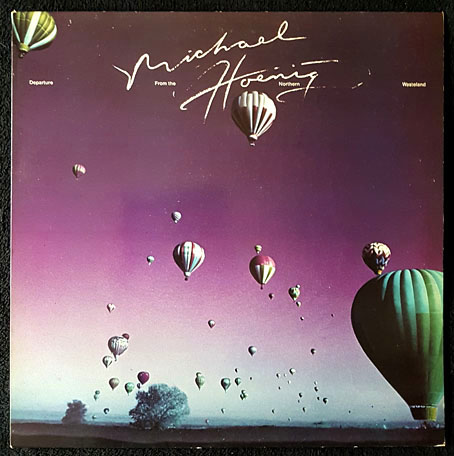
E2-E4 brought Göttsching’s music to a wider audience but Michael Hoenig remains known mostly to soundtrack collectors, synth-heads or German music obsessives. Prior to going solo in 1977 he was keyboard player in the excellent Agitation Free, a group I always recommend to anyone getting deeper into the German music of the 1970s. He was also a member of Tangerine Dream for a few weeks in 1975, filling in for Peter Baumann after the latter abruptly left the group during an international tour. It’s tempting to wonder how Tangerine Dream might have evolved if Hoenig had been a permanent member for the rest of the decade. We would have been spared the mis-steps of the Cyclone album for a start. What we got instead was Hoenig’s own incursion into Tangerine Dream territory with his first solo album, Departure From The Northern Wasteland, in 1977. Early Water doesn’t warrant the journalistic cliché of “lost classic” but that term might well be applied to Hoenig’s little-known debut, one of the few albums that bears favourable comparison to Tangerine Dream’s output in the mid-1970s. It’s also an album that’s long overdue a reissue. How about it, Bureau B?

Note: I bought my CD from the Juno Records store on eBay. Bleep and a few other places have the CD and vinyl both listed as double-disc releases with no further information supplied. I’m fairly sure this is an error.

• Further reading: Synapse magazine, Vol. 2, No. 5 [PDF], features a lengthy interview with Michael Hoenig in which he discusses his time in Agitation Free, his work with Klaus Schulze and Tangerine Dream, and the composition of Departure From The Northern Wasteland. His reference to “the Berlin school of electronic music” during the interview may be the first appearance in print of that label.

Previously on { feuilleton }
Manuel Göttsching, 1952–2022
Cosmic music and cosmic horror

Weekend links 661

rubin.jpg

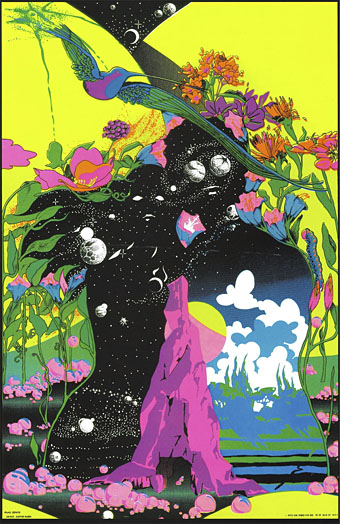
Zephyr (1970), a blacklight poster by Jupiter Rubin. Via.

• I wouldn’t usually expect Clark Ashton Smith’s Zothique to be mentioned at Literary Hub for any reason, but there it is. Emily Temple recommends some of the best stories from a century of Weird Tales that you can read online.

• Mixes of the week: A mix for The Wire by Gamut Inc, and The Last of Us, “a non-stop mix of ambient soundscapes, experimental electronics and modern classical music”.

• “…Yaggy believed that wonder was the helpmate of learning.” Sasha Archibald on Levi Walter Yaggy’s Geographical Maps and Charts (1887/93).

Stylistically, Beardsley’s pictures for Salome are among his most derivative and original. In the sharpness of their lines and great swaths of black and white, we see the well-documented influences of Japanese woodcuts and Ancient Greek vase-painting. And yet, Beardsley’s work bridges these grand traditions of East and West with such fresh dynamism and taboo as to be undeniably, and ultimately definitionally, Nouveau.

Mirror and Window Both: The Brief Superabundance of Aubrey Beardsley by A. Natasha Joukovsky

• New music: Rhinog Fawr by Somatic Responses, and Sargo/Posidonia by Sleep Research Facility/Llyn Y Cwn.

• “Why is there such a voracious consumer appetite for miniature things?” asks Steven Heller.

• At Dennis Cooper’s: Spotlight on…Julio Cortázar Blow Up and other Stories (1967).

• At Unquiet Things: The Prolific Pioneering Pulp Art Of Ed Emshwiller.

Random images from DJ Food’s desktop.

Miniature Sun (1989) by XTC | Adventures In A Miniature Landscape (2009) by Belbury Poly | Miniature Magic (2020) by Plone