Deutsche Kunst und Dekoration #1

dkd01-01.jpg

Last year saw an exploration here of the fecund pages of Jugend magazine so in the same spirit I’m embarking on a serial delve into Jugend‘s more serious contemporary Deutsche Kunst und Dekoration. I’ve made a couple of posts in this direction already but these were done before I’d had a chance to look properly through the editions at the Internet Archive, the first thirty of which form a collection which comprises some 7500 pages. Since few people would want to download and sort through that mountain these posts can serve as a select guide to the contents.

dkd01-02.jpg

Deutsche Kunst und Dekoration was published by Alexander Koch in Darmstadt and the first volume is dated October 1897–March 1898. Jugend was a humour magazine so the contents tend to be frivolous and lighthearted, Koch’s title by contrast was a guide to the best of German contemporary art and design and has the advantage of featuring furniture and architectural designs as well as graphic material. The content of this first edition is relatively sedate compared to some of the later numbers when the Art Nouveau style builds up a head of steam. There’s some astonishing design work in subsequent issues, as well as further illustration discoveries like Marcus Behmer. Watch this space.

Continue reading “Deutsche Kunst und Dekoration #1”

Saint Genet

genet1.jpg

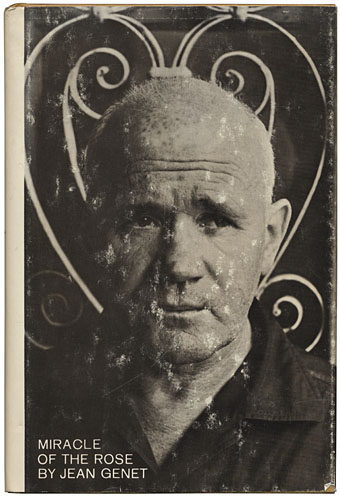
Miracle of the Rose (1965). Photo by Jerry Bauer, design by Kuhlman Associates.

[William Burroughs is] without a doubt…the greatest American writer since WWII. There are very, very few writers in his class; I think Genet is about the only one whom I’d put in the same category. All the British and American writers so heavily touted—the Styrons and the Mailers and their English equivalents—it’s just not necessary to read anybody except William Burroughs and Genet.

JG Ballard, RE/Search interview, 1984.

Jean Genet (the “Saint” was a gift from Jean-Paul Sartre) was born on December 19th, 1910 so consider this a late centenary post. Some of Ballard’s debt to William Burroughs can be found in writings such as The Atrocity Exhibition (1970) and his early text experiments. Genet’s influence, if we have to look for such a thing, I usually see in the use of metaphor to transform an uncompromising reality. Like the moment at the beginning of Crash (1973) when the crushed bodies of package tourists are compared to “a haemorrhage of the sun”. Genet’s writings effected similar transformations from squalid prison environments, turning the sexual assignations and passions of the inmates into ceremonial acts which assume the lineaments of a new religion. He used to claim in later life to have forgotten all his works but we haven’t forgotten him. A small selection of Genet links follows.
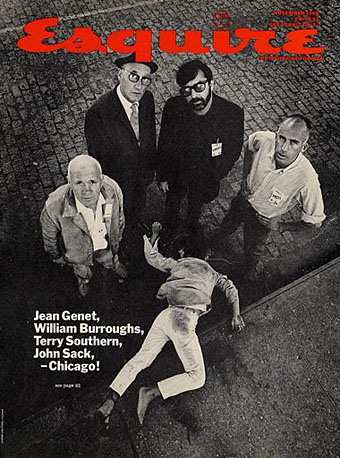
esquire.jpg

Esquire, November 1968.

RealityStudio:

Burroughs’ most famous and most widely read piece for Esquire remains his coverage of the 1968 Democratic National Convention, “The Coming of the Purple Better One,” which was included in Exterminator! Burroughs was hired to cover the convention along with Terry Southern, who was a pioneer in New Journalism with his “Twirling at Ole Miss” (which appeared in Esquire in February 1963), John Sack, who wrote on the experiences of Company M in Vietnam for Esquire (with the legendary cover “Oh my God — We hit a little girl”), and Jean Genet, an authority on oppression who turned increasingly politically active after the events in Europe in May 1968. (Continues here.)

Ubuweb:
Un Chant d’Amour (1950): Genet’s short homoerotic drama which he later disowned. The film’s masturbating prisoners and naked male flesh made it notorious and, for later generations of filmmakers, a pioneering and influential work.
Le condamné à mort (1952): A reading of Genet’s poem (in French) with electroacoustic accompaniment.
Ecce Homo (1989): A short film by Jerry Tartaglia which cuts scenes from Un Chant d’Amour with gay porn.
caillaux.jpg


Bibliothèque Gay:
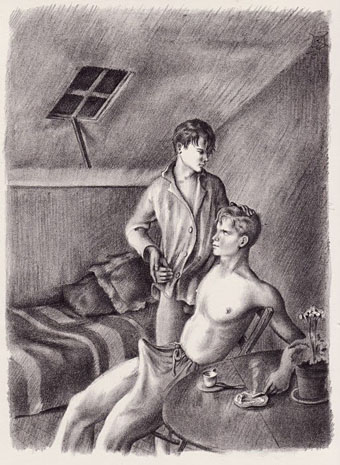
Vingt lithographies pour un livre que j’ai lu, Jean Genet, Roland Caillaux, 1945. A sequence of twenty pornographic drawings.

YouTube:
The Maids (1975): Glenda Jackson and Susannah York in a film by Christopher Miles based on Genet’s play. There’s also Fassbinder’s Querelle (1982) but YouTube’s limitations don’t do it any favours.
Jean Genet (1985): an extract from the BBC interview where the writer makes a fool of interviewer Nigel Williams. This captured Genet a few months before his death and he remains the stubborn outsider to the last, questioning the conventions of the television interview which he compares to a police interrogation. A transcript of the whole fascinating event can be found here.

Previously on { feuilleton }
Emil Cadoo
Penguin Labyrinths and the Thief’s Journal
Un Chant d’Amour by Jean Genet
Le Baiser de Narcisse

brisset1.jpg

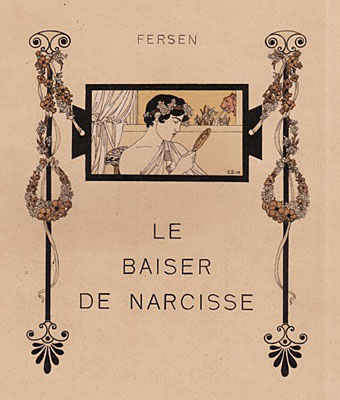
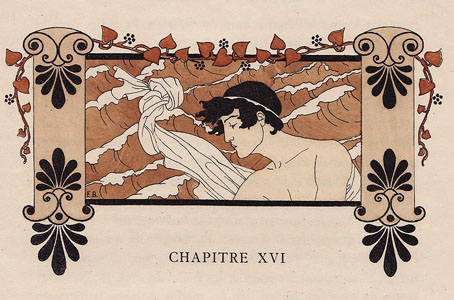
We have the French gay culture site Bibliothèque Gay to thank for posting illustrations by Ernest Brisset from Jacques d’Adelswärd-Fersen’s rare volume of homoerotic fiction, Le baiser de Narcisse (The Kiss of Narcissus). The book was originally published in 1907 but it was a new edition in 1912 which came embellished with Brisset’s Classical drawings and decorations. If these lack a degree of eros it should be noted that the text would have been condemned as outright pornography in the Britain of 1912, a paean to youthful male beauty which lingers over details of a boy’s “polished hips” and his “round and firm sex like a fruit”. As is usual with homoerotics of this period, the Classical setting and allusion to Greek myth provides the vaguest excuse for the subtext even though prudes of the time weren’t remotely fooled by this, as Oscar Wilde discovered.

brisset2.jpg

Among other works by Fersen there’s a decadent roman à clef, Lord Lyllian: Black Masses (1905), which I’ve been intent on reading since it was translated into English a couple of years ago. Here Fersen provides us with yet another fictional extrapolation of Oscar Wilde who the author gifts with some of his own scandalous history. Fersen had been driven from France following a public outrage involving the “Black Masses” of the novel’s title, and the alleged debauching of Parisian schoolboys.

hocker.jpg

Nino Cesarini by Paul Höcker (1904).

Fersen settled in Capri with his partner Nino Cesarini where they spent some years reinforcing the reputation of that island (not for nothing is Noël Coward’s camp and catty character in Boom! named “the Witch of Capri”), and proselytising for the Uranian cause with a literary journal, Akademos, modelled on Adolf Brand’s Der Eigene. Fersen’s later life is reminiscent of that of Elisar von Kupffer, a wealthy contemporary who created a secluded homoerotic paradise of his own, the Sanctuarium Artis Elisarion. Unlike Kupffer, however, Fersen ended his days prematurely in a haze of opium and cocaine. As for Ernest Brisset, if anyone finds other work of his online, please leave a comment.

Elsewhere on { feuilleton }
The gay artists archive

Previously on { feuilleton }
Reflections of Narcissus
Narcissus

Weekend links 39

galas.jpg

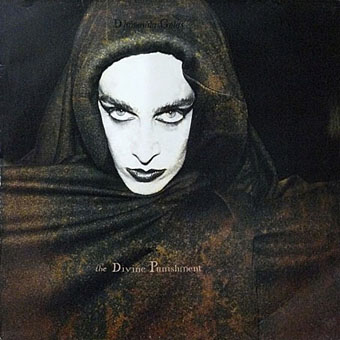
The Divine Punishment (1986) by Diamanda Galás. Design by Paul White/Me Company.

What the Catholic League and certain members of the House presumably wish to remove from their consciousness is thirty years of death sentences handed down to their parishioners and citizenry, who were told not to wear condoms, and the mistreatment of those stigmatized as miscreants and sinners by their viral status and/or homosexuality and/or status as drug addicts.

• Diamanda Galás responds in her usual forthright manner to the censoring of David Wojnarowicz’s film (and her music which accompanied it) by the Catholic League and members of the House of Representatives earlier this week. Related: Demonstrators gather to protest removal of Wojnarowicz art from NPG | Is the censored David Wojnarowicz video really ‘anti-Christian’? | Vengeance is hers: a conversation with Diamanda Galás.

Update: Hide/Seek: Too shocking for America. One of the exhibition curators speaks out against the censorship.

“Their attitude is: ‘Next time you think of writing about sex, don’t,'” said Susie Bright, who was the editor of the Best American Erotica anthology series for 15 years. “I can’t think of any other fundamental human experience that writers would be encouraged to keep to themselves.” Melissa Katsoulis, a literary reviewer for the Times of London, certainly seemed to conform to Bright’s impression when asked to comment on the award by the BBC: “Sex is a subject best avoided altogether,” she said. “If I was writing a novel, I wouldn’t attempt to write it except in the most Victorian and prim way, because it’s awful. It’s a cliché, but the moments of genuine frisson in books are when hardly anything happens.” Speak for yourself, missy.

Laura Miller dissing the Literary Review‘s annual Bad Sex Award. Good to find more voices being raised against this drivel and the admission of failure which it implies.

The latest offbeat experiment from filmmaker David Lynch: pop singles. He gets crazy with the vocoder here. Related: David Lynch talks new music projects.

scenaillustrata.jpg

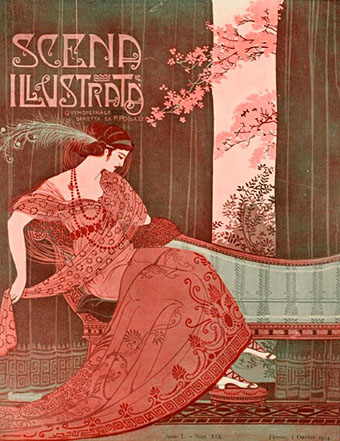
Scena Illustrata (1914). Cover by Ezio Anichini (?). Via this set of magazine covers from 1880–1920.

• Tumblrs of the week: Heart Killer and Pretty Pictures from the Paleo-Future Blog.

The Big Picture’s 2010 Hubble Space Telescope Advent Calendar.

National Geographic‘s Best Underwater Views of 2010.

A seasonal gift from a famous Northampton resident.

Paris versus New York: A Tally of Two Cities.

This is your browser on drugs.

Double-Barrel Prayer (1988) by Diamanda Galás, with a video directed by the late Peter Christopherson.