Abraxas: The International Journal of Esoteric Studies

abraxas.jpg

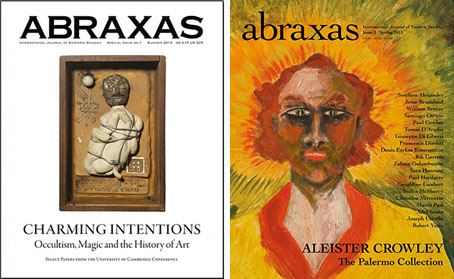
A welcome arrival in the post recently was two issues of Abraxas, the book-format journal of esoteric studies from Fulgur Esoterica. I’ve always observed the contemporary occult scene from a distance, being more interested in cultural spin-offs whether those happen to be music-oriented—as was the late, lamented Coil—or art-oriented. Something I always enjoyed about Kenneth Grant’s books was the amount of unique art material they contained, much of it by his wife, Steffi Grant, or previously unseen work by Austin Osman Spare. Fulgur have for many years continued this artistic focus, starting out by reprinting Spare’s books (and publishing new ones, such as the revelatory Zos Speaks!), and more recently turning their attention to the work of contemporary artists following similar paths.

kostromitin2.jpg

Study for Salome (2012) by Denis Forkas Kostromitin.

Abraxas is a venue for the latter group, especially in the most recent issue, no. 3, which features a wealth of new art, photography, essays and poetry. In the past I’ve complained about the misunderstandings Austin Spare’s work used to generate among otherwise intelligent and sensitive critics when faced with the artist’s occult obsessions; the usual response would be to lazily dismiss this side of his work as “black magic”, and therefore either kitsch or nonsense. Things have improved in recent years but it’s taken a long time for critics and curators who would show the greatest respect to a minority belief from South America, say, to offer the same respect to equally sincere artists who happen to be working in London or New York. One of the values of Abraxas for artists such as Jesse Bransford and Denis Forkas Kostromitin, both of whom are interviewed here, is that they can have a conversation with someone who won’t treat their work or their interests in a condescending manner. I’m particularly taken with Kostromitin, a Russian artist whose work I only discovered recently.

kostromitin3.jpg

M L K (Moloch) (2011) by Denis Forkas Kostromitin.

Elsewhere in Abraxas 3 there’s a feature on the recent exhibition of Aleister Crowley’s extravagant daubs, an article by Francesco Dimitri about tarantism in southern Italy, a piece about Dada by Adel Souto, and text by Paracelsus with illustrations by Joseph Uccello which is printed on a different paper stock. The production quality is as good as any art book but then that’s standard for a Fulgur publication. Mention should be made of the interior design of this issue which far exceeds the often perfunctory layout of many publications from smaller publishers. Tony Hill is credited on the masthead as Creative Director so I’m assuming he’s the person responsible. Abraxas is an essential purchase for anyone interested in contemporary occult art. The hardback of no. 3 is a limited edition that includes a signed and numbered lithograph by Denis Forkas Kostromitin.

Previously on { feuilleton }
I:MAGE: An Exhibition of Esoteric Artists
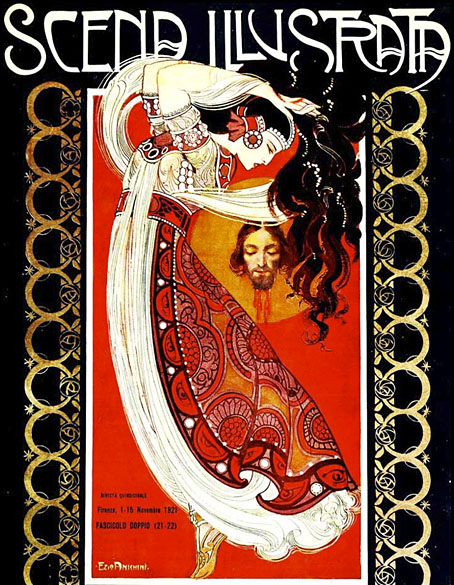
Ezio Anichini’s Salomé

anichini.jpg

Scena Illustrata was an Italian magazine that continued to fly the flag for Art Nouveau into the 1920s, by which time the style’s organic flourishes were looking old-fashioned when compared to the rectilinear forms of early Art Deco. This cover is from 1921 but could easily have appeared any time in the past two decades. Ezio Anichini (1886–1948) was a regular illustrator for the magazine. Searching for more of his work I realised I’d seen several of his covers before without having known his name. His Salomé looks more like something by Léon Bakst than anything from the Middle East, while that impossible reversal of the dancer’s head adds something we haven’t seen before. Steven Heller wrote a short appraisal of the artist’s career last year. There’s a lot more from Scena Illustrata on this Marinni page. (Via Beautiful Century again.)

Elsewhere on { feuilleton }
The Salomé archive

Abrahadabra

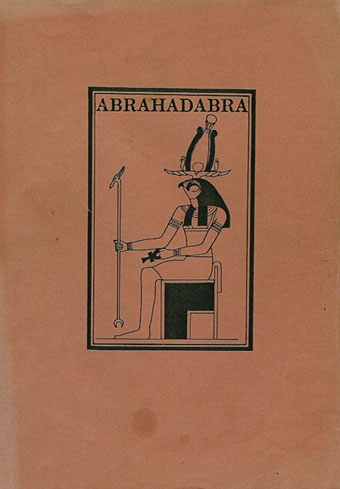
abrahadabra01.jpg

01 First (1985).

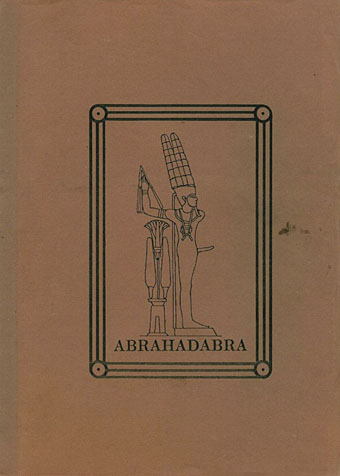
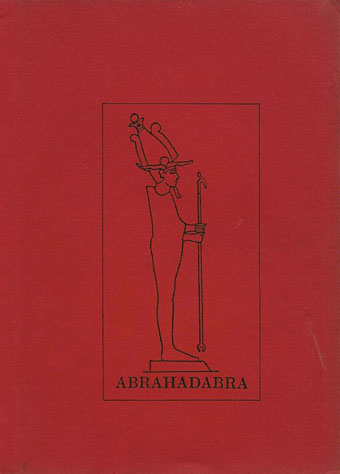
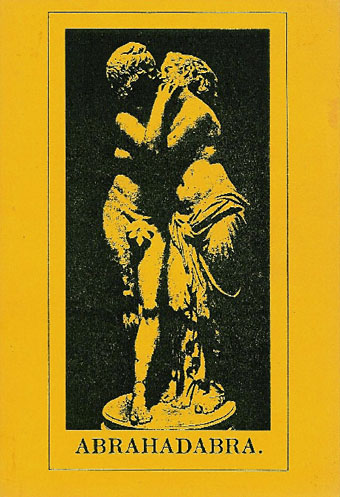
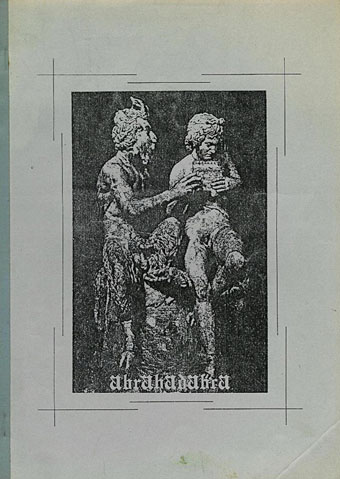
I’ve linked to so many publications at the Internet Archive I’m a little surprised it’s taken me this long to find something featuring my own work. Abrahadabra was a Dutch periodical covering subjects familiar to readers of the esoteric magazines of the 1980s (RE/Search, Rapid Eye, etc): Industrial music of the TG/Psychic TV/Coil variety, transgressive writers such as Burroughs, Ballard and Bataille, weird fiction of the Lovecraft/Machen school, and a heavy emphasis on occultism. My friend Ed was one of the contributors which is how my Pan drawing ended up in the Witches issue in 1987.

For a publication with minimal resources the production was often impressive, the drawing on the cover of the Austin Spare issue, for instance, being printed in silver ink on black paper. The contents were mostly in Dutch but each issue featured interesting and often original graphics. I also drew a small Horus head for issue 11 (which I’d forgotten about until I saw it again), whose title design was used on the cover of issue 12. Some of the other issues I hadn’t seen before so it’s good to find them scanned and easily available. The 1980s was the last time print was used as the primary medium for underground culture to talk to and disseminate itself. By the end of the decade many of the small magazines had either evolved—both RE/Search and Rapid Eye turned into books—or expired. The final Abrahadabra is dated 1990.

abrahadabra02.jpg

02 Second (1985).

abrahadabra03.jpg

03 Third (1985).

abrahadabra04.jpg

04 Sex (1985).

abrahadabra05.jpg

05 Derangement (1985).

Continue reading “Abrahadabra”

Weekend links 150

feanne.jpg

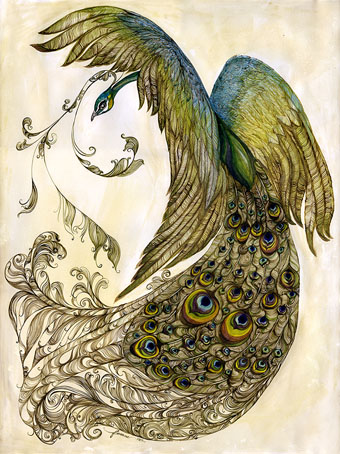
One of A Pair of Peacocks (2012) by Feanne.

Jonathan Barnbrook reveals his package design for the new David Bowie CD. The Barnbrook studio has also designed the catalogue for the forthcoming V&A Bowie exhibition. And there’s more (don’t worry, it’ll be over soon): Jon Savage on When Bowie met Burroughs.

• “Witches have a fashion moment,” says the NYT. Nice clothes but the writing trots out too many of the usual lazy clichés. Related: A Tale of Witches, Woodland and Half-remembered Melodies…, a new mix by Melmoth the Wanderer.

Calidostópia! is a free album (FLAC & mp3) from Marcus Popp aka Oval: “an enticing 16-track collaboration…with seven wonderful singers/musicians from all over South America”.

Before meeting Moorcock in person, [Hari] Kunzru went on to say, ‘I didn’t realise the role he’d played in connecting so many different scenes and undergrounds together – the psychedelic music scene, the science fiction scene, the hip experimental literature scene around people like William Burroughs, pop art’.

Brave New Worlds: A Michael Moorcock Retrospective by Carol Huston. Moorcock’s Elric novels will be published by Glénat in new bande dessinée adaptations later this year.

• More art by Michael W. Kaluta at The Golden Age. And more fantastic comics/illustration by Philippe Caza at 50 Watts. There’s more Caza here.

• Mine and David Britton’s new book, Lord Horror: Reverbstorm, was reviewed at The Spectator.

Google Street Scene: “Moments of cinema captured by Google Street View cameras”.

Cosmic Sentinels and Spiral Jetties: JG Ballard, Robert Smithson & Tacita Dean

• Strange Flowers showcases the heads of Pavel Tchelitchew, 1949–1952.

Setting in the East: Diamanda Galás on Women and Real Horror

Little Joe: “A magazine about queers and cinema, mostly.”

Nanoparticles loaded with bee venom kill HIV.

Treatises on Dust: Antic Found Texts

The Wizard Blew His Horn (1975) by Hawkwind (with Michael Moorcock) | Brothel In Rosenstrasse (1982) by Michael Moorcock’s Deep Fix | Running Through The Back Brain (1983) by Hawkwind (with Michael Moorcock)

Weekend links 145

brundage.jpg

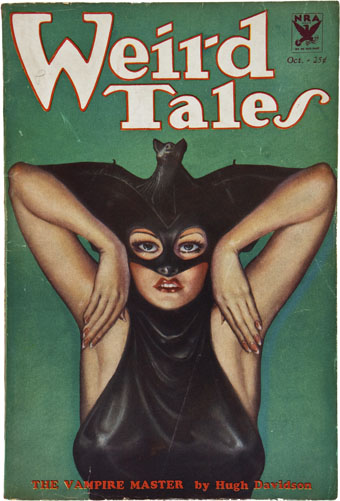
Weird Tales, October 1933. Cover art by Margaret Brundage.

• Michael Moorcock’s novels are being republished this year by Gollancz in a range of print and digital editions. Publishing Perspectives asks Is Now a Perfect Time for a Michael Moorcock Revival? • Related: Dangerous Minds posted The Chronicle of the Black Sword: A Sword & Sorcery Concert from Hawkwind and Michael Moorcock. My sleeve for that album was the last I did for the band. • Obliquely related: Kensington Roof Gardens appear as a location in several Moorcock novels, and also provided a venue for the author’s 50th birthday party. If you have a spare £200m you may be interested in buying them once Richard Branson’s lease expires.

• One of my favourite things in Mojo magazine was a list by Jon Savage of 100 great psychedelic singles (50 from the UK, 50 from the US). This week he presented a list of the 20 best glam-rock songs of all time. For the record, Blockbuster by The Sweet was the first single I bought so I’ve always favoured that song over Ballroom Blitz.

The Alluring Art of Margaret Brundage is a forthcoming book by J. David Spurlock about the Weird Tales cover artist. Steven Heller looks at her life (I’d no idea she knew Djuna Barnes) while io9 has some of her paintings. Related: Illustrations for Weird Tales by Virgil Finlay.

The masterpiece of Mann’s Hollywood period is, of course, Paracelsus (1937), with Charles Laughton. Laughton’s great bulk swims into pools of scalding light out of greater or lesser shoals of darkness like a vast monster of the deep, a great black whale. The movie haunts you like a bad dream. Mann did not try to give you a sense of the past; instead, Paracelsus looks as if it had been made in the Middle Ages – the gargoyle faces, bodies warped with ague, gaunt with famine, a claustrophobic sense of a limited world, of chronic, cramped unfreedom.

The Merchant of Shadows (1989) by Angela Carter. There’s more of her writing in the LRB Archive.

• Television essayist Jonathan Meades was back on our screens this week. The MeadesShrine at YouTube gathers some of his earlier disquisitions on culture, place, buildings and related esoterica.

• Sometimes snark is the only worthwhile response: An A-Z Guide to Music Journalist Bullshit.

• London venue the Horse Hospital celebrates 20 years of unusual events.

The Politics of Dread: An Interview with China Miéville.

How Giallo Can You Go? Antoni Maiovvi Interviewed.

A guide to Terry Riley’s music.

• Three more for the glam list: Coz I Love You (1971) by Slade | Get It On (1971) by T. Rex | Starman (40th Anniversary Mix) (1972) by David Bowie