The Chronicle of the Cursed Sleeve

blacksword7.jpg

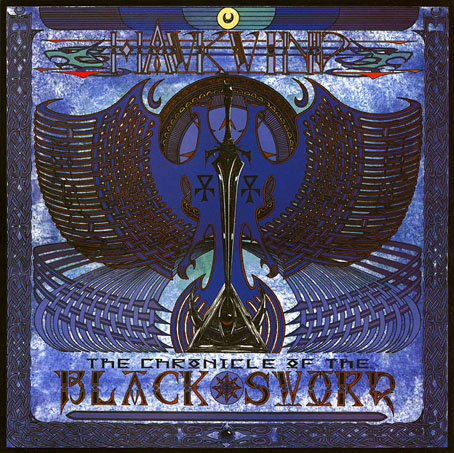
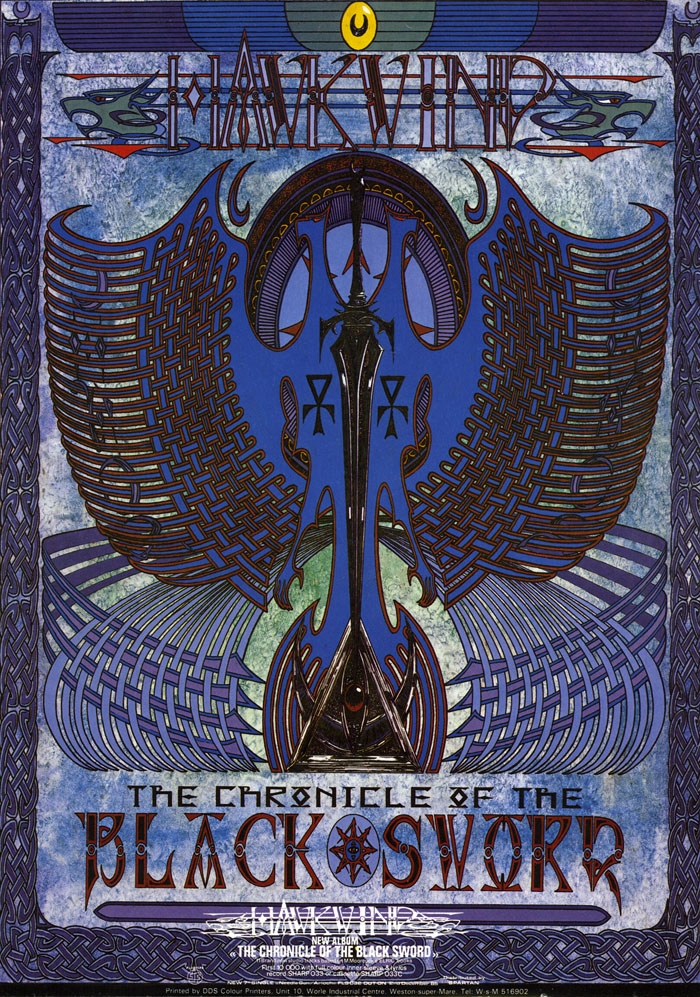
A copy of the cover art that I attempted to colour-correct some years ago to compensate for the poor print reproduction.

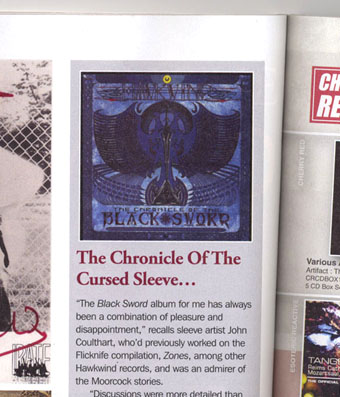
This month I’m in Record Collector magazine talking in a sidebar feature about my work on the Hawkwind album The Chronicle of the Black Sword. The issue is Hawkwind-heavy, with a Nik Turner interview, a history of Flicknife Records (the label that released COTBS), and a retrospective feature on the Black Sword album which was released in December 1985. My words were slightly cut to fit the allotted space but I can run the full text here in which I describe my ambivalent feelings towards this particular cover.
blacksword8.jpg

The Black Sword album for me has always been a combination of pleasure and disappointment. I was very pleased initially to hear that Hawkwind were writing a concept based on the Elric books, a series I’d enjoyed for many years. Cover discussions were a little more detailed than usual since this design was sketched out beforehand then approved by the Dave Brock and co. Prior to this I’d been creating something vague after equally vague requests; communication back then was all done via post and call box as I didn’t own a phone.

This was the first album where I was able to create an integrated front and back cover design. A friend had recently found me a copy of George Bain’s Celtic Art: Its Methods of Construction (1951), a study of the creation of Celtic knotwork, and I was keen to use this somehow. Rather than do a cover that looked like a fantasy paperback the idea was to use the knotwork style to create something that was suitably Hawkish whilst also fitting the Elric theme. The front cover has some nods back to earlier Hawkart in the winged sphere—which goes back to Barney Bubbles and his obsession with Ancient Egypt—and the eye-in-a-triangle, a symbol which first appeared on the cover of the Hawklog booklet in the In Search of Space album, and which I scattered throughout many of my Hawkwind designs.

All the lettering on the album was hand-drawn (not very well in places) using letterforms based on Bain’s examples from the books of Kells and Lindisfarne. I drew the track listing onto the artwork for the back cover, a decision that later proved to be a bad one when the band decided to change the running order of the songs, hence the large purple square that spoils the design. My lack of any direct contact with the record company made problems like this inevitable; I was trying to do graphic design at a distance without having any communication at all with the printers responsible for the sleeve. Before digital design, the creation of an album cover could be a complicated business involving photo-mechanical transfers, knockout areas, overlays, typesetters and more; if you weren’t in direct contact with the printer (or somebody who was) then you simply had to hope for the best.

This process of design-at-a-distance led to the disaster with the cover printing, the front of which has an unwarranted blue cast that dulled the impact of the sleeve and, for me, ruined the whole thing. You can see how the cover should have looked by comparing the background colours of front and back; the front was also printed in its true colours on the back page of the 1985 tour programme. It was this, and the messy appearance of the lettering on the back, that pushed me further towards ending my involvement with Hawkwind and doing something of my own over which I’d have complete control.
blacksword1.jpg

The retrospective feature in the magazine includes a picture of the back cover of the tour programme (above) so those familiar with the album can see the difference in reproduction. The difference isn’t so noticeable on the copies posted here after I tried altering the tones of the cover. Over the years I’ve grown used to the blueness but the back cover remains blighted by its purple boxes.
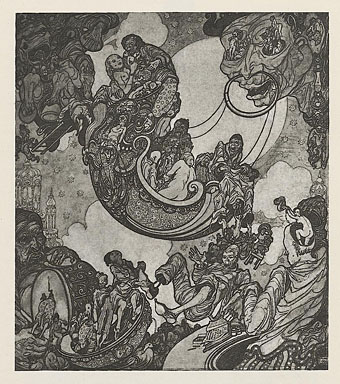
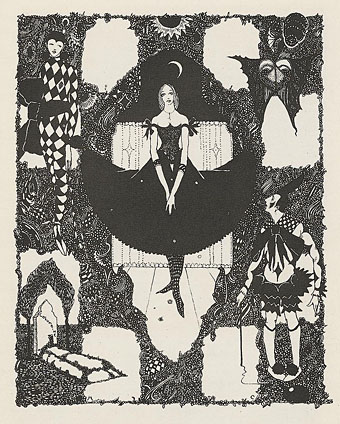
Continue reading “The Chronicle of the Cursed Sleeve”

Harry Clarke and others in The Studio

odle.jpg

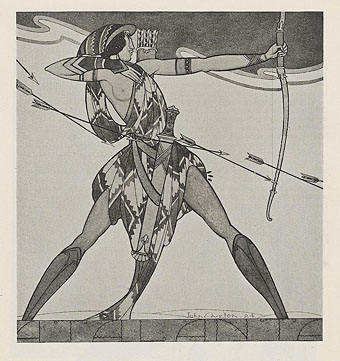
The Swing by Alan Odle.

The University of Heidelberg has for some time now had several years of British art magazine The Studio in its archive but I’ve yet to delve fully into the later issues. These illustrations are from two articles from the volumes covering the year 1925, both of which feature the exceptional Irish artist Harry Clarke. In the first piece Clarke is present along with two contemporaries, John Austen and Alan Odle; the second is a review by novelist Dorothy M. Richardson (Alan Odle’s wife) of Clarke’s illustrations for Goethe’s Faust. All three artists owed an artistic debt to Aubrey Beardsley, and an earlier number of The Studio features a drawing by John Austen of Scheherazade in his Beardsley-derived style. (Thanks to Nick for the tip!)

clarke2.jpg

Columbine by Harry Clarke.

austen2.jpg

Atalanta in Calydon by John Austen.

Continue reading “Harry Clarke and others in The Studio”

Remembering Arthurfest

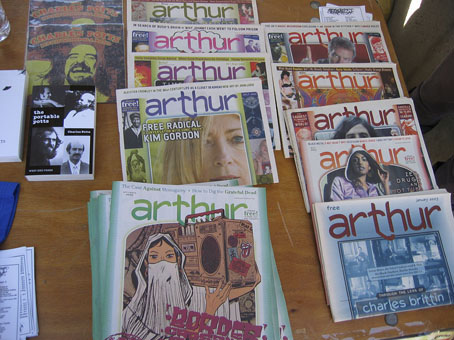
arthurfest06.jpg

The Arthur table. Free mags!

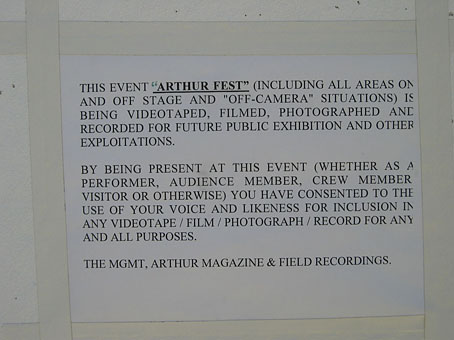
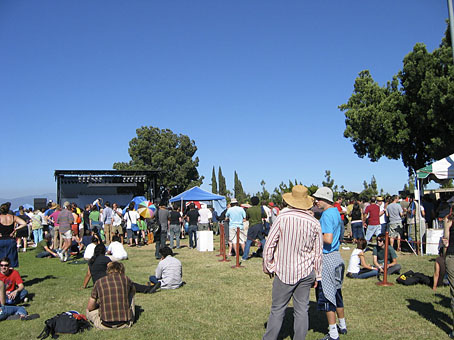
Arthurfest is an as-yet unreleased feature-length documentary by Lance Bangs which captured the two-day music festival of that name in Barnsdall Art Park, Los Angeles. The festival took place ten years ago to the day, and was the first such event organised by the sorely missed Arthur magazine. I was fortunate to witness some of the stunning performances on the park’s tree-bedecked plateau overlooking East Hollywood. Bangs’ cameras were hard to miss at the time—I even photographed one of them—but I’ve never seen any of the footage of the event until the appearance of a teaser which has been posted in advance of a tenth anniversary screening this weekend at Cinefamily, Los Angeles. This is tantalising stuff for the way the cameras bring the bands so much closer than they were when viewed at crowd level. There was also a lot happening each day on three different stages, one of which was indoors in the park’s Gallery Theatre, so it was impossible to see everything. Earth and Sunn O))) played inside the theatre but I missed both their shows as a result of a vampire-like reluctance to queue for a seat in the merciless sunlight. (I did get to drink Jack Daniel’s with the Sunn O))) guys, however…) Fingers crossed that Bangs’ film gets a proper release soon so the rest of us can see it. Meanwhile, here’s a few of my photos of the event…

Update: Arthur‘s Jay Babcock alerts me to footage of the late Jack Rose at the Arthurfest. Also at Lance Bangs’ channel there’s some of the performance by The Juan MacLean. Thanks, Jay!

arthurfest11.jpg

arthurfest18.jpg

The main stage.

Continue reading “Remembering Arthurfest”

More Druillet

fiction1.jpg

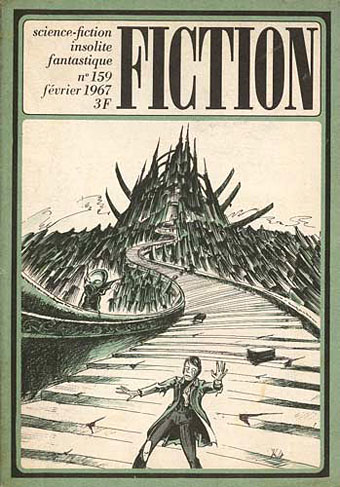
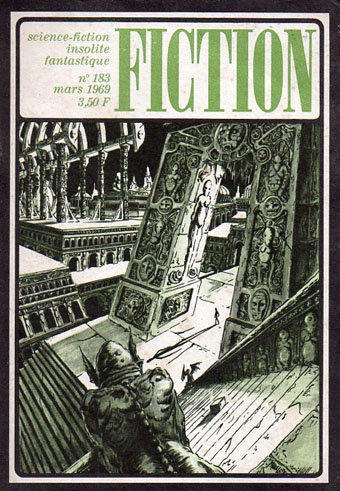
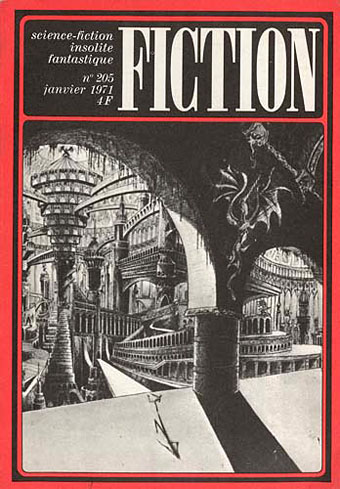
I’ve been working all day to get multiple things finished before leaving for Providence so here’s a handful of Druillet covers pulled from Noosfere. Philippe Druillet must be one of the first artists—possibly the first—whose work is Lovecraftian at core. Artists had been illustrating Lovecraft’s stories since their first publication but Druillet’s work from the late 60s to the mid-70s often seems like a series of reports from Lovecraft’s imagination. This is most evident in two of the artist’s graphic novels, Yragaël (1974) and Urm le Fou (1975), which I find to be more convincingly Lovecraftian than much of the imitative fiction being produced at the time. For more along these lines, see this post about Druillet’s portfolio series, Lovecraft: Démons et Merveilles.

fiction2.jpg

fiction3.jpg

Continue reading “More Druillet”

The art of Karel Thole, 1914–2000

thole4.jpg

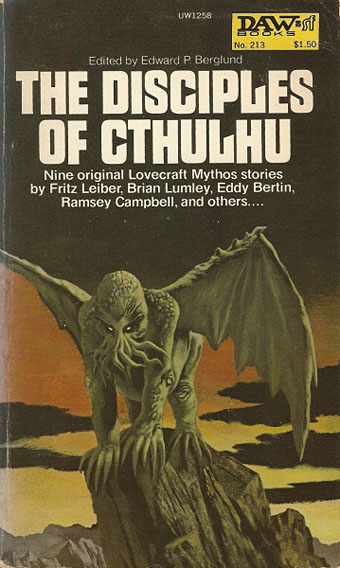
The Disciples of Cthulhu (1976).

A disagreement I have with the burgeoning world of Lovecraft art is the relentless focus on monsters—and I say this in a week when I’ve been working on a new commission of exactly this: six pictures of Lovecraftian creatures. Lovecraft famously emphasised atmosphere as the paramount ingredient in a weird story, and atmosphere in his fiction is often generated by his descriptions of landscape and architecture; Angela Carter’s insightful essay in the George Hay Necronomicon (1978) was entitled Lovecraft and Landscape. Architecture often receives considerable attention in the stories: The Call of Cthulhu, The Dreams in the Witch House, The Haunter of the Dark, and At the Mountains of Madness all concern invented (or reimagined) architectural settings. Given this, you’d expect architecture to be more represented in Lovecraft art but this is seldom the case. When it comes to Cthulhu, a creature whose myriad representations must be reaching some kind of critical mass, artists will lavish great attention on tentacles, claws and flourished wings but the Cyclopean stones of R’lyeh are invariably reduced to a tentative backdrop.

thole1.jpg

I mostri all’angolo della strada (The Monsters on the Street Corner, 1966).

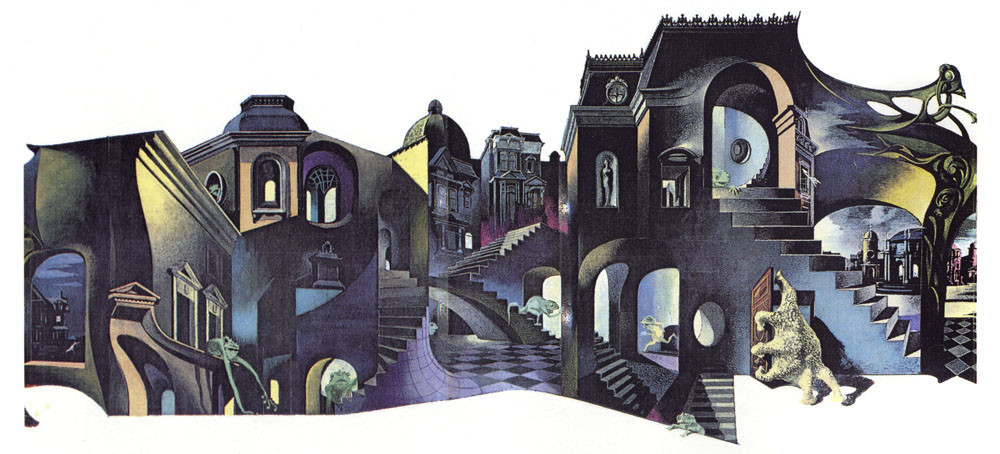
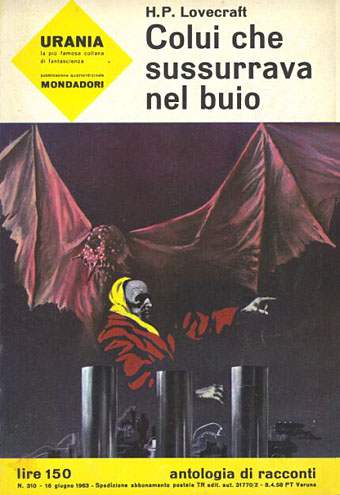
Hence the attraction of the wraparound cover by Karel Thole for I mostri all’angolo della strada, a Lovecraft story collection with one of the few cover designs I’ve seen that attempts to communicate anything of the writer’s preoccupations with angled space. Thole was a very prolific Dutch artist, producing many covers for Italian publisher Mondadori, and painting covers for Mondadori’s SF magazine, Urania, for over 20 years. The first paintings of Cthulhu I saw were those by Thole (above) and Bruce Pennington in Franz Rottensteiner’s The Fantasy Book (1978); Thole’s monster doesn’t have the required scale (and Pennington’s cover is a favourite) but for me it still carries a Proustian charge. The art for I mostri all’angolo della strada was featured in The Cosmical Horror of HP Lovecraft (1991), one of the first attempts to anthologise Lovecraft-related illustration past and present. The book contains many excellent reprints together with dubious material from European comics. Thole’s street scene—a curious combination of Escher, De Chirico and Art Nouveau—stood out among page after page of slavering abominations. I’d like to see more art that follows this direction; less of the monsters, more of the monstrous architecture.

thole2.jpg

Colui che sussurrava nel buio (The Whisperer in Darkness, 1963).

Continue reading “The art of Karel Thole, 1914–2000”