Andreas, HPL and RHB

andreas1.jpg

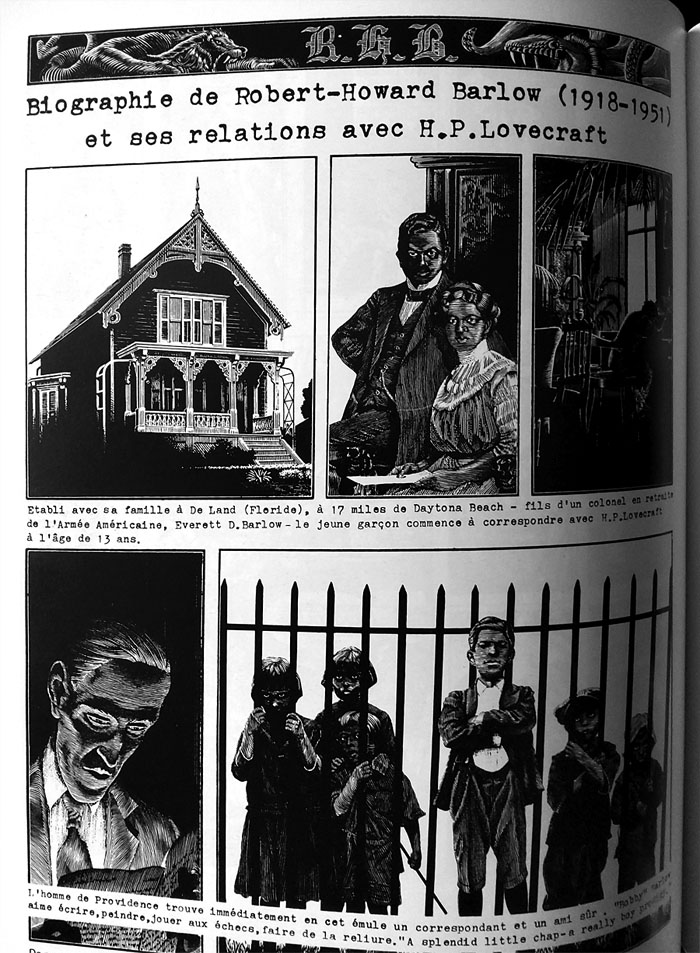
Mention of Robert H. Barlow last week reminded me of a comic strip which is an unusual addition to the world of Lovecraft-related art. RHB, written by François Rivière and illustrated by Andreas (Martens), was published in a French magazine, À Suivre, in 1978. I discovered the story when it was reprinted in The Cosmical Horror of HP Lovecraft (1991), an Italian volume that was the first substantial collection in book form of Lovecraftian comic strips and illustrations. Andreas and Rivière’s strip is a short biographical sketch of Robert H. Barlow’s equally short life which focuses on his connections to HP Lovecraft but doesn’t attempt any spurious fictionalisation. A few of the pages were posted at Deep Cuts in June of this year, together with a translation of the French text. The post there notes something that hadn’t occurred to me before, that Rivière would have taken most of his information about Barlow from L. Sprague de Camp’s Lovecraft biography. The post also made me realise that the Cosmical Horror reprint is missing its last two pages, so after 30 years I finally discover that the panel sequence showing a falling cat (seen earlier being dropped from a height by the young Barlow) has a happy conclusion that also ends the strip itself.
andreas4.jpg

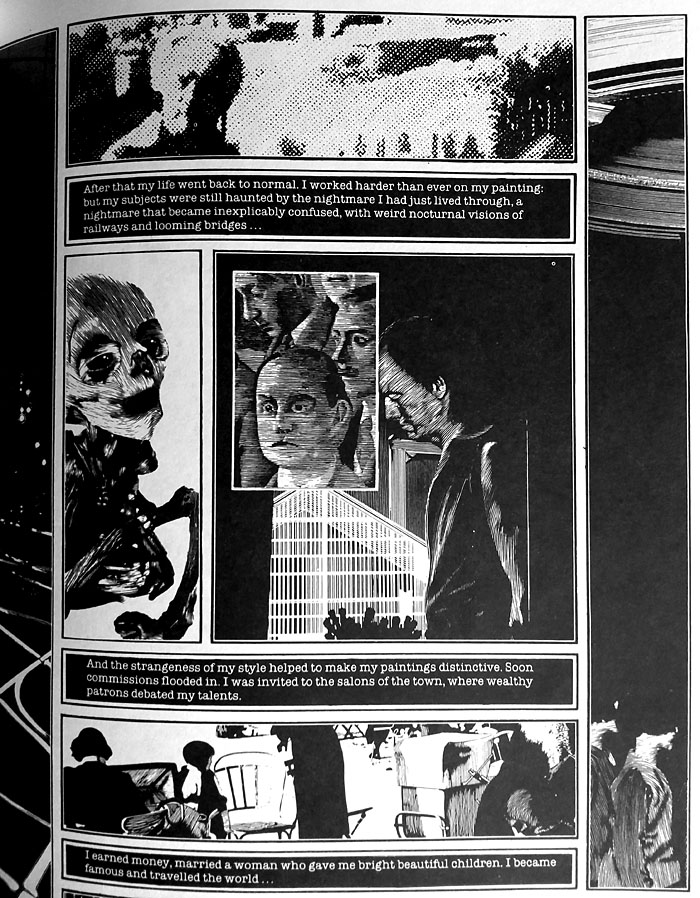
The Spitzner Museum’s Wax Woman.

Andreas has been a favourite comic artist of mine for many years, thanks in part to strips like RHB with its combination of unorthodox page layouts, scraperboard drawings (scratchboard, if you’re American) and the occasional use of enlarged half-toned photos. The scraperboard technique can be a laborious one for a comic artist, especially when applied in a photo-realist manner, which may explain why Andreas has used a more stylised pen-and-ink rendering for many of his own books, the drawings of which often resemble the engraving-like illustrations of Franklin Booth. The only other Andreas strip I’ve seen to date that uses scraperboard is The Spitzner Museum’s Wax Woman, another collaboration with Rivière which relates the ill-fated encounters of a Belgian painter with the woman of the title. The story received its first English printing in issue 17 of Escape magazine in 1989, and its appearance there made Andreas an artist to look out for in the future. The museum tale and the Barlow story were collected with several similar pieces in a book collection, Révélations Posthumes, in 1980. I’d really like to see this even though my French is très pauvre:

Avec ce livre, vous découvrirez d’étonnantes révélations posthumes concernant la vie fulgurante d’un ami et confident de Lovecraft, l’étrange aventure survenue en 1926, à Hastings, à un orphelin et une mystérieuse Thérèse Neele. La rencontre d’un soldat nommé Raymond Roussel et de Jules Vernes, à Amiens. Les origines du talent morbide d’un peintre belge fasciné par les figures de cire du Musée Spitzner. L’avatar maléfique joué à un malheureux jeune Anglais par Pierre Loti en sa maison de Rochefort-sur-Mer.
andreas2.jpg

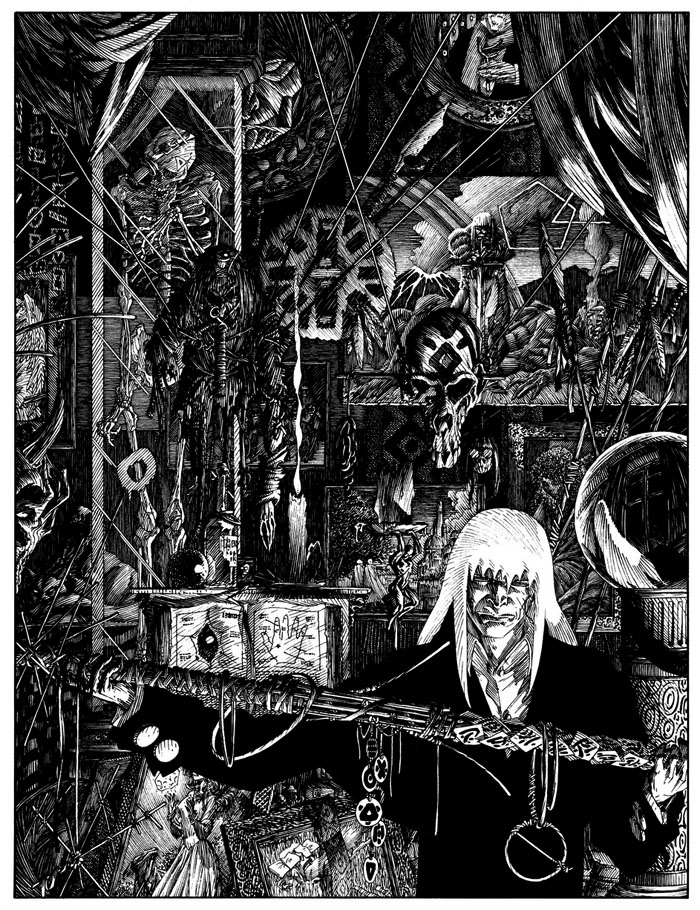
Rork.

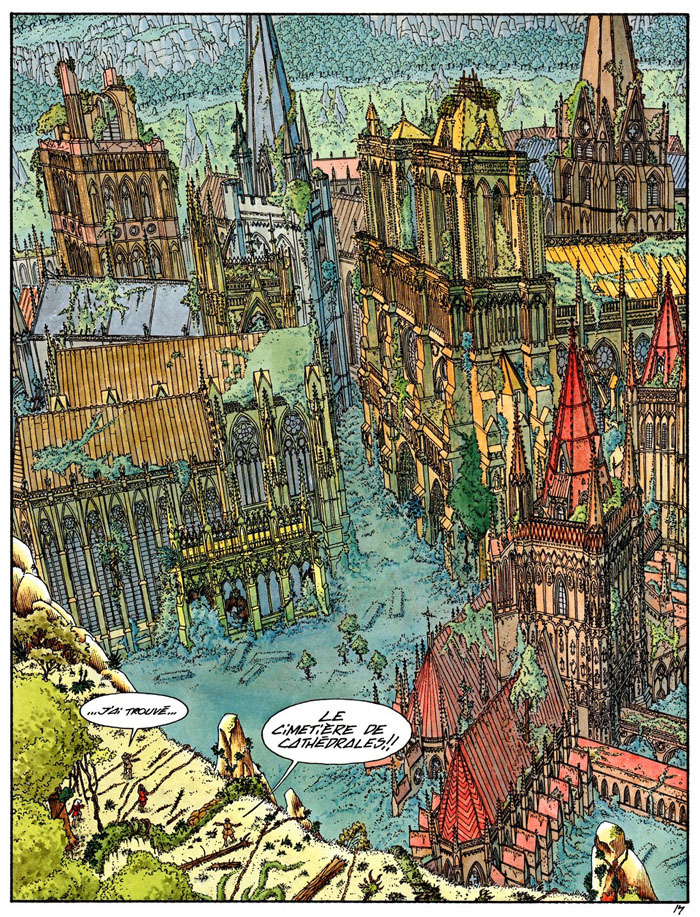
Révélations Posthumes seems to have been a one-off for Andreas. His subsequent, self-written books are more commercial fare, being a succession of weird adventure stories which follow the exploits of eccentric characters such as Cromwell Stone (an occult detective), the ageless, enigmatic Rork (a white-haired magus and occult detective), Capricorne (an astrologer and occult detective), and so on. As with Philippe Druillet, Lovecraft is never far away: the first episode of Cromwell Stone opens with an epigraph from HPL’s Supernatural Horror in Literature, while elsewhere inexplicable leviathan entities lurk in parallel dimensions, and architectural anomalies abound. The Rork series is especially enjoyable, like Doctor Strange without the superhero histrionics, featuring wildly audacious storylines such as Le Cimetière de cathédrales (1988), in which a graveyard for cathedrals is discovered in the Amazonian jungle.
andreas3.jpg

The fantasies of Andreas, like those of François Schuiten, might be more familiar to Anglophone readers if his works had been translated more often (or, in the case of RHB, translated at all). Dark Horse ran English versions of stories by Andreas and Schuiten in their Cheval Noir anthology series in the 1990s, and also published English reprints of the Rork and Cromwell Stone books but, as with the translated editions of Schuiten, these are now hard to find. More recently, Titan Books has published a new English edition of the first Cromwell Stone book but I’ve not seen any indication that they’ll be following this with more of the same. (I’ve also not seen the book itself so can’t vouch for the quality of the translation. Titan’s recent Druillet reprints have been riddled with textual errors. Beware.) Rather than wait for translations that might never arrive, the better option would be to improve my French reading skills. Writing this post has prompted me to order a secondhand copy of Révélations Posthumes. I’m looking forward to seeing what else it contains.

Elsewhere on { feuilleton }
The Lovecraft archive

Previously on { feuilleton }
Lovecraft: Démons et Merveilles
The art of François Schuiten
The art of Andreas Martens

Howard/Seward

hpl.jpg
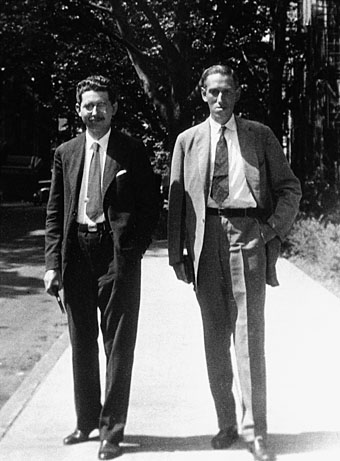
Frank Belknap Long and HP Lovecraft, New York, 1931. Photo by WB Talman.

Two friends—HP Lovecraft and Frank Belknap Long—visit the Egyptian antiquities in New York’s Metropolitan Museum of Art in the 1920s:

Tom Collins (for The Twilight Zone Magazine): I seem to recall a visit to the Metropolitan Museum of Art that you two made together.

Frank Belknap Long: You mean the time we visited the Egyptian tomb? Well, the Metropolitan apparently still has it. This was way back in the 1920s. The tomb was on the main floor in the Hall of Egyptian Antiquities, and we both went inside to the inner burial chamber. Howard was fascinated by the somberness of the whole thing. He put his hand against the corrugated stone wall, just casually, and the next day he developed a pronounced but not too serious inflammation. There was no great pain involved, and the swelling went down in two or three days. But it seems as if some malign, supernatural influence still lingered in the burial chamber—The Curse of the Pharaohs—as if they resented the fact that Howard had entered this tomb and touched the wall. Perhaps they had singled him out because of his stories and feared he was getting too close to the Ancient Mysteries.

burroughssphinx.jpg

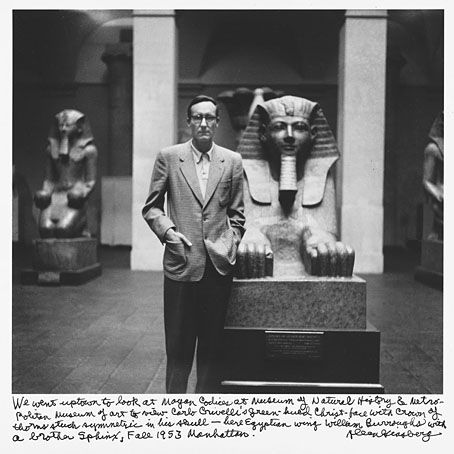
William Burroughs, New York, 1953. Photo by Allen Ginsberg.

Two friends—William Burroughs and Allen Ginsberg—visit the Egyptian antiquities in New York’s Metropolitan Museum of Art in the 1950s:

Allen Ginsberg: We went uptown to look at Mayan Codices at Museum of Natural History & Metropolitan Museum of Art to view Carlo Crivelli’s green-hued Christ-face with crown of thorns stuck symmetric in his skull — here Egyptian wing William Burroughs with a brother Sphinx, Fall 1953 Manhattan.

When I last wrote about the parallels between Lovecraft and Burroughs in a post from 2014 I wasn’t aware of Lovecraft and Long’s visit to the same museum exhibits that Burroughs and Ginsberg visited some 30 years later. I did, however, use the same photos which are posted here, a curious coincidence when Long wasn’t mentioned in the earlier post. This minor revelation is a result of reading the features in back issues of The Twilight Zone Magazine, one of which is an interview with an 81-year-old Frank Belknap Long. The coincidence is a trivial thing but it adds to the small number of connections between the two writers.

cthulhu.jpg

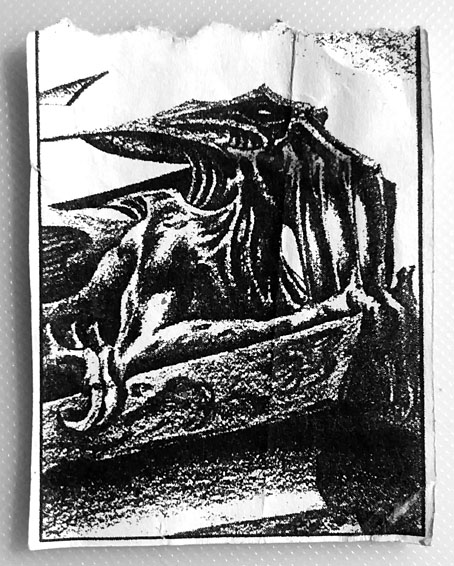
A Cthulhu Sphinx from The Call of Cthulhu, 1988.

Lovecraft and Burroughs were both living in New York City at the time of their excursions, and both touched on Egyptian mythology in their writings, so their having viewed the same museum exhibits seems inevitable rather than surprising. A more tangible connection between the pair is alluded to in Ginsberg’s photograph note when he mentions the Mayan codices. A few years before the museum visit, Burroughs had been studying the Mayan language and the Mexican codices in Mexico City under the tutelage of Robert H. Barlow, the former literary executor of HP Lovecraft. Burroughs’ studies subsequently fueled the references to Mayan mythology that turn up repeatedly in his fiction, and he was still at Mexico City College in 1951 when Barlow killed himself with a barbiturate overdose, afraid that his homosexuality was about to be exposed by one of his students. Burroughs mentioned the suicide in a letter to Ginsberg. The connections don’t end there, however. After Barlow’s death the rights to Lovecraft’s writings passed, somewhat controversially, to August Derleth and Donald Wandrei at Arkham House, and in another curious coincidence Derleth happened to be one of the complainants against a literary journal, Big Table, in 1959, when the magazine ran Ten Episodes from Naked Lunch, and was subsequently prosecuted for sending obscene material through the US mail. Derleth and Arkham House are both mentioned in the court papers.

I’ve never seen any indication that Burroughs was aware of these connections but if he was I doubt he would have paid them much attention, he always seemed rather blasé about his intersections with popular culture. He did think well enough of Lovecraft (or at least the version of Lovecraft’s fiction as presented by the Simon Necronomicon) to invoke “Kutulu” along with the Great God Pan and the usual complement of Mayan deities in Cities of the Red Night. Years later I remember seeing something in a newspaper about him retiring to Lawrence, Kansas, where he was described as passing the time “reading HP Lovecraft”. (I wish I could give a reference for this but I don’t recall the source.) If so then I like to think he might have given Creation Books’ Starry Wisdom collection more than a passing glance when it turned up at his door.

Elsewhere on { feuilleton }
The Lovecraft archive
The William Burroughs archive

Weekend links 582

dore.jpg

Illustration by Gustave Doré from L’Espagne (1874) by Jean Charles Davillier.

• Warp Records has announced the forthcoming publication of Atmospherics by Jon Hassell, a short book collecting the diary extracts, composition notes and other ephemera that Jon compiled as an evolving appendix for his website. I was involved with the first iteration of the Atmospherics when we were working on his site in 2004, and for me this section was always the most interesting part of the project, comprising unique, personal material. The book will be published in October.

• “Almost everything in his book would be dismissed by today’s streaming behemoths as ‘too quirky, too local, too slow, too dry, too difficult, too weird’.” Sukhdev Sandhu reviewing The Magic Box, a history of British TV from the 1950s to the 1980s by Rob Young.

• New music: Cobalt Desert Oasis by Marco Shuttle, Angel’s Flight (AD 93) by Biosphere, and The Shildam Hall Tapes: The Falling Reverse by Stephen Prince, a sequel to an earlier release by A Year In The Country which includes an accompanying novella.

• Mix of the week, month and year: Sentimental Ornament: A Broadcast Rarities Mix by Aquarium Drunkard. First posted almost a year ago, I only discovered it last week; Aquarium Drunkard is now added to my RSS feed to avoid further neglect.

• I didn’t post anything for Bloomsday this year but if I’d seen these caricatures by Craig Morriss back in June I would have linked to them at the time.

• At Unquiet Things: The Eerie Moods and Pulpy Frights of Henri Lievens.

• Whole lotta rarities: the strangest Led Zeppelin artwork.

• Old music: A Willow Swept By Train by Janet Beat.

Instant Lettering Database

Atmospheres (1967) by Wimple Winch | Atmospheric Lightness (2018) by Brian Eno | Ligeti: Atmosphères (2019) by Orchestre Philharmonique de Radio France; Alan Gilbert

PlacePrints by David Rudkin

pp1.jpg

Hidden voices and haunted landscapes are conjured up in ten unique stories from the imagination of visionary writer David Rudkin. Join a stellar cast including Juliet Stevenson, Toby Jones, Josie Lawrence, Michael Pennington and Stephen Rea, among many others on an enlightening journey across the British Isles with this dramatic audio cycle that will transform your sense of the landscape around you.

PlacePrints is the umbrella title for ten new audio plays by David Rudkin, a series directed by Jack McNamara for the New Perspectives theatre company. The series has been freely available online for over a year but only came to my attention last month. One of the pleasures of recent years has been seeing David Rudkin’s dramas being reappraised after many years of neglect, although interviews suggest the writer has ambivalent feelings about the concentration on the gaudier, generic elements of his surviving TV plays. In The Edge Is Where The Centre Is, a book by Texte und Töne about Penda’s Fen, Rudkin is determined to frame the film as a political work when most of the reaction to it over the past decade has been to label it “folk horror”. I can’t complain too much when I’ve been partly responsible for giving it the horror label in the first place, having written (at the request of one of the editors) a short review of the film for Horror: the Definitive Guide to the Cinema of Fear (2006), and later contributed a lengthy piece about Rudkin’s stage and TV dramas to Folk Horror Revival: Field Studies (2015). In my defence, the latter was intended to draw attention to Rudkin’s work as a whole, and you have to start somewhere. In 2006 Penda’s Fen and Artemis 81 were mysteries to most people, not horror enough for the MR James obsessives, or, in the case of Artemis 81, too weird for the science-fiction crowd; both of them were also unavailable in any form. Grant Morrison was the only person I’d met who not only knew who Rudkin was but had read the available playscripts. Some of Rudkin’s works may touch on generic horror or science fiction but even his adaptation for the BBC of The Ash-Tree by MR James can be grouped with his own dramas via its themes of religious conflict and the presence of history in the landscape. He also changes Mothersole’s warning from James’s “There will be guests at the hall!” to the pithier “Mine shall inherit!”, a threat delivered with a playwright’s economy, and a declaration whose reference to inheritance connects the film to a persistent Rudkin theme, the legacies of people, place and history.

pp2.jpg

All of which makes the existence of the PlacePrints dramas very welcome indeed. For the most part, these are closer to Rudkin’s theatrical works than his TV films, being a collection of lone voices engaging repeatedly with the legacies of people, place and history: a British Celt watching the invading Roman army build one of their roads across the Warwickshire fields (River, Of Course); a close description of a walk along an ancient pathway in Cornwall (Nemeton); the scathing voice of an earthwork following the clumsy searches of an aged academic (Grim’s Ditch); a young student slipping in and out of visions of life in Suffolk 30,000 years ago (Cave Girl/The Stone Age). The series features an impressive range of acting talent, especially Juliet Stevenson in Grim’s Ditch, and Frances Tomelty as an elemental spirit haunting the waters of Lough Fea in To the Waters and the Wild. Sympathetic sound design and music by Adam McCready adds a hint of location atmosphere and dramatic texture without ever being obtrusive. Each piece is preceded by an authorial introduction, one of which suggests that Rudkin may not be too displeased about being tagged with the horror label when he describes Grim’s Ditch as being a contemporary equivalent of an MR James warning to unwary academics. The episode has its share of uncanny moments, with Toby Jones as the professor receiving a lesson from the landscape that he won’t forget. The final recording is an interview with David Rudkin by Gareth Evans, one of the interviewers and contributors to The Edge Is Where The Centre Is.

There’s a further parallel in some of these pieces with chapters from Voice of the Fire by Alan Moore, a novel that also deals with (among other things) ancient Britain, the Roman invasion and the patterns of history. Fitting, then, that New Perspectives have produced the audio version of Voice of the Fire with the same director and sound designer, and with Toby Jones returning as one of the characters. I generally prefer to read books rather than to hear them read but I’m looking forward to listening to this one as well. (Thanks to Jay for the tip!)

Previously on { feuilleton }
Voice of the Fire
Penda Reborn
Folk Horror Revival: Field Studies
The Edge Is Where The Centre Is
Afore Night Come by David Rudkin
White Lady by David Rudkin
Penda’s Fen by David Rudkin
David Rudkin on Carl Dreyer’s Vampyr