Weekend links 196

wellcome1.jpg

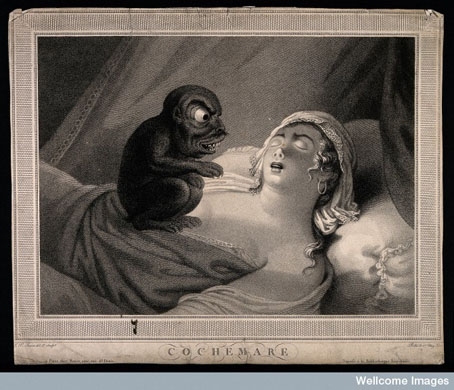
Cochemare (1810) by Jean Pierre Simon. One of 100,000 high-resolution images now available from Wellcome Images.

• Ted Morgan’s Literary Outlaw: The Life and Times of William S. Burroughs (1990) was a solid biography blighted by a bizarrely bad-tempered and judgemental attitude towards many of Burroughs’ friends and colleagues. Morgan says Burroughs disliked the book (he also says his subject died in 1993, not 1997…) so I’m looking forward to the new biography by Barry Miles, Call Me Burroughs: A Life. There’s a curious detail in Jeremy Lybarger’s piece about August Derleth, HP Lovecraft’s publisher and lifetime champion, causing a fuss after the Chicago Review published extracts from Naked Lunch in 1958. Burroughs enjoyed Lovecraft’s fiction but it’s unlikely that Lovecraft would have been anything other than appalled by Burroughs’s work. Barry Miles will be holding a Q&A session at the ICA, London, next month following a screening of Howard Brookner’s restored documentary, Burroughs: The Movie.

• Mix of the week: Secret Thirteen Mix 105 by Sturqen. At 3quarksdaily Dave Maier writes in praise of drones (the musical variety), and links to three mixes.

• Interviews: Haakon Nelson talks to Harold Budd, Joseph Burnett talks to William Basinski, John Stezaker talks to Nicolas Roeg.

Derek responded to an invitation to address [AIDS] hysteria by lining the gallery with a set of tarred and feathered mattresses loaded with the traces of queer love-making and then framing them against wallpaper made from Xeroxed, blood-spattered front pages. In the middle of all this he then constructed a makeshift barbed-wire cage that imprisoned and protected a pair of apparently naked lovers – usually a pair of handsome, sleeping boys, but for one afternoon at least Tilda Swinton dropped by, just to make the point that the boys didn’t have an exclusive stake in or artistic rights to this crisis. Between the walls and the cage, the air of the gallery was thick with tension and hatred – sometimes literally so, as visitors to the gallery objected vociferously to what they were seeing.

Neil Bartlett on celebrating Derek Jarman 20 years after his death.

• William Friedkin’s Wages of Fear remake, Sorcerer (1977), receives an overdue reissue on DVD/Blu-ray in April.

James Knowlson asks “What lies beneath Samuel Beckett’s half-buried woman in Happy Days?”

• The UK’s web filtering seems to be blocking common sense says Jane Fae.

wellcome2.jpg

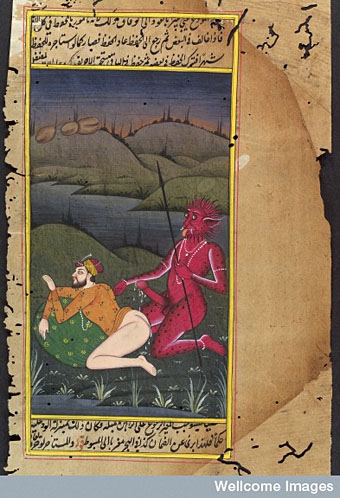
A devil buggering a man (19th century).

• The poetry of Hart Crane, from the American epic to personal belonging.

The Sonny Sharrock Quartet play Stupid Fuck, live 1988.

Pinterest nightmares

Borogoves

• Lutinemusic: Espera | Died Of Love | All I Have Is Gold

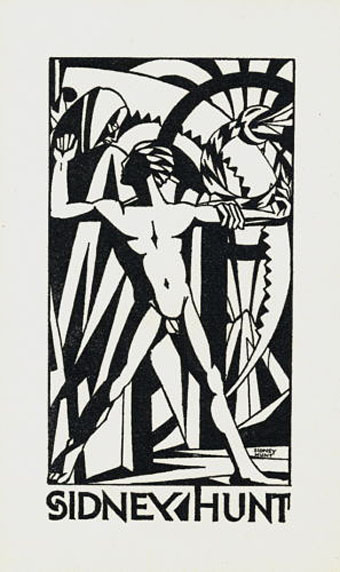
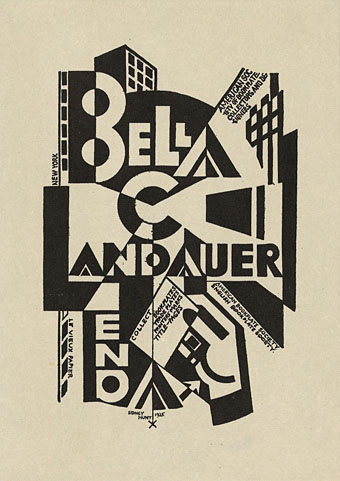
The art of Sidney Hunt, 1896–1940

hunt01.jpg

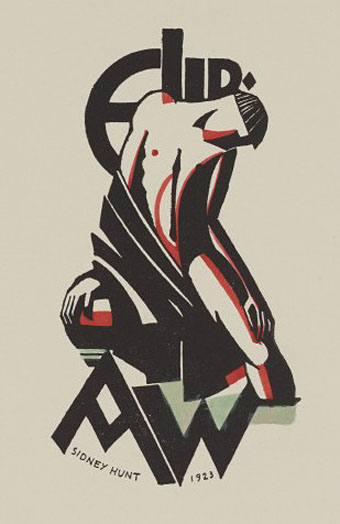
Ganymede Before Zeus (1921).

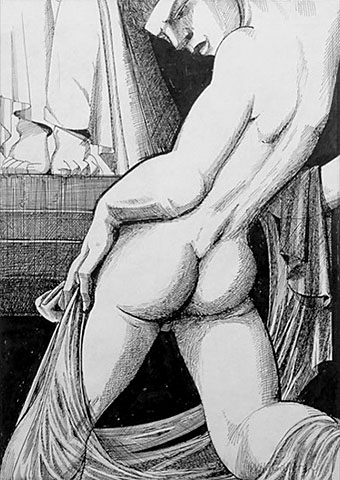
Another of those artists about whom detail remains tantalisingly remote if the web is your primary research tool. Hunt was a British Modernist who also edited an avant-garde magazine, Ray, from 1926–27. Most of the works here are bookplates from around 1923, many of them distinctly homoerotic which adds to their interest. The note at Wikipedia is unsourced but tells us that his output included “experimental prose-poem fantasies of 18-year-old hermaphrodites”. Maybe these, and more of his work, will turn up eventually.

hunt02.jpg

hunt03.jpg

hunt04.jpg

Continue reading “The art of Sidney Hunt, 1896–1940”

What the Butler Saw by Joe Orton

orton4.jpg

Dr Rance: You can’t be a rationalist in an irrational world. It isn’t rational.

“Lunatic” is a description suited to the frenetic pace and escalating calamities of the stage farce. Here the word gains greater resonance when the farce takes place in a psychiatric hospital. The customary sexual shenanigans are all in place—the play opens with Dr Prentice telling a prospective secretary to remove her clothes so he can see whether she’s suitable for the job—but in place of Carry On-style belly laughs we have another attack against authority and social ideas of normal behaviour, sexual or otherwise. This is a blacker shade of comedy than you usually find in farce. Joe Orton uses the mechanics of the form whilst undermining the cosy formulas; the ending is a happy one but only after the characters have gleefully overlooked double-incest and an act of rape. Bad taste was Orton’s forte, and that quality is very much in evidence here.

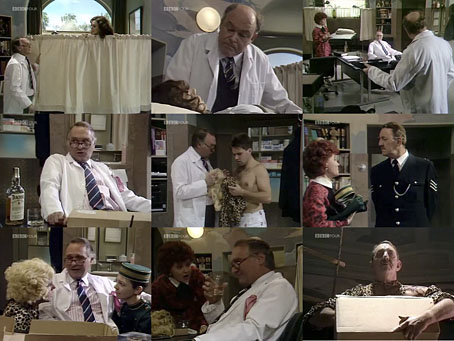
What the Butler Saw was one of several plays shown in the BBC’s Theatre Night strand in 1987. In this production Dinsdale Landen plays Dr Prentice with Prunella Scales playing Mrs Prentice. Timothy West (Prunella’s husband off-screen) perfectly incarnates the monstrous Dr Rance, a character so intoxicated with his own righteousness that he’s prepared to sign a committal order against anyone who crosses his path. (He boasts at one point of having committed his entire family.) It’s a great performance but West is ably matched by Dinsdale Landen and Prunella Scales. Barry Davis is the director. Plays such as this suffer without the involvement of an audience but this production gives an idea of how manic a decent stage production must be. The version on YouTube is in six parts.

What the Butler Saw: part 1 | part 2 | part 3 | part 4 | part 5 | part 6

Previously on { feuilleton }
A Genius Like Us: A Portrait of Joe Orton
Malicious Damage
Joe Orton Online
Joe Orton

A Genius Like Us: A Portrait of Joe Orton

orton1.jpg

Last week’s reading was the script of Joe Orton’s Loot after finding one of the first published editions of the play. Reading a play is never the same as seeing it performed, of course, but it’s still very funny, and many of its digs at police corruption haven’t dated at all. There is a film of Loot but it’s poor stuff, with Richard Attenborough miscast as the belligerent Inspector Truscott. Much better is Douglas Hickox’s film of Entertaining Mr Sloane (1970) which appeared shortly before Loot, and which is worth seeing for Beryl Reid reprising her stage role as the unfortunate Kath.

orton2.jpg

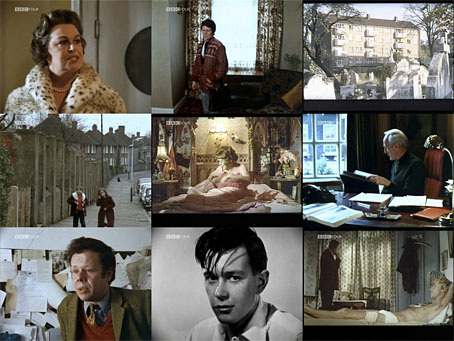
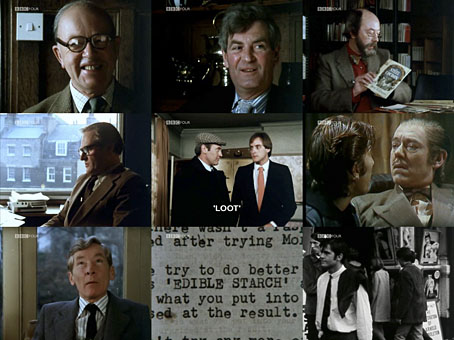
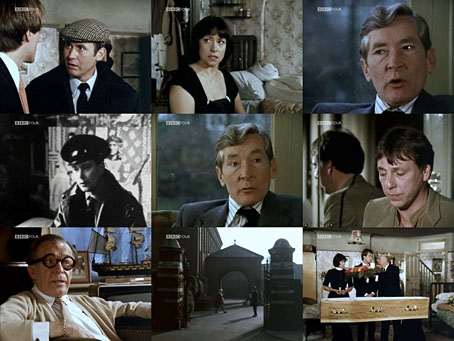
Orton’s brief career—a mere four years from complete obscurity in 1963 to his death at the hands of partner Kenneth Halliwell in 1967—is explored in A Genius Like Us: A Portrait of Joe Orton, a 70-minute BBC Arena documentary from 1982. Anyone who’s seen Prick Up Your Ears (1987)—Stephen Frears’ Orton biopic with a script by Alan Bennett—will be familiar with the train of events. Pamela Brighton and Nigel Williams’ film interviews some of the real people who appear in Prick Up Your Ears, notably surviving members of Orton’s family and Orton biographer John Lahr. In addition there’s a substantial contribution from Kenneth Williams, a close friend of Orton and Halliwell’s who was also badly miscast as Inspector Truscott in the first disastrous performances of Loot. Between the interviews there are some scenes from a lacklustre TV performance of Loot, a stage performance of What the Butler Saw, and bits of Entertaining Mr Sloane.

orton3.jpg

Previously on { feuilleton }
Malicious Damage
Joe Orton Online
Joe Orton

Weekend links 193

gauger.jpg

A Problem Glyph by Eliza Gauger. Problem Glyphs are “symbolic illustrations … drawn in response to problems sent in by tumblr users”.

Kosmische Night takes place at the Museum of Bath at Work, Bath, Somerset, on January 25th (Rescheduled to February 22nd).  “…a celebration of all things Teutonic for anyone who enjoys Neu!, Can, Tangerine Dream, Stockhausen and Kraftwerk,” say the organisers. Also on the bill, The Electric Pentacle, a Carnacki-esque collaboration between Narco Lounge Combo and The Levels.

• Shock Headed Peters’ Fear Engine II: Almost As If It Had Never Happened. Joe Banks on Karl Blake, “…one of the most fascinating and colourful characters to emerge from the fertile loam of the post-punk scene”.

• “The great question in the film and the tale is not the existence of the ghosts but the way the governess understands their no-longer-lived lives and desires.” Michael Wood on The Innocents.

Nobody, however, is a greater authority on the intersection of porn and alternative spirituality than Annie Sprinkle. Beginning as a prostitute in the 1960s and 70s, she entered porn in the pre-AIDS era and made over two hundred films. She then jumped into a career as a sex-positive author and educator, which brought her into close conflict not only with feminists like Andrea Dworkin and Catharine MacKinnon, but also right-wing patriarch Jesse Helms, who denounced one of her sex magick performance pieces on the floor of the Senate. For Sprinkle, both sexuality and performance are explicitly spiritual and magical, part of her role as a cultural shaman.

In the Valley of the Porn Witches by Jason Louv.

Stars of the Lid and Wordless Music Orchestra playing for two hours last month at the Basilica of Our Lady of Perpetual Help in Sunset Park, Brooklyn.

Rick Poynor on the late Martin Sharp’s contributions to People, Politics and Pop: Australians in the Sixties (1968) by Craig McGregor.

Maggie Greene on The Woman in Green: A Chinese Ghost Tale from Mao to Ming, 1981–1381.

• “TED actually stands for: middlebrow megachurch infotainment,” says Benjamin H Bratton.

Geoff Manaugh on how corpses helped shape the London Underground.

Tony White on Eduardo Paolozzi at New Worlds by David Brittain.

• Mix of the week: Secret Thirteen Mix 102 by Frank Bretschneider.

• At Dangerous Minds: film of Syd Barrett‘s first psychedelic trip.

NYPL Wire: a New York Public Library Tumblr.

Microbial art by Eshel Ben-Jacob and others.

Interstellar Rock: Kosmische Musik (1974) by The Cosmic Jokers | I, Bloodbrother Be (1984) by Shock Headed Peters | Obscene and Pornographic Art (1991) by Bongwater