Vintage swordplay #5

vintage.jpg

In honour of the overturning of Prop 8 in California—and because I haven’t posted one of these for a while—another piece of beefy weapon-handling. No idea who this fellow is but he can be seen a lot bigger (if not actually tumescent) at the Haunted Lamp, a place of assorted delights that you really ought to go and browse.

Elsewhere on { feuilleton }
The men with swords archive

Weekend links 24

early.jpg

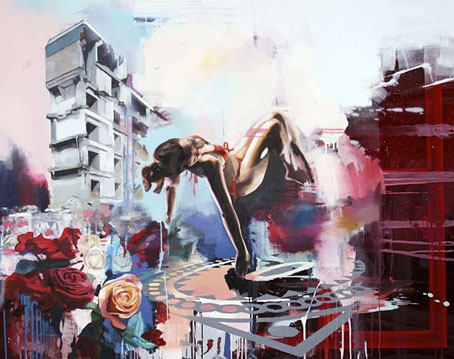
Delta-Wing (2009) by Chloe Early.

• “Feted British authors are limited, arrogant and self-satisfied, says leading academic”. Stating the bleeding obvious but it still needs to be said, apparently, especially when the announcement of the Booker list this year caused the usual confusion when Amis Jr. and McEwan weren’t included, as though the mere existence of their novels makes them prize-worthy. And as someone pointed out, the word “male” is missing from that headline.

Hero of Comic-Book World Gets Real: Alan Moore again, in the NYT this time. Related: a review of Unearthing live.

• Announcing The Hanky Code by Brian Borland & Stephen S Mills, a 40-poem book to be published next year by Lethe Press. For an explanation of the Hanky Code there’s this, and there’s also an iPhone app.

Folk—the ‘music of the people’—is now hip again, says (who else?) Rob Young who can also be heard on the archived podcast here. Related: the folk roots of Bagpuss. Related to the latter: The Mouse Mill.

zvorykin.jpg

An endpiece from The Firebird and other Russian Fairy Tales by Boris Zvorykin.

‘Yes’ to Catastrophe: Roger Dean, Prog and SF. A lengthy and thoughtful analysis of Roger Dean’s early work.

Into the Media Web, the enormous Michael Moorcock book which I designed, is officially published this week.

Cassette playa: in praise of tapes. I’ve complained about tapes in the past but people continue to find them useful. Some technologies die harder than others.

Boy BANG Boy: “Quiet moments made suddenly very loud with the attitude and opinion of what it means to be a young male in an impossibly diverse world.” An exhibition opening at Eastgallery, London, on August 5th.

Empty your heart of its mortal dream: Alfred Kubin’s extraordinary novel, The Other Side.

Ghostly and Boym Partners devise a new way to deliver digital music.

Besti-mix #27: a great selection by producer Adrian Sherwood.

Agnostics are troublemakers. Amen to that.

• RIP Harry Beckett.

Acousmata.

Let Us Go In To The House Of The Lord by Pharoah Sanders (live, 1971): Part 1 | Part 2

The Lady Is Dead and The Irrepressibles

lady1.jpg

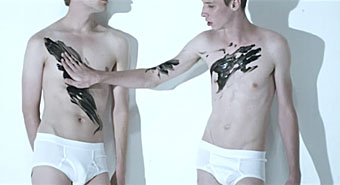
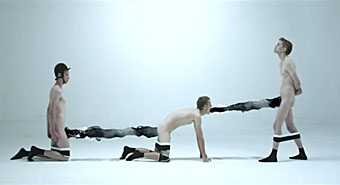
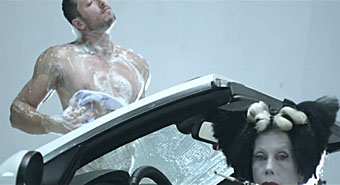
The lady may be dead but the art here is very much alive. The second great video of the week comes via the always essential Homotography, a short piece by director Roy Raz whose film features a pair of tattooed lesbians, a tennis match involving meat (or something), boys stripping out of their underwear to indulge in some peculiar—and for all we know, metaphysical—sexual congress, an elderly lady dancing round a piano, and a gang of luscious hunks who soap a car before sponging down their own bodies.

lady2.jpg

Do we have to worry about What It All Means? Of course we don’t, although the usual crowd of bewildered YouTube commenters struggle with comprehension like medieval rustics attempting to decipher so many signs and wonders. Think of it as the kind of thing Wes Anderson might create if someone dosed him with psychotropic chemicals that also turned him gay.

lady3.jpg

More important for me is the utterly fantastic song which Roy Raz uses, a number entitled In This Shirt by a ten-piece British group, The Irrepressibles, whose name I recognised but whose music I hadn’t heard until this. Lead singer Jamie McDermott’s voice is very reminiscent of Antony Hegarty which is no bad thing, although McDermott is probably weary of the comparison. Our musical culture would be greatly improved by more people taking their lead from Antony. The Irrepressibles’ site has a Soundcloud page where you can hear other songs from their recent Mirror, Mirror album, the CD of which is now on my shopping list. They also have a couple of videos showing their live performances which look rather spectacular. 2010 is turning out to be a good year for British music; when that music comes with cute guys attached it’s an added bonus.

lady4.jpg

Update: Roy Raz’s film is now also on Vimeo with other of his works.

Schloss Neuschwanstein

neuschwanstein1.jpg

This weekend’s film viewing was a DVD of Luchino Visconti’s Ludwig (1972), something I’ve seen in parts before but don’t recall ever having watched all the way through. I enjoyed it on the whole although Visconti’s “hose-piping” camera style and crash zooms are frequently annoying. Helmut Berger was very good as the tragic King of Bavaria and the subject was given additional interest by my reading earlier this year of a number of Philippe Jullian books. Ludwig II was camp enough to have interested Jullian whatever age he lived in but the way his life connects to the Symbolist period lends him a special significance. He can’t quite be described as a Symbolist monarch but his tireless support for Symbolist god Richard Wagner, and his lavish construction projects, made him a hero to Verlaine and others, who saw in the realisation of his fantasies the actions of an artist working on the grandest scale.

neuschwanstein2.jpg

Of all the palaces, Schloss Neuschwanstein at Hohenschwangau is easily the most spectacular, and Wikimedia Commons has a great selection of photos of which the two here are examples. The first picture is a 1900 photochrome print originally from the Library of Congress collection and the large version makes a great desktop picture. The helicopter view shows how the apparent isolation of the castle depends on where you place the camera. Visconti’s film makes use of all the King’s buildings although we never see a full exterior shot of Neuschwanstein possibly because the castle was unfinished at the time of Ludwig’s death in 1886. While he was alive Ludwig’s palaces were regarded as outrageous extravagances by a government dismayed by his patronage of Wagner, his scandalous homosexual behaviour, and his lack of interest in the nation’s political squabbles. Over a century later, Wagner’s music receives endless performances around the world while Schloss Neuschwanstein is the most popular tourist destination in Germany. Bavaria’s wars are long forgotten yet it was the King they declared to be “mad”. There’s a moral there.

The Neuschwanstein pool at Flickr

Previously on { feuilleton }
Temples for Future Religions by François Garas
Willy Pogány’s Lohengrin
Dallamano’s Dorian Gray

Weekend links 23

groovy.jpg

“The Go-Go wonder of Paris — That’s space girl. Transistors never wear down, they just go on and on — Even her heart is made of vinyl — It’s a marvy life — With nothing else to do but dance — Why not? – Love? — Forget it, baby — Not for her —” From Mod Love (1967) by Michael Lutin and Michel Quarez.

• “Gay people are not advancing themselves in the (publishing) industry, they’re just regurgitating familiar territory. Of course, artists are always ahead of gatekeepers. That’s the way it works—artists innovate. But in order to fulfill your promise as an editor, agent, publisher or reviewer, you have to be a person who’s embracing the new and looking to elevate what is not yet known. And unfortunately, there’s not a discussion among publishing professionals about enhancing this aspect of people’s responsibilities. In fact, it goes the other way. So there needs to be a psychological revolution on behalf of the people who are controlling what information is allowed to be seen.” From an interview with Sarah Schulman at Lambda Literary.

Jonathan Ross meets Jim Steranko. Also at the Guardian: Unearthing the truth about Alan Moore.

• Photographing an abandoned Art Deco skyscraper. From the people who photographed Neverland at night.

Powers: “aural sculptures” by Andy Partridge inspired by the strange science fiction art of Richard M Powers.
barbier.jpg

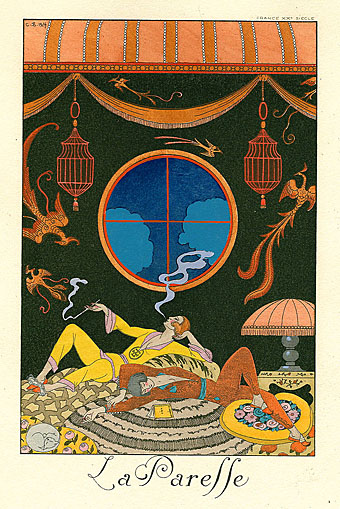
La Paresse (Laziness) (1924) by George Barbier.

Lautréamont’s poison-drenched pages. Roger Cardinal reviews a new edition of Les Chants de Maldoror and Poésies.

The Wire‘s Top 50 Rhythms of All Time, a list from 1992. Some great recommendations but it’s impossible to imagine that being written now without a mention of Klaus Dinger. And where’s Fela Kuti?

• The Wire Salon at Cafe Oto, London, on August 5th presents Rob Young discussing his forthcoming book, Electric Eden: Unearthing Britain’s Visionary Music.

American Pictorial Photography, 1912–1955. Another astonishing picture set at Golden Age Comic Book Stories.

The Beats: Pictures of a Legend. Edmund White on a new exhibition of Allen Ginsberg’s photographs. Related: the trailer for Howl.

The Dream Machine is a point-and-click adventure game made using hand-crafted animation.

Fuck yeah Francisco Lachowski: Brazilian model cutie has many Tumblr fans.

Polly Morgan’s wings of desire. The taxidermy artist interviewed.

Thomas Dolby’s solar-powered boat studio.

Rückstoss Gondoliere (1971) by Kraftwerk: pt. 1 | pt. 2