Weekend links 87

scott.jpg

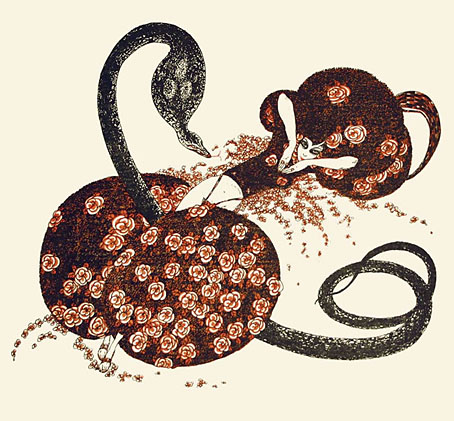
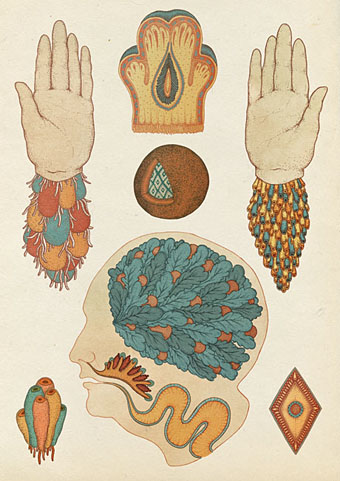
Untitled art by Katie Scott.

“…the very fact that people cannot get published by the big-name publishers in the way that they used to has meant that you’ve got some really interesting and often really beautiful little small publishing houses that are springing up and coming into existence. And the stuff that they’re providing is actually a lot better. I’m thinking of people like Tartarus Press, Strange Attractor and various other commendable small publishers that do a beautiful job and that are producing books that are good to have on your bookshelf.”

Alan Moore discussing books old and new in a lengthy interview at Honest Publishing. In part two he takes to task hardboiled moron Frank Miller and offers his thoughts on the Occupy movement. Elsewhere the Guardian finally paid some attention to the importance of design in the book world. Some of us who do this for a living have been saying for years that if publishers want to see physical books thriving they need to maintain (or improve) the quality of their design and materials. Related: The Truth About Amazon Publishing, Laura Hazard Owen at paidContent examines some the figures behind Amazon’s PR.

• “Tenniel argued for several changes to the characters as conceived by Carroll. The croquet mallets are ostriches in the original drawings, and the hoops are footmen bent over with the tails of their coats hanging down over their bottoms like an animal’s. Tenniel left them out. He told the author that a girl might manage a flamingo, but not an ostrich.” Marina Warner again on John Tenniel, Lewis Carroll and the Alice books.
schoeler.jpg

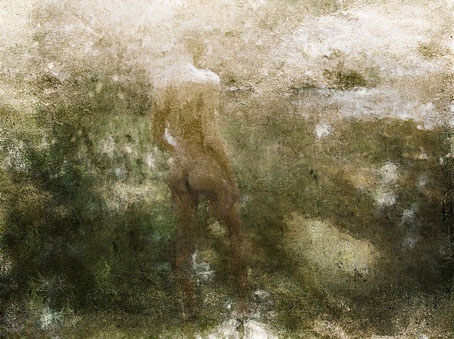
Untitled painting by Christian Schoeler who was interviewed for a second time at East Village Boys.

Shamanism and the City: Psychedelic Spiritual Tourism Comes Home and Scientists finding new uses for hallucinogens and street drugs. Related: LSD – A Documentary Report (1966), “a totally new kind of record album”.

• More books: Interview with a Book Collector. Mark Valentine, author, biographer and editor was also the co-publisher in 1988 of my adaptation of HP Lovecraft’s The Haunter of the Dark.

• The Priapus Chandelier “features six hand-sculpted phalluses cast in translucent resin, which radiate an atmospheric light.”

Stewart Lee on Top Gear, in which the comedian and Dodgem Logic contributor eviscerates the BBC’s pet trolls.

• The Beinecke Rare Book and Manuscript Library put the Voynich Manuscript online.

• The 432-page SteamPunk Magazine collection with my cover art is now on sale.

Hubble, Bubble, Toil & Trouble: The Haxan Cloak Interviewed

• The Sunn O))) chapter of The Electric Drone by Gilles Paté.

Colonel Blimp: The masterpiece Churchill hated

Submergence (2006) by Greg Haines | Reyja (2011) by Ben Frost & Daníel Bjarnason | The Fall (2011) by The Haxan Cloak.
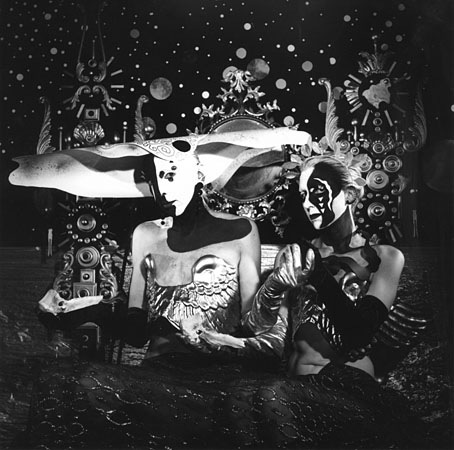
Flamboyant excess: the art of Steven Arnold

arnold1.jpg

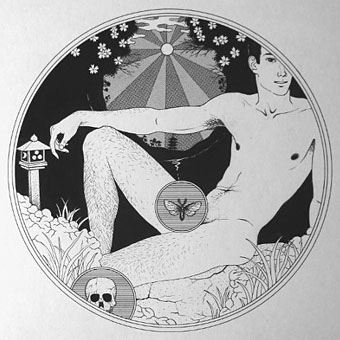
Invitation to Yin and Yang by Steven Arnold.

“Less is NOT more, MORE is more, less is less.”

Steven Arnold

Thanks to Monsieur Thombeau for pointing the way to The Steven Arnold Archive, a respository of biographical and career detail about Steven Arnold (1943–1994):

…a California-based multi-media artist, spiritualist, gender bender, and protégée of Salvador Dalí. His work consisted of drawings, paintings, rock and film posters, makeup design, costume design, set design, photography, and film.

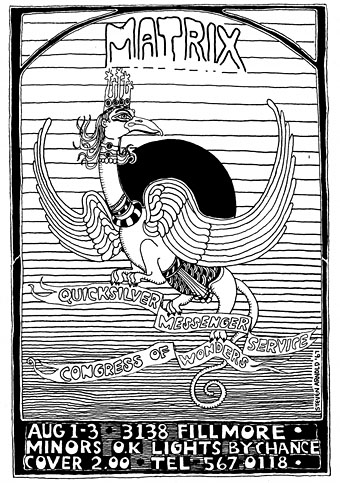
Arnold’s work with outrageous performance troupe The Cockettes seems to receive more attention today than his other creations so it’s good to see the balance being redressed. It was a surprise, for instance, to find he’d drawn a poster in 1967 for The Matrix club, San Francisco. Similar works are mentioned but the site doesn’t have any examples and I’ve yet to see any elsewhere.

arnold2.jpg

arnold3.jpg

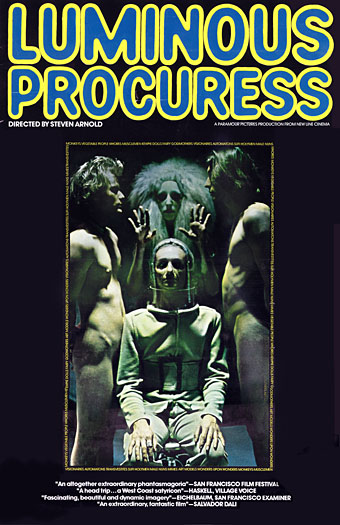
And I haven’t seen the Cockettes film, Luminous Procuress (1971) either. Salvador Dalí unsurprisingly responded with enthusiasm to its atmosphere of androgynous weirdness:

Luminous Procuress is an altogether extraordinary, individualistic phantasmagoria. It was filmed entirely in San Francisco over a two-year period, and describes the adventures of two wandering youths in San Francisco who visit the home of a mysterious woman, the Procuress. She is an elegant emblem of sorcery, her vivid features glowing under bizarre, striking maquillage, and one is not certain who she is or where she intends to lead the protagonists. Although the language she speaks is vaguely Russian, it appears that the Procuress has psychic powers. She discerns a sympathetic response to her on the part of the youths, and by magical means, conducts them through fantastic rooms, on a psychic journey… (more)

Definitely one for the future viewing list. Meanwhile, one of Arnold’s tableaux photos, The Advantages of Modern Marriage, is currently on display in Cruising the Archive: Queer Art and Culture in Los Angeles, 1945–1980 at the ONE National Gay & Lesbian Archives, Los Angeles. The exhibition runs to April 1st, 2012.

Previously on { feuilleton }
James Bidgood

Los Bikers by Dënver

losbikers1.jpg

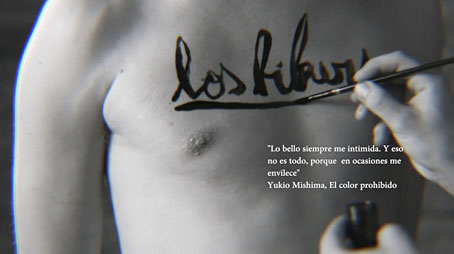
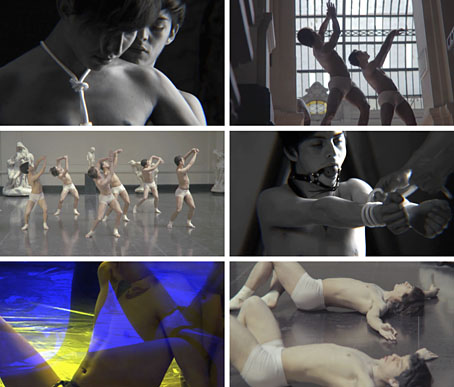
What’s going on here then? An epigraph from Yukio Mishima…an Air-like song…a pair of boys stripping down to their underwear to play bondage games…gorgeous dancers in white briefs performing amid statuary… Yes, it gets my vote.

Dënver are from Chile, and the song is Los Bikers from their 2010 album Música, Gramática, Gimnasia. I’d tell you who directed the video but they’re not very clear about that themselves. There’s more video and music on the inevitable Dënver Myspace page. Via Homotography.

losbikers2.jpg

Previously on { feuilleton }
The Lady Is Dead and The Irrepressibles
Forbidden Colours
Mishima’s Rite of Love and Death

Weekend links 86

alastair.jpg

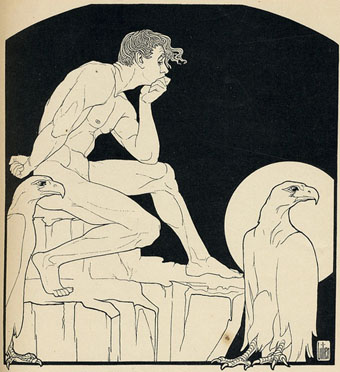
Salammbô by Alastair (Hans Henning Voigt) from Harry Crosby‘s Red Skeletons (1927). Dover published a new collection of Alastair’s drawings in September.

A Taste of Honey showed working-class women from a working-class woman’s point of view, had a gay man as a central and sympathetic figure, and a black character who was neither idealised nor a racial stereotype.” RIP Shelagh Delaney. Related: Shelagh Delaney’s Salford (1960), directed by Ken Russell, and all 47 minutes (!) of The White Bus (1967), Lindsay Anderson’s strange, pre-If…. short, written by Shelagh Delaney, filmed in and around Manchester.

Since birth I’ve craved all things psychedelic, the energy and beauty of it. The pleasure… […] But in the US the exploration of consciousness and its powers—or really any curiosity about anything at all—is actively discouraged, because the system is so corrupt that it depends on people being virtually unconscious all the time. Burroughs cracked that code long ago. Spirituality here equals money; no one seems to be able to think, never mind explore their own consciousness.

Laurie Weeks: Making Magic Out of the Real

• Ian Albinson shows us The Title Design of Saul Bass while Ace Jet 170 has a copy of the new Bass monograph.

Kris Kool (1970) at 50 Watts, Philip Caza’s lurid, erotic, psychedelic comic strip.

lilien.jpg

Götz Krafft by EM Lilien from a collection at Flickr.

Serious Listeners: The Strange and Frightening World of Coil.

The Octopus Chronicles, a new blog at Scientific American.

• We now live in a world where there are Ghost Box badges.

Kilian Eng interviewed at Sci-Fi-O-Rama.

Dalí Planet

Bedabbled!

A Taste of Honey (1962) by Acker Bilk | A Taste of Honey (1965) by Herb Alpert’s Tijuana Brass | A Taste of Honey (Moog version) (1969) by Martin Denny.

Japanese gay art

hasegawa.jpg

An untitled drawing by Sadao Hasegawa from Japanese Gay Art, an English-language site with a substantial collection of works by Hasegawa and others, all of which are for sale. Examples run the spectrum from Gengoroh Tagame‘s beefcake S&M to Hideki Koh‘s delicate geisha boys. Something for everyone, in other words. There are also artist interviews, and a handful of articles about this area of the Japanese art world.

Elsewhere on { feuilleton }
The gay artists archive

Previously on { feuilleton }
Gekko Hayashi: homoerotics and monsters
The art of Ben Kimura
The art of Goh Mishima, 1924–1989
The art of Hideki Koh
Secret Lives of the Samurai
The art of Sadao Hasegawa, 1945–1999
The art of Takato Yamamoto