Weekend links 104

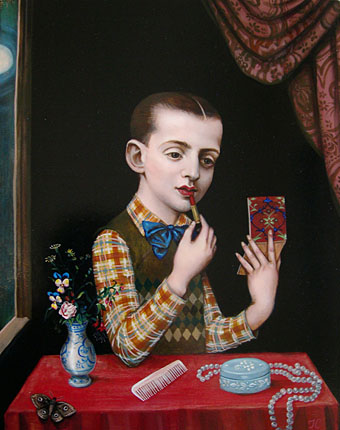
cummings.jpg

Prettiest Star (2004) by Timothy Cummings.

I Want Your Love, a feature film directed by Travis Mathews catches my attention for having been described as “the gay Shortbus” even though (as the director notes) Shortbus was pretty gay to begin with.

• I’ve always found Hans Christian Andersen’s story of The Tinderbox—a tale of spectral dogs with enormous eyes—to be rather weird. But these illustrations by Heinrich Strub for a 1956 edition beat everything.

• “From an early age, however, I became in secret the slave of certain appetites.” The line that Robert Louis Stevenson deleted from The Strange Case of Dr Jekyll and Mr Hyde.

Scientific American: Homophobes might be hidden homosexuals. Not exactly fresh news but always worth bearing in mind when someone starts ranting about those evil gays.

Minimal Wave: The 80s synth-pop underground. The Minimal Wave label releases a vinyl compilation by Hard Corps this month.

• “Blame the Victorians for making menswear boring.” Alex Jung on the endless tyranny of the suit-and-tie combination.

• Women, Vaginas and Blood: Breaking menstrual taboos with artist Sarah Maple.

London’s lost rivers (again): the hidden history of the city’s buried waterways.

Vincenzo Pacelli says the Knights of Malta murdered Caravaggio.

Street style 1906: Edward Linley Sambourne’s fashion blog.

Architectural Stationery Vignettes at BibliOdyssey.

Hans Bellmer & Unica Zürn at Ubu Gallery, NYC.

Pam Grossman admits to being a “candle hooch”.

Dirty (1986) by Hard Corps | Lost Rivers Of London (1996) by Coil | The Tinderbox (2009) by Patrick Wolf.
Frederic Leighton’s sculptures

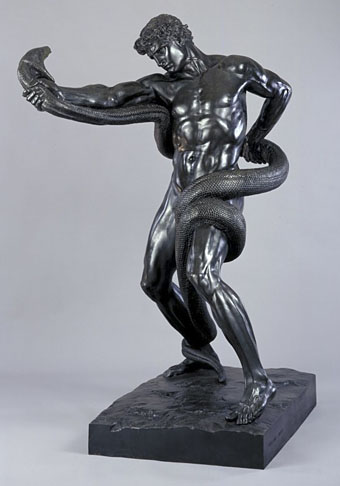
leighton1.jpg

An Athlete Wrestling with a Python (1877).

The python wrestler by Frederic Leighton (1830–1896) has appeared here before, and it’s one sculpture that always catches my eye for having appeared in my adaptation of The Call of Cthulhu in 1988. It’s now one of the Leighton works available for close viewing at the Google Art Project although only from a single angle, something that seems a flaw in web presentation of three-dimensional art.

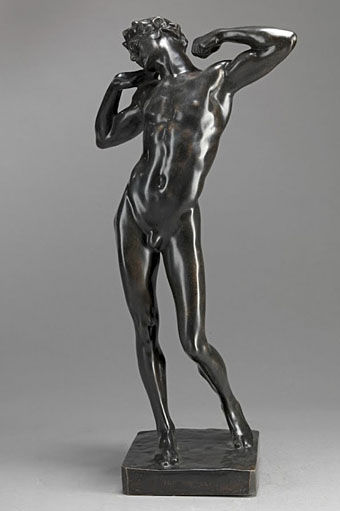
leighton2.jpg

The Sluggard (c. 1895).

In the same collection is a copy of Leighton’s The Sluggard from the Yale Center for British Art. What’s notable about this piece is that it’s generally offered as Exhibit A for the homo-prosecution during discussion of the artist’s sexuality. The Sluggard to which most people refer is the life-size bronze which is a lot more robust and muscular than this lithe and twinky specimen. According to a note at the V&A Yale’s copy is one of many cast from the clay model for the life-size version. What was excused at the time as a late Victorian exercise in contrapossto looks even more camp—in the Philip Core definition—than the finished piece which makes me wonder whether Leighton beefed up the original to disguise something. Core defined camp as “the lie that tells the truth”; camp art always pretends to be one thing whilst simultaneously telegraphing a very different message about its creator. Leighton’s sexuality is a source of continual speculation which means it’s unlikely now to be resolved in any direction, and the artist himself would loathe our prurience, but it’s only by reappraising works in this way that we’re able to show that gay people didn’t magically erupt via some process of spontaneous generation in 1967. If Leighton had any dalliances whilst holidaying in the gay resort of Capri then he was perfectly circumspect. Back at home, as a President of the Royal Academy he had a rather pompous and remote reputation, being memorably described by Violet Paget as “something between an Olympian Jove and a head waiter.” For more camp, see The Narcissus Hall in the artist’s incredibly lavish home, Leighton House in London, where 1st Baron Leighton, PRA, lived splendidly alone.

Previously on { feuilleton }
Angelo Colarossi and son
Men with snakes

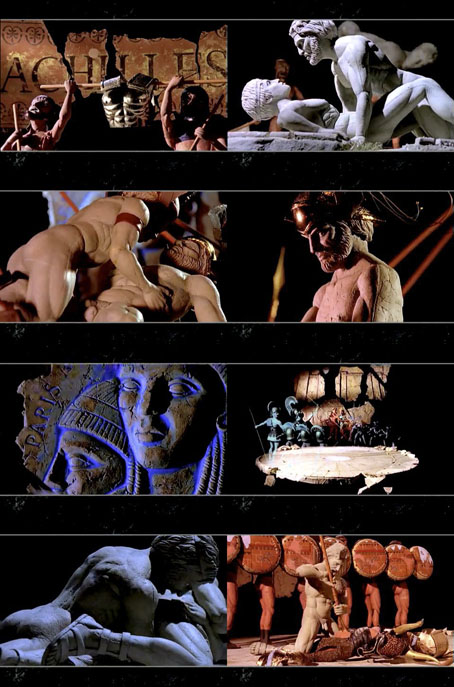
Achilles by Barry JC Purves

achilles.jpg

I wondered how to focus on the relationship between Achilles and Patroclus without the others getting in the way. This intense physical relationship developed into the focus of the film, rather than any more Harryhausenesque aspects of the Greek myths. Intimacy had not really been treated seriously with puppets…

Barry JC Purves

Several people seemed to appreciate the link a week or so ago to The Torchbearer by Václav Svankmajer so here’s another animated short about helmeted warriors, albeit with a very different tone. Barry JC Purves is a British animator and theatre director who produced Achilles, an 11-minute puppet animation, in 1995, back when the UK’s Channel 4 was still regularly financing animated films. Derek Jacobi narrates an exploration in the style of Ancient Greek theatre of the relationship between Achilles and his alleged lover, Patroclus. (Whether or not the pair were lovers is still a subject of dispute.) It’s rare to find any overt sexuality in the world of puppet animation unless the directors are the Brothers Quay; it’s even more rare for that sexuality to have a homoerotic aspect which is what Purves depicts. A groundbreaking piece of work, then, which can be viewed in full here. The director’s website has more about the creation of the film, and a collection of stills from the production.

Previously on { feuilleton }
The Torchbearer by Václav Švankmajer

Tamotsu Yato’s men with katanas

yato1.jpg

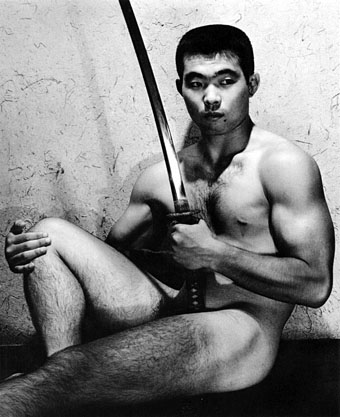
Unidentified model from Otoko (1972).

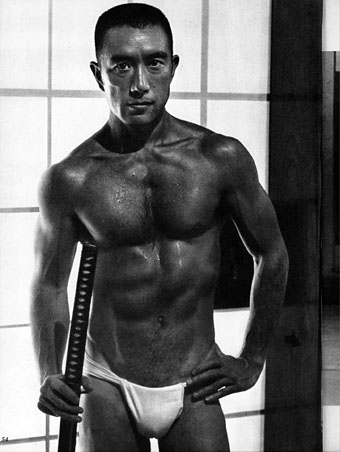
Two photos by Tamotsu Yato (c. 1928–1973), a pioneer of homoerotic photography in Japan who published his work in three collections: Young Samurai: Bodybuilders of Japan (1967), Naked festival: A Photo-Essay (1969), and Otoko: Photo-Studies of the Young Japanese Male (1972). Yukio Mishima introduced the first two volumes, and also appeared in the first posing with a sword. The third book was dedicated to Mishima’s memory. This site has a selection from each of the books while Richard Hawkins’ site has a fascinating overview of the photographer’s life and work. Via Form is Void.

yato2.jpg

Yukio Mishima from Young Samurai: Bodybuilders of Japan (1967).

Elsewhere on { feuilleton }
The men with swords archive

Previously on { feuilleton }
Forbidden Colours
Mishima’s Rite of Love and Death

Weekend links 102

flannery.jpg

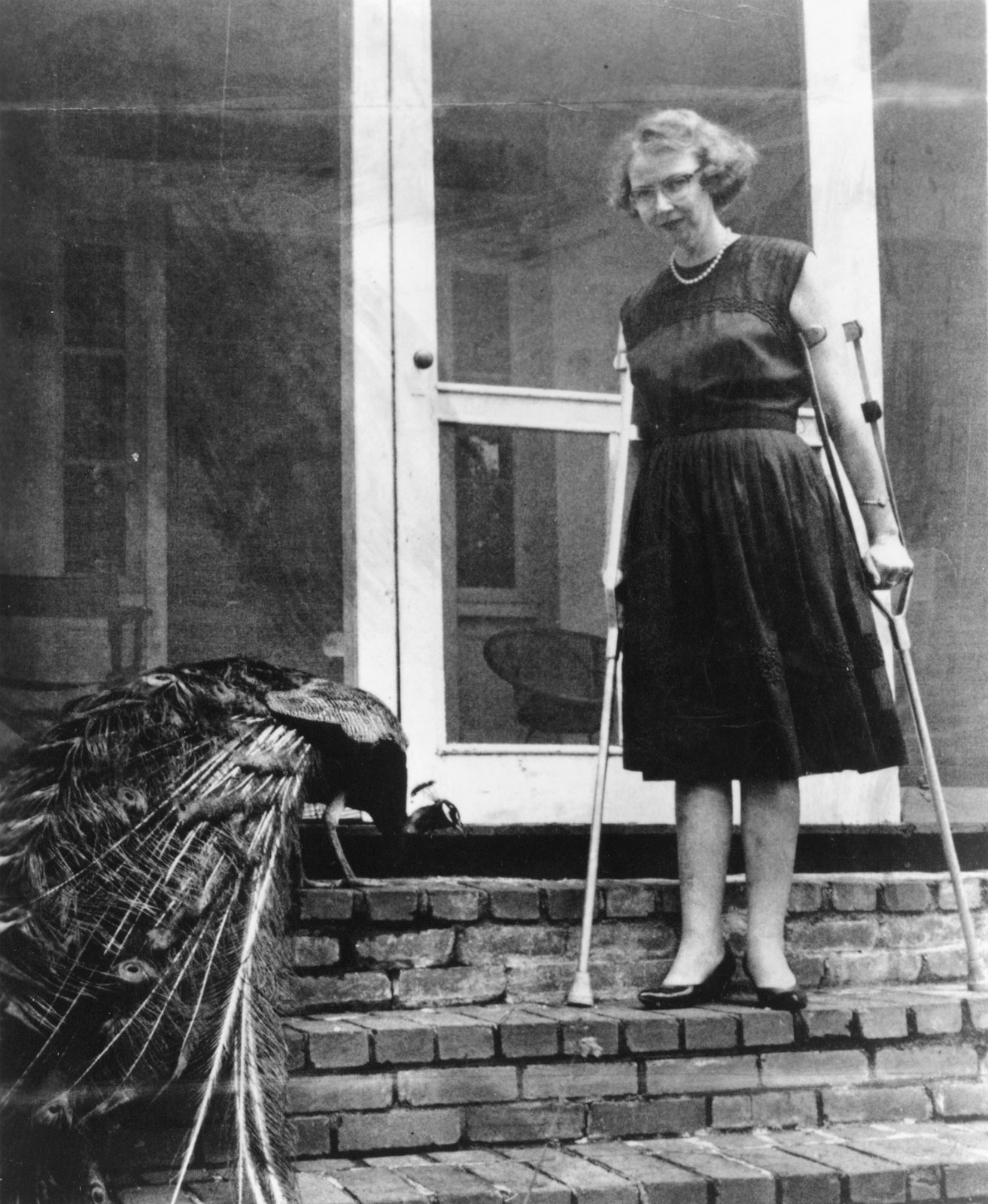
Flannery O’Connor with one of her many peacocks.

When the peacock has presented his back, the spectator will usually begin to walk around him to get a front view; but the peacock will continue to turn so that no front view is possible. The thing to do then is to stand still and wait until it pleases him to turn. When it suits him, the peacock will face you. Then you will see in a green-bronze arch around him a galaxy of gazing haloed suns. This is the moment when most people are silent.

Flannery O’Connor

Essay of the week was without a doubt Living with a Peacock by the great Flannery O’Connor, originally published in Holiday magazine in September 1961. I’d heard about Flannery’s peacocks before but had no idea she was such a pavonomane. Thanks to Jay for the tip!

• “‘He’s chameleon, comedian, Corinthian and caricature.’ But he was more like the very hungry caterpillar, munching his way through every musical influence he came across…” Thomas Jones reviews two new books about David Bowie for the LRB.

• In June Mute Records release The Lost Tapes by Can, a 3-CD collection. Here’s hoping this doesn’t merely repeat the outtakes that’ve been circulating for years as the Canobits bootlegs. This extract is certainly new.

• Animator Suzan Pitt, director of the remarkable Asparagus (1979), discusses her new film, Visitation, inspired, she says, by reading HP Lovecraft in a cabin while wolves howled outside.

Night Thoughts: The Surreal Life of the Poet David Gascoyne, a biography by Robert Fraser reviewed by Iain Sinclair.

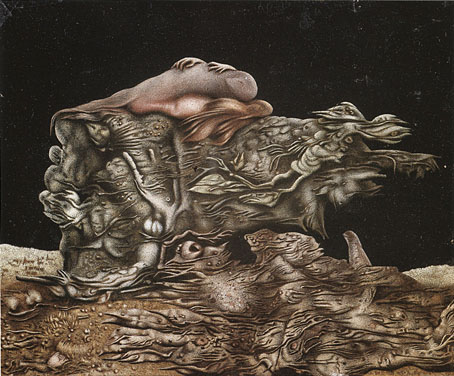
oelze.jpg

The Dangerous Desire (1936) by Richard Oelze (1900–1980) at But Does It Float.

• Making the Mari: the stuff of nightmares brought into the world by Jefferson Brassfield.

• The Background to the Moorcock Multiverse: Karin L. Kross reviews London Peculiar.

Orson Welles’s lost Heart of Darkness screenplay performed for the first time.

The Erotic Films of Peter de Rome: the new BFI DVD collection reviewed.

• Page designs by Alphonse Mucha for Ilsée, Princess de Tripoli (1897).

• A Slow-Books Manifesto by Maura Kelly.

Tim Parks asks “Do we need stories?”.

Musical table by Kyouei Design.

Horror Asparagus Stories (1966) by The Driving Stupid | Peacock Lady (1971) by Shelagh McDonald | Peacock Tail (2005) by Boards of Canada.