Weekend links 165

smart.jpg

Cahill Expressway (1962) by Jeffrey Smart whose death was announced this week.

• “Russell Beale is awed by the beauty of the Roman silver Warren Cup showing men and youths making love, so startlingly erotic that the first time the British Museum was offered it in the 1950s, it turned it down flat. In 1999, when it came on the market again, the museum had to raise £1.8m to acquire it. ‘It’s just heaven, isn’t it?’ Russell Beale sighs.” Maev Kennedy on Same-Sex Desire and Gender Identity, a new exhibition at the British Museum.

• “The route to Tyburn Tree snaked through Holborn and St Giles, then went along Tyburn Road, today’s Oxford Street. It was dense with spectators.” Matthew Beaumont on the tiny memorial (Google view) for the estimated 50,000 people executed in the centre of London.

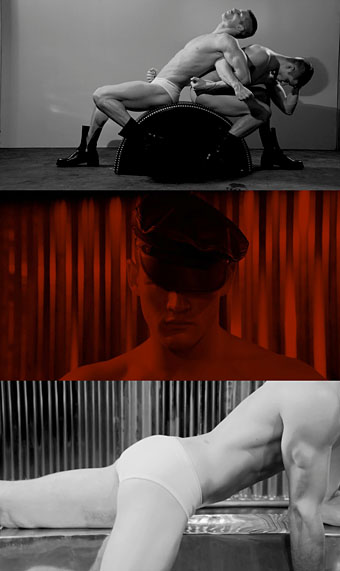
• Mixes of the Week: Bottoms Up by Staffan Lindberg for BUTT Magazine, and Electronic Ladyland, a collection of women with synths (and other instruments) from Bitch Media.

But the very thing that is valuable about diversity – the cultural and ideological clashes that it brings about – is precisely what many people fear. And that fear takes two forms. On the one hand you have the little Englander sentiment: immigration is undermining the national fabric, eroding our sense of British or Englishness, turning our cities into little Lahores or mini-Kingstons. And on the other you have the multicultural argument: that diversity is good, but it has to be policed to minimise the clashes and conflicts and frictions that diversity brings in its wake. And so we have to restrain speech, and police the giving of offence.

Kenan Malik on The Pleasures of Pluralism, The Pain of Offence.

L’Empire des Lumières is a great title for Anne Billson’s blog about Belgium. Tram-wire covered streets are one of my favourite things.

The Outer Church, 28 musical artists with an uncanny temperament collected by Joseph Stannard for Front & Follow.

His Heavy Heart, a film by Alan Moore & Mitch Jenkins, is looking for Kickstarter funding.

• In 1997 Quentin Crisp wrote about “Ten Wonderful Gangster Movies” for Neon magazine.

Raymond Chandler’s The Big Sleep redesigned for the Penguin Design Award, 2013.

• Out on DVD/Blu-Ray this month: The Curtis Harrington Short Film Collection.

A billion-pixel panoramic view of the planet Mars from the Curiosity Rover.

• In the TLS: Robert Craft on Stravinsky and The Rite of Spring.

Typophonic: Album cover typography.

The Owl Theremin is a thing.

LSD ABC

Spring Rounds From The Rite Of Spring (1975) by Alice Coltrane | Revenge Of The Black Regent (1999) by Add N To (X) | Sore Ga Afrirampo (2010) by Afrirampo

Stille Nacht V: Dog Door

dogdoor.jpg

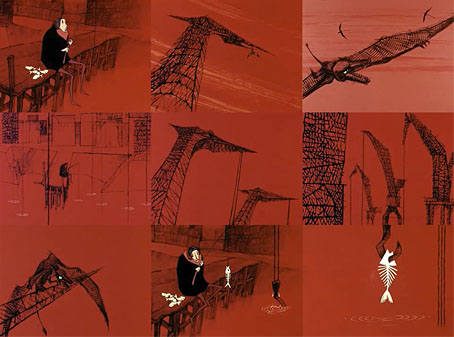
A short animation by the Brothers Quay which I evidently missed last year when I was searching for their uncollected works. As far as I’m aware this is the most recent addition to the Stille Nacht series, all of which were made to serve some function external to the films themselves: so Stille Nacht I was an MTV ident, II was a music video for His Name Is Alive, III was an extended trailer/preview for Institute Benjamenta, and IV was another music video for His Name Is Alive.

Number V in the series is another music video, this time for Sparklehorse’s Dog Door, a song from the group’s 2001 album It’s A Wonderful Life. Tom Waits is the guest vocalist providing his usual enigmatic wailing. The video was one of several commissioned to illustrate the album’s songs but the Quays still manage to make something that’s very much their own. As with the His Name Is Alive films there’s an atmosphere of polymorphous perversity via the two characters of a masturbating dog (or is it a fox?) and a recumbent doll, also masturbating. A slogan at the end states in French “You’re never too young for debauchery”. (In the earlier videos there was another doll and a toy rabbit.) Copies on YouTube are rough but for the moment it’s the only way you’ll see this one.

Elsewhere on { feuilleton }
The Quay Brothers archive

LightSpin

lightspin.jpg

After a week or so of posts looking back over a century of dance, this brings everything into the present. Eric Paré’s LightSpin used stop-motion photography and twenty-four cameras to capture half a million photos which were then edited into a short video. All of the lighting, which floats around the dancers, is done by hand. Core77 goes into the technical detail, and also has some astonishing jpeg loops from the same sessions.

Meetings with Remarkable Men

meetings1.jpg

Another Peter Brook film, and a very strange one it is, not for its content but more for the way you wonder how the director managed to get anyone to pay for it, and what kind of audience it was supposed to be aimed at. Meetings with Remarkable Men is a book by GI Gurdjieff which is supposedly an account of the mystic’s early life and youthful questing for truth, although there’s always been debate about how much of it was intended as straight autobiography and how much as symbolic instruction. I’ve known about Brook’s film since it was first released in 1979 but its resolutely uncommercial nature means it never had a wide cinema release, and I’ve never seen it listed for TV screening either.

meetings2.jpg

I’ve not read Gurdjieff’s book but know enough about the man’s life and general philosophies to at least appreciate Brook’s film. Many other viewers would have considerable problems when Brook and screenwriter Jeanne Salzmann make no attempt to elaborate on the details of Gurdjieff’s quest. From youthful worries about life and death, to a search for a secret brotherhood who may have preserved ancient philosophies, the film illustrates scenes in the sketchiest manner: old volumes are bought then discarded; a map is sought then forgotten; gurus are pursued only to be found unsatisfying. For a film about enlightenment it’s surprising to be left so unenlightened. Much of the film was shot on location in Afghanistan shortly before the Soviet invasion, and at times the film seems like a chase from one dusty location to another with little reason or purpose.

The most bizarre feature of all is the cast: Gurdjieff is portrayed by a Serbian actor, Dragan Maksimovic, but many of the other roles provide cameos for an array of British talent, not least Terence Stamp in between appearances as General Zod in the Superman films. Elsewhere there’s Warren Mitchell (!) playing Gurdjieff’s dad, Colin Blakely, Marius Goring, Ian Hogg (who was also in The Marat/Sade), and most surprising of all since I was watching him recently in Quatermass and the Pit, Andrew Keir as the head of the mysterious Sarmoung Monastery. The cast alone helps maintain some interest although at times it’s like one of those all-star features such as Around the World in Eighty Days where you’re wondering who’s going to turn up next. For those whose curiosity is piqued, the entire film is on YouTube.

Previously on { feuilleton }
The Marat/Sade

The Marat/Sade

maratsade1.jpg

The Marat/Sade (1967).

Good to find this Peter Brook film on YouTube (for the time being…) as I’d been watching Ian Richardson in a couple of things recently and wanted to remind myself of how he fares here. He’s excellent, of course, as the serious foil to Patrick Magee’s equally serious Marquis de Sade. Brook’s film is a recording of his stage presentation of Peter Weiss’s play, in which the two actors embody the poles of a dialogue about the perennially knotty problems of revolution, freedom, and the interests of the individual in the face of political abstractions. What fascinates most about this is the Brechtian nature of the drama: structured as a play-within-a-play (we’re watching the inmates of an asylum performing a fictional Sade drama), and with a proxy audience regarding the performance through iron bars, the staging is as far away from dry theorising as you can get. Brief moments of debate between Sade and the asylum inmate portraying Marat act as punctuations between scurrilous chorus songs and frequent scenes of outright chaos which erupt when the demands of performance become too much for the inmates. It’s loud, sardonic, cynical, and often riveting. One of the more miserable features of drama from the 1960s and 70s is the recurrence of ham-fisted political didacticism which, however well-intentioned, makes for a dismal viewing experience. Weiss’s play shows how well you can deliver political rhetoric when the staging doesn’t ignore the presence of a possibly sceptical audience who might also like to be entertained.

maratsade2.jpg

Peter Brook has had a peculiar career as a film director, most of his films being screen adaptations of his stage productions, or odd one-offs such as his documentary-like (and somewhat superfluous) film of Lord of the Flies, and the bizarre Meetings with Remarkable Men. (More about that later.) Brook’s Royal Shakespeare Company staging of the Weiss play was performed to great acclaim in 1965 so we’re fortunate that it’s captured so well here. The cast includes many first-rate actors, not only Richardson and Magee but Glenda Jackson as the inmate given the task of portraying Charlotte Corday, Michael Williams as the Herald, and (easy to miss among the clown-faced chorus) Freddie Jones. A low-grade YouTube copy does little for David Watkin’s superb photography which gives the film a very different look to other films of the 1960s. Studios films of the era tended to be horribly over-lit so it’s refreshing to find a film such as this using only the available light to illuminate the action. Searching around for DVDs reveals a single Spanish edition which I’m tempted to buy if I could be sure it was widescreen and with the English soundtrack intact. As for the play itself, the concerns may be typical of the period but many of the sentiments have lost none of their relevance. Highly recommended.

maratsade3.jpg