Weekend links 188

blackwell.jpg

The Baron in the Trees (2011), a book-cut sculpture by Su Blackwell.

Kurt Andersen at Vanity Fair examines the latest claims that Vermeer used a combination of lenses and mirrors to aid the creation of his remarkable paintings. David Hockney caused a considerable fuss in 2006 when he made similar assertions. Andersen recounts how Tim Jenison (who isn’t an artist) decided to test the hypothesis by building a replica of the room from Vermeer’s The Music Lesson (1662–65) which he then painted with the assistance of a lens-and-mirror apparatus. I’m agnostic on this issue, and don’t regard it as a devaluing of the work of Vermeer (or any other artist) if some special apparatus was used to help create the paintings; artists for centuries have been using whatever technology was available.

One point which isn’t mentioned in the article: lens optics were being developed to a high standard in the Netherlands during Vermeer’s time. One of the developers of the microscope, Antonie van Leeuwenhoek, was a contemporary of Vermeer’s in Delft, and is even alleged to be portrayed in some of the artist’s paintings.

• Before Alfred Hitchcock’s film and Daphne Du Maurier’s short story, The Birds was an “eerie yet satirical and rather metaphysical novel” by Frank Baker, inspired in part by Arthur Machen. Michael Dirda reviews a new edition. Related: “The Day of the Claw: A Synoptic Account of Alfred Hitchcock’s The Birds“, an essay by Ken Mogg examining avian menace through the ages.

Kevin Brownlow and Carl Davis on how they brought Abel Gance’s 270-minute silent masterwork, Napoleon (1927), back to the screen.

Finally, he was asked about the growth of surveillance and the militarization of the police.

“The phenomenon itself shouldn’t be surprising—the scale was surprising—but the phenomenon itself is as American as apple pie,” Chomsky said. “You can be confident that any system of power is going to use technology against its enemy: the population. Power systems seek short-term domination and control, not security.”

Matthew Robare on “American Anarchist” Noam Chomsky in (of all places) The American Conservative.

• “Why the hell wouldn’t I?” Evan J. Peterson on reading/performing his poetry in public, and his new book, The Midnight Channel.

The adversaria of Google Books: captured mark of the hand and digitization as rephotography.

• No surprise that the rabies-haunted town of Scarfolk is soon to have its history fixed in print.

Mazzy Star made a rare TV appearance last week, playing a song from their recent album.

The Sorcerer Blog is obsessively devoted to William Friedkin’s cult film.

• Unexpected Artefacts: Pushing the envelope with Bristol’s Emptyset.

• Mix of the week: Secret Thirteen Mix 097 by Lee Gamble.

• At PingMag: Ryokudo—Tokyo’s Green Roads.

Norman Records’ Top 50 albums of 2013.

Birds Of Fire (1973) by Mahavishnu Orchestra | Attack Of The Killer Birds (2006) by Émilie Simon | One Thousand Birds (2012) by Six Organs of Admittance
Dunsany’s highwaymen

pledge.jpg

The Pledge.

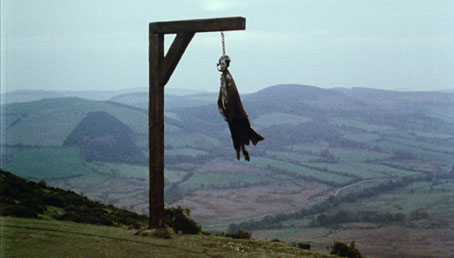
As mentioned last week, the BFI’s DVD of Schalcken the Painter includes as extras two short films by other directors. Edward Abraham’s The Pit (1962) is an adaptation of Poe’s The Pit and the Pendulum which is creditable but lacks the sustained malevolence of Jan Švankmajer’s version. The second film is The Pledge (1981), a 21-minute adaptation by Digby Rumsey of The Highwaymen, a short story by Lord Dunsany. This is unusual for being one of the very few film adaptations of Dunsany, Rumsey being responsible for two others: Nature and Time (1976), and In the Twilight (1978). Since this is a low-budget work it’s no surprise that the story is a historical piece rather than one of the florid fantasies so beloved of HP Lovecraft. A trio of highwaymen decide to rescue the hanging body of their former comrade and inter it in a bishop’s tomb. (The bishop’s bones, they decide, can go in the earth.) The story is so slight it’s more of a curio than anything, and would probably be better seen along with with the other Dunsany adaptations. Of note is a typically jaunty score by Michael Nyman, while Nyman’s later collaborator, Peter Greenaway, assisted with the editing. If nothing else, Greenaway would have appreciated the film’s macabre nature.

sime.jpg

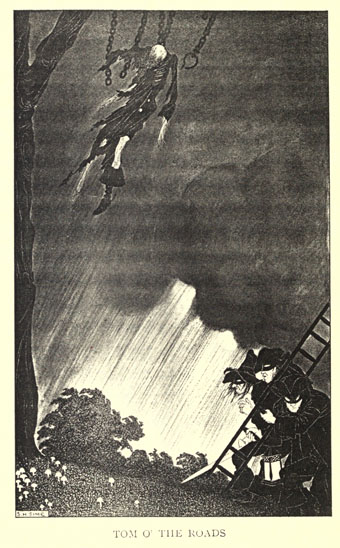
Illustration for The Highwaymen by Sidney Sime.

The original story appeared in Dunsany’s 1908 collection The Sword of Welleran and Other Stories. The Internet Archive has a scan of the entire book with illustrations from Sidney Sime’s prime period. The depiction of the scene at the gibbet is a lot more atmospheric than in the film but then that’s the advantage of the illustrator: there’s no need to worry about a budget.

Previously on { feuilleton }
Schalcken the Painter revisited
The Pendulum, the Pit and Hope
Sidney Sime paintings
Haschisch Hallucinations by HE Gowers
Sidney Sime and Lord Dunsany

Weekend links 187

delia.jpg

Delia Derbyshire (2007) by Iker Spozio.

Whatever you think of Doctor Who, Delia Derbyshire’s recording of Ron Grainer’s theme tune is a landmark piece of electronic music. Those glassy electronic tones still sound unique today, not least for their having been created using rudimentary oscillators and much laborious tape editing. In Radiophonic Workshop: the shadowy pioneers of electronic sound, Joe Muggs looks at the history of the BBC’s electronic composers. If you’re a Radiophonic-head then the Alchemists of Sound TV documentary from 2003 is essential viewing.

There’s more (there’s always more): Delia Derbyshire – Sculptress of Sound: part one of a seven-part radio documentary about the great electronic music composer, and Blue Veils and Golden Sands, Martyn Wade’s radio play about Delia. Related: Delia-Derbyshire.org, Delia Derbyshire: An audiological chronology and A History of the Doctor Who theme. And don’t miss: Silence Is Requested In The Ultimate Abyss (1969) by Welfare State and White Noise, an incredible slice of electro-psychedelia from the John Peel Presents Top Gear album.

• “Why don’t books for grown-ups have illustrations any more?” asks Christopher Howse. Some of them do, this past week I’ve been finishing a new series of illustrations for a story anthology.

• From 2006: Ian Penman on cigarettes, espionage, and the masterful (and superior) television adaptation of Tinker, Tailor, Soldier, Spy.

It was Malcolm [McLaren] who suggested that the main characters be a boy who looks like a girl who looks like a boy and vice versa. What was strange was that, actually, in 1985 this was nobody’s vision of the fashion industry. Since then, fashion and fascism have crept closer: you’ve got John Galliano doing his promotional bits for the Third Reich, you’ve got Alexander McQueen killing himself, you’ve got Versace and that horrible, violent stalker coming for him. Since it was written, almost all of it has come true apart from the nuclear winter, but I think we’re working on that. The actual society that the story happens in is much more like the society we have now than culture was in 1985.

Alan Moore on Fashion Beast, Situationism, and why he hates superheroes.

• KW Jeter talks about his latest novel, Fiendish Schemes, and the “cultural juggernaut” that is steampunk.

• Grit and Social Dynamics in Smoke Ghost: Elwin Cotman on the weird fiction of Fritz Leiber.

The Secret Lives of the Vatican’s Gay Cardinals, Monks, and Other Clergy Members.

Don Cherry & Organic Music Theatre, live in the RAI TV studios, 1976.

• Otherworldly Art and Photography: Mlle Ghoul finds the best things.

• From 1998: Rahma Khazam on composer Bernard Parmegiani.

• Mix of the week: Marshland: The Mix by Hackneymarshman.

• “Let’s colonize the clouds of Venus,” says Ian Steadman.

J. Hoberman on David Cronenberg’s Visual Shock.

The Delian Mode (1968) by Delia Derbyshire | Tom Baker (1981) by The Human League | Doctor Who? (1984) by Doctor Pablo & The Dub Syndicate

L’Araignéléphant

kamler.jpg

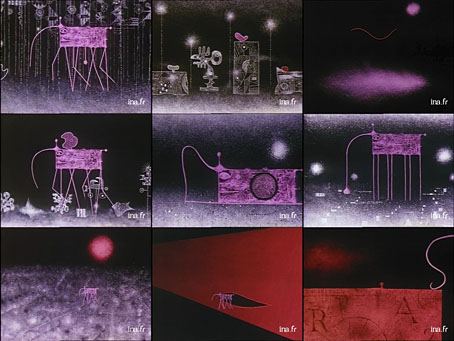
L’Araignéléphant (1967) is another of the strange animations made by Piotr Kamler in the 1960s and 1970s, this one being a 9-minute piece concerning the travails of “the spiderelephant”. As with Kamler’s Le labyrinthe, the music is by the French electroacoustic composer Bernard Parmegiani whose death was announced this week, hence the link. Parmegiani had a varied career which included scores for a number of other films (among them a Jan Lenica short, A, which I’ve not been able to find), and more commercial music than people at his serious end of the composition scale usually produce.

Ubuweb has a selection of Parmegiani’s longer compositions, one of which, Pop’eclectic (1969–1973), chops up pop and classical recordings (spot the Small Faces!) in a manner which would become commonplace a decade or so later with the advent of sampling. The Kamler films, meanwhile, are all available on a single DVD where the narration for L’Araignéléphant—which doesn’t explain very much—is subtitled.

Previously on { feuilleton }
Psyché Rock
Le labyrinthe and Coeur de secours
Chronopolis by Piotr Kamler

Jackpot by Adam Baran

jackpot.jpg

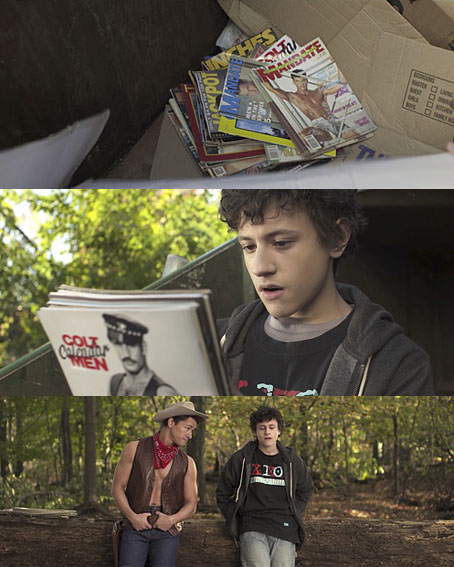
Jackpot is a 10-minute film by Adam Baran about a gay teen in 1994 who goes looking for a stash of abandoned gay porn mags. Baran says:

I really made the film because I loved teen movies and never really saw one for gay kids that both addressed their sexuality in the way that straight movies like Weird Science or American Pie or Superbad did, and let them get what they want. Jack in my film learns that he has to fight back for what he wants, even if it means he has to take a couple of licks. I think that’s a resonant message for gay kids everywhere.

I mentioned the Kickstarter completion bid for this a couple of years ago then promptly forgot about it so it’s good to find that the film got made, and won Best Short at the 2013 Miami Gay and Lesbian Film Festival. The whole thing can now be watched on Vimeo where Baran is trying to raise money to expand Jackpot into a feature. Via Towleroad.