Flowers: A Pantomime for Jean Genet

flowers.jpg

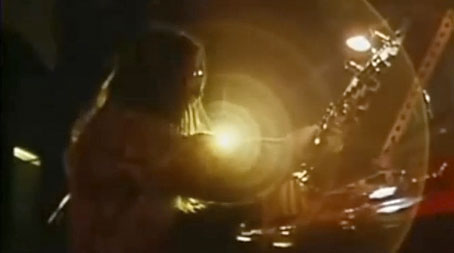
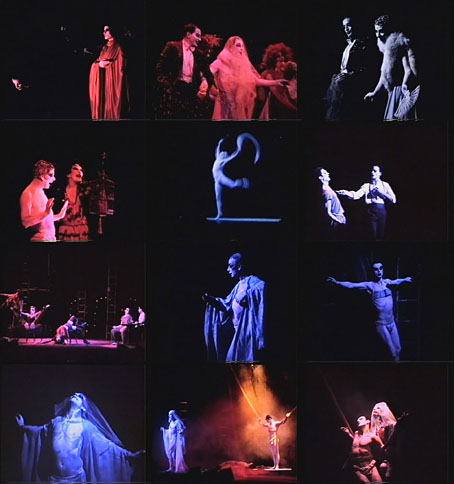
Flowers (1986) by the Lindsay Kemp Company. Photos by Maya Cusell.

Weidmann appeared before you in a five o’clock edition, his head swathed in white bands, a nun and yet a wounded pilot fallen into the rye one September day like the day when the world came to know the name of Our Lady of the Flowers. His handsome face, multiplied by the presses, swept down upon Paris and all of France, to the depths of the most out-of-the-way villages, in castles and cabins, revealing to the mirthless bourgeois that their daily lives are grazed by enchanting murderers, cunningly elevated to their sleep, which they will cross by some back stairway that has abetted them by not creaking. Beneath his picture burst the dawn of his crimes: murder one, murder two, murder three, up to six, bespeaking his secret glory and preparing his future glory.

A little earlier, the Negro Angel Sun had killed his mistress.

A little later, the soldier Maurice Pilorge killed his lover, Escudero, to rob him of something under a thousand francs, then, for his twentieth birthday, they cut off his head while, you will recall, he thumbed his nose at the enraged executioner.

Finally, a young ensign, still a child, committed treason for treason’s sake: he was shot. And it is in honour of their crimes that I am writing my book.

(Our Lady of the Flowers by Jean Genet. Translation by Bernard Frechtman, 1963)

Lindsay Kemp’s all-male version of Oscar Wilde’s Salomé has been the subject of several earlier posts, a production staged in the mid-70s with Kemp himself playing the part of Wilde’s femme fatale. Kemp’s company produced a related work in 1974, Flowers: A Pantomime for Jean Genet, a stage adaptation of Genet’s first novel, Our Lady of the Flowers (1942), in which Kemp played the part of drag queen Divine. Wilde and Genet aren’t so far removed from each other artistically although I can’t imagine them getting on in person. Both men were prisoners, of course, and Our Lady of the Flowers was famously written in prison, the first copy being discovered by a warder and destroyed. There’s a more direct connection in Fassbinder’s Querelle during the scenes where Lysiane (Jeanne Moreau) sings “Each man kills the thing he loves”, the most famous line from Wilde’s The Ballad of Reading Gaol which refers to (among other things) one of Genet’s obsessions: the prisoner condemned to death. Wilde would no doubt appreciate Genet’s poetic reimagining of his fellow prisoners, and his use of flowers as symbols; what Genet would have made of Lindsay Kemp’s typically extravagant and rather camp stage creation is anyone’s guess. He did write several plays but in later years evaded questions about them or his novels by claiming to have forgotten all his works. By the 1970s Genet was much more interested in the political struggles of the Black Panthers and the Palestinians.

Much as I like Wilde’s play, given the choice I think I’d prefer to see the Genet staging. Salomé is familiar enough from various stage and film adaptations whereas Flowers was unique. There is a video record of the latter from 1982 but the copy uploaded by Lindsay Kemp has had its soundtrack removed following the usual annoying copyright complaints about the music. So there’s the frustrating choice of watching the whole thing with no sound or watching this 28-minute video compilation of still photos by Maya Cusell from a 1986 performance with music that may be the original live score. One thing the photos show is how close in appearance is Kemp’s Divine to his dancer at the beginning of Derek Jarman’s Sebastiane (1976). In 2012 Kemp talked to Paul Gallagher about his film and stage career, Flowers included.

Update: As noted by radioShirley below, there is a copy of the 1982 performance with full soundtrack!

Previously on { feuilleton }
Querelle de Brest
Jean Genet, 1981
Un Chant d’Amour (nouveau)
Jean Genet… ‘The Courtesy of Objects’
Querelle again
Saint Genet
Emil Cadoo
Exterface
Penguin Labyrinths and the Thief’s Journal
Un Chant D’Amour by Jean Genet
Querelle de Brest

querelle01.jpg

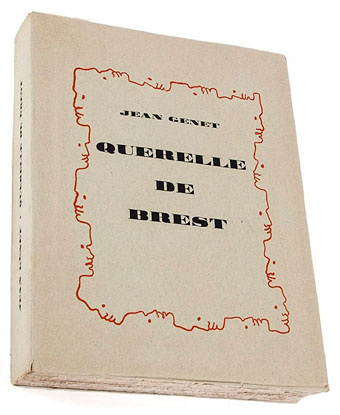
Querelle de Brest (1947) by Jean Genet. Cover design by Jean Cocteau.

This weekend’s viewing was Fassbinder’s Querelle (1982) which is marvellous in its new Blu-ray transfer, and a great improvement on the muddy picture of the earlier DVD release. The film is still only the briefest sketch of Genet’s novel (although Genet biographer Edmund White enjoyed it) but I like the overheated atmosphere, the phallic set designs, Franco Nero (hey, it’s Django Gay!), and the film as a whole is a fitting memorial to Brad Davis, everyone’s favourite sweating matelot. So in honour of all that, here’s a small collection of Querellerie past and present.

querelle02.jpg

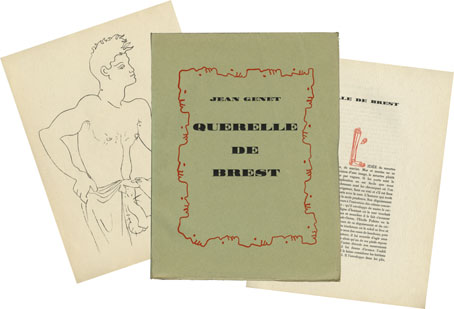
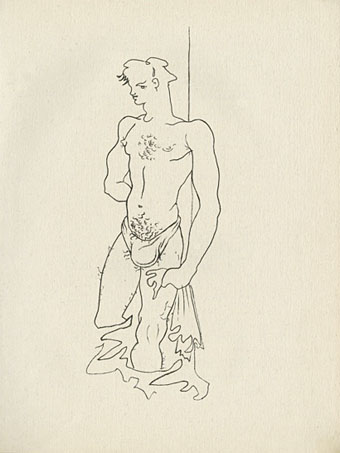
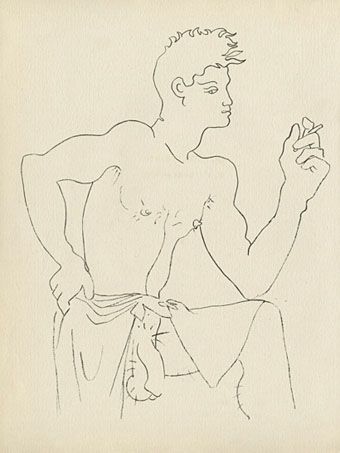
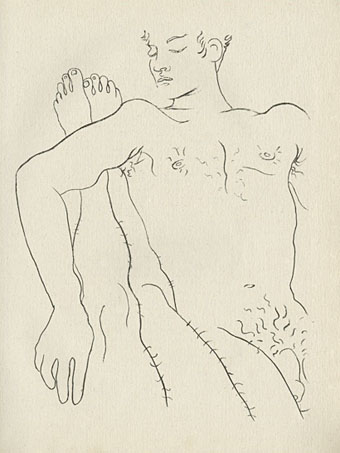
Querelle de Brest was published in a limited edition of 525 copies illustrated throughout by Jean Cocteau who didn’t avoid the pornographic details. Even though copies were seized by the authorities, and the author fined, Cocteau’s involvement did little to harm his public reputation, something that’s impossible to imagine happening elsewhere. A few of the illustrations follow below, many more of the series can be found scattered across various websites.

cocteau1.jpg

cocteau2.jpg

cocteau3.jpg

Continue reading “Querelle de Brest”

Dick Smith, 1922–2014

smith1.jpg

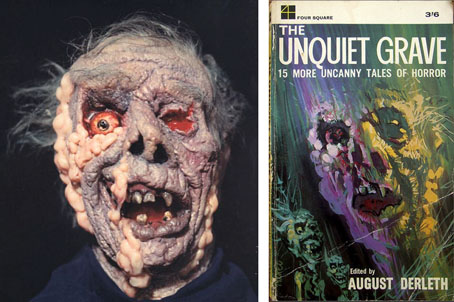
left: Dummy head by Dick Smith for The Picture of Dorian Gray (1961); right: Cover art by Michel Atkinson (aka Michel) for The Unquiet Grave (1963).

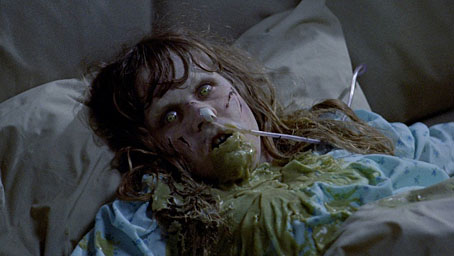
Cinema in the 1970s would have been very different without Dick Smith‘s makeup artistry.

smith2.jpg

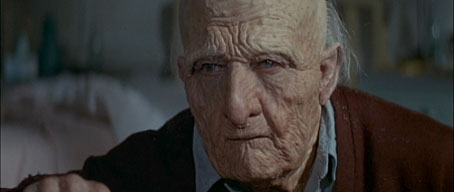
Dustin Hoffman in Little Big Man (1970).

smith3.jpg

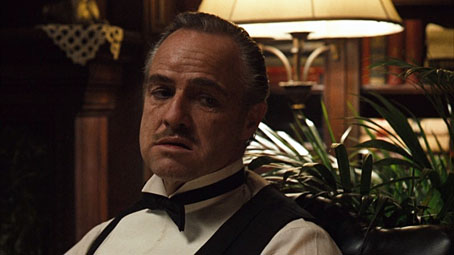
Marlon Brando in The Godfather (1972).

smith4.jpg

Linda Blair in The Exorcist (1973).

Continue reading “Dick Smith, 1922–2014”

Synthesizing

synths1.jpg

Tangerine Dream’s Chris Franke, 1973.

Following yesterday’s post, more synth-mania with an emphasis on the Analogue Seventies. YouTube is laden with this stuff but the best things often take some searching out.

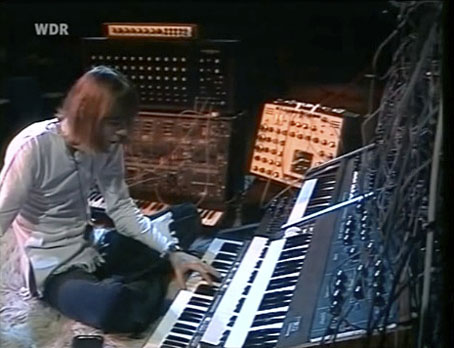
Tangerine Dream, Paris, 1973
This is one I’d not seen before, Tangerine Dream when they were still in their Krautrock phase prior to signing to Virgin. The music sounds like outtakes from the Atem album, and as usual with these films it’s great to see what instruments are being used.

synths2.jpg

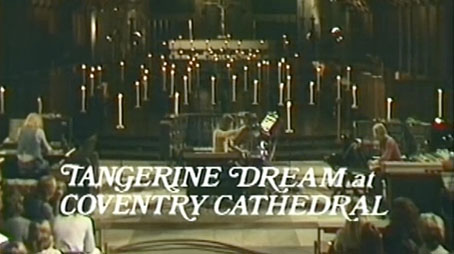
Tangerine Dream at Coventry Cathedral, 1975
Baumann, Franke and Froese again performing one of their cathedral concerts. Tony Palmer directed this but the sound was lost so the 27-minute film has edits of the Ricochet album as the soundtrack. (See Voices in the Net.) Ricochet was compiled from live recordings from the same period so it’s not so inappropriate.

synths3.jpg

Klaus Schulze, 1977
Klaus Schulze played drums on the first Tangerine Dream album, Electronic Meditation (1970), but was never an official member of the group. This lengthy improvisation is typical of the swathes of beatless music he was producing for much of the 1970s.

synths6.jpg

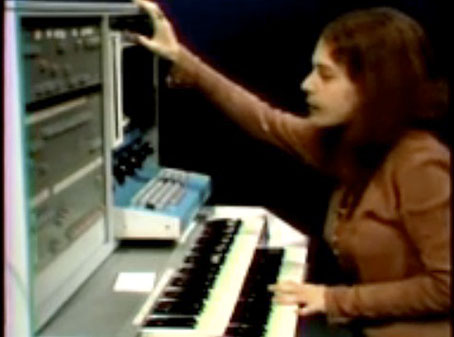
Laurie Spiegel, 1977
Laurie Spiegel demonstrates one of the earliest digital synthesizers. Spiegel’s 1980 album, The Expanding Universe, was reissued in 2012, and is well worth seeking out. There’s more rare analogue and digital synthesis on her YouTube channel.

synths4.jpg

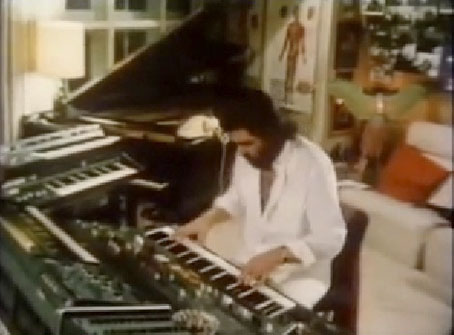
Vangelis, 1978
Vangelis in the studio recording the China (1979) album. If you can overlook the Chinoiserie clichés there’s some very good music on this release, some of which looks forward to the Blade Runner soundtrack.

synths7.jpg

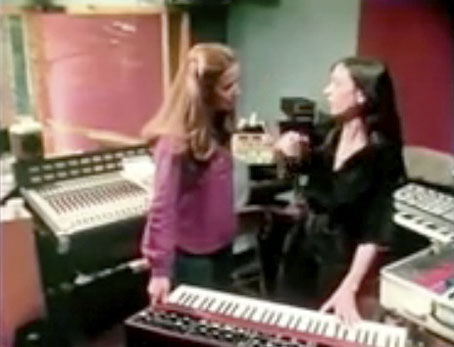
3-2-1 Contact, 1980
A great little film with Suzanne Ciani demonstrating synthesizers for a show on the Children’s Television Workshop. Featuring an oscilloscope and a Prophet 5.

synths5.jpg

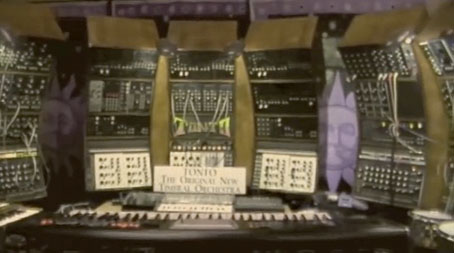
The Original New Timbral Orchestra
Malcolm Cecil and Robert Margouleff made their name as Tonto’s Expanding Head Band, “Tonto” being Cecil’s custom-built TONTO (The Original New Timbral Orchestra) synthesizer. Cecil shows off his analogue gear in this short film.

Previously on { feuilleton }
Tangerine Dream in Poland
Electronic Music Review
Tonto’s expanding frog men
A Clockwork Orange: The Complete Original Score
White Noise: Electric Storms, Radiophonics and the Delian Mode

Afore Night Come by David Rudkin

rudkin.jpg

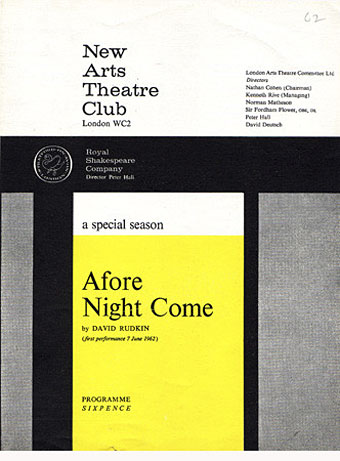
RSC programme, 1962.

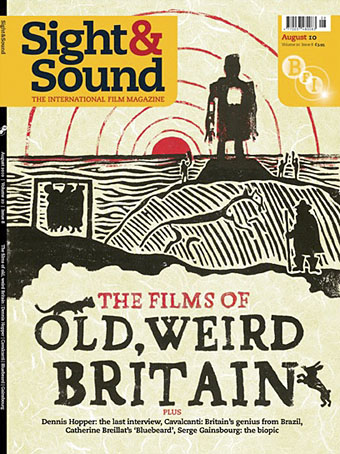
Not a review, this, you can’t really review a stage play you’ve never seen. Following the re-viewing of David Rudkin’s White Lady I’ve gone back to some of the published plays. If all you know of Rudkin’s work is his television drama, the plays are instructive for showing the consistency of his themes across the years. The recent resurgence of interest in Penda’s Fen and Artemis 81 has seen Rudkin’s work included among that group of film and TV dramas that Rob Young memorably labelled Old Weird Britain (after Greil Marcus and The Old, Weird America), a loose affiliate that would include films such as The Wicker Man and Blood on Satan’s Claw, television works by Nigel Kneale and Alan Garner (The Owl Service, Red Shift), and the BBC MR James adaptations, one of which, The Ash Tree, was also written by Rudkin.

If the Old Weird Britain lies at an intersection between different dramatic forms—ghost story, horror story, science fiction, historical drama—then not all of Rudkin’s work would fall into the intersection, but two of the plays—The Sons of Light and his first staged work, Afore Night Come—could be coaxed into the charmed circle: The Sons of Light, with its sinister human experiments taking place underground, has ties to Artemis 81, while Afore Night Come is another piece about (intentional or otherwise) human sacrifice in rural England. I hadn’t read Afore Night Come until last week, and was struck by its similarity to John Bowen’s Robin Redbreast (1970), a more deliberately ritualistic piece of work. In its first act Afore Night Come is an almost documentary-like account of a day in the life of workers hired to pick the pear harvest in an orchard outside Birmingham; the eruption of violence in the second act is certainly foreshadowed but seems less premeditated than in Robin Redbreast, a factor which has apparently shocked many audiences. During its performances in the early 1960s the tendency was to see the play in the light of Harold Pinter and Artaud’s Theatre of Cruelty, it’s only in retrospect that a connection with more generic works emerges. There’s also a connection to White Lady via the pesticide spraying about which the workers are continually warned, and whose advent coincides with the moments of violence.

oldweird.jpg

Sight and Sound, August 2010. Illustration by Becca Thorne.

A couple of other things are worth noting: until 1968 all the plays performed in Britain were vetted by the Lord Chamberlain’s office who would routinely strike out any material deemed offensive or irreligious. Knowing this I was surprised by the recurrence of the word “fuck” in Rudkin’s script, and also the hint of same-sex attraction between two of the male characters, a detail that would usually have been removed. It seems that plays pre-1968 could be performed without censorship if the theatre was declared to be a private club for the evening (a similar state of affairs helped evade some film censorship) which is what happened with Afore Night Come in 1962. Given this, and the incident of a decapitated head being rolled across a London stage (probably the first since the Jacobeans, says Rudkin), it’s easy to see why audiences at the time might have felt assaulted, although the play still won the Evening Standard Drama Award that year. Sexual ambiguity/ambivalence or outright homosexuality have been a continual thread in Rudkin’s drama yet he’s seldom been given much credit for this pioneering work. A year after Afore Night Come there was Rudkin’s first play for television, The Stone Dance, a piece which sounds like another potential addition to the works in the Old Weird Britain catalogue. Rudkin describes it thus:

A Revivalist pastor pitches his crusade tent within a Cornish stone circle. His repressed son becomes sexually obsessed with an outward-going local boy, and suffers a hysterical loss of speech. A storm blows the pastor’s tent away, and amid the stones, their primal purity reasserted, by the boy’s accepting touch the son is healed.

I believe that, prior to this, no tv play had overtly treated homosexual emotions as a central theme. (In Britain at this time, any gay sex could incur a prison sentence of up to two years.)

Many of the TV plays from the 1960s are now lost so there’s no guarantee that we’ll ever see this, a shame considering that Michael Hordern and John Hurt were the leads. No guarantee either that we’ll see any staging of the more interesting plays like The Sons of Light and The Triumph of Death which seem to be too eccentric for theatre directors. The scripts can at least be picked up relatively cheaply. To date there’s only Afore Night Come that seems to be revived with any regularity. Michael Billington, a long-time champion of Rudkin, reviews the Young Vic production from 2001 here.

Previously on { feuilleton }
White Lady by David Rudkin
The Horror Fields
Robin Redbreast by John Bowen
Red Shift by Alan Garner
Children of the Stones
Penda’s Fen by David Rudkin
David Rudkin on Carl Dreyer’s Vampyr