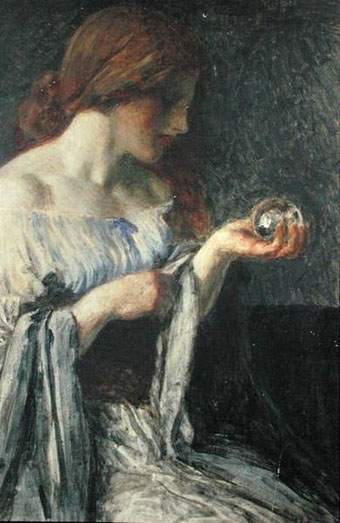
The Crystal Ball (c. 1900) by Robert Anning Bell.
Crystal balls in art, film and the pulp magazines.
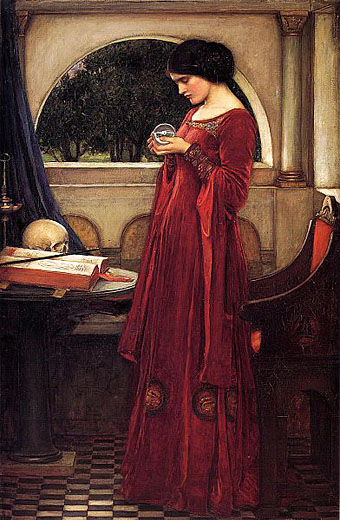
The Crystal Ball (1902) by John William Waterhouse.
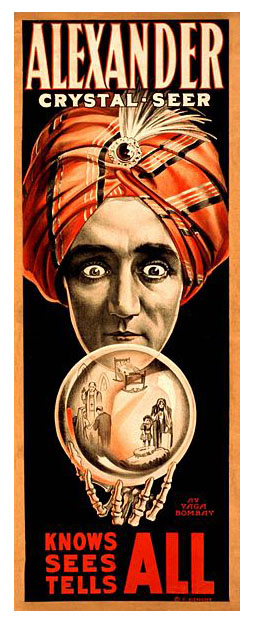
Alexander, Crystal Seer (1910).
A journal by artist and designer John Coulthart.

Film
The Crystal Ball (c. 1900) by Robert Anning Bell.
Crystal balls in art, film and the pulp magazines.
The Crystal Ball (1902) by John William Waterhouse.
Alexander, Crystal Seer (1910).
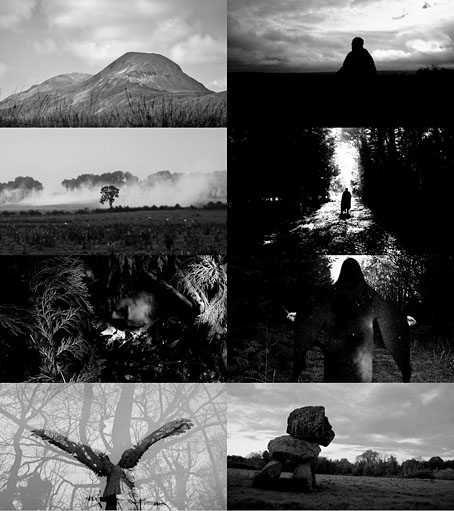
When Dave Colohan was in touch late last year he mentioned work on a new film which is now available for viewing at Vimeo. A Darkness Made of Beating Wings is another meditation on the sombre beauties of the Irish landscape (with additional shots of the Inner Hebrides) only this time there’s more textual substance in the figure portrayed by Ciarán MacAoidh, a traveller caught between the Celtic past and present, shadowed all the while by a spectral figure. Deliciously atmospheric work once again, with monochrome photography by Mick Carey.
Given all the Celtic business, I thought the hills seen at the beginning might be the Paps of Anu in Kilarney but searching revealed that they’re a different set of breast-shaped hills, the Paps of Jura in the Hebrides, which I’d not heard of before. The isle of Jura produces one of my favourite brands of malt whisky so this adds an additional note of approval.
Previously on { feuilleton }
• Newlyborn, a film by Dave Colohan
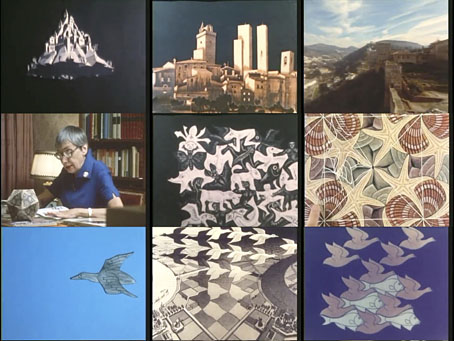
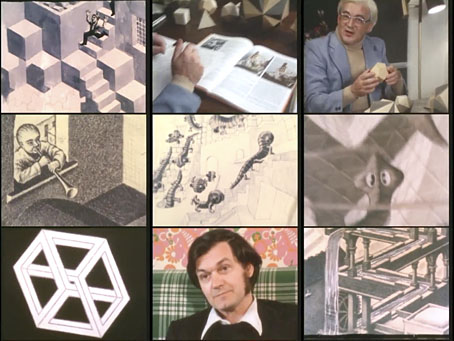
An Italian documentary about the Dutch artist made in 1980 and directed by Michele Emmer. I don’t recall ever seeing a British TV documentary about Escher (although I’d be surprised if there were none) but this resembles the type of thing the BBC used to do so well. Shots of the Italian towns where Escher lived for many years show the influence of the vernacular architecture on Escher’s prints. Elsewhere, animated sequences bring to life his tessellations, while various mathematicians examine some of the structural principles at work in these very familiar images. Of greatest interest for me is mathematician and physicist Roger Penrose discussing his first encounter with Escher’s work, and the development with his father of the Penrose Triangle, an impossible object similar to those that appear in some of Escher’s prints. (I used a Penrose Triangle in my cover art for Zones by Hawkwind.) The Fantastic World of MC Escher runs for 50 minutes, and may be watched here.
Previously on { feuilleton }
• MC Escher album covers
• Escher and Schrofer
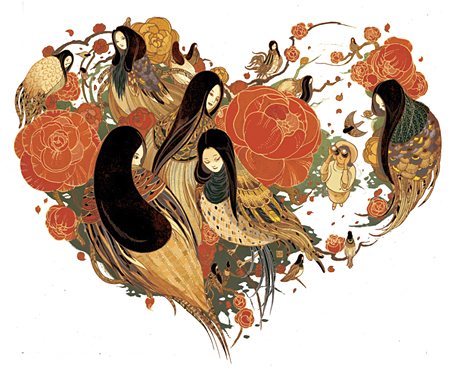
Love Hunter by Victo Ngai.
• “The strangeness of the lyric style, the misuse of words and awkward phraseology that have been criticized even by Poe’s fervent admirers, are here taken as virtues, heightening as they do, a given poem’s conscious and calculated formalism.” Marjorie Perloff reviews The Poet Edgar Allan Poe: Alien Angel by Jerome McGann.
• Mix of the week: Secret Thirteen Mix by Jeremy Kolosine. Starting with Michael Rother is apt when I’ve spent the past week in a Cluster/Harmonia/Kraftwerk/La Düsseldorf/Neu!/Rother loop.
• Court records “suggest that the supposedly prudish Victorians had a far more relaxed attitude to sex between men than their 1960s counterparts”. Historian Jeff Evans has the data.
• “Part of HP Lovecraft’s acknowledged debt to Machen also lies in hearing without seeing.” London Sound Survey on Arthur Machen’s “sounds from beyond the veil”.
• “…pity the designer who has to enact the stage direction that instructs rats to carry away a character’s feet.” Andrew Dickson on the extreme theatre of Sarah Kane.
• Psychedelic collage artist Wilfried Sätty receives a mention in Carey Dunne‘s piece about how LSD helped shape California’s ecstatic design legacy.
• More psychedelia: The Psychedelic Sex Book by Eric Gotland & Paul Krassner, edited by Dian Hanson.
• At Dangerous Minds: Robert Fripp demonstrates Frippertronics on The Midnight Special, 1979.
• Dreams from a Glass House: artist Josiah McElheny on the glass architecture of Paul Scheerbart.
• Director Peter Strickland on six films that fed into The Duke of Burgundy.
• The Zero Of The Signified (1980) by Robert Fripp | Heptaparaparshinokh (1981) by Robert Fripp & The League of Gentlemen | 1984 (1981) by Robert Fripp
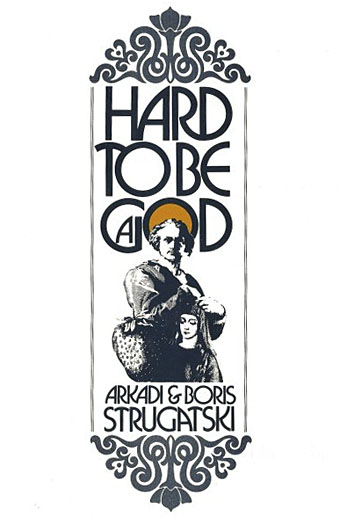
First English-language edition of Hard to Be a God, 1973. Cover design by Alan Peckolick.
A group of scientists is sent to the planet Arkanar to help the local civilization, which is in the Medieval phase of its own history, to find the right path to progress. Their task is a difficult one: they cannot interfere violently and in no case can they kill. The scientist Rumata tries to save the local intellectuals from their punishment and cannot avoid taking a position. As if the question were: what would you do in God’s place?
Hard to Be a God is a 170-minute Russian science-fiction film based on a novel by Arkady & Boris Strugatsky, the authors of Roadside Picnic. The film was the magnum opus of director Aleksey German (1938–2013) who died shortly before post-production was complete. German’s wife and son finished the film.
“…the wonder about this exhausting, astonishing film is not that it took so long to make, it’s that it got made at all,” says Gabriel Winslow-Yost; “one of the most consistently disgusting films ever made,” says Glenn Kenny, “…not only an unforgettable individual masterpiece but probably one of the capital-G Great Films.”; “There are no bones to be made about it, Hard to Be a God is a modern masterpiece,” says Matt Thrift.
This pushes all of my cinematic buttons, of course, so now I’m itching to see it. YouTube has trailers, and (if you must) you can also find the entire film without subtitles. I’d rather wait for a disc version. Meanwhile, Chicago Review Press have republished the novel with a new translation by Olena Blumberg and a foreword by Hari Kunzru.
• At the Guardian John Doran recommends new Middle Eastern and North African music; the playlist includes a song from the forthcoming album by Melechesh which features my cover art. At the Quietus this week Doran explored Manchester’s urban wastelands with local musician Julie Campbell aka Lonelady.
• “Research into psychedelics, shut down for decades, is now yielding exciting results,” says Michael Pollan. Related: Ryan Cooper on why the [US] government should be funding mass scientific studies of Ecstasy, magic mushrooms, and LSD, and “Early humans used magic mushrooms, opium“.
Dad combined porn with all manner of genre fiction. He wrote pirate porn, ghost porn, science-fiction porn, vampire porn, historical porn, time-travel porn, secret-agent porn, thriller porn, zombie porn and Atlantis porn. An unpublished Old West novel opens with sex in a barn, featuring a gunslinger called Quiet Smith, without doubt Dad’s greatest character name. By the end of the decade, Dad claimed to have single-handedly raised the quality of American pornography.
Chris Offutt on the prolific writing career of his father, Andrew Jefferson Offutt V
• The Sound Repository 2 by Wizards Tell Lies, a free collection of “rare tracks, demos, early and alternative versions” at Bandcamp.
• Jennifer Rothwell‘s new fashion collection uses prints based on Harry Clarke’s stained-glass windows.
• Mix of the week: My Body Full Of Stars, an Afrofuturism mix by Oyinboy.
• Terry Gilliam’s title sequence for Cry of the Banshee (1970).
• Endless Endless: Kraftwerk at Tumblr.
• Sehr Kosmisch (1974) by Harmonia | Walky-Talky (1975) by Harmonia | Sometimes In Autumn (1976) by Harmonia 76