More Spare things

spare.jpg

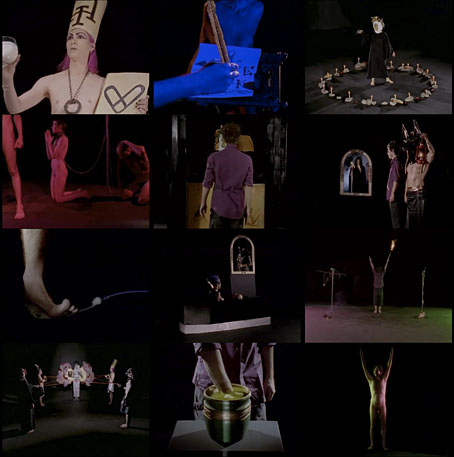
A couple of Austin Spare-related news items arrive in the same week so it’s worth linking again to Earth: Inferno (2003), a short film by Mor Navón & Julián Moguillansky based on the book by Austin Osman Spare. This is a production I have to damn with faint praise by being pleased that Spare is the focus of the work while being disappointed in the film as a whole. Despite the elaborate costumes, careful tableaux and copious nudity, Earth: Inferno confirms that an occult film needs to be more than a record of people dressing up and gesturing hieratically. If nothing else, occult rituals transform the perceptions of those involved, and this quality should be represented or implied in any film dealing with magical operations. The films of Kenneth Anger and Derek Jarman show different approaches, with the raw image transformed by superimposition, exaggerated grain, accelerated/decelerated motion, and so on. Inauguration of the Pleasure Dome and In the Shadow of the Sun are examples to follow. And now the news:

Lost Envoy: The Tarot Deck of Austin Osman Spare, edited by Jonathan Allen & Mark Pilkington. Out later this year from the fabulous Strange Attractor.

Surrealism, Austin Osman Spare and the Occult Underground of 1890s and 1990s London:

Nadia Choucha discusses the context and evolution of her ground-breaking book, Surrealism and the Occult, first published in 1991. The book traces the evolution of Surrealist ideas and situates them within the occult currents of fin-de-siècle European culture, revealing how these currents infused the work of various thinkers and artists in their quest for the ‘marvellous’. The work of Austin Osman Spare is also discussed as a way of comparing and contrasting his methods and techniques with those of the Surrealists. With the 25th anniversary of the publication of the book approaching, this evening will also present an analysis of the work as occurring within a unique historical and cultural moment.

Jun 23rd, 6:30 pm–8:00 pm at the Last Tuesday Society, London.

Previously on { feuilleton }
A Book of Satyrs by Austin Osman Spare
Spare things
Dreaming Out of Space: Kenneth Grant on HP Lovecraft
MMM in IT
Abrahadabra
Murmur Become Ceaseless and Myriad
New Austin Spare grimoires
Austin Spare absinthe
Austin Spare’s Behind the Veil
Austin Osman Spare

TV Wipeout revisited

tvwipeout.jpg

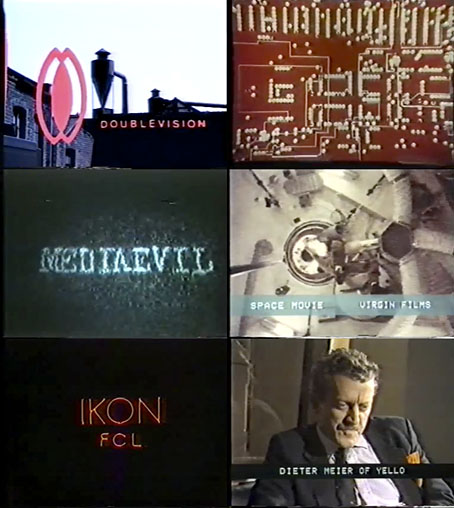
TV Wipeout, as detailed in an earlier post, was a one-off “video magazine” compiled and released on VHS by Cabaret Voltaire in 1984. This was the fourth title on the Cab’s own Doublevision label which was easily the best of the UK’s independent video labels at the time. Many of the other Doublevision releases have either been reissued on DVD or can be found online but TV Wipeout has remained elusive, in part because it contains material that would offend YouTube’s copyright restrictions. Cabaret Voltaire’s deal with Virgin Records enabled them to pad the running time with music promos and trailers for some of the films on Virgin’s own video label.

Back in 2012 I was able to find some of the more popular items but not the obscurities, a situation that’s now resolved by this YouTube playlist which has uploaded the entire cassette as a series of separate items. Most of the previously missing pieces will only be of interest to completists—some of them are scratch-video creations that look very dated today—but if you’re like me, and have waited over 30 years to see this thing in its entirety, it means your curiosity can now be assuaged. A couple of items by Cabaret Voltaire and Japan are still missing but they’re easily found elsewhere.

Update: As noted in the comments, the Japan clip was missing due to an oversight, and is now in place. I’m still getting a message saying the Cabaret Voltaire video is “blocked in your country on copyright grounds” so that must be UK-specific.

Previously on { feuilleton }
Cabaret Voltaire on La Edad de Oro, 1983
Doublevision Presents Cabaret Voltaire
Just the ticket: Cabaret Voltaire
European Rendezvous by CTI
TV Wipeout
Seven Songs by 23 Skidoo
Elemental 7 by CTI
The Crackdown by Cabaret Voltaire
Network 21 TV

Weekend links 263

nakayama.jpg

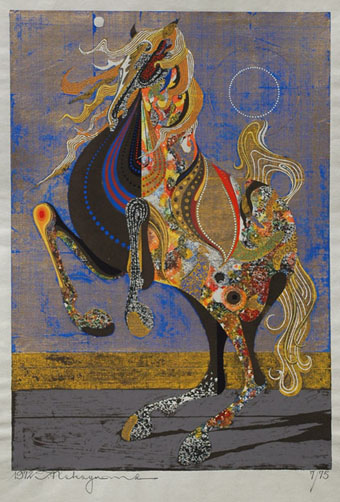
Dancing Horse (1972) by Tadashi Nakayama.

• The Wounded Galaxies Festival of Experimental Media takes place in Bloomington, Indiana, on October 7–11, 2015. The event is an offshoot of the earlier Burroughs Century, and the phrase “wounded galaxies” is one of Burroughs’ own. It’s also the partial title of Wounded Galaxies Tap At The Window, the most recent album by Cyclobe who will be performing at the festival. Cyclobe’s Stephen Thrower will be in London later this month for the launch of his new book, Murderous Passions: The Delirious Cinema of Jesús Franco, and a screening of Franco’s Vampyros Lesbos (1971).

• Gallery sites showcasing erotic art are often coy about the details of the work they’re exhibiting. That’s not the case with Artists Space, NYC, whose Tom of Finland: The Pleasure of Play is running from June 14–August 23, 2015.

• “I just loved the songs, and I didn’t mind the age in their voices, and I didn’t mind the fact that they were unaccompanied, it didn’t matter.” Shirley Collins talking to Ben Graham about her love of English folk music.

The more important question is what do we do with psychedelia now? I think the drugs themselves and the experiences they produce in individuals and for society are too important and vital to be pigeon-holed and taken hold of by a bloodthirsty media that always aims to reduce all experience to a few simple straplines for improved consumerism.

Dr Ben Sessa talking to Barnaby Smith about psychedelic drugs. Breaking Convention 2015, the Third International Conference on Psychedelic Consciousness, takes place at the University of Greenwich next month.

• “…if someone opens a door or if sunlight falls on them they shoot off the grid and suddenly you have a roomful of what sounds like sick bagpipes.” Will Gregory on the physicality of Moog synthesizers.

• Mixes of the week: The Necromancer-Queens of Neverland, an exotic collection by SeraphicManta, Secret Thirteen Mix 156 by Asusu, and an Ornette Coleman playlist.

• “In 2015, the thought of anything as incendiary as Scum or Made in Britain turning up on TV just seems bizarre.” Danny Leigh on the great Alan Clarke.

• More psychedelia: ‘Art That Transcends‘, my article for Communication Arts, has been posted on the magazine’s website.

Phantasmaphile recommends Thus Were Their Faces, a collection of short stories by Silvina Ocampo.

Earth filmed playing live in Brooklyn, NY, September 24, 2014. The full set, and a great performance.

• At Dangerous Minds: “How Far Will You Go?” Meet Smokey, the outrageously gay 70s cult rockers.

Peter Strickland on six films that fed into The Duke of Burgundy.

Things I Found In Records

Christopher Lee sings!

Polly On The Shore (1970) by Shirley & Dolly Collins | The Quiet Joys Of Brotherhood (1972) by Sandy Denny | The Banks of Red Roses (1988) by June Tabor

Dracula and I by Christopher Lee

dracula.jpg

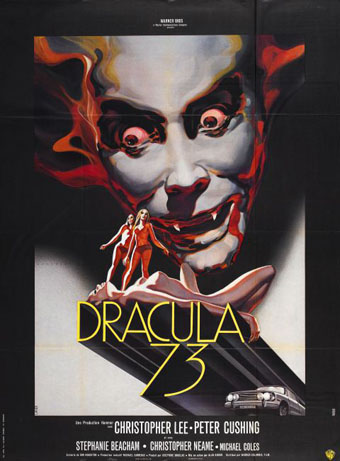
Impossible, not to say foolish, to attempt a brief summary of Christopher Lee’s incredible life and career. Rather than compete with the obituaries, here’s something you won’t find elsewhere, a short piece by Lee himself about his relationship to the role that made him famous. This is taken from The Dracula Scrapbook, a collection of Dracula and vampire-related cuttings assembled by Peter Haining for New English Library in 1976. The Lee piece was originally written for Midi Minuit Fantastique, Éric Losfeld’s film magazine which, we’re told, ceased publication in 1971. Haining dates Lee’s article as 1973 so I’ve left it undated, although it does seem to have been written around the time he was making (or had made) Dracula AD 1972. To compound the confusion, the poster above is for that very film but titled Dracula 73. Lee preferred Jesús Franco’s Count Dracula (1970) to the two final Hammer Draculas but the latter have their enthusiasts.

*

DRACULA AND I by Christopher Lee

I should certainly be pleased to play the part of Dracula again on the screen (surely it is the immortal role par excellence?), although I have many times refused to accept it. Nowadays I think the public identifies me with this part, and if I have sometimes refused it, it was for fear that, like the unfortunate Bela Lugosi, I should spend the rest of my life unable to play anything else. However I would willingly play it again, always provided that the production and scenario of this great subject satisfied me to the full. In any case, I have no intention of playing it to gain some sort of cheap publicity or for the financial benefit of a group of individuals incapable of appreciating or understanding the great power and the classical style of this great subject.

The part is one which needs to be played with respect and dignity, although one must always consider the commercial angle, which nowadays cannot be ignored.

I wrote recently that a true actor ought to be able to play a great diversity of parts. I think I have proved this as far as I am concerned, and that consequently there is no danger for me of being ‘typed’. But I am first and foremost an actor and must earn my living, and if the occasion arises again I shall he delighted to play the part of Dracula again under conditions which satisfy me.

Above all I should wish my interpretation to be more faithful to the novel of Bram Stoker. It seems to me that in the film Horror of Dracula (which, by the way, was excellent and a great success) the scenario left in the shade some aspects of the novel which, if they had been retained, would have improved the film as a whole considerably. For example, the sequences with the wolves and the capital scene with Jonathan Harker and the mirror, not to mention the boat sailing for England. The omission of Renfield was also very regrettable.

I believe that these scenes were not shot for financial reasons; they would have made the film considerably longer and therefore called for a great increase in the production budget.

It may surprise you to know that I have not seen any of the other versions of Dracula. Most of them were produced when I was very young and my age did not allow me to go to see them. But I think this is an advantage in my case, for above all I should not like to be influenced in my approach to the part by those who preceded me, even by the great Bela Lugosi. It will always be a cause for great regret to me that I never met him, whereas I know Boris Karloff very well and have a great admiration for him.

My personal idea of the interpretation of Count Dracula was of course based on the novel which I have read over and over again, and within the framework of the scenario and the production I have tried to give my personal view of its interpretation.

Bram Stoker’s grand-daughter came to see me on the set during the shooting, and was kind enough to assure me that my interpretation was excellent, and that she was sure her grandfather would have appreciated it.

Of course there was a great difference between the scenario and the novel, but I have always tried to emphasise the solitude of Evil and particularly to make it clear that however terrible the actions of Count Dracula might be, he was possessed by an occult power which was completely beyond his control. It was the Devil, holding him in his power, who drove him to commit those horrible crimes, for he had taken possession of his body from time immemorial. Yet his soul, surviving inside its carnal wrapping, was immortal and could not he destroyed by any means. All this is to explain the great sadness which I have tried to put into my interpretation.

Another problem was involved in the interpretation, a problem of a sexual nature. Blood, the symbol of virility, and the sexual attraction attached to it, has always been closely linked in the universal theme of Vampirism. I had to try to suggest this without destroying the part by clumsy over-emphasis. Above all, I have never forgotten that Count Dracula was a gentleman, a member of the upper aristocracy, and in his early life a great soldier and leader of men.

Of course it was impossible, within the limits of the scenario, to show this, but it is still possible by one’s interpretation to suggest the facts of the past without actually showing them.

As I have already told you, I am quite in favour of the idea of playing the part of Count Dracula again, always provided that the period and the Gothic atmosphere of the novel are respected.

I believe it is perfectly possible for a production of a film on this subject to be made in a modern setting, but there is only one Dracula, and his period must not be changed under any circumstances.

I have not read the whole of Bram Stoker’s work; I have only read (apart from Dracula) The Lair of the White Worm and one of his shortest stories, The Squaw. The first could not be screened, but the second in a shortened form would make an extraordinary film. The Squaw is, moreover, one of the most terrifying stories that Bram Stoker ever wrote.

The part of Count Dracula was one of the great opportunities of my career, and earned me a worldwide reputation.

It is one of the greatest parts ever created, one of the most famous and fantastic…no actor can ask more.

Midi Minuit Fantastique

Previously on { feuilleton }
The Dracula Annual
Nightmare: The Birth of Horror
Albin Grau’s Nosferatu
Count Dracula
Symbolist cinema