Johann Theodor de Bry’s Neiw Kunstliches Alphabet

debry.jpg

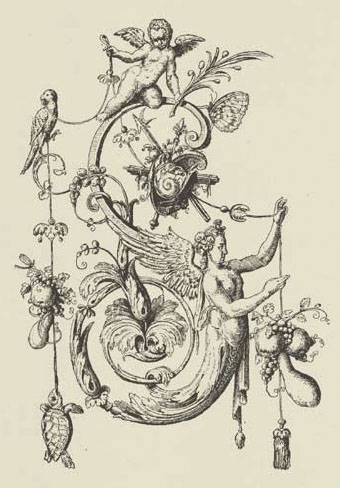
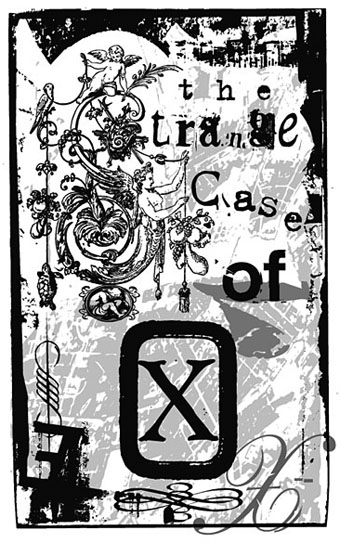
A page from Johann Theodor de Bry’s Neiw Kunstliches Alphabet (1595) which can be found in a free PDF version here, the scans being taken from a Victorian reprint. The late, lamented Giornale Nuovo featured some of these curious letter designs in 2005. Each capital is embellished with various symbolic figures—Moses appears perched on the letter M, for example—whilst also being draped with fruit, lobsters and even insects. I used a smaller redrawing of De Bry’s letter S for one of the page designs in Jeff VanderMeer’s City of Saints and Madmen in 2002. Probably not the use that De Bry intended but then I expect he’d be surprised that his work was still being used at all after four hundred years. Via BibliOdyssey.

strange.jpg

Previously on { feuilleton }
The Book of Ornamental Alphabets
Paul Franck’s calligraphy
Gramato-graphices
John Bickham’s Fables and other short poems
Letters and Lettering
Studies in Pen Art
Flourishes

Weekend links: Ghosts, Spooks and Spectres edition

spectres.jpg

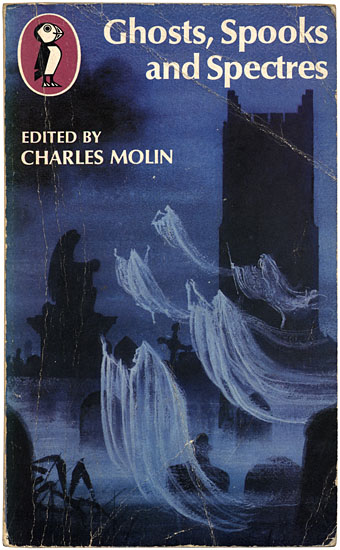
Cover design by Philip Gough.

Ghosts, Spooks and Spectres (1972 reprint). Editor Charles Molin collected nineteen ghost stories by writers including Oscar Wilde (The Canterville Ghost), Charles Dickens (The Signal-Man), J. Sheridan Le Fanu (Madame Crowl’s Ghost) and HG Wells (The Inexperienced Ghost). This was one of my favourite books when I was ten-years old. There’s nuffin like a Puffin. Puffin Books’ parent company, Penguin, is 75 this year.

• The good people at the Outer Alliance have posted an interview with me here in which I talk about the subversive sexualities of sf in the 1970s and also admit to writing fiction.

• There’s just time to mention It Came From Pebble Mill, an event which includes another screening of David Rudkin’s Penda’s Fen.

• “In our society, there has tended to be a very strong compartmentalization of different experiences, different cultural forms, different genres. We can talk in a very broad sense and say art is separate from science, for example, or body is separate from mind, or we can talk in a specific sense and say one certain form of dance music is separate from one form of, say, heavy metal. I don’t really buy those compartmentalizations. I understand why they exist, how they’ve come into being and why they’re convenient, but it’s not the way I think, it’s not the way I experience the world, it’s not the way I believe things should be.” From an interview by Colin Marshall with David Toop at 3QD. Toop’s latest book is Sinister Resonance: The Mediumship of the Listener.

The Kingdom of the Pearl by Léonard Rosenthal, illustrated by Edmund Dulac.

Ghost Stations by Dollboy, a CD package. And then there’s the Ghostly Bento.

7 Inch Cinema are Birmingham-based cultural historians.

• Mark Pilkington’s Mirage Men now has its own site.

Borges on Pleasure Island: JLB and his love of RLS.

• RIP Arne Nordheim, Norwegian composer.

• Charlie Visnic’s Modular Ghost Synth.

On the trail of Tutankhamen’s penis.

Photos by Thom Ayres.

Ghosts by Japan | Spooky Rhodes by Laika | Purple Dusk by Spectre.

The Midsummer Chronophage

chronophage.jpg

The Midsummer Chronophage.

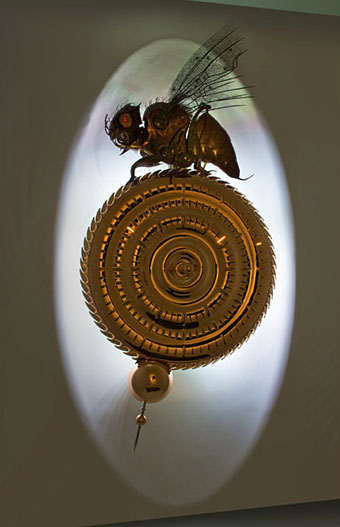
John C Taylor’s Corpus Chronophage—the extraordinary mechanical clock surmounted by a time-devouring monster—was featured here following news of its installation at Corpus Christi College, Cambridge, in 2008. Two years later its creator is ready to unveil a new clock which he calls The Midsummer Chronophage.

The Midsummer Chronophage pays homage to the 18th century clockmaker John Harrison, inventor of the marine chronometer and the ‘grasshopper’ escapement, a low-friction mechanism for converting pendulum motion into rotational motion. The Midsummer Chronophage takes the grasshopper escapement out of the clock and presents it on the outside as a sculpture. The mythical creature is also the world’s largest grasshopper escapement.

The face of The Midsummer Chronophage is a 24 carat gold-plated steel disc almost 1.5M in diameter, polished to resemble a pond of liquid metal with ripples that allude to the Big Bang. It was created by a series of underwater explosions.

The Midsummer Chronophage has no hands or numbers but displays time by aligning slits in discs behind the clock face back lit with blue LEDS; these slits are arranged in three concentric rings displaying hours, minutes and seconds.

Dr Taylor’s new clock can be seen at London’s Masterpiece Fair from 23rd of June. For those outside London there are more pictures of the device here, and videos of the Corpus Clock in action here.

Previously on { feuilleton }
Andrew Chase’s steel cheetah
Another Midsummer Night
The Corpus Clock
A Midsummer Night’s Dadd
William Heath Robinson’s Midsummer Night’s Dream
The Bowes Swan

Odes and Sonnets by Clark Ashton Smith

cas.jpg

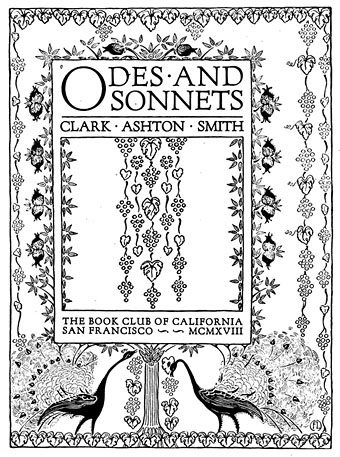
Clark Ashton Smith’s weird fiction is reprinted more often and more widely than his poetry so it’s convenient for those curious about his verse that the Internet Archive has two volumes of early work. Odes and Sonnets is from 1918 and features embellishments by illustrator Florence Lundborg whose grape-devouring peacocks nod towards the fin de siècle spirit Smith was trying to capture in his poems. The Star-Treader, and Other Poems is Smith’s first book from 1912, published when he was just 19, and is heavily indebted to the Decadents. That Decadent influence carried over into the stories he wrote for Weird Tales and augments their unique flavour and over-heated atmosphere, an atmosphere which raised his work above the often mediocre level of his contemporaries. On page 58 of The Star-Treader can be found The Eldritch Dark, the poem from which the leading Smith website takes its name.

Previously on { feuilleton }
Clark Ashton Smith book covers

Weekend links 16

clockwork.jpg

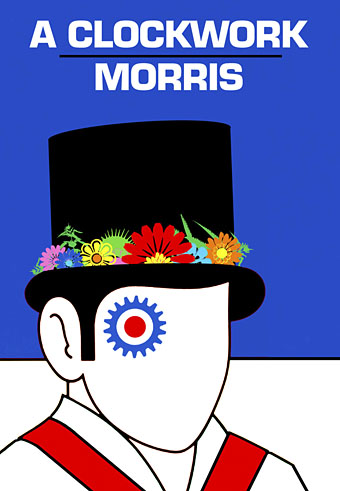
Sumer Is Icumen In but you wouldn’t have known it today, it being cold and wet, O my brothers. The picture above is the work of David Owen whose Ink Corporation does a splendid job of updating the iconography of the folk music world. Via Electric Eden.

• Biting the hand that feeds: designer Jonathan Barnbrook’s contribution to the Biennale of Sydney takes a dig at the whole enterprise. The art market is impervious to criticism (or shame) but the gesture is an amusing one.

Emanuel Schongut’s book covers of the 1960s and 1970s on the artist’s own Flickr pages. Via A Journey Round My Skull.

• Owen Freeman on illustrating William Burroughs. Related: Reality Studio interviews Victor Bockris.

• RIP Jack Birkett, Derek Jarman’s Caliban and the Pope in Caravaggio. And RIP Dennis Hopper, actor, director and photographer.

seanettle.jpg

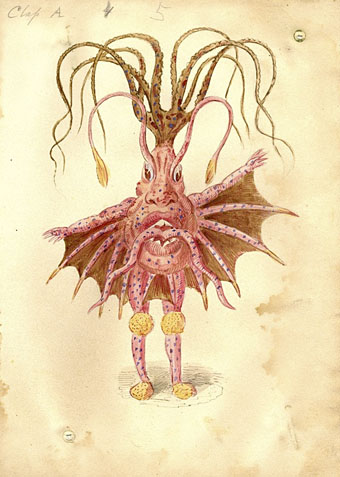
“Sea Nettle” (1873), a costume design by the Mistick Krewe of Comus. From this BibliOdyssey posting of New Orleans Mardi Gras designs.

• Chris Summerfield’s surfer boys at Lulu.

• Homotography also has a Tumblr page.

The Ghost Box Study Series Singles.

• More 3D projection on buildings.

John Foxx interviewed at FACT.

Song of the week: Ineffect (1989) by Material.