Uncharted islands and lost souls

lostsouls1.jpg

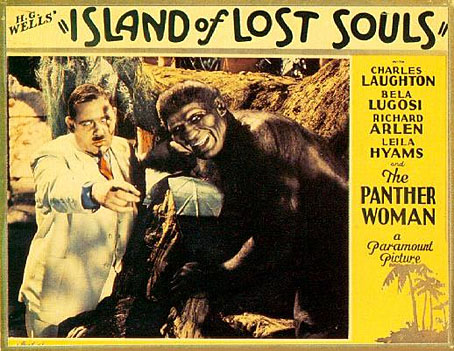
The pulp fiction of the early 20th century favoured remote or uncharted islands as locations for the bizarre and the fantastic; in isolated jungles all manner of savage and grotesque behaviour could take place out of sight of the civilised world. Islands are secure from interference; they can be visited by accident or intention, and later fled from when everything goes wrong. The Island of Doctor Moreau is an early example of the type although Jules Verne’s The Mysterious Island (1874) pre-dates it by twenty-two years. The Island of Lost Souls (1932), the first film adaptation of the Wells novel, is one of a crop of mysterious islands that appeared in the 1930s following the success of the Universal adaptations of Dracula (1931) and Frankenstein (1931). The recent Eureka DVD/Blu-ray edition of the film is the first UK release to present the film in its original, uncensored form. I watched it this weekend.
lostsouls3.jpg

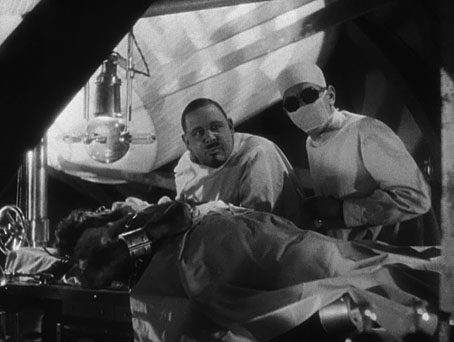
Moreau (Charles Laughton) and Montgomery (Arthur Hohl) at work.

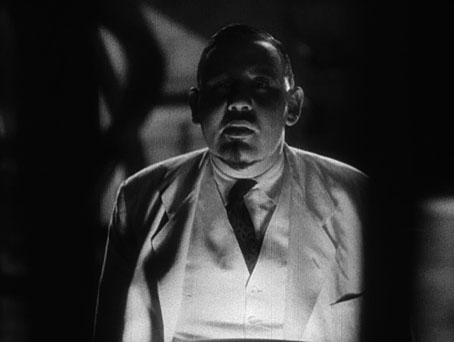
HG Wells famously hated the film, and his vociferous complaints helped to ensure it was banned in Britain until 1958. Even without Wells’ complaints there was enough there to bait the censors who declared it to be “against nature”: writers Philip Wylie and Waldemar Young push the erotic implications of Wells’ story to a degree that would have been impossible in 1896, and would be equally impossible two years later when the Hays Code clamped down on cinematic salaciousness. Charles Laughton’s Moreau is eager to discover whether Lota, the Panther Woman (Kathleen Burke), will show any sexual interest in the marooned Edward Parker (Richard Arlen). The bestiality theme continues when Parker’s fiancée arrives on the island and finds one of Moreau’s Beast People at her bedroom window. Add to this Moreau’s declaration that he feels like God (a similar line was cut from James Whale’s Frankenstein), a traditional British squeamishness towards maltreating animals (unless they’re foxes), and the Panther Woman’s skimpy outfit, and it’s no surprise that the authorities collapsed with the vapours.
lostsouls4.jpg

Sensationalism aside, this is one of the greatest horror films of the early 1930s, and one which follows its source material with much more fidelity than Universal’s Dracula and Frankenstein. The production had been commissioned by Paramount to capitalise on the success of the Universal films, hence the presence of a very hirsute Bela Lugosi as the Sayer of the Law. Cinematographer Karl Struss had worked the year before on Rouben Mamoulian’s excellent Dr. Jekyll and Mr. Hyde; prior to this he photographed Sunrise (1927) for Friedrich Murnau. The combination of Struss’s chiaroscuro compositions, some adept direction from Erle C. Kenton (including crane shots), and a tremendous performance by Charles Laughton puts The Island of Lost Souls in a different league entirely to Tod Browning’s stagey and over-rated Dracula. Laughton’s cherub-faced Mephistopheles is a performance that runs counter to the cod theatricals of the period: he’s sly, confident and completely authoritative even if he looks nothing like Wells’ white-haired doctor.
Continue reading “Uncharted islands and lost souls”

Weekend links 189

wilson.jpg

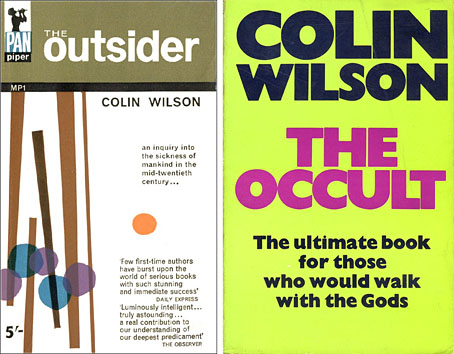
The Outsider (1956), 1963 edition; The Occult (1971), 1973 edition.

The cover of the 1973 UK paperback of Colin Wilson‘s mammoth overview of occultism can still be offered as a pinnacle of hyperbole. The book itself is a very serious and informative study but its success set Wilson on a path as a writer about the paranormal where he’d previously been concerned with literature, philosophy and psychology. For many critics this finished his already shaky reputation as a serious thinker. He continued to write about philosophy and literature in subsequent books but dubious speculations about Atlantis are always more commercially attractive than studies of Nietzsche, hence the proliferation of lost continents in the later part of a bibliography which the Wilson website lists at 114 titles. Wilson was a maverick intellectual whose curiosity ignored many of the boundaries that restrained his metropolitan contemporaries; he was also an autodidact of a type that seems to irritate the university-educated. Mentions of his name in British newspapers were frequently couched in sneering or dismissive terms. His current reputation can be measured by the lack of attention the news of his death has prompted in the UK at the time of writing. (That said, dying on the same day as Nelson Mandela was unfortunate timing.)

Savoy Books published an edition of Wilson’s crime novel, The Killer, in 2002. I designed that volume, rather badly, I think. In 2004 Robert Meadley wrote a book-length reaction to Wilson’s autobiography, Dreaming to Some Purpose, which can be downloaded for free from Savoy. In it Meadley mounts a robust defence of Wilson against the broadsheet termagants. Elsewhere: the only newspaper obituary so far is at The Times (subscription required); Colin Wilson on Desert Island Discs in 1978; Gary Lachman interviewing Wilson for Fortean Times in 2004; musician Anthony Reynolds discussing his collaboration with Wilson.

• “Art, music and a mind-blowing voyage of discovery”: Richard Neville on the late Martin Sharp. At Design Observer Rick Poynor looks back at Sharp’s book and magazine illustrations of the 1960s. Of particular note is Sharp’s contribution to the “Magic Theatre” issue of Oz magazine, a unique combination of collaged visuals and text which Alan Moore often refers to as a favourite work. (See issue 12 of Moore’s Promethea, “The Magic Theatre of the Mind“.)

• “The naked woman in art isn’t unusual, but we have trouble viewing the male body as a sexual, or artistic, object,” says James Polchin.

But how can anyone be bored when there’s always death to think about? Every day. Every hour. Don’t you? All the rest is just evading or glossing the real subject of our lives. Beckett, again, the maestro of death: Never but the one matter. The dead and gone. The dying and the going. From the word go. I too shall cease and be as when I was not yet, only all over instead of in store.

Jenny Diski on death and dying.

• A teaser trailer for The Dreamlands, a film by Huan Vu (Die Farbe) based on HP Lovecraft’s Dream Cycle.

• “On Watching Wages of Fear with my 11-Year-Old Daughter” by Debra Morris.

Abram Games’ “bat wings” BBC logo is 60 years old. See it in action here.

• At Strange Flowers: Romaine Brooks‘ portraits of her famous friends.

• At Front Free Endpaper: Mervyn Peake illustrates Treasure Island.

The Great God Pan (plus satyrs and fauns) at Pinterest.

Dan Wilson on “Electric Music” on the Victorian stage.

• Mix of the week: Fact Mix 414 by Julianna Barwick.

• The BFI chooses 10 great British rural horror films.

Dunwich – The search for Britain’s Atlantis.

The Grand Canyon filled with fog.

• The Bells of Dunwich (1975) by Stone Angel | O.O.B.E. (1992) by The Orb (feat. Colin Wilson) | Why We Make It Difficult On Ourselves (2010) by Anthony Reynolds & Colin Wilson

Albert Goodwin’s fantasies

viriconium-goodwin.jpg

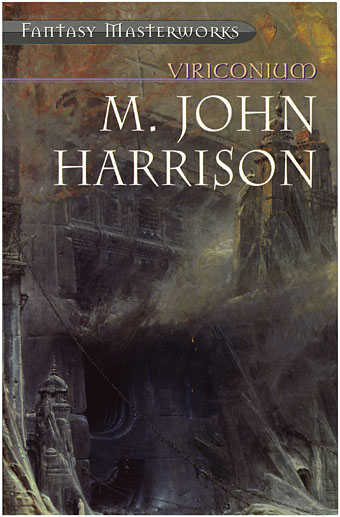
Viriconium (Millennium/Gollancz, 2000). Painting: The Gates of the Inferno (no date).

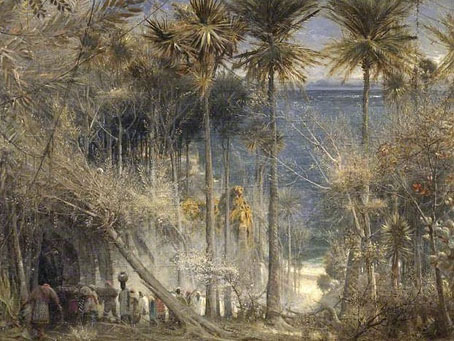
The web continues to be an incomparable treat for anyone interested in art history. One of the great advantages of the BBC’s Your Paintings site is having the opportunity to see pictures by artists whose output would rarely be deemed important enough to appear in a book. Albert Goodwin (1845–1932) is one such artist, a painter of landscapes and seascapes with a sideline in fantastic scenes, some of which may have been inspired by the apocalyptic canvases of John Martin. The cover of the Viriconium anthology was my first sighting of anything by Goodwin. That particular painting appears to be in private hands so to date this is the only copy I’ve seen. The combination of minatory architecture and a nebulous atmosphere is just the kind of thing I enjoy so it’s disappointing to not find him producing anything similar.

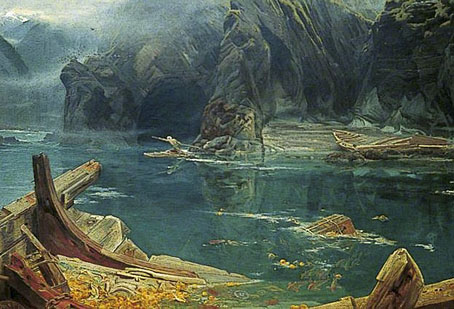
The paintings below show some of Goodwin’s other forays into the fantastic, mostly illustration of one sort or another. The two final pictures wouldn’t be out-of-place on a collection of William Hope Hodgson sea stories; the devastated Armada isn’t fantastical per se but it reminds me of Hodgson’s descriptions of the Sargasso Sea.

goodwin7.jpg

Apocalypse (1903).

goodwin1.jpg

Ali Baba and the Forty Thieves (1901).

goodwin2.jpg

Sinbad Entering the Cavern (1879).

Continue reading “Albert Goodwin’s fantasies”

The Court of the Dragon

atget.jpg

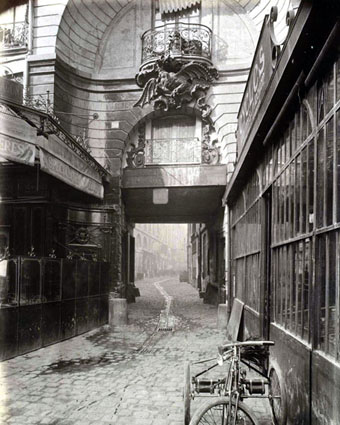
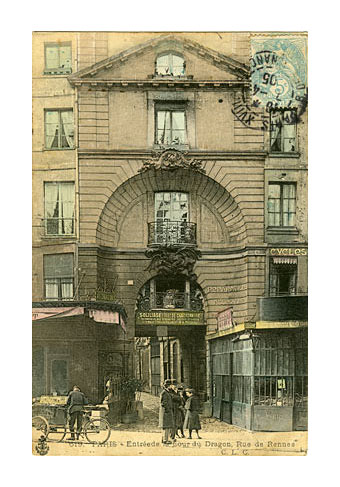
50 Rue de Rennes (1900) by Eugène Atget.

I live in the Court of the Dragon, a narrow passage that leads from the Rue de Rennes to the Rue du Dragon.

It is an “impasse”; traversable only for foot passengers. Over the entrance on the Rue de Rennes is a balcony, supported by an iron dragon. Within the court tall old houses rise on either side, and close the ends that give on the two streets. Huge gates, swung back during the day into the walls of the deep archways, close this court, after midnight, and one must enter then by ringing at certain small doors on the side. The sunken pavement collects unsavoury pools. Steep stairways pitch down to doors that open on the court. The ground floors are occupied by shops of second-hand dealers, and by iron workers. All day long the place rings with the clink of hammers and the clang of metal bars.

Unsavoury as it is below, there is cheerfulness, and comfort, and hard, honest work above.

Five flights up are the ateliers of architects and painters, and the hiding-places of middle-aged students like myself who want to live alone. When I first came here to live I was young, and not alone.

In the Court of the Dragon (1895) by Robert W. Chambers.

Drawing the King in Yellow for the Karl Edward Wagner story in Lovecraft’s Monsters (see yesterday’s post) sent me back to the Robert W. Chambers story collection where the strange and terrible regent first appears. Despite having written in the past about the covers for Chambers’ book I hadn’t read the stories for some time. Chambers’ blending of Bohemian romance, fantasy, horror, and early science fiction is just the thing to point to when people ask for a definition of weird fiction, writing that comes from a period before the straightjacket of genre definition had fastened itself about imaginative writing.

Chambers’ collection contains ten stories but only the first four are weird tales: The Repairer of Reputations, The Mask, In the Court of the Dragon, and The Yellow Sign. Of the four, In the Court of the Dragon is the weakest, although my re-reading caused some surprise when I realised that the story takes place in a location in Paris which the great photographer of the city, Eugène Atget, had memorably fixed five years after the book was published. Chambers was American but pursued a career as an artist in Paris before he took up writing; the description above can be taken as his own experience of the city.

ruederennes3.jpg

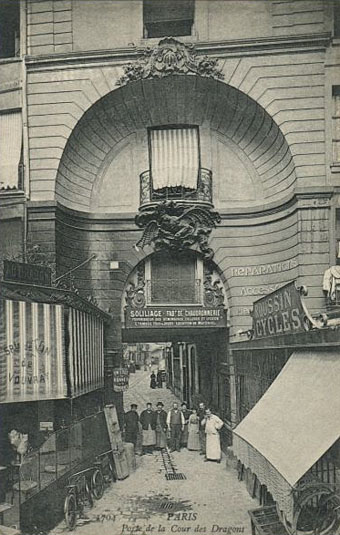
Undated postcards showing wider views.

ruederennes2.jpg

Atget is a photographer whose work I’m always happy to return to, especially his views of the streets and courtyards of a Paris now cleaned and tidied, if not altogether redeveloped. His view of the dragon balcony in the Rue de Rennes features everything I like about his street scenes: an unpeopled vista, weathered cobblestones, curious architectural detail, and the hazy distance of the courtyard itself. Chambers’ story may not communicate quite the same atmosphere but the pair for me are now inextricably linked. This place couldn’t have survived, could it?

ruederennes.jpg

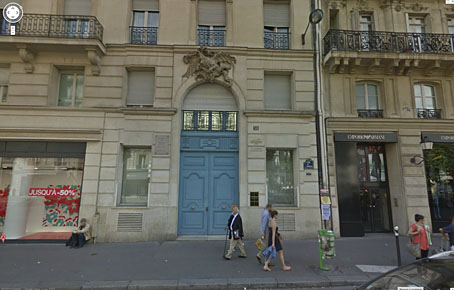
Well, yes and no. The dragon is still there on the wall at 50 Rue de Rennes but the court was apparently redeveloped in the 1950s. Behind those blue doors is a tidy little park for the use of the locals, a common feature in Paris although tourists seldom see more than a glimpse of these places when gates are opened.

dragon.jpg

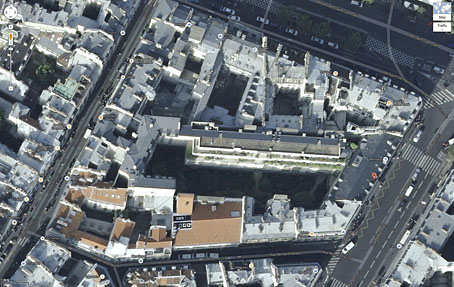
The satellite view below shows the park, the red A marking the position of the blue doors. Nothing in Paris looks like Atget’s photos any more—that’s a part of their fascination—so these kinds of changes are no surprise. But I’m pleased to discover that the dragon still exists. Next time I’m there I’ll have to pay homage.

court.jpg

ernst.jpg

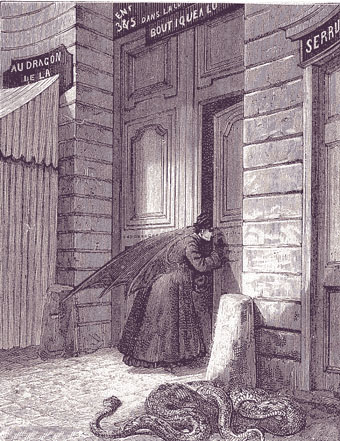
Fourth collage from the La Cour du Dragon chapter of Une Semaine de Bonté (1934) by Max Ernst.

The King in Yellow at the Internet Archive.

Update: Added a couple more pictures.

Update 2: Thanks to Herr Doktor Bimler for reminding me of Ernst’s collage novel, Une Semaine de Bonté, whose second chapter takes its title from the court. Considering this is a favourite book I really ought to have remembered it. Two of the collages show the entrance to the court but the dragon isn’t seen, its presence having been transferred to creatures lurking at the edges of the picture, and the Doré demon wings that many of the characters are sporting.

Update 3: Laurent drew my attention to this post which includes more photos and historical detail. Thanks, Laurent!

Previously on { feuilleton }
Atget’s corners
Rue St. Augustin, then and now
Brion Gysin’s walk, 1966
The King in Yellow

Bookmark: Mervyn Peake

peake1.jpg

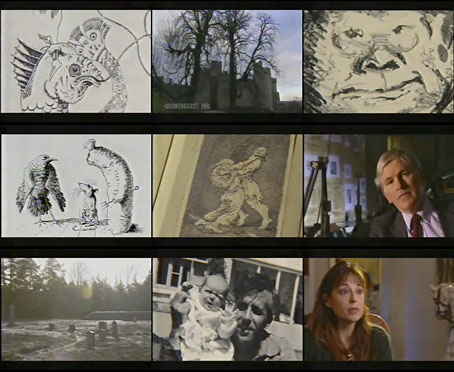
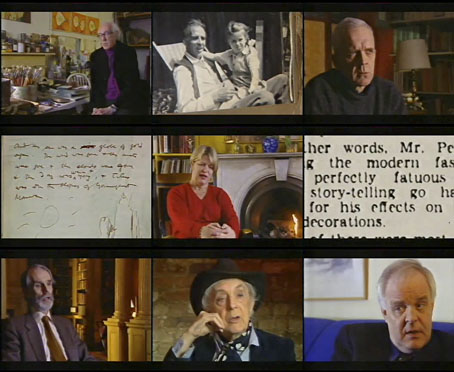
Another not-so-old TV documentary. It’s good to keep finding these as I have no means at the moment of viewing all the video tapes I’ve kept. Bookmark is (or was) a BBC series about the lives of various writers. This edition concerns author and artist Mervyn Peake, and was broadcast in 1998, shortly before the BBC screened their flawed dramatisation of the Gormenghast books.

Peake’s three children—Sebastian, Fabian and Clare—all recall life with their father, while other contributors, Quentin Crisp among them, discuss his work, his experiences during the Second World War, and life on the island of Sark. The narrator is Julian Glover, and the readings are by Simon Russell Beale. The catastrophic collapse of Peake’s health that occurred when he’d barely reached middle age means a journey through his biography is always a sombre business, but it does make the scale of his achievements seem all the more remarkable. The film is 48-minutes long, and may be viewed here.

peake2.jpg

Previously on { feuilleton }
The Web by Joan Ashworth
Peake’s glassblowers
Mervyn Peake in Coronation Street
The Worlds of Mervyn Peake
A profusion of Peake
Mervyn Peake at Maison d’Ailleurs
Peake’s Pan
Buccaneers #1
Mervyn Peake in Lilliput
The Illustrators of Alice