Weekend links 580

kausch.jpg

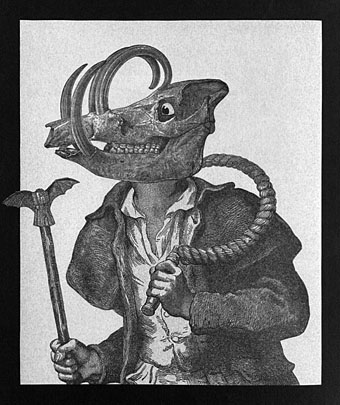
The Collective Lie We All Live By, a cut-paper collage by Allan Kausch from Maintenant 15, A Journal of Contemporary Dada Writing and Art.

• “It’s unusual that an album manages to be at once so much of its moment, yet so much outside it. Time was unmistakably a response to the electronic and synth waves that rose in the wake of punk. It was also a concept album about time travel, which couldn’t have been more pre-punk had it been focus-grouped that way.” David Bennun on Time (1981), ELO’s masterwork of science-fiction pop. The first song on the album, Twilight, is a thundering piece of synth bombast that prefigures Trevor Horn’s equally bombastic productions, and was used to memorable effect in the copyright-infringing animation made in 1983 for the opening of Daicon IV.

• New music: Disciples Of The Scorpion by The Rowan Amber Mill, and Shade by Grouper.

• “Psychedelic spirituality: Inside a growing Bay Area religious movement“.

• “It’s time to farewell this project,” says Ballardian.

• At Wormwoodiana: the seven greek vowels.

• A playlist for The Wire by Douglas Benford.

Norman Blake‘s favourite albums.

Astronomia Playing Cards.

• RIP Dusty Hill.

Time (1973) by David Bowie | Time (1976) by La Düsseldorf | Time (1992) by Lull

Pynchonian cinema

tpa.jpg

(Pynchonian? Pynchonesque? Pynchon-heads can no doubt supply the most common descriptor but for now Pynchonian will do.)

Is it possible to identify a Pynchonian strand in cinema? This question came to mind while I was reading the end of Gravity’s Rainbow, and probably a little before then during a scene that takes place in the Neubabelsberg studio in Berlin. The Pynchon reading binge is still ongoing here—after finishing the Rocket book I went straight on to Vineland, and I’m currently immersed in Mason and Dixon—so I’ve been watching films that complement some of the preoccupations in the Pynchon oeuvre, at least up to and including Vineland. This is a small and no doubt contentious list but I’m open to further suggestions. Inherent Vice is excluded, I’ve been thinking more of films that are reminiscent of Pynchon without being derived from his work.

Elements that increase the Pynchon factor would include: a serio-comic quality (essential, this, otherwise you’d have to include a huge number of thrillers); detective work; paranoia; songs; and a conspiracy of some sort, or the suspicion of the same: a mysterious cabal–the “They” of Gravity’s Rainbow—who may or may not be manipulating the course of events.

tpa2.jpg

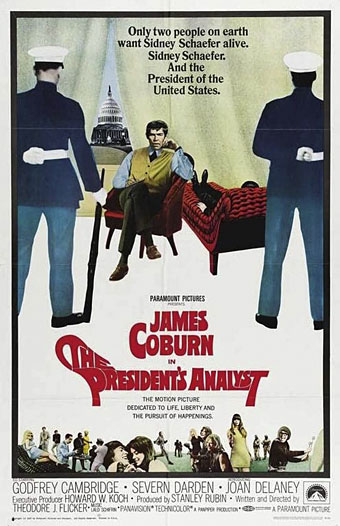
The President’s Analyst (1967)
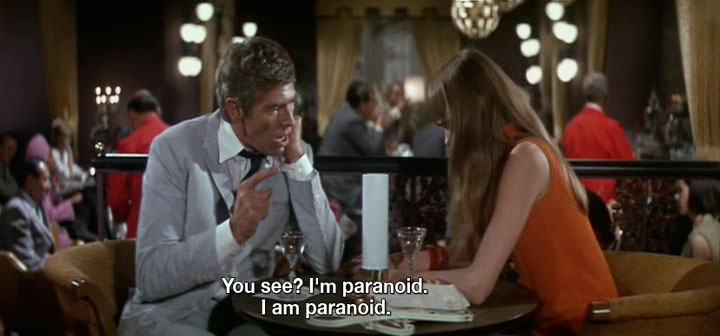
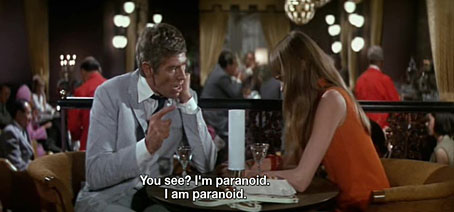
I’d be very surprised if Pynchon didn’t like this one. James Coburn as the titular analyst, Dr Sidney Schaefer, has little time to enjoy his new job in Washington DC before half the security services in the world are trying to kidnap him to discover what he’s learned about the President’s neuroses. This in turn leads the FBI FBR to attempt to kill Schaefer in order to protect national security. Pynchonian moments include a bout of total paranoia in a restaurant, Canadian spies disguised as a British pop group (“The ‘Pudlians”), and a visit to the home of a “typical American family” where the father has a house full of guns, the mother is a karate expert, and the son uses his “Junior Spy Kit” to monitor phone conversations. Later on, an entire nightclub gets spiked with LSD. This is also the only film in which someone evades abduction to a foreign country by the cunning use of psychoanalysis.
Is it serio-comic? Yes.
Is there detection? In the background: the CIA CEA and KGB agents have to work together in order to outwit the FBI FBR and discover who the ultimate villains might be.
Is there paranoia? You only get more paranoia in one of the serious conspiracy dramas of the 1970s like The Conversation or The Parallax View. (The latter includes the same actor who plays the All American Dad, William Daniels.)
Any songs? Yes. Coburn hides out for a while with the real-life psychedelic group Clear Light, and helps with their performance in the acid-spiked nightclub.
“They”? There are multiple “Theys” in this one.
Pynchon factor: 5. Maybe a 6 for the LSD.

nashville.jpg

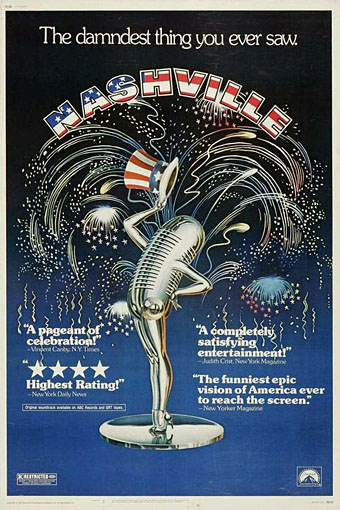
Nashville (1975)
This one is a stretch but Robert Altman is the director I think of as closest to Pynchon’s sensibility even if individual works are light on the Pynchon factor. His films are often rambling, quirky and satirical—especially when he goes the ensemble route—but never too comic to avoid a sudden lurch into the dark. The Long Goodbye might seem a more likely choice, given the way it points to subsequent Chandler variations like The Big Lebowski (see below) and Inherent Vice, but it’s still Chandler’s story. Nashville is pure Altman, the best of his ensemble entries and my choice for his best film of all, a portrait of America in the mid-1970s where someone can be loved by millions yet still be a target for assassination. It’s worth noting that the director of Inherent Vice, Paul Thomas Anderson, was the insurance standby when Altman was directing his final film, The Prairie Home Companion.
Is it serio-comic? Yes.
Is there detection? No.
Is there paranoia? No, although as a portrait of the USA in the 1970s it can’t avoid a lurking sense of unease.
Any songs? Lots of songs.
“They”? No.
Pynchon factor: 2

simon.jpg

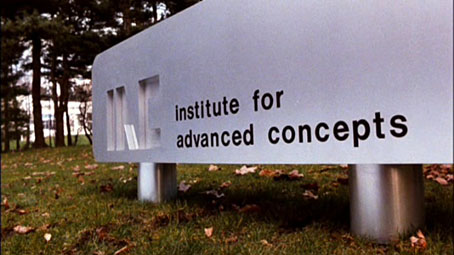
Simon (1980)
The debut feature from Marshall Brickman, Simon is an overlooked oddity with a great performance by Alan Arkin as a college professor, Simon Mendelssohn, who gets tricked by the Institute for Advanced Concepts into believing he’s an extraterrestrial. Parts of this play like a comic version of Altered States, which coincidentally was released the same year. Both films feature reckless quests for academic glory, flotation tank experiments (Simon includes a reference to Dr John Lilly), and regressions to earlier stages of evolution. Pynchonian moments include a church commune who worship the television, a gas that reduces intelligence, and a self-aware computer called “Mother” whose human interface is a giant phone receiver.
Is it serio-comic? Yes.
Is there detection? No.
Is there paranoia? A little.
Any songs? No.
“They”? The IAC are a small but powerful “They”, with carte blanche to foist their whims on an unsuspecting nation.
Pynchon factor: 2.5

tbl.jpg

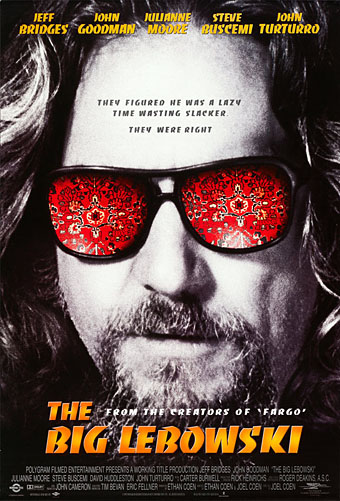
The Big Lebowski (1998)
When the book trailer for Inherent Vice appeared in 2009 (with narration by the author himself…or was it? etc), a common reaction was “This sounds just like The Big Lebowski“. If The President’s Analyst is the closest Hollywood gets to The Crying of Lot 49 then The Big Lebowski may be the closest to Vineland‘s story of the youth of the hippy era coping with life in a world that’s passed them by.
Is it serio-comic? Yes.
Is there detection? Yes.
Is there paranoia? A little. Most of the time The Dude is more concerned with trying to keep up with his continual changes of fortune.
Any songs? Lots of songs on the soundtrack, plus the Busby Berkeley-style dream sequence.
“They”? Yes.
Pynchon factor: 4.5

huckabees.jpg

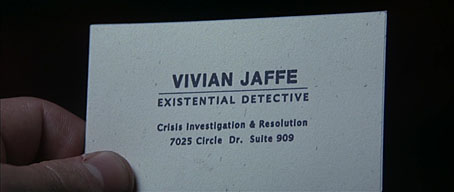
I Heart Huckabees (2004)
David O’Russell’s mélange of existential philosophy, environmentalism and coincidence is like Wes Anderson with a more political edge, and the kind of quirky comedy there was still space for in the Hollywood of the late 1990s/early 2000s. Jason Schwartzman is Albert Markovski, a poetry-writing environmental activist with a coincidence problem who turns to existential detectives, Vivian Jaffe (Lily Tomlin) and husband Bernard Jaffe (Dustin Hoffman), for a solution. “Everything is connected”, Bernard insists, so it’s no surprise that the presence of Lily Tomlin returns us to Nashville, while the pair require a little of Sidney Schaefer’s psychoanalysis to get to the bottom of Albert’s problems. Meanwhile, the Jaffes’ former pupil, Caterine Vauban (Isabelle Huppert), is lurking in the wings, tempting Albert with the attractions of sex and nihilist philosophy (shades of The Big Lebowski).
Is it serio-comic? Yes.
Is there detection? Yes.
Is there paranoia? A little. Albert is increasingly worried about losing control of his protest group.
Any songs? Shania Twain puts in an appearance but she doesn’t sing.
“They”? The Huckabees Corporation is a small-scale “They”, manipulating the environmentalists for their own ends.
Pynchon factor: 3.5

utsl.jpg

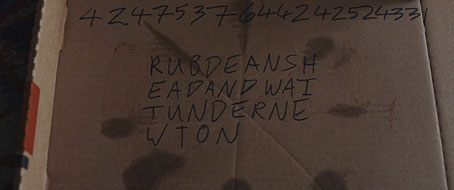
Under the Silver Lake (2018)
David Robert Mitchell’s surprising follow-up to the excellent It Follows is self-consciously Lynchian, and quite possibly self-consciously Pynchonian too. A long and rambling tale of burgeoning paranoia in the hip Los Angeles enclave of Silver Lake where slacker Sam (Andrew Garfield) discovers a web of interconnected mysteries after trying to find out why his attractive female neighbour has disappeared. It’s sinister, funny and bizarre, with mysterious deaths, hidden codes, treasure maps, chess games, pop music, Californian cults and more. Mitchell wisely avoids explaining too much which means the film now has a cult following determined to dredge its alleged secrets.
Is it serio-comic? Yes.
Is there detection? Yes.
Is there paranoia? Yes.
Any songs? Lots of songs, also a mysterious Songwriter character and an indie band, Jesus and the Brides of Dracula.
“They”? Multiple “Theys”.
Pynchon factor: 5

L49-01.jpg

Lodge 49 (2018–2019)
Several people recommended this TV series (thanks!) so here it is. And while Jim Gavin’s creation may not be a feature film it’s very definitely Pynchonian. See this post for details.
Is it serio-comic? Yes.
Is there detection? Yes.
Is there paranoia? A little. Dud and Ernie have a paranoid episode involving a drone.
Any songs? Yes, from the characters themselves and also from Broadcast and others on the soundtrack.
“They”? Once again, there are multiple “Theys”.
Pynchon factor: 49


Honourable mentions: WD Richter’s The Adventures of Buckaroo Banzai Across the 8th Dimension (1984) makes it to the Pynchon Zone via its appropriation of “Yoyodyne”, the name of the defence contractor from V. and The Crying of Lot 49. Despite this, and much as I like Buckaroo Banzai, I don’t think it’s Pynchonian enough for this list, although the writers at the defunct Pynchon site, Spermatikos Logos, might disagree. This archived page makes a case for the film, and also mentions a possible reciprocation from the author which I missed when I was reading Vineland.

Likewise, Richard Linklater’s debut, Slacker (1990), also came to mind. It has the requisite large cast of idlers and eccentrics (including a couple of conspiracy obsessives), plus a meandering yet connected structure, but it doesn’t otherwise seem Pynchonian enough.

Anything else I’ve missed?

Update 1: Added Lodge 49.
Update 2:
Further recommendations at Letterboxd.
Update 3: Finally added Under the Silver Lake.

Previously on { feuilleton }
Going beyond the zero
Pynchon and Varo
Thomas Pynchon – A Journey into the Mind of [P.]

Weekend links 577

preisler.jpg

Black Lake (1904) by Jan Preisler.

• Upcoming releases on the Ghost Box label will include a new album by {feuilleton} faves Pye Corner Audio, plus the surprising appearance of figures from Bruegel on a Ghost Box cover design.

Tilda Swinton and Olivier Saillard pay tribute to the films of Pier Paolo Pasolini. (Or to Pasolini’s costume designer, Danilo Donati.)

• New music: Spectral Corridor by The House In The Woods, and Re:Moving (Music for Choreographies by Yin Yue) by Machinefabriek.

• At Spoon & Tamago, Technopolis gets all the good things: “Giant kitty now greets commuters at Shinjuku Station.”

Anil Ananthaswamy on the ways in which psychedelics open a new window on the mechanisms of perception.

• Mixes of the week: Isolated Mix 112 by Suna, and GGHQ Mix #56, “An Unfortunate Kink”, by Abigail Ward.

• In this week’s impossible task, Alexis Petridis attempts to rank The Velvet Underground’s greatest songs.

• DJ Food unearths more flyers for London’s Middle Earth club, plus covers for the East Village Other.

• Global signals: Aki Onda on Holger Czukay and radio’s power to connect.

• At The Paris Review: Paintings and collages by Eileen Agar (1899–1991).

Will Sergeant’s favourite albums.

The Babel Tower Notice Board

Shaking Down The Tower Of Babel (1983) by Richard H. Kirk | Pärt: An Den Wassern Zu Babel (1991) by Estonian Philharmonic Chamber Choir conducted by Paul Hillier | The Black Meat (Deconstruction Of The Babel-Tower of Reason) (1994) by Automaton

Going beyond the zero

gr1.jpg

“But it is a curve each of them feels, unmistakably. It is the parabola. They must have guessed, once or twice—guessed and refused to believe—that everything, always, collectively, had been moving toward that purified shape latent in the sky, that shape of no surprise, no second chances, no return. Yet they do move forever under it, reserved for its own black-and-white bad news certainly as if it were the Rainbow, and they its children….”

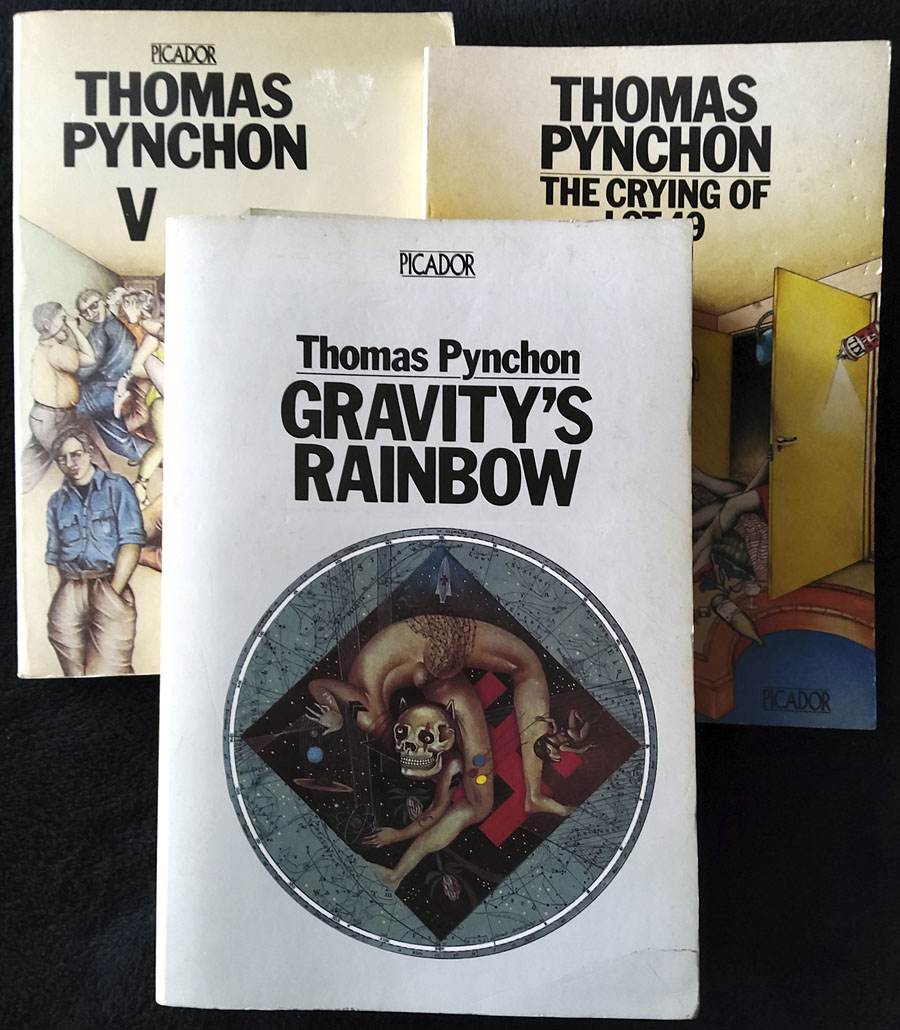
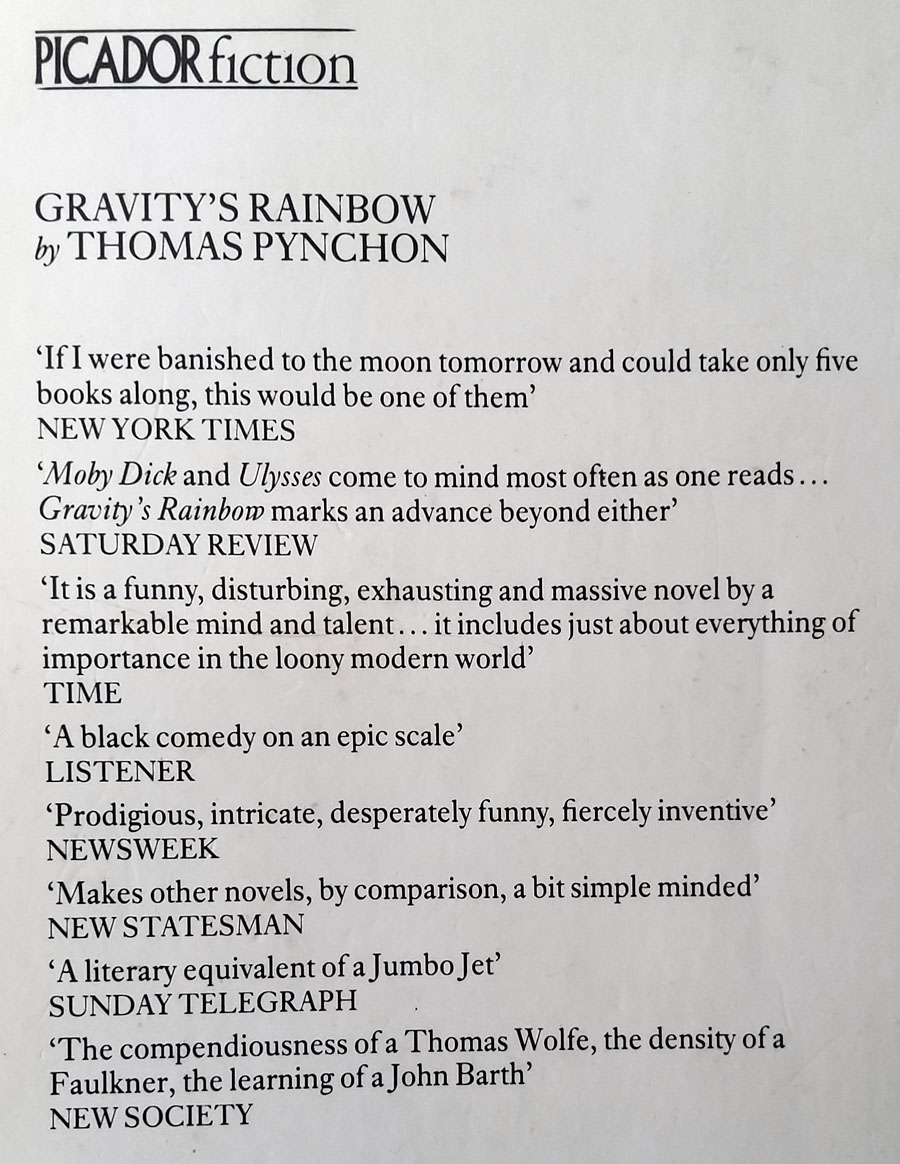
Reader, I read it. It isn’t an admission of great achievement to announce that you’ve reached the last page of a novel after a handful of stalled attempts, but when it’s taken me 36 years to reach this point it feels worthy of note; and besides which, Gravity’s Rainbow isn’t an ordinary novel. Umberto Eco is partly responsible for my return to Pynchon. I’d just finished The Name of the Rose, a book I’d avoided for years even while reading (and enjoying) a couple of Eco’s other novels, and was wondering what to read next. Maybe it was time to try the Rocket book again? The thick white spine of the Picador edition—760 pages in 10pt type—would accuse me every time I spotted it on the shelf: “Still haven’t made it to page 100, have you?” For many people this happens with novels because a book is “difficult” (which I didn’t think it was), or boring (which it isn’t at all), or simply too long (page count doesn’t put me off). Back in 1985 I was looking for more heavyweight fare after reading Ulysses, something I’ve now done several times, so I wasn’t going to be intimidated by a novel which is misleadingly compared to Ulysses on its back cover. If anything the comparison was an enticing one. Pynchon at the time exerted a gravitational pull (so to speak) for being very mysterious, although this was a decade when most living authors, especially foreign ones, were mysterious to a greater degree than they are today, when so many have their own websites and social media profiles. Pynchon’s works were also referred to in interesting places, unlike his less mysterious contemporaries. I may be misremembering but I seem to recall a mention of the W.A.S.T.E. enigma from The Crying of Lot 49 in Robert Shea & Robert Anton Wilson’s Illuminatus!; if it is there then it’s no surprise that a writer so preoccupied with conspiracy and paranoia would find favour with the authors of the ultimate conspiracy novel. (And that’s not all. I’m surprised now by the amount of coincidental correspondence between Illuminatus! and Gravity’s Rainbow. Both novels were being written at the same time, the late 1960s, yet both refer to the Illuminati, the eye in the pyramid on the dollar bill, Nazi occultism, and the death of John Dillinger. Both novels also acknowledge the precedent of Ishmael Reed’s Mumbo Jumbo, another remarkable conflation of conspiracy, secret history, and wild invention.)

gr2.jpg

Pynchon had other connections to the kind of fiction I was already interested in. One of his early short stories, Entropy, had been published in New Worlds magazine in 1969, although editor Michael Moorcock later claimed to have avoided reading any of the novels until much later. And, Pynchon, like Shea & Wilson (and Moorcock…), made pop-culture waves. I think it was Laurie Anderson who put Gravity’s Rainbow in the centre of my radar when she released Mister Heartbreak, an album whose third song, Gravity’s Angel, refers to the novel and is dedicated to its author. As for the novel itself, in the mid-1980s this was still Pynchon’s major work, the one that fully established his reputation. Nothing new had appeared since its publication in 1973; Vineland, and the subsequent acceleration of the authorial production line, was six years away. The final lure was the refusal of the Picador edition to communicate very much of its contents: what was this thick volume actually about? The back cover is filled with praise but doesn’t tell you anything about the novel at all, while the cover illustration by Anita Kunz suggests a scenario connected with the Second World War but little else. (“This was one of the most complicated books I ever read,” says the artist, “and really hard to get the germ of the idea. Pynchon kept going off in tangents. I mixed up the art the same way the writer did and made an image that can be read in all directions.”) It’s only when you start reading the book that you find the connection between the novel’s dominant concerns—the development of the V-2 rockets used by the Nazis to bomb London, and the erotic compulsions of Tyrone Slothrop, an American lieutenant at large in war-ravaged Europe—subtly reflected in the illustration, much more subtly than the cover art on the edition that preceded this one.

Continue reading “Going beyond the zero”

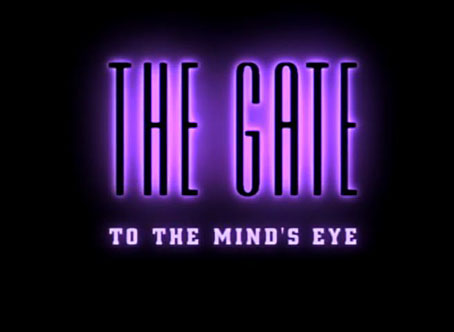
The Gate to the Mind’s Eye

tgttme1.jpg

Turn a 6 on its head and you’ll see a number 9. Do the same with the psychedelic culture of the 1960s and you get the 1990s when psychedelia emerged again, after a fashion, in a profusion of new drugs (plus the same old ones), “ambient” music (a lot of which was never very ambient at all), and, of course, computer graphics. The resemblance of the overlit, weightless world of early computer graphics to the vivid inner landscapes of psychedelic hallucination prompted people like Timothy Leary to declare computers to be their new drug of choice, while also inspiring the resurrection of the kind of visual tripping aid that would have been considered dead and buried in the very un-psychedelic 1980s. (There were a few musical exceptions in that decade—the Paisley Underground, the Dukes of Stratosphear albums, Around The World In A Day by Prince & The Revolution—but all these were counter to the dominant trends of the time.)

tgttme2.jpg

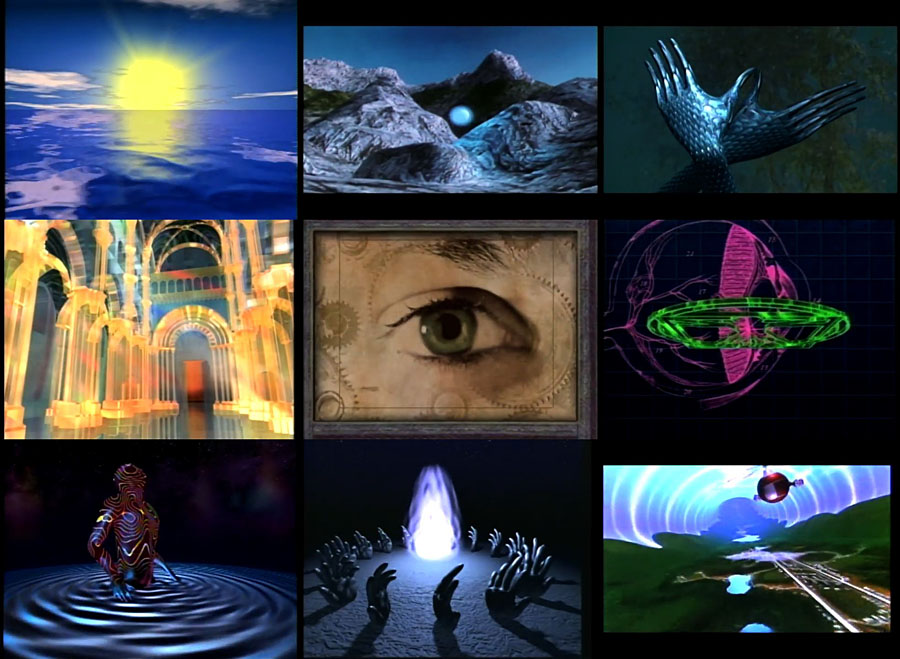
CD-ROMS were the hippest vehicle for far-out visuals in the mid-90s. Brian Eno was vocal in his criticism of the limitations of the point-and-click CD-ROM format but he still provided music for a thing called Headcandy in 1994, one of a series of “video kaleidoscopes” with 3-D visuals created by Chris Juul and Doug Jipson. Not so overtly druggy was a series of VHS tapes and laserdiscs released throughout the 1990s by Odyssey Productions, all of which had the words “Mind’s Eye” in their titles: The Mind’s Eye: A Computer Animation Odyssey (1990), Beyond the Mind’s Eye (1992), The Gate to the Mind’s Eye (1994) and Odyssey Into The Mind’s Eye (1996). Where Headcandy and its relations created far-out visuals using original data encoded on a CD-ROM, the Mind’s Eye laserdiscs wowed the viewer by stitching together the latest examples of CGI from a variety of sources—showreels, TV ads, music videos and so on—giving you an hour of coloured balls bouncing across crystal mountains, pulsating blobs of mercury, shiny objects zooming through corridors and vortices, together with the clumsy figure animation that’s a consistent feature of early computer graphics. Each instalment was provided with a soundtrack by a different musician, so each release is really a long music video in itself, rather like The Orb’s Adventures Beyond The Ultraworld (Patterns & Textures) (1992), a 50-minute collage of rave footage, dolphins, spacewalking astronauts and cheap video effects soundtracked by live music from The Orb.

tgttme3.jpg

The Gate to the Mind’s Eye is highlighted here mainly for its having a soundtrack by Thomas Dolby that I hadn’t heard before. Other instalments feature original music by Jan Hammer (which may be okay), and Kerry Livgren from Kansas (which promises to be as unpalatable as Giorgio Moroder’s misconceived mauling of Fritz Lang’s Metropolis). The Gate to the Mind’s Eye doesn’t feature the best of Dolby’s music, it should be said, which may explain why the soundtrack CD has only been reissued once since 1994, while the visual material looks like a combination of music video and computer game. But there’s a lot of this stuff around today, especially at the Internet Archive which now has a laserdisc section containing several uploads from Odyssey Productions and its affiliate, Miramar Productions. Closer to the psychedelic ideal is a series of discs from Japan with the uninventive name of Video Drug. The Internet Archive has five discs from this series. I might have been happy to watch these in the 1990s when late-night TV in the UK was either dull or non-existent but today I’m more taken with outmoded things like Electric Light Voyage aka Ascent 1, a video release from 1979 which featured analogue video effects of a type you don’t find at all in the digital world.

Elsewhere on { feuilleton }
The abstract cinema archive

Previously on { feuilleton }
Kusama’s Self-Obliteration, a film by Jud Yalkut
Science Friction by Stan VanDerBeek