Weekend links 565

kircher.jpg

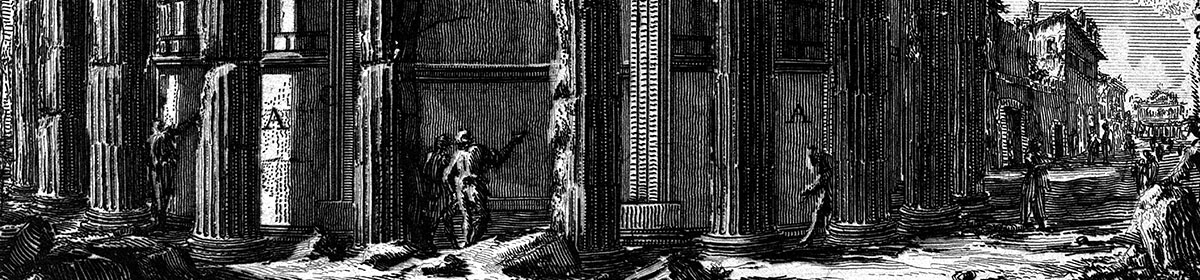
The Labyrinth of Crete from Turris Babel (1679) by Athanasius Kircher.

• “My self appointed tutors were, in the order I discovered them, Robbe-Grillet, Borges, Nabokov, and Burgess. All of them associable in one way or another with labyrinths, all practitioners of non-linearity, all happy not to explain, all precursors of Godard’s celebrated and liberating ‘a beginning a middle and an end but not necessarily in that order.’ Burgess, of course, also came from the provincial lower middle class, and gave the address at Benny Hill’s funeral.” Jonathan Meades talking to Owen Hatherley about (what else?) the tastes and opinions which were always to the fore in his long-running series of TV films about architecture, art, food, and culture in general. This time last year I rewatched Meades’ TV oeuvre thanks to downloads from MeadesShrine and YouTube. It’s no surprise to learn that he won’t be making any more of these films now that the increasingly useless BBC has decided that the arts-oriented BBC 4 will be an archive channel only. The days are long past when someone like Meades would be given a new six-part series, or an artist like Leonora Carrington 50 minutes of BBC 1 airtime.

• Food and film: “As with so much else in his life, [Alfred] Hitchcock’s accomplice in this peculiar gastronomic odyssey was Alma Reville, his wife, best friend, longest-serving creative collaborator, and, to quote Hitchcock, ‘as fine a cook as ever performed miracles in a domestic kitchen.'” Edward White on Alma Reville and the status of food in the Hitchcock household.

• Food and books: “The supply of hides for parchment was always dependent on the dietary preferences of the local population… For hundreds of years, the transmission of knowledge had depended on carnivorous appetites and good animal husbandry.” Ross King on the laborious process of bookmaking in the 15th century.

• At Wormwoodiana: Sphinxes & Obelisks, a new collection of essays “on rare books and recondite subjects” by Mark Valentine.

• New music: crystallise, a frozen eye by James Ginzburg, and Multiverse by Gadi Sassoon.

• At Dennis Cooper’s: Spotlight on…Amos Tutuola The Palm-Wine Drinkard (1952).

• At Spoon & Tamago: Step inside the miniature worlds of Tatsuya Tanaka.

• Mixes of the week: 30 years of People Like Us, and Fact Mix 803 by oxhy.

And all that jazz: innovative album covers from the 1950s on.

• In praise of Edward Gorey, style icon.

Labyrinthe (1995) by Zbigniew Preisner | Labyrinth (2010) by Chrome Hoof | The Seventh Labyrinth (2018) by Pye Corner Audio
The Devourer Below

devourer.jpg
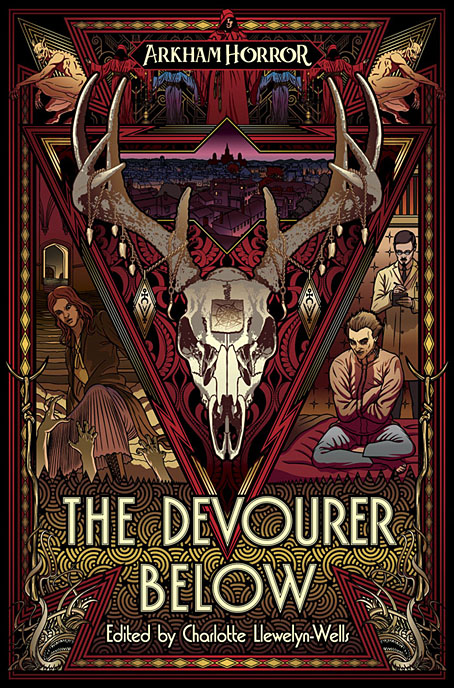
Another week, another cover design. This is the third cover of mine for the Arkham Horror line from Aconyte Books, a fiction series which complements the Lovecraftian Arkham Horror game:

Something monstrous has come to Arkham, Massachusetts. There have always been shadows here, but now a new hunger has risen from the depths and threatens those who dwell here. But there are heroes too—people who stand up and fight to stem the tide, even when it costs them everything. Explore eight shocking new tales of occult horror, captivating mystery, and existential fear—from a zealous new heroine to conniving cultists, bootleg whiskey to night terrors, and fiends that crawl from open graves. A nightmare has fallen across Arkham, and it will devour all.

As with the earlier titles I’ve worked on, The Last Ritual and Litany of Dreams, the general style is Art Deco in keeping with the period in which the game and the stories are set. The new cover worked out especially well thanks to the brief which suggested extending the triangle that appears on the previous covers so that it became a frame for a deer skull bedecked like a ritual artefact. This created a little more space for the requisite character panels, the figures here being an underworld investigator and a lycanthropic asylum inmate, both of whom feature in the game. The brief also requested that Arkham be represented somewhere, so I spent a lot of time drawing a view over the gambrel rooftops of the haunted town, only to shrink the panel down to a size which loses much of the detail. It may be a miniature view but it’s like one of those special effects shots you see in a film, something you know must have taken a lot of work to achieve but which is only visible for a few seconds; a minor presence that adds to the texture of the whole. And the view of nocturnal architecture provides a further link with the previous covers.

The Devourer Below will be available in ebook and US paperback in July, with a UK paperback following in September.

Elsewhere on { feuilleton }
The Lovecraft archive

Previously on { feuilleton }
Litany of Dreams
The Last Ritual

Weekend links 564

kolbe.jpg

Fantastical Tree (c. 1830) by Carl Wilhelm Kolbe.

• “It’s just a square and a semi-circle at the end of the day.” Pete Adlington navigates the rapids of high-profile cover design for the UK edition of Kazuo Ishiguro’s Klara and The Sun. I’m not always keen on the minimal approach but the Faber edition is a better design than the equally minimal US cover whose circle in a hand makes it look like a reprint of Logan’s Run. Faber also produced a limited edition with the sun circle wrapped onto sprayed page edges.

• “‘With a mysterious smile on her lips,’ writes the Chilean film director Alejandro Jodorowsky, ‘the painter whispered to me, “What you just dictated to me is the secret. As each Arcana is a mirror and not a truth in itself, become what you see in it. That tarot is a chameleon.”‘” The painter referred to is the now-ubiquitous Leonora Carrington whose own Tarot deck is investigated by Rhian Sasseen.

• “‘Horror is an emotion,’ Douglas E. Winter tells us. I would respectfully like to amend that assertion. Horror is a range of emotions. And each of these moods, if they are to be successful, must be cultivated differently.” Brian J. Showers offers his thoughts on horror fiction.

• “You move from awareness of—and preoccupation with—how sounds affect our bodies, into how that might create a web of connection with the external world—with the natural world.” Annea Lockwood talking to Jennifer Lucy Allan about her career as a composer and sound artist.

• Gay cruising and its geography in cinema and documentary, a list of films by Mike Kennedy. Related: Shiv Kotecha on O Fantasma (2000), a film by João Pedro Rodrigues.

• Coming from Strange Attractor in June: Coil: Camera Light Oblivion, a photographic record by Ruth Beyer of the first live performances by Coil from 2000–2002.

• At Wormwoodiana: Mark Valentine on The Star Called Wormwood (1941), a strange novel by Morchard Bishop.

• At Unquiet Things: Ephemeral and Irresistible: The Spectacular Still-life Botanical Drama of Gatya Kelly.

• “Fevers of Curiosity”: Charles Baudelaire and the convalescent flâneur by Matthew Beaumont.

• 1066 and all that: Explore the Bayeux Tapestry online.

• Mix of the week: Secret Thirteen Mix 311 by Arigto.

• New music: Terrain by Portico Quartet.

Fever (1956) by Little Willie John | Fever (1972) by Junior Byles | Fever (1980) The Cramps

More Swans and Robots

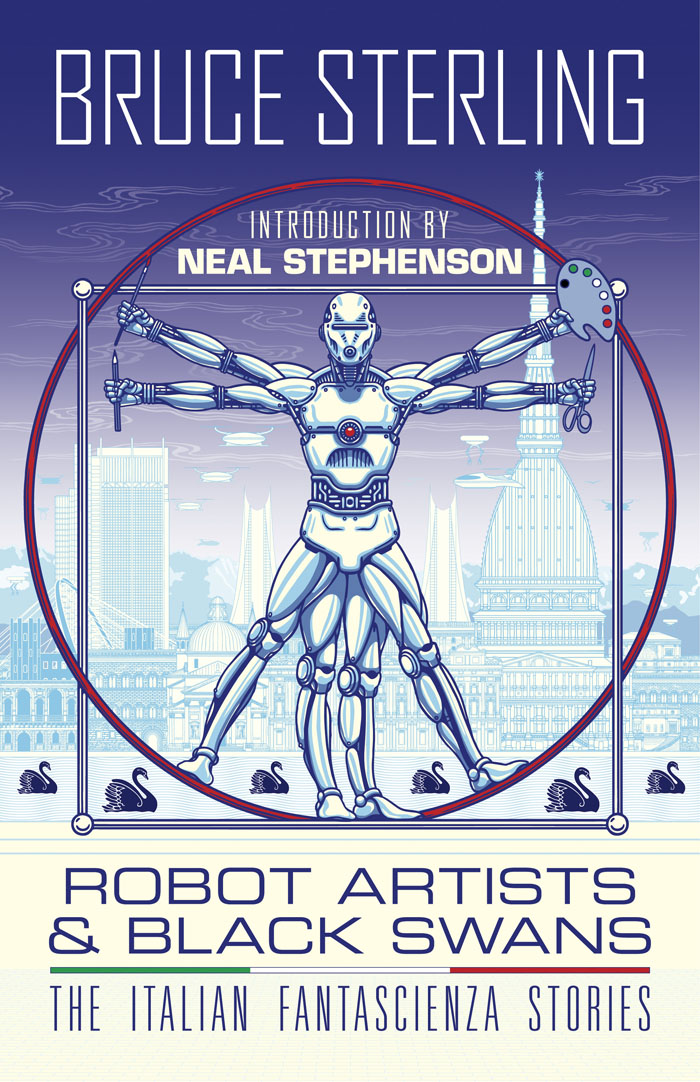
robotartists01.jpg

Real Italian fantascienza is an authentic expression of Italian culture, which is brainy, nerdy, gutsy and pulp, it’s far-out but down-home, and raw but civilized. I would not proclaim that it’s the best fantasy writing ever created in the world, but it encourages and motivates me.

Bruce Sterling talking to Paul Semel about his collection of fantascienza stories, Robot Artists and Black Swans. My cover design was posted here last September; the book itself is published this week by Tachyon so I can at finally reveal the interior illustrations. Sterling’s collection presents seven stories written by his Italian alter-ego, Bruno Argento, with several of them appearing in English for the first time. The Italian theme informs the design as well as the content, although the associations aren’t always as obvious as they are in my illustrations for Sterling’s earlier fantascienza book for Tachyon, Pirate Utopia, the art and design for which adapted graphics by the Italian Futurists.

robotartists08.jpg

As I mentioned in the earlier post, while searching for more recent Italian graphics I came across the work of Franco Grignani (1908–1999), a designer whose most famous work was the Woolmark logo, one of those international symbols that most people will have seen even if few know who was responsible for its creation. The Woolmark’s black-and-white stripes are typical of Grignani’s designs, many of which work variations on the eye-jangling Op Art style pioneered by Bridget Riley. Grignani’s work seemed at first as though it might offer a suitable model for the cover design but it quickly became apparent that his style wasn’t suitable for this title so I went in another direction. Grignani’s influence is present inside the book, however, in the more abstracted illustrations, and in the parallel lines that provide a connecting thread between the stories and their illustrations. The Eurostile fonts used throughout the book also have an Italian flavour. They’re a little clichéd for science fiction but I liked the way they combined SF associations with more Italian design, being the work of Alessandro Butti and Aldo Novarese.

robotartists15.jpg

The other design influence, and a more identifiable source, is MC Escher, a choice prompted by the black swans in the title. Escher’s tessellated patterns feature a variety of animals, swans included, so I adapted two of the artist’s swan patterns to prevent the illustration from being robot-heavy. Escher also has an Italian side, as it happens; he enjoyed holidaying in Italy, and the vernacular architecture of the country’s small coastal towns may be found in many of his lithographs. The Escher swans led in turn to a self-indulgent illustration that fills two pages at the front of the book, something that came about after I was playing with Penrose triangles in Illustrator. I’d made a group of these impossible shapes into a construction which a little tweaking turned into a piece of equally impossible architecture, rather like those in the Escher-influenced mobile game, Monument Valley. All that was required to flesh things out was to cover the walls in a brick pattern then add a few swans and robots.

Continue reading “More Swans and Robots”

Solid Space: Jon Anderson’s cosmic voyage

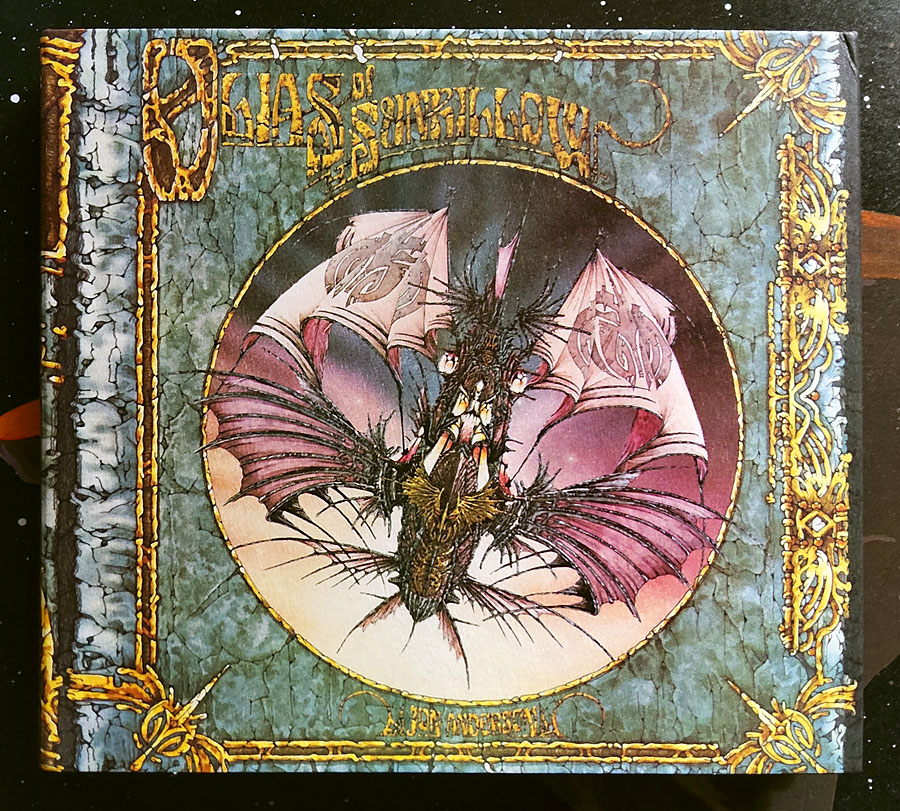
olias1.jpg

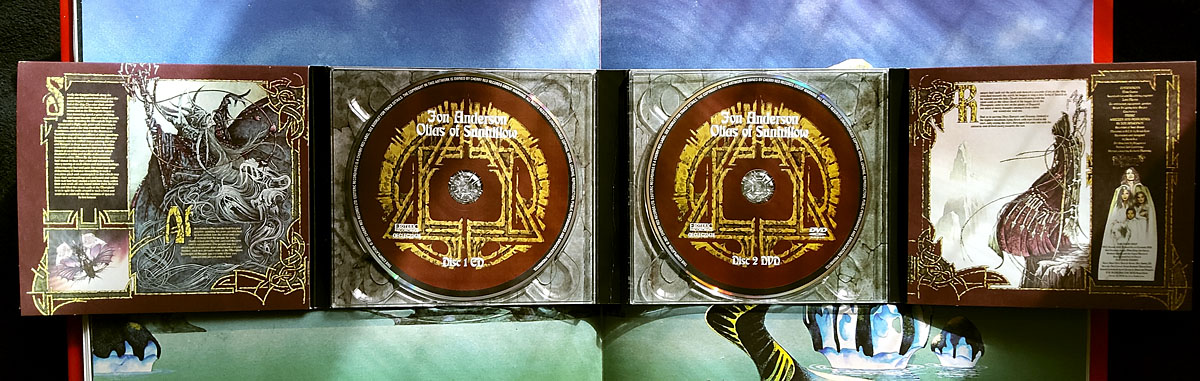
Jon Anderson’s solo debut, Olias Of Sunhillow, is reissued this week in a double-disc set comprising a remastered CD plus an audio DVD. I’d been hoping for some time that this album might be given a proper reissue, it’s one I like a great deal but my old CD has never sounded as good as it ought to. The album may command cult status round here but you don’t see it mentioned anywhere outside Yes forums or partisan enclaves like the Prog Archives. This post may be taken as a small corrective to the neglect.

olias2.jpg

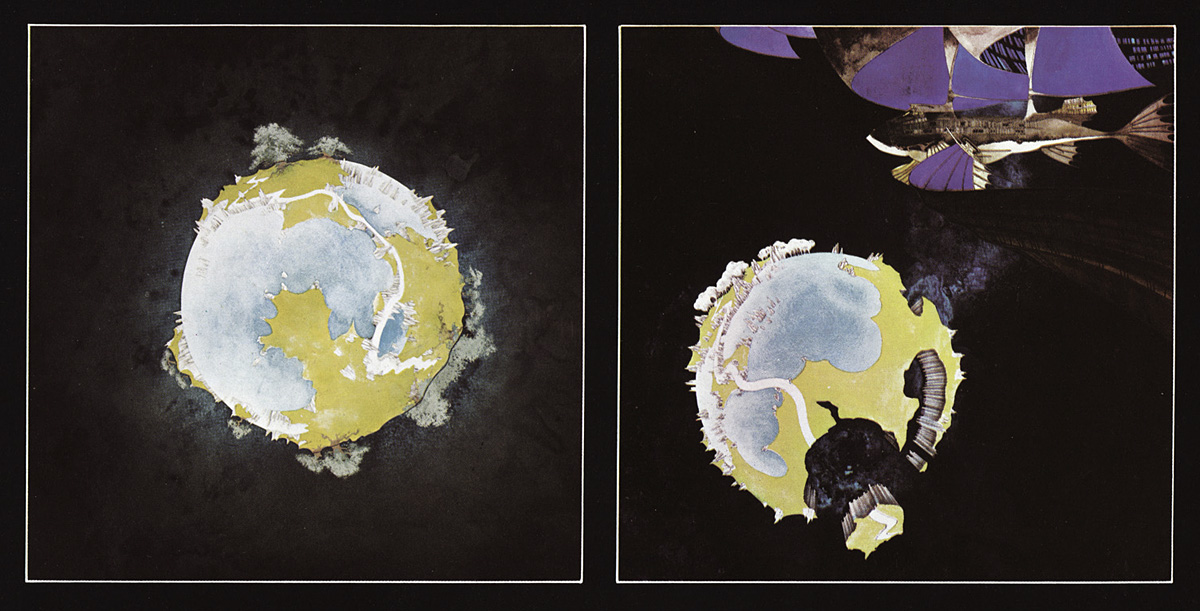
Olias Of Sunhillow was released in 1976, and was the most unusual of all the solo albums recorded by the individual members of Yes in the mid-70s, being a spin-off from some of the group’s early albums, or at least their cover art. Roger Dean’s first cover work for the group was on Fragile in 1971, for which he painted a miniature world rather like one of MC Escher’s planetoids. This was Dean’s idea, the band had suggested a broken piece of porcelain as the cover image. The back cover of the album showed the same planet in a state of fragmentation with a fish-like spaceship floating above it (see below). Another drawing of the fish-ship was added to the front cover before the album’s release, and it’s this ship, and the narrative it suggests, that leads eventually to Anderson’s solo album. Two years after Fragile, the planetary disintegration had turned into an exodus on the group’s triple-live album, Yessongs, the back cover of which shows pieces of planet being towed through space by a similar fish-ship. The other panels of the cover depict the arrival of these fragments on a newer, larger world. Anderson’s album takes this sequence of events then filters them through Vera Stanley Alder’s mysticism to craft a musical odyssey which Discogs describes as:

…the story of an alien race and their journey to a new world due to catastrophe. Olias, the title character, is the chosen architect of the glider Moorglade, which will be used to fly his people to their new home. Ranyart is the navigator for the glider, and Qoquaq is the leader who unites the four tribes of Sunhillow to partake in the exodus.

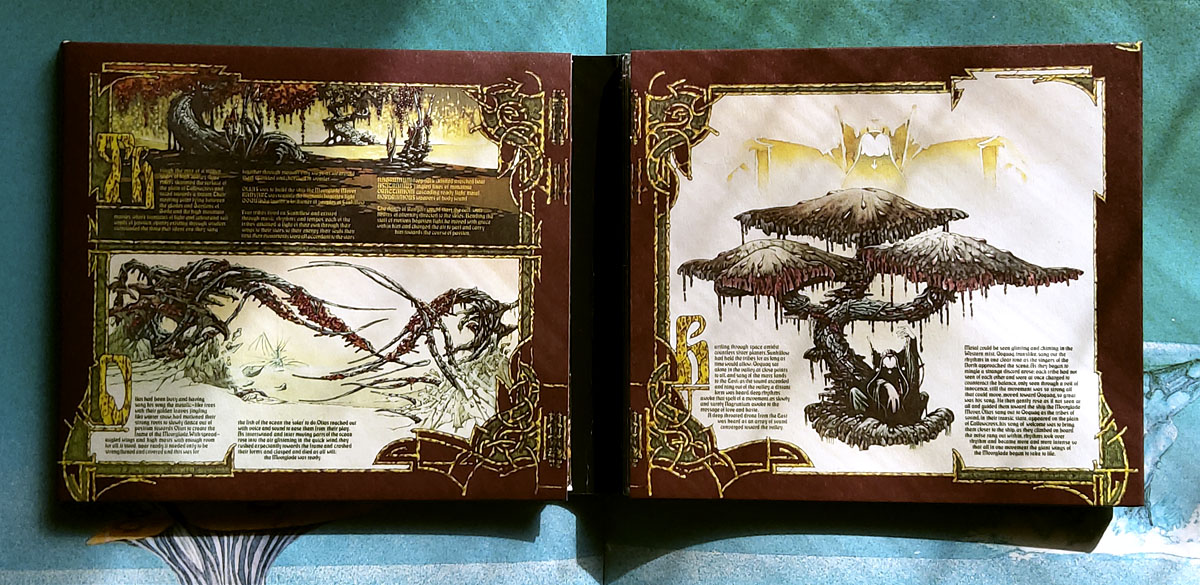
olias3.jpg

For many years in British music circles it would have been a grave error to even acknowledge this album’s existence, never mind admit to actually liking it. This was partly the old animus against progressive rock, an unexamined prejudice that lasted well into the 1990s, but Anderson’s album had so many strikes against it that it might have stood as the winner of a disapproval lottery for the more ideologically rigid writers and readers of the NME. It’s Jon Anderson (strike 1), the lead singer of progressive rock (2) group Yes (3), whose album is a science fiction (4)/ fantasy (5) concept (6), littered with Tolkien-like invented names and words (7), and with a multi-page sleeve embellished with detailed fantasy illustrations (8) by David Fairbrother-Roe. The design was art directed by Hipgnosis, who subsequently designed the next two Yes albums. Anderson originally wanted Roger Dean to create the packaging, which would have provided a further strike of disapproval against the album, but Dean’s career had gone into overdrive following the publication of Views so he either didn’t have the time or didn’t want to be involved. In Views Dean mentions “another project” based on the fish-ship’s journey which may be a reference to Anderson’s forthcoming album, the credits of which thank Dean for “planting the seed”.

views1.jpg

Roger Dean’s original artwork for Fragile (1971). Another fish-ship was added to the final cover art.

Continue reading “Solid Space: Jon Anderson’s cosmic voyage”