Glaser goes POP

glaser1.jpg

The purchase of big art and design books requires careful consideration round here, what with shelf space being stressed in multiple ways. (One of the shelves bearing the heavier volumes sags alarmingly.) But this one was recommended to me by a couple of people, and I’d also had a book token hanging around unused for over a year so here we are.
glaser2.jpg

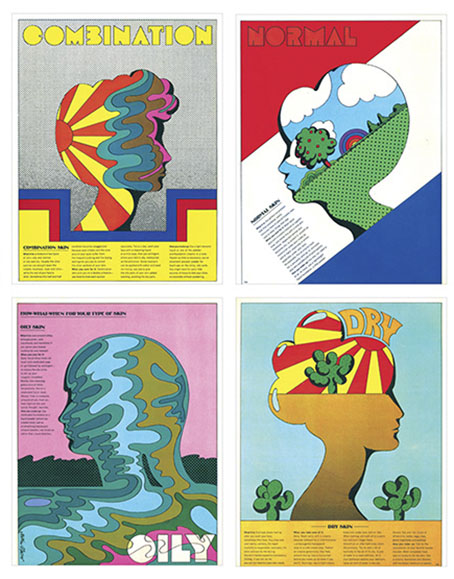
Skin types for Seventeen magazine, 1967.

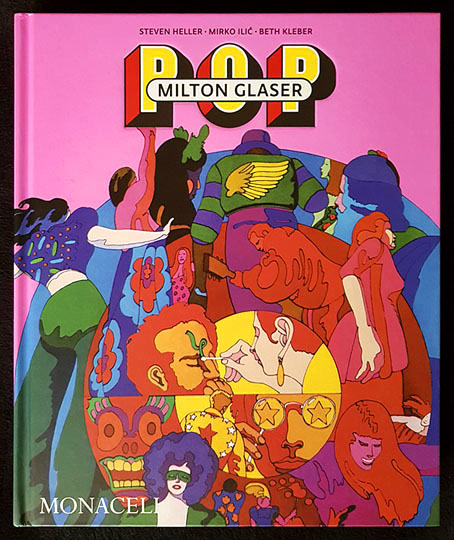
Milton Glaser: POP is a copiously-illustrated 288-page study of the work produced by Milton Glaser and his colleagues at Push Pin Studio, with an emphasis, as the title and cover art suggests, on the company’s prime decade of the 1960s. The book was compiled and edited by the redoubtable Steven Heller, together with Mirko Ilic and Beth Kleber, and presents an overview of Glaser’s remarkable career as designer and illustrator. Glaser was an exceptionally versatile artist, something which has often made appraisal of his career a difficult business. You could easily choose ten of his book or album covers from the many examples assembled by Heller and co., and all would look like the work of different people.
glaser3.jpg

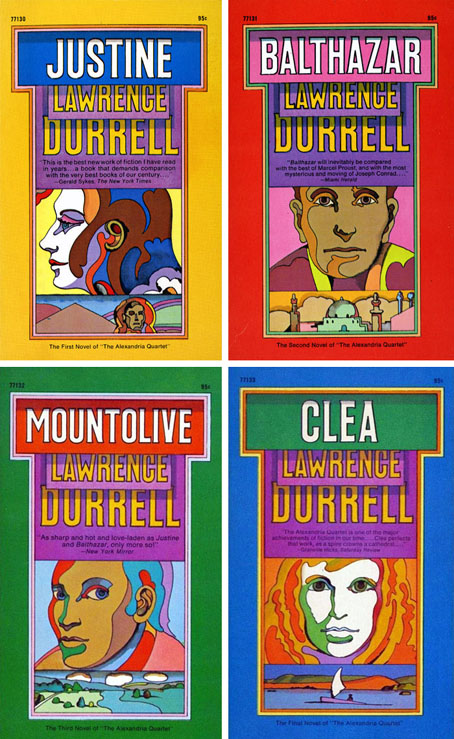
The Alexandria Quartet by Lawrence Durrell; Pocket Books, 1969. I’d much rather have this set than my Faber collection which packages the four books into an unwieldy brick.

Matters are further complicated by the often collaborative nature of the work at Push Pin, and the fact that designers and illustrators aren’t always given credit for their commissions. In the past I’ve gone looking for Glaser’s work then given up when I seemed to be encountering designs that weren’t by him at all. In addition to demonstrating Glaser’s range, Heller, Ilic and Kleber have done everyone a service by showing unused illustrations and crediting work that was previously debatable. Some years ago I wrote a post about the uncredited cover art for the first budget sampler album, The Rock Machine Turns You On (1968), an entry which didn’t manage to resolve the issue of whether or not the cover art was Glaser’s work. It turns out it was by him after all, collage being one of the techniques he employed from time to time.
glaser5.jpg

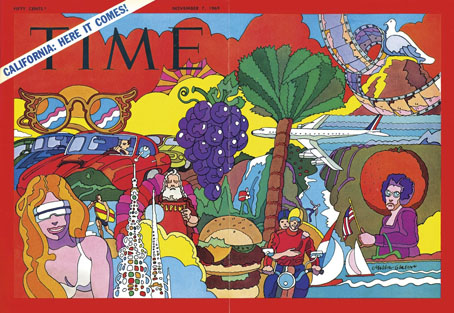
TIME magazine gets groovy. A fold-out cover from 1969.

On a more personal level, Glaser’s versatility and multi-disciplinary approach is encouraging if you find yourself being led in a similar direction. Designer-illustrators are no longer as rare as they used to be, but illustrators, like many fine artists, still tend to develop a favourable style which they then stay with year after year. Illustrators who change their style according to their mood, or the nature of the brief, or a desire to experiment, remain in the minority. Glaser’s illustration ranges more widely than any other artist I’ve seen, from realistic pen-work and watercolour sketches, through bold, stylised designs, to complete abstraction. He could also be playful and frivolous in a manner you can’t imagine from some of his more serious contemporaries, while also being adept enough at illustrating children’s stories that he might easily have spent his career doing this alone.
glaser4.jpg

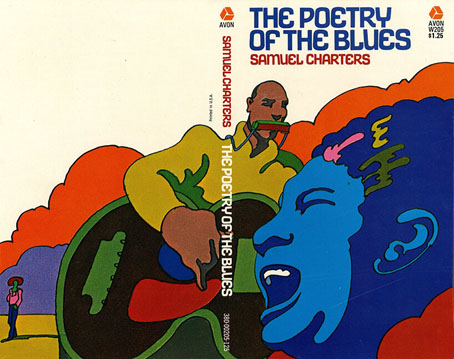
Avon Books, 1970.

But the main attraction of Milton Glaser: POP for this reader is the focus on all those bold graphics, especially the commissions that reworked the emerging psychedelic styles for the commercial sphere. The cover illustration is emblematic of many other examples. This drawing first appeared in a New York magazine supplement in 1967 to accompany an article about LSD, before being reused on the dustjacket of Tom Wolfe’s book about Ken Kesey and friends, The Electric Kool-Aid Acid Test. Glaser and his colleagues at Push Pin were prime exponents of something I’ve taken to calling “the groovy look“, a term I reserve for commercially oriented quasi-psychedelic art. This isn’t meant to be a serious label, it’s a private term that I used to attach to anything resembling the art styles seen in the Yellow Submarine feature film. Serious or not, the label persists when I continue to feel the need for a suitable descriptor for this type of art. “Psychedelic” is the most common label (and one which obviously suits Yellow Submarine) but it seems inappropriate when discussing magazine adverts for household products or illustrations in children’s books. Steven Heller prefers the term “Pop”, but this strikes me as too loose, risking confusion with the many varieties of Pop Art which seldom resemble the vivid, stylised creations of Glaser et al. Pop would also seem misapplied as a description for commercial art when Pop Art was all about the appropriation (ironic or otherwise) of commercial iconography. If you start to label a swathe of commercial art as Pop along with the gallery art that was borrowing from it then the term becomes so diffuse it loses its meaning. The “groovy style” had a long reach, and evolved beyond the decade it was born in. Plenty of examples may be found in the early 1970s by which time Pop Art (in the gallery sense) had lost its momentum.
glaser6.jpg

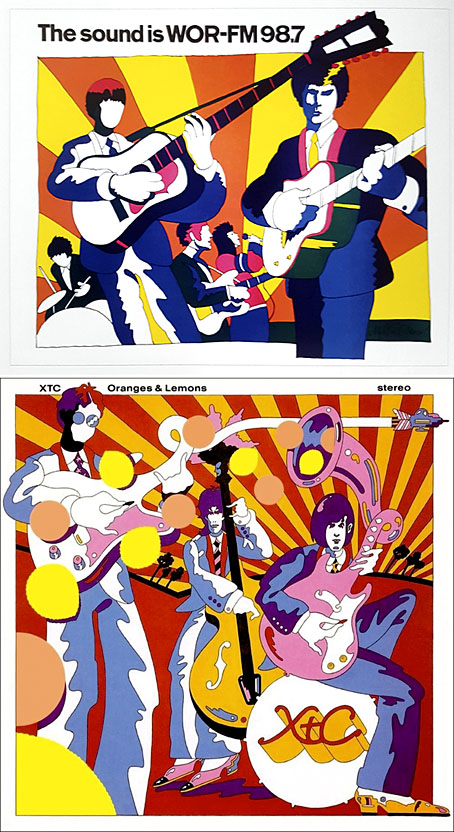
Above: Glaser ad art, 1966. Below: Dave Dragon’s cover art for XTC, 1989.

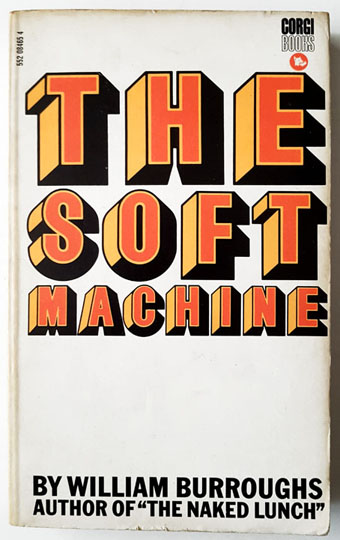
I’ll no doubt return to this question, especially when I’ve just done something in the groovy style myself. (You’ll have to wait a few months before you see the results.) In the meantime there’s a lot to enjoy in this book. I haven’t yet mentioned Glaser’s unused promotional art for the Saul Bass feature film, Phase IV, or the many typeface designs that Glaser created with his associates, and the way one of them—Baby Fat—is used on the cover of the first UK paperback of The Soft Machine. I think this was the first William Burroughs book I ever bought, and it’s been sitting on my shelves all this time without my realising it was a Glaser production. That’s how it often is with graphic designers; they shape our world almost as much as architects do yet their specific influence isn’t always recognised.
glaser7.jpg

Corgi Books, 1970.

And by coincidence, the latest post at The Daily Heller is about a Glaser exhibition tied to the publication of the book. If you’re in New York it’ll be running for the next two weeks.

Previously on { feuilleton }
The groovy look
Milton Glaser album covers

Dennis Leigh book covers

leigh03.jpg

Secker & Warburg, 1989.

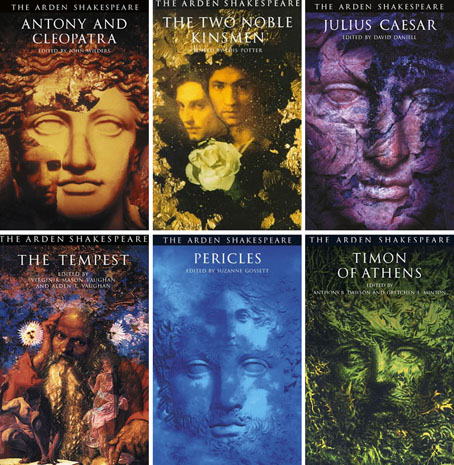
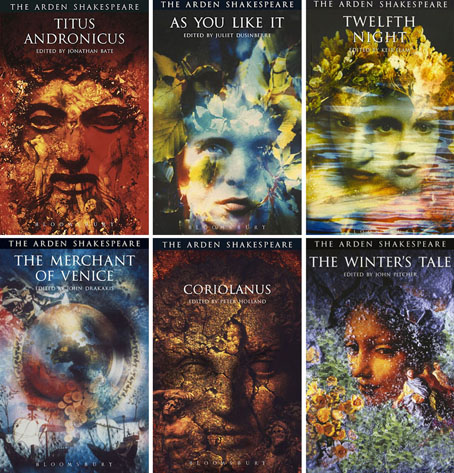
Most people will know Dennis Leigh—if they know him at all—as John Foxx, the name that Leigh adopted in the 1970s when he was the lead singer and songwriter in Ultravox! (That exclamation mark was a fixture for the group’s first two albums.) Foxx and Leigh maintained parallel careers for a while, or alternating careers in the 1990s when he was working more as an illustrator than as a musical artist.

leigh25.jpg

Routledge/Thomson Learning.

I’ve been asked a few times to consider writing about artists or designers who create covers for literary titles. This is something I often consider myself but the research is never easy. If you’re looking for genre titles you can go to isfdb.org and immediately find entries for hundreds of artists with lists of their credits; Dennis Leigh has an entry there himself. There’s no equivalent source for literary fiction, and nothing for crime novels or non-fiction either. This post is based on a list compiled by a correspondent (thanks, Marc!) to which I added a couple of discoveries of my own. It’s not complete but it ranges through Leigh’s career as a cover artist from the 1970s to the 2000s.

leigh26.jpg

Bloomsbury.

One of the useful things about Dennis Leigh having a more popular alter ego is the amount of interviews in which John Foxx discusses his work outside the music business. While researching this post I found a Smash Hits interview where Foxx mentions having attended Blackpool art college for a short time. This was the same art college that my mother attended in the 1950s, and a place I happily avoided myself. The college is so undistinguished I think Foxx/Leigh may be the only person of any note to have passed through its doors. A more recent interview for Shakespeare Magazine features some discussion of the techniques behind the book covers.

leigh01.jpg

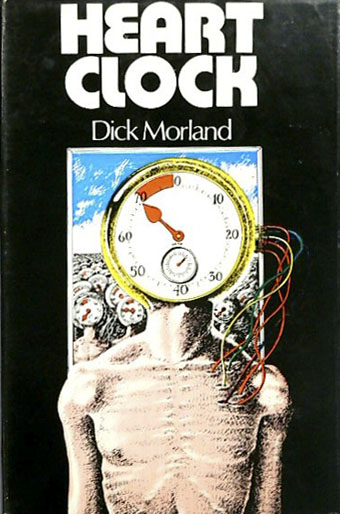
Faber, 1973. Reginald Hill wrote two science-fiction novels as “Dick Morland”, this one and Albion! Albion! (1974). The latter is also listed as having a Leigh cover but the evidence for this is unclear so I’ve not included it.

Missing from this list are covers for novels by Neil Bartlett, Michael Cunningham, Evan Eisenberg, Eva Figes, and Marina Warner, all of which are only available as very low-grade images or not available at all. Another hazard when researching these posts is that artists and designers aren’t always credited, especially on paperbacks, so there may be a few more to be found. Be aware that some covers that might look like Dennis Leigh creations may be the work of somebody else. In the late 80s/early 90s there was a trend for Photoshop montage and what I call “artschool assemblage” (collage riffs on Joseph Cornell and others). If any of the examples here are erroneous attributions let me know.

leigh02.jpg

Faber, 1973.

leigh04.jpg

Vintage, 1990.

Continue reading “Dennis Leigh book covers”

Weekend links 670

mutzel.jpg

An octopus catching a lobster (1894) by Gustav Mützel.

• RIP Barry Humphries. He emailed me a couple of years ago in his capacity as a collector of fin-de-siècle art, hoping I might answer a question about a very obscure artist. If you require justifications for the blogging habit then add this to the list. Humphries’ first book, Bizarre (1965), is a more cerebral counterpart to Charles Addams’ Dear Dead Days, and a compendium of oddities that I’d buy if I ever saw it in a secondhand shop. RIP also to incendiary singer Mark Stewart.

• “Schulz gets compared to Kafka because of his dreamy, disconcerting stories, but in Balint’s book, a version of Schulz emerges that is closer to one of Kafka’s characters—a man on the run who can’t get past the city walls; an artist exiled by a shape-shifting, unknowable tormentor—than to Franz himself.” Leo Lasdun reviewing a new biography of Bruno Schulz by Benjamin Balint.

• “Instead of asking whether an octopus shows aspects of human intelligence, perhaps the better question is whether humans can show aspects of octopus intelligence.” David Borkenhagen on octopuses and what they might teach us about the perception of time.

• “Uproar was my element, I wanted to get people moving, the more they roared, the bolder I became.” The pioneering theatrical performances of Valeska Gert are explored at Strange Flowers.

• Digital copies of albums by the mighty Earth may currently be purchased at the group’s Bandcamp page for $1 each. I’ve got everything already but you may wish to sample something.

Charles Drazin on the director who dared to tell uncomfortable truths: Lindsay Anderson at 100.

Steven Heller on Commercial Art, a magazine from the 1920s that chronicled UK design.

• At Unquiet Things: The luminous drama of Frants Diderik Bøe’s bejewelled floral still lifes.

• New music: This Vibrating Earth by Field Lines Cartographer, and Draw/Orb by Extra.

• Mix of the week: XLR8R podcast 796 by Gold Panda.

• The Strange World of…Andrzej Korzynski.

The Jewel In The Lotus (1974) by Bennie Maupin | Jewel (1985) by Propaganda | Black Jewelled Serpent Of Sound (1985) by The Dukes Of Stratosphear

Eco Del Universo

edu1.jpg

Eco Del Universo, the ninth album by Mexican band Los Mundos, was released last month on Acid Test Recordings. I designed and illustrated the outer and inner sleeves for an album whose music is described on the group’s Bandcamp page as psychedelic rock. I’ve not seen a physical copy yet but the vinyl disc is available in two pressings that complement the colours of the cover.

edu2.jpg

The brief for this one was for something based on the concrete fantasia known as Las Pozas, an overgrown park with accompanying hotel that Edward James spent many years and a great deal of money building in the Mexican jungle. James was a British aristocrat who fell for Surrealism in a big way in the 1930s, using his inherited wealth to support artists such as Salvador Dalí, René Magritte and Leonora Carrington, while creating Surrealist-styled homes for himself, first at Monkton House in West Sussex then at Xilitla in Mexico. James and his jungle resort have been recurrent subjects here so I didn’t need much encouragement to create something based on his constructions. In the past I’ve described Las Pozas as unfinished but this suggests a scheme with a final goal in mind. I don’t think this was ever James’s intention. His creations are more like very large concrete sculptures rather than architecture, even though some of them have a recognisable architectural form. Finished or not, the structures are a unique hybrid of the purposeless architectural folly—a popular indulgence for British landowners of the 18th and 19th centuries—and caprices like the Palais Idéal of Ferdinand Cheval.

edu3.jpg

My cover art is a fantasy on the fantasy which makes James’s improvisations look a little more planned than they are by mirroring their disposition. I also crowded together several of the constructions which at Las Pozas are in separate areas of the complex. Looking at the artwork again I’m reminded of some of Roger Dean’s views which wasn’t my intention originally. I think it’s the combination of unusual architecture, layered foliage and the treatment of light and shade. If the structures weren’t outlined and the sky was a Dean-like gradient there’d be even more of a similarity. The beautiful stellar photo is from the European Southern Observatory (ESO) whose images of the cosmos are free to use so long as you give them credit. This one was by Stéphane Guisard.

Previously on { feuilleton }
The Secret Life of Edward James
Palais Idéal panoramas
Las Pozas panoramas
Return to Las Pozas
Las Pozas and Edward James

Bugged by Jaffee

jaffee-bug1.jpg

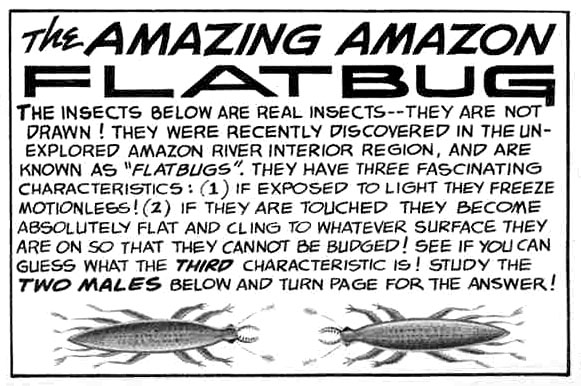
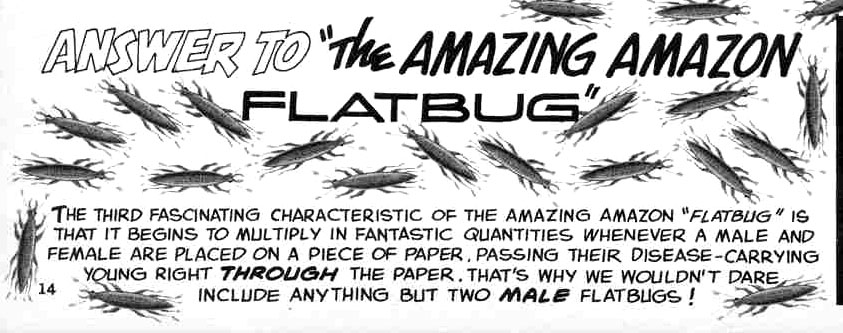
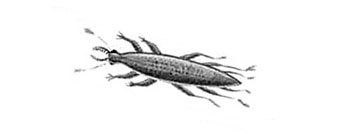
This one is for my own benefit as much as anyone else’s. Last week, after reading about the late Al Jaffee, I went looking for the panel you see above, a minor item in a much longer Jaffee feature for an issue of Mad magazine from the 1960s. The flatbugs have been one of my favourite Jaffee jokes for many years, but never having kept a note of which issue they appeared in I’ve always had a problem finding them when I’ve wanted to tell someone about them or see them again. On this occasion searches for various combinations of “mad”, “magazine”, “jaffee”, “bugs”, “flatbugs”, “flat bugs” yielded nothing other than a brief mention on a Reddit thread, along with too many articles about insect infestation. Google Books is sometimes useful for search leads but not this time. Twitter still has its uses, however; someone there had mentioned the flatbugs a couple of years ago, as well as the issue they appeared in, Mad no. 107 for December 1966, so here they are at last.

jaffee2-bug2.jpg

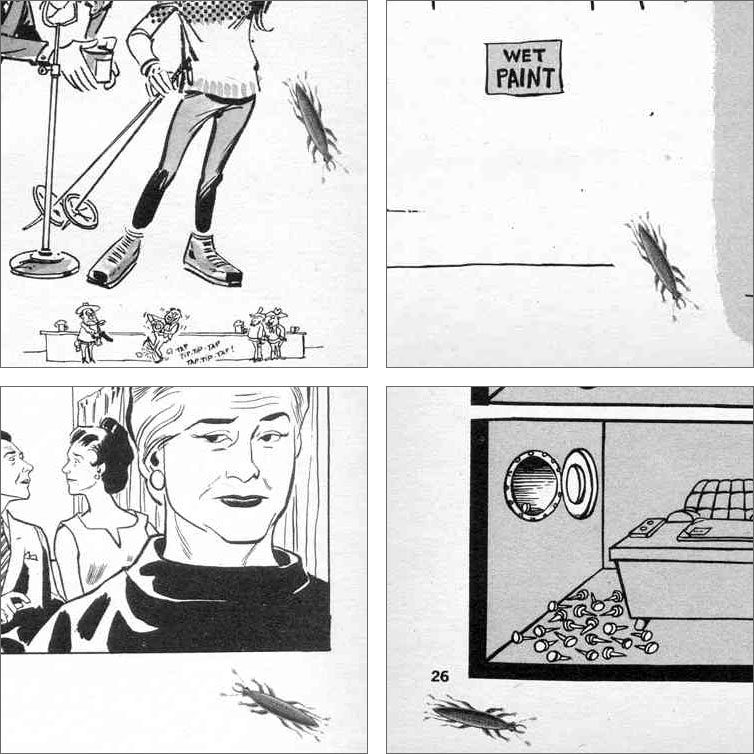
The thing that made the flatbugs so memorable (if not locatable) was that this is a rare Mad joke that’s allowed to extend throughout the rest of the issue. Jaffee’s bug panels occupied two corners of a three-page collection of puzzles and visual gags which is why they’ve always been difficult to track down, you won’t see any mention of them in an index or table of contents. Despite this, issue 107 really ought to be called the flatbug issue. Once you’ve read about the breeding habits of the creatures you start seeing more of them on the pages that follow, even those by artists other than Jaffee; the last of the bugs appears on Jaffee’s fold-in page. This has some precedent in the tiny Sergio Aragones cartoons that appeared in the page margins but I’ve not seen any other one-off gags used like this. Jaffee is lauded for his fold-ins but this shows him playing with the form of the magazine in a different way, suggesting that these were real creatures, albeit motionless and almost two-dimensional.

jaffee-bug4.jpg

I only got to see issue 107 a few years ago when scanned copies of the magazine began to turn up online. Prior to this I knew the flatbugs from one of the reprint books which were all you got to see of older copies of Mad magazine outside the US. I might never have seen these either if it wasn’t for a friend at school who collected humour paperbacks. He had a huge stock of the things, not only the Mad books but many of their spin-offs by Al Jaffee, Don Martin and co. The book with the flatbugs, Rip Off Mad, dates from 1973 but most of the material inside is from the previous decade. I’ve not seen a copy of this since the 1970s but I know that the bugs spread throughout the book just as they did in the magazine, even though the contents were different to issue 107.

lambshead.jpg

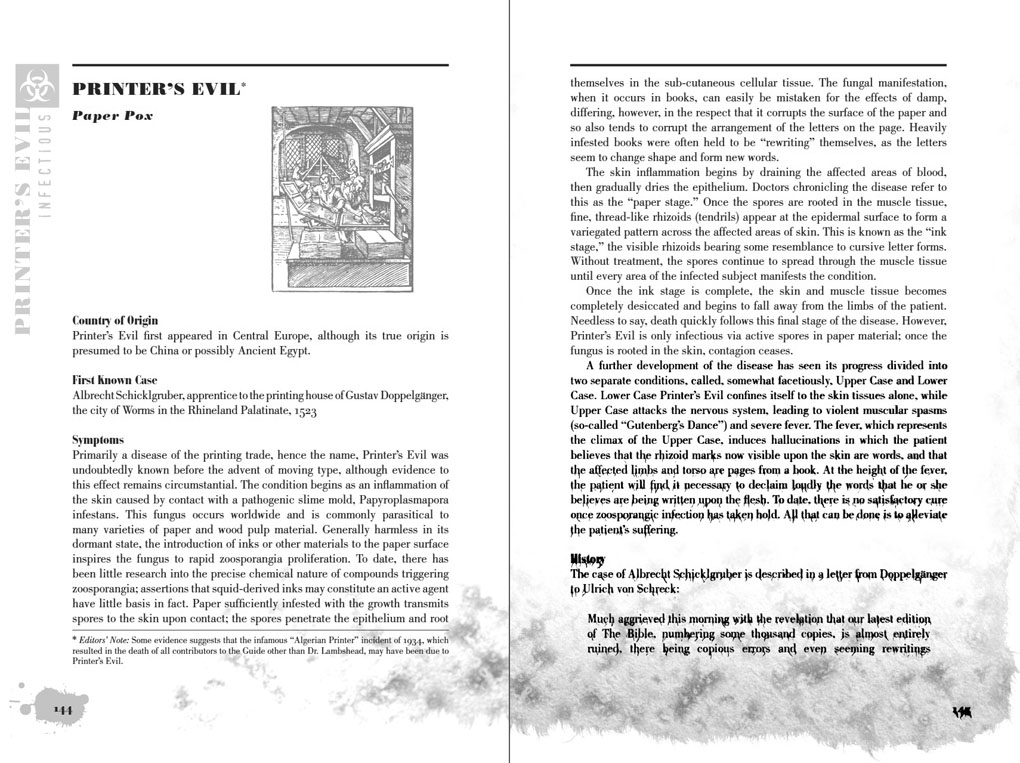
In 2003 the flatbugs came to mind when I was writing my entry for the Thackery T. Lambshead Pocket Guide to Eccentric and Discredited Diseases. My disease, “Printer’s Evil”, is a fungal growth that infects paper, and thereby passes to anyone who touches an affected page. The entry itself was, of course, contaminated in this way. Ideally one of the pages for this section would have had a frayed edge but there wasn’t the budget for such indulgence. If you do have the budget then the possibilities expand for humorous invention. The first Monty Python book, Monty Python’s Big Red Book, features a die-cut page (below), while Eric Idle’s Rutland Dirty Weekend Book has a parody of Rolling Stone magazine (Rutland Stone) printed on smaller-sized newsprint pages bound into the centre of the book. The Python books were developing a convention established by Mad (and continued in National Lampoon) of parodying print media in exacting detail, matching fonts, layouts, graphics and so on. (See this article.)

python.jpg

From the Python books. Left: Monty Python’s Big Red Book (1971); right: The Brand New Monty Python Bok (1973).

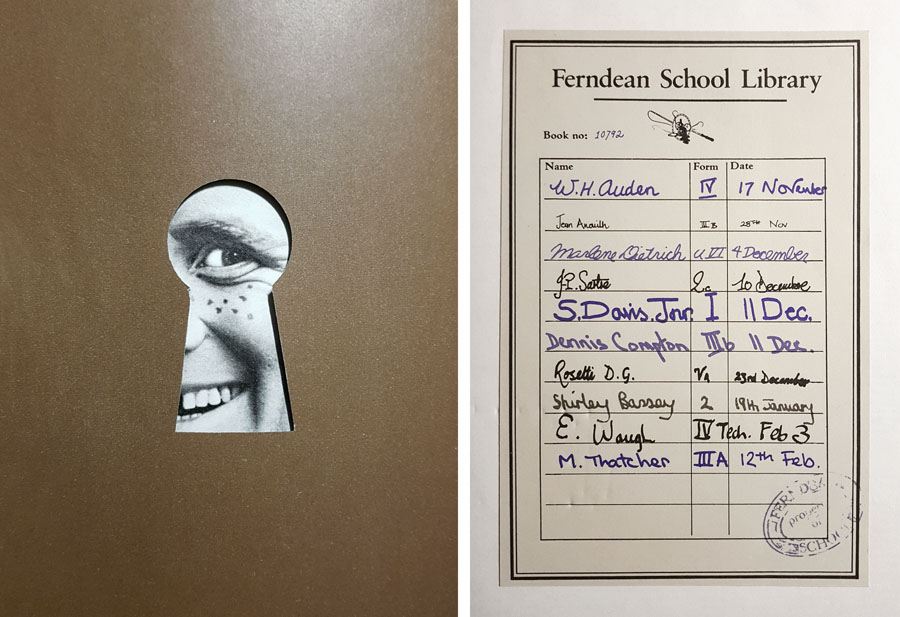
The pinnacle in this sphere is The Brand New Monty Python Bok, with its smudged fingerprints printed on a white dust-jacket (which prompted complaints from booksellers), beneath which you find a cover for a very different book, Tits ’n Bums: A Weekly Look at Church Architecture, a cover that must cause problems for resale if the dust-jacket is missing. Inside the book there’s a tipped-in library card showing the names and signatures of previous owners, while two differently-sized supplemental sections are bound into the pages. In the early 1960s Terry Gilliam had worked for Harvey Kurtzman’s Help! magazine so there’s a direct line from Python back to Mad, especially when other artists on the Help! staff included Mad regulars Al Jaffee, Jack Davis and Will Elder; Kurtzman and Gilliam subsequently collaborated on a puzzle book where the graphics and the humour sit mid-way between Mad and Monty Python. The Mad-like quality of The Brand New Monty Python Bok is reinforced by a pair of Gilliam comic strips. Jaffee’s flatbugs would be (immovably) at home there.

Previously on { feuilleton }
Blivets
The Thackery T. Lambshead Cabinet of Curiosities
Gilliam’s shaver and Bovril by electrocution
Portuguese Diseases
Pasticheur’s Addiction

jaffee-bug3.jpg