Dan O’Bannon, 1946–2009

alien.jpg

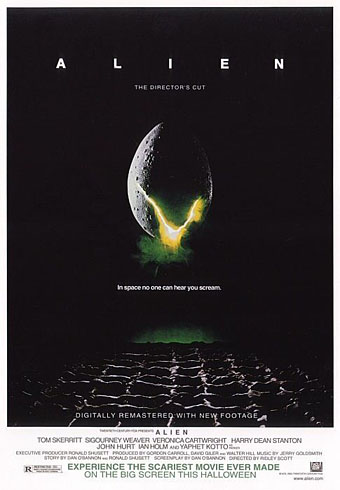
Re-release poster by Bemis Balkind.

Alien was a big deal for me when it appeared in late 1979, one of those films that seems to arrive at exactly the right moment. I’d just left school, I was eagerly reading reprints of French and Belgian comic strips in Heavy Metal magazine, and also paperback reprints of science fiction stories from New Worlds; I was listening to Hawkwind and becoming increasingly obsessed with HP Lovecraft. I was, in short, the target audience for a serious SF-themed horror film with contributions from major artists like HR Giger and Jean “Moebius” Giraud, and I went to see it three times in a row.

Watching Star Wars two years earlier (for which Dan O’Bannon created the computer displays), I’d enjoyed the special effects but been disappointed by its space-opera tone and dumb heroics. HR Giger’s large-format Necronomicon art book was published in the UK the same year and the sight of his work was a revelation for the way it pushed Dalí-esque Surrealism to a pitch of unprecedented mutation and malevolence. A year later his paintings were appearing in Omni magazine but it was Alien which exploded his popularity. Throughout 1979 you could hardly open a magazine or newspaper without finding a Giger interview or examples of his work. Alien benefited from the SF boom that Star Wars generated but Dan O’Bannon didn’t need George Lucas’s feeble mythology to point him towards science fiction, he’d already made one low-budget sf film, Dark Star, with John Carpenter, and was planning the effects for Jodorowsky’s ill-fated Dune project years before the world had heard of Luke Skywalker. Dune introduced him to Moebius, and the pair collaborated on an SF-noir strip, The Long Tomorrow, which was published in Heavy Metal in 1977. But it was Giger’s connection with the Dune project which proved crucial for Alien:

“(Dune) collapsed so badly,” O’Bannon says, “that I ended up in L.A. without any money, without an apartment, without a car, with half my belongings back in Paris and the other half in storage.”

He retreated to the sofa of a friend, screenwriter Ron Shusett, and didn’t leave it for a week. But depressed or not, O’Bannon knew he had to get back to work. He got his files and typewriter out of storage, and he and Shusett went to work on stacks and stacks of partially completed ideas.

“We pulled out one that I liked very much,” he says, “an old script called Memory that was half-finished and was basically what the first half of Alien is now. I told Ron I’d never been able to figure out the rest of the story. So he read it and said, ‘Well, you told me another idea you had once for a movie. It was the one where gremlins get onto a B-17 bomber during World War II and give the pilots a lot of trouble. So why don’t you make that the second half and put it on a spaceship?’

“That was a great idea, but then we had to figure out the monster. Well, I hadn’t been able to get Hans Rudi Giger off my mind since I left France. His paintings had a profound effect on me. I had never seen anything that was quite as horrible and at the same time as beautiful as his work. And so I ended up writing a script about a Giger monster.”

The working title was Star Beast. O’Bannon had a fortunate brainstorm late one night as he continued to write while Shusett slept. “I was writing dialogue and one of the characters said, ‘What are we going to do about the alien?’ The word came out of the page at me and I said, ‘Alien. It’s a noun and an adjective.’ So I went in the other room and shook Ron awake and told him and he said, ‘Yeah, OK,’ and went back to sleep. But I knew I had found a really hot title.”

The Book of Alien (1979) by Paul Scanlon and Michael Gross

Lest we forget, it was O’Bannon who insisted that Ridley Scott look at Giger’s work during the production of the film after artist Ron Cobb failed to produce a sufficiently nightmarish creature. O’Bannon’s script was mauled by Walter Hill who removed sub-plots, and further scenes were trimmed to speed the pace, but Alien‘s unique atmosphere remains as potent today as it was in 1979. It’s ironic that O’Bannon died in the week that James Cameron’s Avatar (which happens to star Sigourney Weaver) is released. To watch all four Alien films in sequence is to witness progressively diminishing returns, and it was Cameron’s sequel which set the pattern for the later films by dropping the adjective part of the O’Bannon’s title in favour of the noun. There had been plenty of movie monsters before but it was the inhuman quality which we label “alien” that O’Bannon and Giger brought to SF cinema. It’s a quality that few have been able to deliver since, not least in Avatar which (from what I’ve seen) looks less alien than something Frank R Paul might have painted in the 1930s. O’Bannon did a lot more after Alien, of course, but it’s his first big success which will always mean the most to me. I recommend Ridley Scott’s director’s cut from 2003 which restored scenes and shots removed from the original release.

Remembering the late, great Dan O’Bannon
The first action heroine: Ellen Ripley and Alien, 30 years on

Previously on { feuilleton }
Alejandro Jodorowsky’s Dune
The monstrous tome

Grandville’s Un Autre Monde

grandville1.jpg

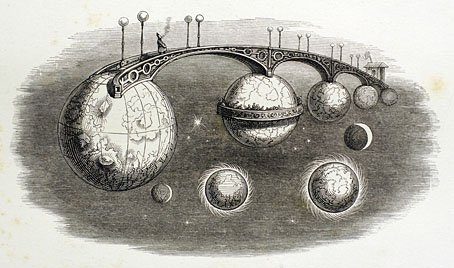
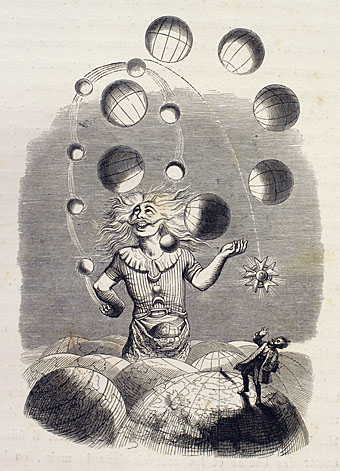
Un Autre Monde by JJ Grandville is a satire from 1844 whose wittily inventive illustrations were among that select group of prior works which received praise from the Surrealists. Some of them also act as early examples of humorous science fiction, and the two pieces shown here have been reprinted endlessly, they even turn up in histories of astronomy. The other illustrations are rarely seen, however, so it’s good to find a Flickr set with scans of the entire book. Comic artist Philippe Druillet took the bridge between worlds as the inspiration for his Lone Sloane story Torquedara Varenkor: The Bridge Over the Stars in 1970, turning the already unlikely construction into a galaxy-spanning edifice.

grandville2.jpg

Elsewhere on { feuilleton }
The etching and engraving archive

Previously on { feuilleton }
Druillet meets Hodgson

Teleny, Or the Reverse of the Medal

teleny1.jpg

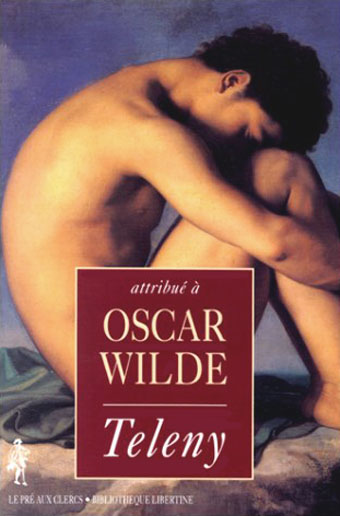
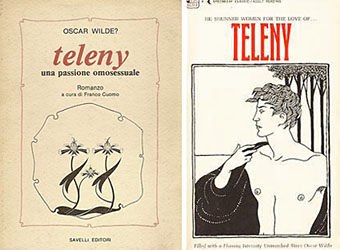
Bibliothèque Libertine edition (1996).

The quintessence of bliss can, therefore, only be enjoyed by beings of the same sex… Teleny

More Wildeana, and yes, it’s that painting againTeleny is an authorless, explicitly homoerotic novel often attributed to Oscar Wilde although what evidence there is regarding its creation points to its being the work of several hands. The book was published in a limited edition by Leonard Smithers in 1893 then subsequently reissued in a variety of editions which, being illicit and copyright-free, suffered excisions and textual amendments. Smithers was a good friend of Wilde’s. In addition to being Victorian London’s most prominent pornographer (a sign in his Bond Street shop window proudly declared “Smut is cheap today”), Smithers also financed The Savoy magazine, and kept Aubrey Beardsley solvent after the artist’s commissions dried up following Wilde’s imprisonment in 1895.

The convoluted history of Teleny begins with its mysterious origin, recounted here by Beardsley scholar Brian Reade in Philippe Jullian’s 1969 Wilde biography:

Charles Hirsch, a Parisian bookseller, came to London in 1889 and opened a shop in Coventry Street where he sold Continental books and newspapers. Wilde was a frequent customer of his, and Hirsch used to obtain for him Alcibiades enfant à l’Ecole and The Sins of the Cities of the Plain. Many of these were reprints of well-known works of this character. Towards the end of 1890 Wilde brought into the shop a thin paper commercial-style notebook, wrapped up and sealed. This he instructed Hirsch to hand over to a friend who would present his card. Shortly afterwards, one of Wilde’s young friends whose name Hirsch had forgotten by the time he recorded the incident called at the shop and after showing Wilde’s card took away the packed-up notebook. A few days later the young man came back and handed the manuscript to Hirsch, saying another man would call and collect it in a similar manner. In all, four men seem to have taken away and returned the manuscript, and the last left the wrapper undone. Succumbing to temptation, Hirsch opened the parcel and read the contents of the notebook, the leaves of which were loose. On the cover there was a single word TELENY; inside about 200 pages of a novel which appeared to be a collaborative effort. No author’s name was given. The handwritings were various; there were conspicuous erasures, cuttings-out and corrections. Hirsch believed that some of the writing was Wilde’s. In due course Hirsch gave the manuscript back to Wilde. He next came across Teleny when he found it had been printed by Leonard Smithers in an edition privately issued and limited to 200 copies, with only the imprint ‘Cosmopoli’ at the bottom of the title page, and the date 1893. In this printed version, Paris had been substituted for London as the scene of the action, and there were certain differences of detail. There was an added sub-title Or the reverse of the Medal, and the Prologue had been cut out. When Hirsch got to know Smithers in 1900, he asked about the book, and was told that Smithers had wished not to upset the self-respect of clients by leaving the story with a London background. There was also Des Grieux, A Prelude to Teleny which was announced for publication by the Erotica Biblion Society in 1908. One can go over the names and literary mannerisms of some of the better-remembered persons in his circle in 1890, but to associate any of them with the authorship of Teleny would be difficult. Copies of Teleny in the 1893 edition are very rare indeed. The British Museum has one, but those in private possession have been reduced in number no doubt by executors and others who considered them unfit for anything else than fire. A new edition was brought out by the Olympia Press of Paris, and in it Wilde was definitely, but mistakenly, credited with the authorship; and an expurgated version was produced in paperback form by Icon in 1966, with an introduction by Montgomery Hyde.

Neil McKenna in The Secret Life of Oscar Wilde (2003) is convinced of Wilde’s involvement whereas Richard Ellmann firmly dismissed the notion in his own more substantial biography. Some of the dissent is perhaps a result of competing agendas, in McKenna’s case a determination to establish a firmly gay persona for the author. McKenna explores Wilde’s sex life in detail, something that Ellmann frequently skates over. Ellmann, meanwhile, has a better grasp of Wilde’s literary prowess and evidently thought that Teleny didn’t adequately match the rest of the author’s work. I remain agnostic on the issue while being struck by the frequent use in Teleny of flower metaphors which the narrator deploys when describing the object of his affection. Having recently read McKenna’s book (which quotes throughout from Wilde’s letters), and re-read The Picture of Dorian Gray, it’s impossible to avoid Wilde’s continuous recourse to flower imagery when referring to people or even items of furniture. One of the more striking examples of this was his description of Aubrey Beardsley and sister Mabel in a letter to Ada Leverson: “What a contrast the two are—Mabel a daisy, Aubrey the most monstrous of orchids.” On the debit side of the authorship argument I’d say that Wilde is unlikely to have invented the central relationship between Camille de Grieux and his Hungarian lover, René Teleny. McKenna’s book makes it clear that Wilde preferred younger men, particularly teenagers, and would no doubt have outlined a different story had he been the sole originator.

teleny2.jpg

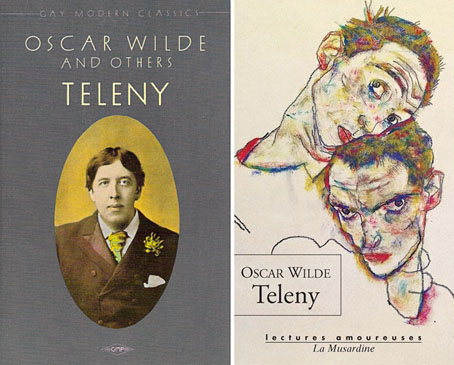
left: Gay Men’s Press edition (1986); right: La Musardine edition (with Egon Schiele cover, 2009).

Everyone who discusses Teleny, however, is agreed that its prose is more finely-wrought than much general writing of the period, never mind the era’s pornography. The sexual description is powerfully erotic and gives the lie to the canard (perpetuated by the egregious Auberon Waugh and his annual Bad Sex in Fiction Award) that describing sex is almost always a mistake. Describing anything poorly is a mistake, the challenge is to do the thing well, and Teleny describes the encounters of its pair of lovers better than many writers would manage today.

teleny3.jpg

Genuine (left) and pastiche (right) Beardsley designs.

With such an intriguing work it’s always a boon if there’s further discussion on the subject, and the Wilde connection pays off here with a whole section of the Oscholars website being devoted to the book. Of particular note is John McRae’s introduction to a revised and textually corrected edition published in 1986 by London’s Gay Men’s Press. Jason Boyd, meanwhile, argues that the book could never be wholly attributed to Wilde. Also present is a page showing different cover designs for the various editions, some of which are shown above. As well as the inevitable Wilde portraits and Beardsley designs there’s the surprise appearance of Flandrin’s Jeune Homme Assis au Bord de la Mer on several editions. Other pages at Oscholars include plates from an illustrated edition of the novel whose publisher and illustrator, Uday K Dhar, forbid reproduction elsewhere, an all-too-common example of copyright paranoia which ensures the audience for their work remains a limited one. By contrast, artist Jon Macy has an entire site devoted to his comic strip adaptation of Teleny. His black-and-white drawing and attention to detail combine to make his book another item for the shopping list.

Update: The Oscholars site appears to have folded so the links now connect to archived pages.

Elsewhere on { feuilleton }
The Oscar Wilde archive
The recurrent pose archive

Dodgem Logic

dodgem1.jpg

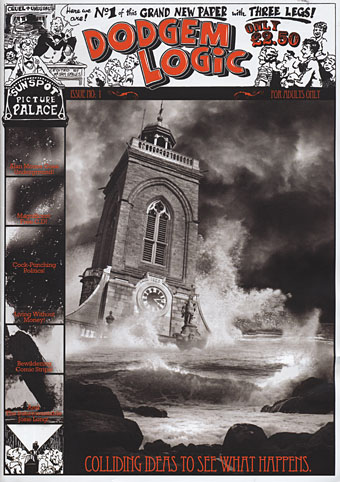
You need this, boys and girls, yes you do. Dodgem Logic is the first worthwhile independent culture mag this country has produced since the sorely-missed Strange Things Are Happening. Perhaps significantly, both those titles featured Mr Alan Moore, being interviewed in Strange Things and presiding over the new title as resident magus and eminence gris-gris.

“…we’ve tried to resurrect a spirit of the 60s underground papers, but without the look or ambience or some of the oversights. There were a lot of very good ideas that emerged from the 60s underground. It was the first place I heard about women’s liberation – as we used to call it then – or gay liberation. They were fanatically anti-war. Many of their most extreme political statements, such as the fact that sometimes the police kill people, or that sometimes we make deals with dictators and criminal governments that we keep quiet about – these things are pretty much standard stuff of conversation these days and not reserved purely for bearded wild-eyed burbling radicals (chuckles).” (More.)

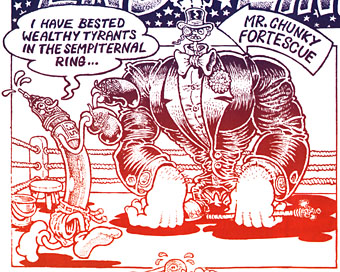
Among other delights, there’s a page of Alan’s where he returns to cartooning (below) with a paean to my favourite drawing pen, the Rotring Rapidograph, Melinda Gebbie writing on feminism, Kevin O’Neill with a WTF of cosmic proportions, and much more, including a smart feature on how to reclaim local land which the council won’t use. All this and a free CD! Who says we can’t have good things?

Update: I should have noted that Americans can order Dodgem Logic through Top Shelf.

dodgem2.jpg

Previously on { feuilleton }
International Times archive
The Realist
Revenant volumes: Bob Haberfield, New Worlds and others
Oz magazine, 1967-73
Alan Moore interview, 1988
Strange Things Are Happening, 1988-1990

Humpty Dumpty variations

thurstan.jpg

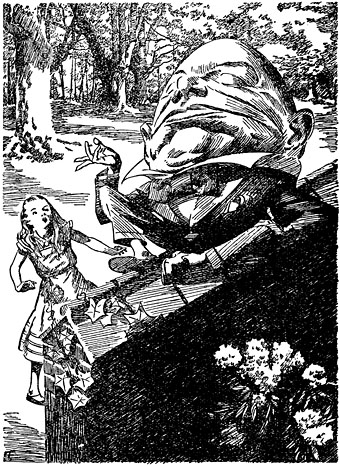
Humpty Dumpty by EB Thurstan (1930).

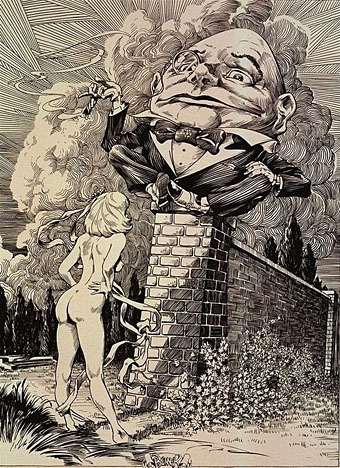
A preoccupation of the past couple of weeks has been Lewis Carroll’s Alice books as I’ve been working on an Alice in Wonderland project which I’ll unveil shortly. Looking around at some of the numerous visual interpretations of the stories I came across two portfolios I hadn’t seen before by comic artist Frank Brunner. These are from the late Seventies, and typically for that decade they work an erotic twist on the books by adding ten years to Alice’s age whilst depriving her of clothes. Nudity aside, Brunner’s drawings don’t depart from tradition very much—or add much, for that matter—but I did notice that he’d based his Humpty Dumpty figure on an earlier version by illustrator EB Thurstan.

brunner.jpg

Humpty Dumpty by Frank Brunner (1978?).

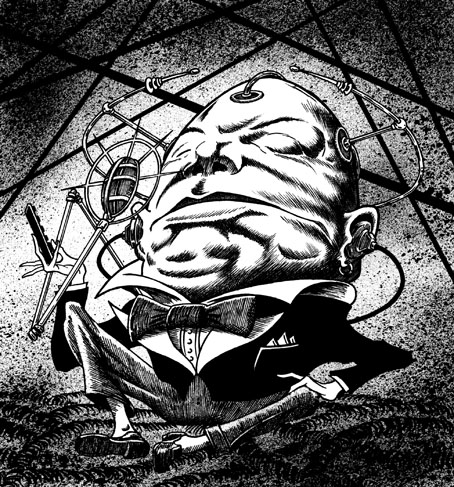
The reason Thurstan’s Humpty is so familiar is that I’d borrowed it myself for one of the many appearances by the character in the Lord Horror comic series, Reverbstorm. Humpty’s presence there would involve too much explanation so you’ll have to be satisfied with the character who explains Jabberwocky remaining inexplicable. As for Brunner’s drawings, you can see coloured versions on his website.

reverbstorm.jpg

Humpty Dumpty from Reverbstorm #3 (1994).

Previously on { feuilleton }
Alice in Wonderland by Jonathan Miller
The Illustrators of Alice