Le Città In/visibili

sbe06.jpg

Thin Cities 3: Armilla by Luca Enoch.

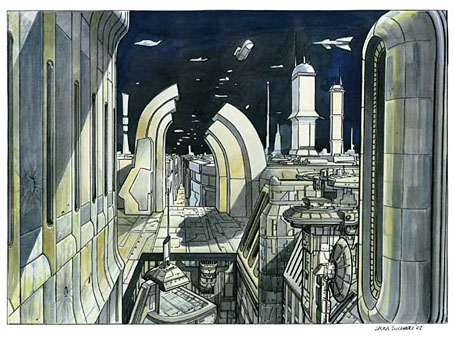
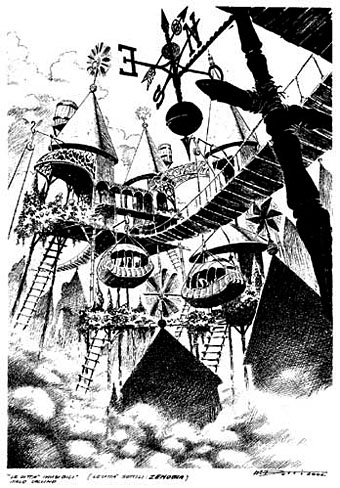
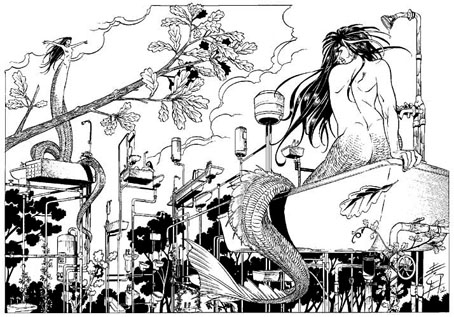
Sergio Bonelli Editore, an Italian comics publisher, staged an exhibition of art based on Italo Calvino’s Invisible Cities at the Triennale Milano in 2002. The drawings for Le Città In/visibili head in the opposite direction from Mikhail Viesel’s depictions, and in several pictures push the cities towards generic fantasy and science fiction. These images are from an extinct page on the publisher’s website although they may also be seen on the current site with a little searching. The publisher doesn’t offer much information, however, so while the artists are identified it’s less clear which cities are being depicted. I’ve noted the more obvious ones; Calvino obsessives can have fun guessing which the others might be.

sbe02.jpg

Laura Zuccheri.

sbe05.jpg

Thin Cities 2: Zenobia by Maurizio Dotti.

Continue reading “Le Città In/visibili”

Weekend links 257

tarot.jpg

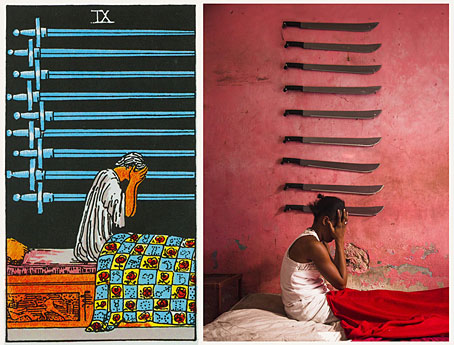
The Nine of Swords by Pamela Colman Smith, and the same card from The Ghetto Tarot, a Haitian deck created by photographer Alice Smits and Haitian art group Atis Rezistans.

Almost four months after the murders in Paris, Charlie Hebdo continues to be problematic, to use a common epithet. The “p” word occurs with such frequency in current discussions about offence—and those discussions so often seem like a secular version of old religious arguments, with Manichean forces pitted against each other, and the same schisms, heresies and witch hunts—that I’ve taken to translating “problematic” as “sinful”. Charlie Hebdo is nothing if not a heretical text even if many of those pronouncing on its heresies have never read a copy. Back in January I was confident that we’d be seeing a great deal of equivocation (if not outright victim-blaming) when people began to look closely at the magazine, or at least read hasty appraisals of its contents. You didn’t have to be a psychic to predict any of this because the equivocations are merely the current manifestation of a familiar syndrome. This week’s authorial objections about PEN America honouring Charlie Hebdo have led to a reiteration of the grumblings we heard in January: “Yes, of course, we condemn the violence but…” But, what? “But, it’s a sinful publication…”(This piece by one of the PEN objectors in the LRB is typical.) Publication liberties, which in the UK are more constrained than in the US, are apparently best championed for the virtuous (the responsible, the respectful, etc), not the sinful. In 1963 “Yes, but…” equivocations about freedom of speech were being deployed in the letters page of the Times Literary Supplement with worthies such as Victor Gollancz and Edith Sitwell wondering why it was necessary to defend a deplorable book like The Naked Lunch; in 1992 I sat in a courtroom watching a judge make similar comments when grudgingly overturning an obscenity ruling against David Britton’s Lord Horror novel. The same judge then upheld the obscenity charge against Britton & Guidio’s Meng & Ecker comic which he regarded as trashier fare, “luridly bound” and containing “pictures that will be repulsive to right-thinking people”.

So much for old arguments. Jodie Ginsberg at Index on Censorship goes into some detail about the PEN kerfuffle in a piece entitled “I believe in free expression, but…”; Justin EH Smith for Harper’s says:

I heard from [friends and equals] countless variations on the banality that “violence is always wrong.” How did I know that this judgment, though perfectly true in itself, was only a banality, the expression of a sentiment that had little to do with pacifism? By the clockwork predictability of the “but” that always followed.”

Kenan Malik, who writes a great deal about these issues (his new book is The Quest for a Moral Compass: A Global History of Ethics) posted a statement from Jo Glanville from English PEN, and a lengthy piece by Leigh Phillips. This affair will rumble on.

• More sinful material: Samuel R. Delany’s Hogg is a novel so transgressive/offensive that it took 26 years to find a publisher. You seldom see any mention of the book when Delany’s work is being discussed, especially in prudish SF circles, but Dennis Cooper’s blog ran a retrospective feature about it this week. Caveat lector. Related: Stories for Chip: A Tribute to Samuel R. Delany is looking for crowdfunding.

• “[Judy] Oppenheimer relates that Jackson kept a library of over two hundred books on witchcraft, and her interest in the subject was not purely academic.” Martyn Wendell Jones on Shirley Jackson.

The Satyr and Other Tales, a collection by Stephen J. Clark, the title story of which is “inspired by the life and ethos of sorcerer and artist Austin Osman Spare”.

• Mixes of the week: Bacchus Beltane 2: The Mists of Avalon by The Ephemeral Man, and The Ivy-Strangled Path Vol. VI by David Colohan.

Boy and his SIR: BDSM and the Queer Family, a photo series by Kevin Warth, and Xteriors II, a photo series by Desiree Dolron.

• The Quest for Stenbock: David Tibet talks to Strange Flowers about his obsession with the eccentric Count.

Dark Star: HR Giger’s World is a documentary about the artist by Belinda Sallin.

1 in 3 Impressions, a free EP of Moog music by M. Geddes Gengras.

The rise and fall of the codpiece

Blade Runner Reality

Some Weird Sin (1977) by Iggy Pop | Sin In My Heart (1981) by Siouxsie and The Banshees | It’s A Sin (1987) by Pet Shop Boys

More Alberto Solsona

solsona01.jpg

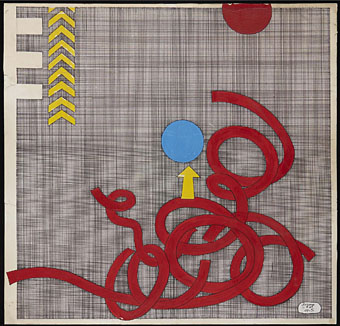
Opus 5 (1968).

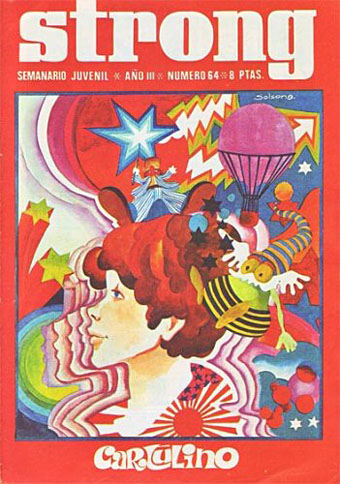
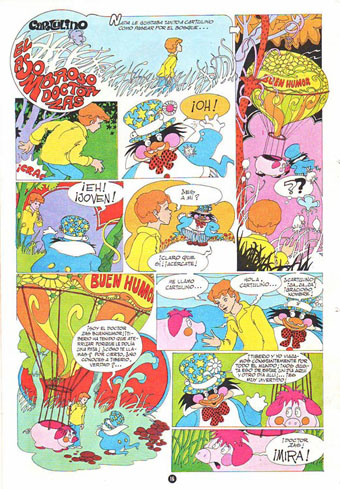
It’s dismaying to learn that Alberto Solsona, the creator of the wonderful Agar-Agar, was only 41 when he died in 1988. It’s also a little disappointing to discover that his work for comics is the least part of an artistic career begun in the late 1960s; I’d been hoping there might be other work in the same style. Solsona’s early paintings are very much in the Pop Art sphere which makes them more attractive to me than his later shift into a form of Abstract Expressionism. Between painting he was working as a book illustrator and a comic artist in magazines for children. Among the examples of the latter the page from Strong (1971) is the closest to Agar-Agar, unsurprisingly when they both date from the same period. This museum page has examples of many more paintings and prints.

solsona02.jpg

Strong (1971).

solsona03.jpg

El asombroso doctor Zas (1971).

Solsona also had a humorous strip about King Arthur in Strong but I prefer the drawing style in this one, yet another example of the diluted psychedelic graphics that filtered into children’s stories in the early 70s. (See this post.)

solsona04.jpg

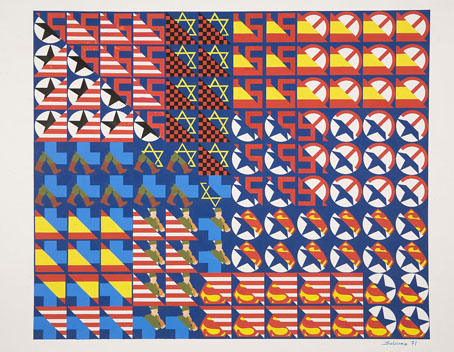
Símbolos (1971).

Not very surprising seeing American symbols mixed with swastikas—the war in Vietnam provoked many such responses—but I wonder how much of a risk it was to do the same with the Spanish flag when the Franco regime was still in power. This painting also refers to Superman, a character that Agar-Agar takes a dig at.

Continue reading “More Alberto Solsona”

More Esteban Maroto

maroto05.jpg

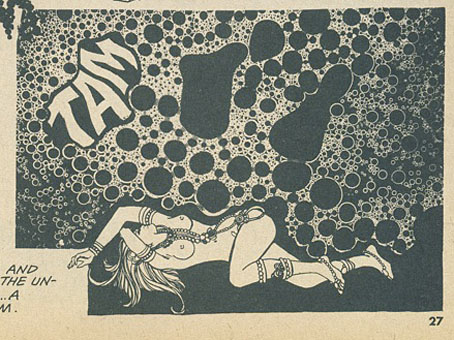
Psychedelic Kali from Vampirella 18.

Copies of the Dracula comics may be scarce these days but two of the artists who appeared in the title—Esteban Maroto and José Beá—were also appearing regularly in Vampirella around the same time. The Internet Archive has a large collection of Warren titles including an almost complete run of Vampirella. Esteban Maroto’s work stands out for me for his draughtsmanship, his page layouts, the atmosphere of heady eroticism, and the frequent touches of psychedelia of which the panel above is one of the more striking examples. The best strips are the ones he wrote himself; when he works with American writers the results tend to be more restrained. It’s a shame Vampirella was mostly a black-and-white title, so many of these pages would benefit from the same colour treatment as Wolff.

maroto01.jpg

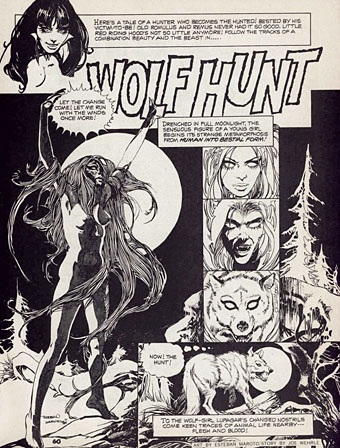
Wolf Hunt from Vampirella 14.

And speaking of wolves, there’s a similar collection of witches and lycanthropes in these stories.

maroto02.jpg

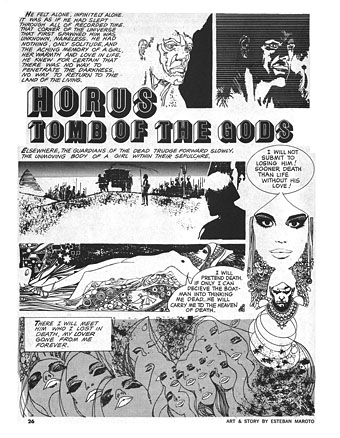
Tomb of the Gods: Horus from Vampirella 17.

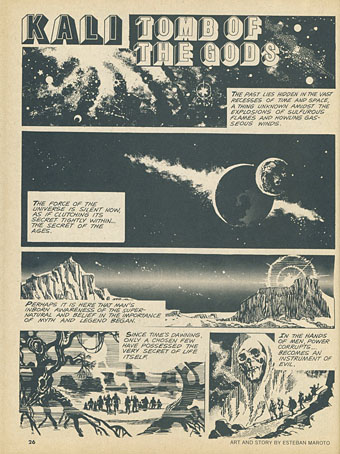
Tomb of the Gods is a short series in which mythological stories are explored Maroto-style. The exception is Gender Bender, a piece of science fiction with masculine and feminine psyches pitted against each other in a virtual arena. The story title is a surprise for anyone thinks that phrase originated in the 1980s.

maroto03.jpg

Tomb of the Gods: Kali from Vampirella 18.

Continue reading “More Esteban Maroto”

The Dracula Annual

wolff1.jpg

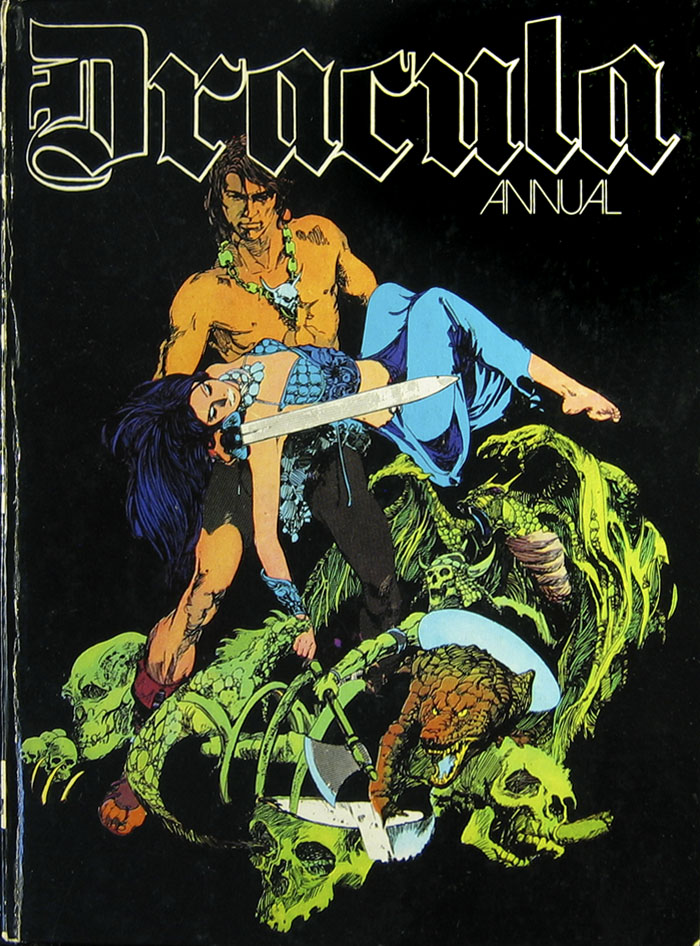
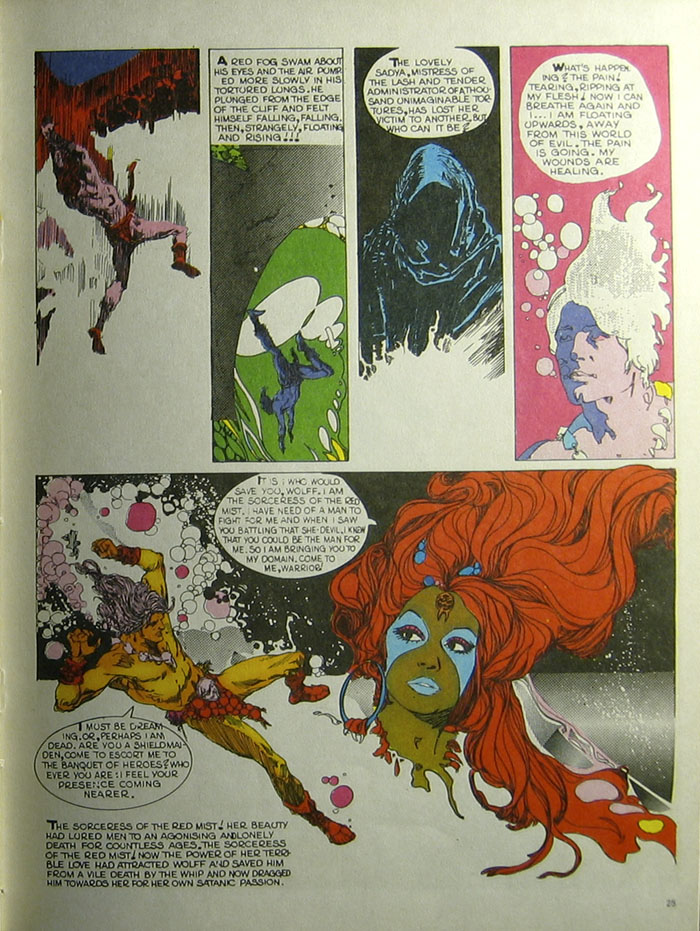
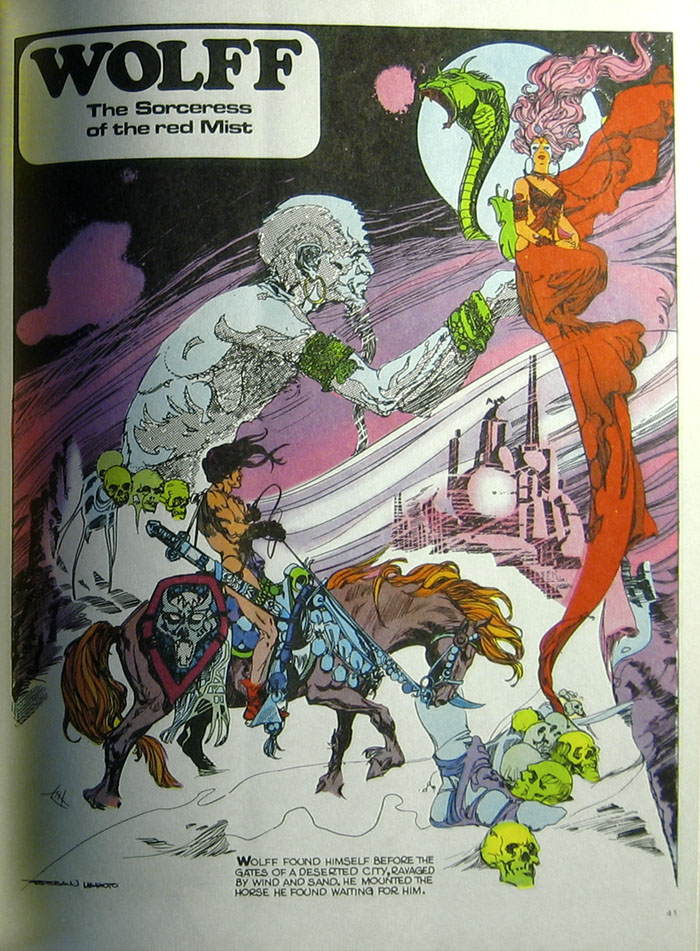
A comment by Modzilla in last month’s post about psychedelic comic book Saga de Xam is responsible for this recent book purchase. Dracula was a full-colour large-format comic book from notorious pulp imprint New English Library (later to be distributors for my colleagues at Savoy Books) that repackaged Spanish horror strips for a British audience. The comic ran for 12 issues in the early 1970s; the pages shown here are from the hardback annual that gathered all the issues into a single volume. I remember this being around in secondhand shops for years but I never paid it any attention at all so the artwork has been a revelation.

NEL’s Dracula isn’t much of a horror comic, despite its title; Dracula himself only appears in one story, and that’s a jokey throwaway piece. The two main episodic strips are Wolff, a Conan clone searching for his lost wife in a world ravaged by witches, werewolves and other supernatural threats; and Agar-Agar, a deliriously psychedelic picaresque concerning a hyper-sexual “sprite” (or a hippyish young woman with blue hair and magic powers) from the planet Xanadu. Everything in the book is redolent of the early 1970s when strains of psychedelia were still percolating through pop culture. Watered-down psychedelia used to bore me because I wanted the authentic stuff but forty years on this kind of work is much more attractive.

wolff2.jpg

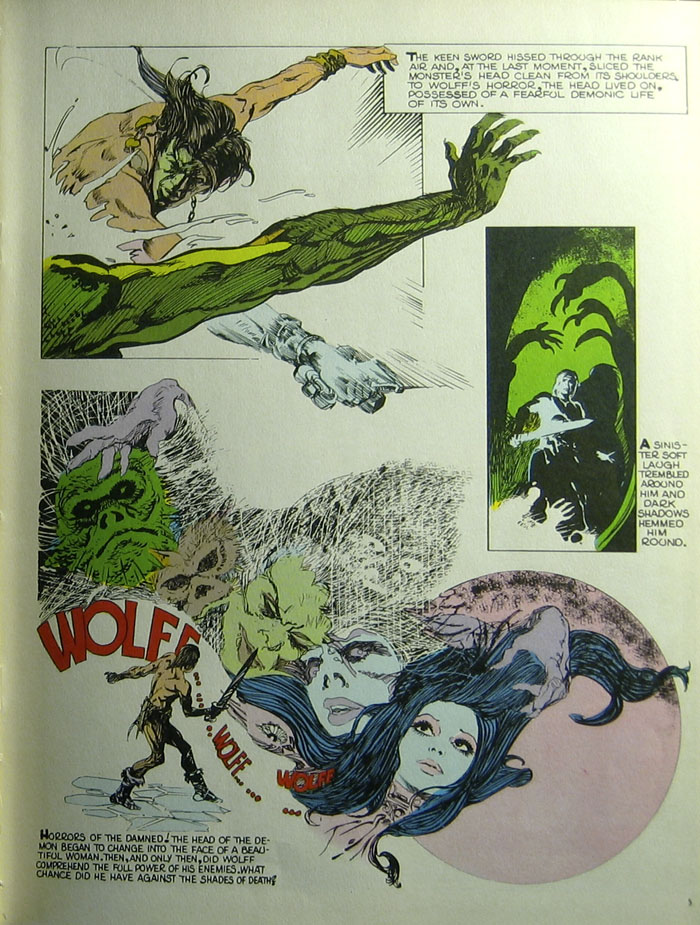
Wolff is the work of Esteban Maroto whose splash pages and inventive layouts give Barry Windsor-Smith’s Conan the Barbarian (which was running at this time) some serious competition. Wolff is very much in the Conan mould—he even shouts “Crom!” at crucial moments—a pawn of supernatural forces he often fails to comprehend. The artwork in Smith’s Conan was often praised for its details and decor but the Art Nouveau influence in Maroto’s work is much more overt. Maroto’s flame-haired witches are like Alphonse Mucha sirens—one panel even borrows from Mucha’s Salammbô—and he’s no slouch with the Frazetta-like demons either. The scripting is perfunctory but I don’t mind that when it turns up pages like these. There’s also a brief nod to Lovecraft when “R’Lyeh” is mentioned.

wolff3.jpg

wolff4.jpg

Continue reading “The Dracula Annual”