Weekend links 681

hunter.jpg

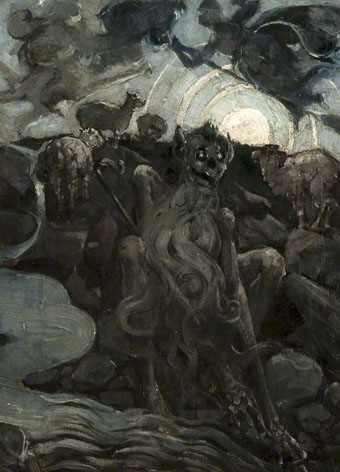
All Cats are Grey At Night (2009) by Kenny Hunter.

“They found ways to do the impossible”: Hipgnosis, the designers who changed the record sleeve for ever. Lee Campbell talks to Anton Corbijn about Squaring the Circle, Corbijn’s documentary about the Hipgnosis design team. Peter Christopherson is shown in the accompanying photo but Campbell doesn’t mention him at all, despite his having been an equal partner with Storm Thorgerson and Aubrey Powell from the mid-70s on. Many of those famous covers were photographed by Christopherson’s camera.

• A new book by Stephen Prince at A Year In The Country: “Lost Transmissions weaves amongst brambled pathways to take in the haunted soundscapes of electronica, the rise of the occult in the 1970s, cinema and television’s dystopian dreamscapes and hauntological work which creates and gives a glimpse into parallel worlds…”

• New music: Ambient Bass Guitar by John von Seggern, and Sturgeon Moon/Beaver Moon by Missing Scenes.

• How Samuel R. Delany Reimagined Sci-Fi, Sex, and the City.

• Mix of the week: Tranquility by A Strangely Isolated Place.

Galerie Dennis Cooper presents…Snow Globalists.

• The Strange World of…African Head Charge.

• Steven Heller’s font of the month is Baudot.

Nights on Earth.

Transmission (1979) by Joy Division | Clandestine Transmission (1994) by Richard H. Kirk | Transmission (1996) by Low

Franz von Bayros’s Inferno

bayros01.jpg

Viennese artist Franz von Bayros (1866–1924) is unusual among illustrators in that his erotic art tends to be easier to see today than his less scandalous commissions. Such is the case with his illustrations for Dante’s Inferno, some of which I’d seen before but never as many as in a book which arrived recently at the Internet Archive. This is a home-made presentation that uses the Longfellow translation of the Inferno for the text. Bayros can’t compete with the sombre spectacle of Gustave Doré’s illustrations but he depicts some of the less dramatic moments that Doré’s full-page engravings avoid, while also placing a number of his drawings in the same monumental frames he liked to use for his pornographic art.

bayros02.jpg

bayros03.jpg

bayros04.jpg

bayros05.jpg

Continue reading “Franz von Bayros’s Inferno”

Weekend links 680

wijdeveld.jpg

15 Miles into the Earth (1944) by Hendrik Wijdeveld.

• “He realized that there were individuals around him who had never appeared in the great altarpieces and frescoes, individuals who had been marginalized by the cultural ideology of the previous two centuries. And there were hours of the day—transient, yet unequivocal in their lighting—which had never been reproduced, and which were pushed so far from habit and use that they had become scandalous, and therefore repressed.” Pasolini on Caravaggio.

• “Reading Albert Camus and Mikhail Bulgakov by day, by night, crucially, they were listening to Chic, Kraftwerk, Donna Summer, Michael Rother and Grace Jones in the clubs.” Graeme Thomson on the atmosphere and influences that helped create my favourite album by Simple Minds, Empires And Dance. Borges was also a minor influence, apparently, which wasn’t something I knew until this week. I like it when your favourite things join up this way.

• “This being England, a ‘tea shop’ is not a shop that sells tea. That would be a tea merchant. A tea shop serves tea.” Mark Valentine on the perennial connections between rambling and tea-drinking.

Talking about generations as if they really existed and had sway over people is much more respectable and widespread than the belief that events and personalities are governed by the movements of the planets. But is there really much more substance and reality to “generations”? If not “a bunch of bullshit”, the discourse of generations is certainly generative of bullshit: tenuously grounded overviews and opinion pieces, specious analysis and analogies, platitudes and truisms. And yet, like astrology, it is a fun game to play along with. And far more than astrology, it’s a mode of talk that partially constitutes its object: generalizing about a generation actually brings it into semi-existence, shaping how people perceive themselves and how they are perceived by earlier or later generations. What may just be an illusion, a shaky set of alleged affinities, becomes a social fact.

Simon Reynolds analyses the generation game

• More Milton Glaser: PDFs of the Glaser Gazette, a memorial publication in three parts: Vol 1 | Vol 2 | Vol 3

• New music: Tractatus Lyra-Organismus by Lyonel Bauchet, and Grounded Rectangle by Ambidextrous.

• “A digital archive of graphic design related items that are available on the Internet Archives.”

• DJ Food found a handful of psychedelic posters by Nicole Claveloux.

• “Rights to Jorge Luis Borges’s work go to his wife’s nephews.”

• “Is this the earliest known phallic art?

Young Generation Dub (1976) by Augustus Pablo | Chile Of The Bass Generation (1990) by Mental Cube | Invisible Generation (1992) by Cabaret Voltaire

Talking time: Cabaret Voltaire interviews

cabs1.jpg

Cabaret Voltaire, circa 1981. Left to right: Richard H. Kirk, Chris Watson, Stephen Mallinder.

…A few brief facts. CV came about from a mutual interest in producing “sound” rather than “music”, a few years ago, making very rare live appearances from time to time. Now an interest has developed in the band, we are playing live more frequently instead of just recording. CV dislike the sick commercialism which pervades most “contemporary music”.

At the moment we are working on a basis which involves two types of performance. A “set” which consists of songs, and a set which is completely improvised, lasting from 20 minutes to “x” number of hours. CV also use films + slides as lighting in live performance. A CV concert is like a bad acid trip; CV want to create total sensory derangement. MIT UND OHNE POLITIK, UNVERNUNFTIGKEIT.

INFLUENCES — “anything which is unacceptable”.

The band’s line up is —
RICHARD – Guitar, Clarinet, Tapes, Vocals.
MAL – Bass, Electronic Percussion, Lead Vocals.
CHRIS – Electronics, Tape, Vocals.

Early band correspondence with a German fanzine

Another week, another book of music talk. Cabaret Voltaire: A Collection of Interviews 1977–1994 was published two years ago but I only just discovered it as a result of my recent cycling through the Cabs’ discography. I’ve never been a great reader of music books yet here I am with three of them devoted to this particular group. Fabio Méndez’s collection joins Cabaret Voltaire: The Art of the Sixth Sense, the first Cabs book from 1984, in which Mick Fish and D. Hallberry interrogate Kirk and Mallinder about their progress to date; and Industrial Evolution, a reprint of the Sixth Sense interviews plus newer ones appended to Fish’s memoir about life in the Cabs’ home town of Sheffield during the 1980s. The Méndez collection is the most substantial of the three, gathering articles from fanzines, magazines and newspapers, and translating into English many pieces from European publications.

cabs2.jpg

Badges not included.

As with Coil, I’ve always liked hearing what Kirk, Mallinder and Watson had to say. There was a fair amount of historical intersection between the two groups, Cabaret Voltaire having been a part of the first wave of Industrial music along with Throbbing Gristle, 23 Skidoo (whose records were produced by TG & CV), Clock DVA and the rest; later on the Cabs were part of the Some Bizzare stable along with Soft Cell, Coil, Einstürzende Neubauten and others. One of the interviews in Méndez’s book is from Stabmental, a short-lived fanzine edited in the early 1980s by a pre-Coil Geoff Rushton/John Balance. The zine ended its run with a cassette compilation, The Men With The Deadly Dreams, which included two exclusive recordings by Chris Watson and Richard Kirk. Watson’s piece, which applies cut-up theory to a radio news broadcast, is a good example of Cabaret Voltaire’s engagements with William Burroughs’ speculations about electronic media. Further examples of cut-up theory may be found in the group’s lyrics and in the video material they created, initially for use as projections while playing live, then later for their music videos which were in the vanguard of the form in the early 1980s.

A lot of the things we do tend to get glossed over. We’ll talk to anyone. We do loads of interviews with fanzines.

Unidentified group member, 1980

582 pages of interviews with a group that never had any kind of popular success is more information than most people would ever want or need. But as with Nick Soulsby’s Coil book, Méndez is doing future historians a service by resurrecting material from scarce and ephemeral sources. The post-punk period from 1978 to 1982 was a uniquely fertile musical moment, especially in Britain. For a few years absolutely anything seemed possible, with much of the wilder activity being logged and discussed in fanzines like Stabmental which usually had a limited circulation (often distributed by mail order) and a print run of a few hundred copies at most. The British music press also covered this scene, of course, but only up to a point, especially when the music was pushing the boundaries of the possible or the commercially acceptable. Méndez’s book emphasises the differences between the music-press approach—where the article is often as much about the writer as the group itself—and the fanzine interview which tends to be a list of questions with a small amount of contextual commentary. Fanzines were a circumscribed medium but they had advantages over the music papers; sincerity, for a start, allied with genuine enthusiasm and fewer of the tics that made reading the music press each week such a chore. The small publications weren’t always free of the bad habits of the weeklies but there was less of the journalistic posturing, the ignorant dismissal of whole areas of music, and the relentless snark and sarcasm which you’ll find thriving today on social media. The drawbacks of the fanzines were mostly about quality; fact-checking was often non-existent. Méndez’s book is littered with footnotes that log the errors present in the transcripts.

Which bands are influential on your music?
Chris: “Can, Neu!, Kraftwerk, Captain Beefheart…especially Can have influenced us.”

Spex magazine interview, 1980

Questions about influence are a common feature of any interview with creative people. Chris Watson’s reply is the first example I’ve seen of the Cabs mentioning so many German groups, as well as Captain Beefheart. A recurrent theme of these interviews concerns the group’s unusual trajectory, a career which evolved through a series of changes in direction that weren’t always predictable. The trio had started out in 1974 as resolute non-musicians and sound-collage provocateurs with Dadaist intentions; the music-making took time to develop. By the late 1970s the group that now called itself Cabaret Voltaire had become a more disturbed and disturbing counterpart to Sheffield’s other electronic music ensemble, The Human League. When Chris Watson departed in 1981 Kirk and Mallinder joined the Some Bizzare roster and followed the League to Virgin Records where a substantial advance helped the pair upgrade their equipment, launch their own independent music and video label, Doublevision, and record some of their best work.

Continue reading “Talking time: Cabaret Voltaire interviews”

Weekend links 679

gay.jpg

All this and the best tunes. Via.

• As noted last month, Space Ritual by Hawkwind turned 50 this year so here comes the inevitable reissue which in its most lavish edition will run to 11 discs. This isn’t as immediately attractive for me as the recent Calvert-era collection—I already own four different copies of Space Ritual, including the original vinyl—but I may feel differently a few months from now.

• At Wormwoodiana: Mark Valentine explores The Prophecies of N’Gai, something which sounds like a story from Weird Tales but isn’t.

• “Is function in the eye or mind of the beholder?” Steven Heller on Jacques Carelman’s Catalogue of Impossible Objects.

• At Spoon & Tamago: Yoko Tada began painting in her 80s. At 100 she’s publishing her first book.

• “The Magnificent Ambersons: rebirth for ruined Orson Welles masterpiece that rivalled Citizen Kane.”

At Wyrd Daze: Disco Rd 3: 23 pages 23 minutes. Free PDF, music mix, Discordianism, etc.

• A (brief) conversation with Milena Canonero, Wes Anderson’s costume designer.

• At Public Domain Review: Specimens of Fancy Turning (1869).

• New music: Móatún 7: Tetsu Inoue by Various Artists.

Arik Roper’s favourite album artwork.

• RIP Peter Brötzmann.

Table Turning (1973) by The Upsetters | Forever Turning (1995) by Scorn | Turning Towards Us (2008) by Redshift