One Way Street: Fragments for Walter Benjamin

benjamin1.jpg

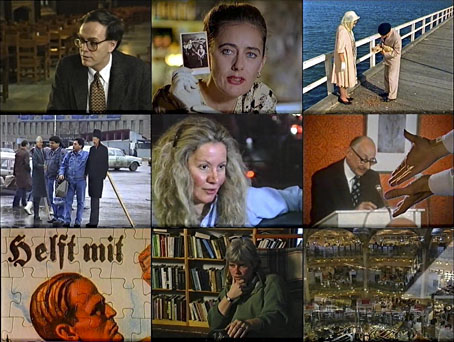
I thought I was going to intensely dislike One Way Street (1993) owing to the deployment of that bane of documentary film and television: the actor impersonating a historical figure. But these moments are sporadic, and John Hughes’ film is a reasonable introduction to Walter Benjamin’s elusive philosophies. It probably helps if you already know something of Benjamin’s life and work; there are several allusions, for example, to the famous “angel of history” thesis, and we even get to see the Paul Klee print to which the thesis refers (and which Benjamin owned); but there isn’t a reading of the thesis itself, an omission that the BBC in its documentary heyday wouldn’t have allowed. Various writers and academics do their best to convey something of Benjamin’s thought in sound-bite form, and the film as a whole can probably evade some criticism by claiming to be Benjaminesque in its disjointed and fragmented nature (although that would also be an evasion). I think if I hadn’t read any of Benjamin’s books there’d be enough to stimulate my curiosity, in which case the film would have succeeded. Watch it here. (Via Open Culture.)

benjamin2.jpg

Previously on { feuilleton }
Passage des Panoramas

Year by Angus MacLise

beardsley.jpg

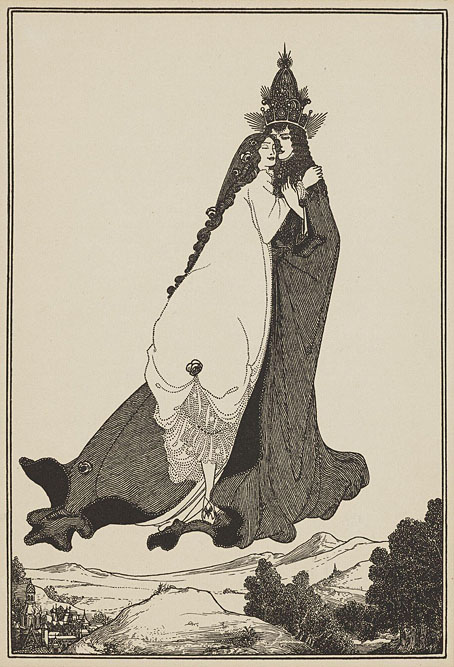
The Ascension of St Rose of Lima (1896) by Aubrey Beardsley.

There’s something about the idea of renaming the calendar that I find very attractive even if this is only workable on a personal level. When the Gregorian calendar is a reinvention of the Roman calendar based around Christian holidays (and with the days of the week still alluding to Norse gods), it’s easy to feel at liberty to start again.
maclise1.jpg

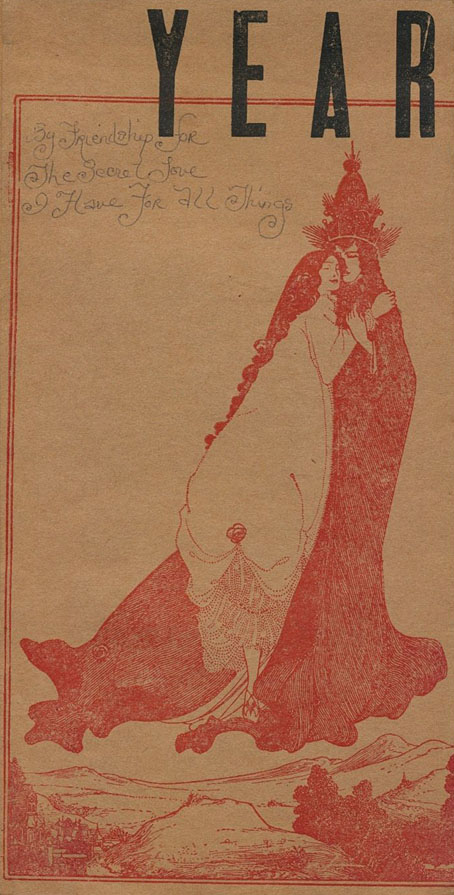
Year (1962) by Angus MacLise.

The most famous example of calendrical reinvention is the French Republican Calendar which called upon a gathering of scientists, a mathematician and a gardener to rename the months and days of the year. In this system the 29th of July would be “Panic” (ie: the plant Switchgrass) in the month of “Thermidor” which runs from July 19th to August 17th. (For the record, this is the year 221 in French Republic time.) The French Republican Calendar may have been an inspiration for the Pataphysical Calendar invented by Jarryites (or Ubuists) which is also French, and a sight more complicated:

The pataphysical era (EP) started on 8 September 1873 [Alfred Jarry’s birthday.] The week starts on a Sunday. Every 1st, 8th, 15th and 22nd is a Sunday and every 13th day of a month falls on a Friday. Each day is assigned a specific name or saint. For example, the 27 Haha (1 November vulg.) is called French: Occultation d’Alfred Jarry or the 14 Sable (14 December vulg.) is the day of French: Don Quichote, champion du monde.

The year has a total of 13 months each with 29 days. The 29th day of each month is imaginary with two exceptions:

• the 29 Gidouille (13 July vulg.) is always non-imaginary
• the 29 Gueules (23 February vulg.) is non-imaginary during leap years

So today, July 29th, would be 16th Tatane (“Shoe” or “Being worn out”), Transfiguration de St V. van Gogh, transmutateur, in the Pataphysical Year 140.

maclise2.jpg

Month XI from Year by Angus MacLise.

After the Pataphysical Calendar, Year by percussionist/composer/poet Angus MacLise (1938–1979) comes as a relief. This is a poetic renaming of the days of the year which MacLise published in a now very rare booklet edition in 1962. I’ve known about this for years but still haven’t seen a full text so it was a surprise to discover that the cover illustration was The Ascension of St Rose of Lima by Aubrey Beardsley, one of the artist’s later pieces which tends to Catholicism despite being used to illustrate his unfinished erotic novel, Under the Hill. It’s difficult to say why this was chosen by MacLise or his publisher, but it pre-empts the renewed attention that Beardsley’s work received from 1966 on. MacLise’s names for the days are beautifully evocative, and infinitely preferable to the many days which few in this country bother about:

smoke of the shore
day of the inner lid
day of the magic child
day of bessie smith
day of anna
rose over the cities
the fire is a mirror
hrungirs heart

The full text for November and December can be found on this page. If anyone knows of an online source for the full text of MacLise’s Year then please leave a comment. For those with Android phones, there’s a page here offering a Pataphysical Calendar app. Bosse-de-Nage says “Ha ha”.

Weekend links 170

macarthur.jpg

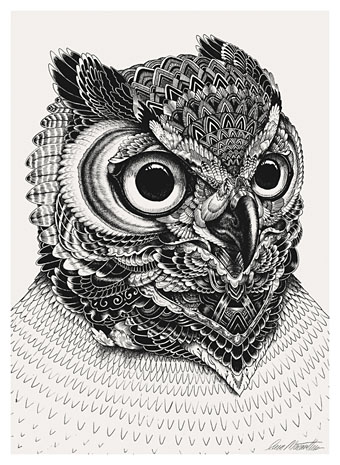
Owl portrait by Iain Macarthur.

• “Ghost Box is a glance through a window seeing something running alongside our version of reality. Like, what if Paul McCartney had made records with the Radiophonic Workshop?” Ghost Box designer and Mr Focus Group, Julian House is interviewed.

• “…that book with the girl with the hatchet in her head…” Dave Tompkins remembers Denis Gifford’s A Pictorial History of Horror Movies (1973), a formative influence of mine, and that of many other people, it seems.

Salvador Dalí’s 1946 illustrated edition of Macbeth. Related: From Macbeth to the Wizard of Oz: New exhibition explores the erotic side of witchcraft.

I do not want to live in a world where the government and a select few conservative feminists get to decide what we may and may not masturbate to, and use the bodies of murdered women or children as emotional pawns in that debate. It is supremely difficult to achieve radical ends by conservative means. Feminists and everyone who seeks to end sexual violence should be very cautious when their immediate goals seem to line up neatly with those of social conservatives and state censors.

Laurie Penny on the recent Tory policy of attempting to limit online pornography.

The Facebook page for The Wicker Man has details of the pursuit for a complete print of the film. A Blu-ray edition will be released in October.

Anne Billson visited the Hotel Thermae Palace in Ostend, the columnated location of Daughters of Darkness.

Kenneth Anger on how he made Lucifer Rising. The ICA in London is screening his films this weekend.

krenkel.jpg

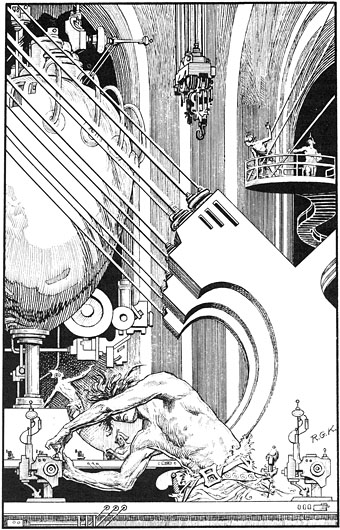
Roy Krenkel illustrates Tales of Three Planets by Edgar Rice Burroughs, 1964.

The Electric Banana Blows Your Mind: The soundtrack library alter ego of The Pretty Things.

• Mix of the week: an ambient (in the 90s’ sense of the word) DJ set by Surgeon.

Bernie Krause shares the happiest sounds he’s heard in nature.

• RIP Walter De Maria, sculptor and musician.

Sexodrome by Asia Argento with Morgan.

• Metabolist: Identify (1980) | Curly Wall (1980) | Ymuzgo/Pigface (1981)

Mati Klarwein book covers

mati1.jpg

The World’s Desire (1972) by H. Rider Haggard & Andrew Lang. Painting: Astral Body Asleep (1968).

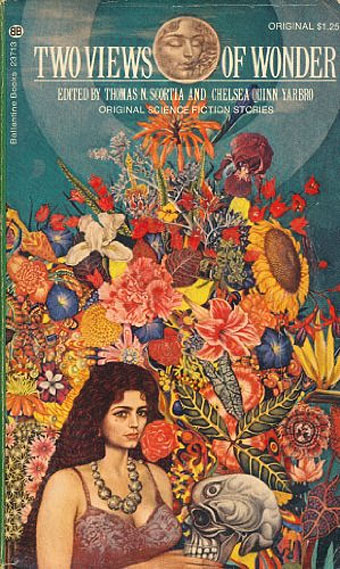
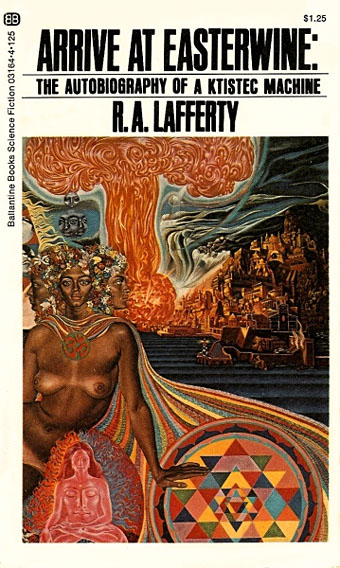
The use of Mati Klarwein’s paintings on album covers is well documented, the official Klarwein site has a small section devoted to some of the covers. Less well-known are these book covers which were evidently the product of a brief enthusiasm for Klarwein’s work in the Ballantine Books’ art department. As with many of the album covers, these are all pre-existing paintings which have been cropped for use as cover art.

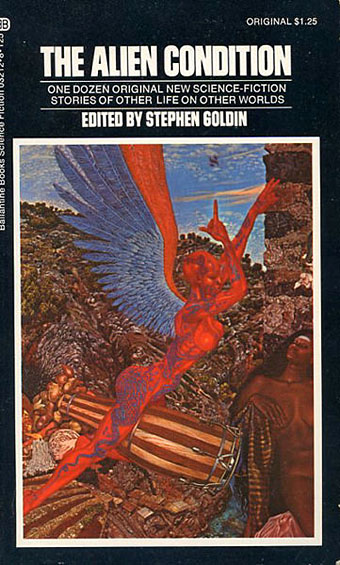
The most surprising example is the cover for The Alien Condition with its detail from Annunciation, a painting better known for its appearance on Abraxas (1970), a very successful Santana album. Given how visible that cover art would have been in 1973 you have to suspect that the painting’s use as a book cover was a deliberate bid to attract a youthful readership. All these titles are works of science fiction or fantasy; I don’t recall having seen a Klarwein cover for any non-genre titles. If anyone knows of an example then please leave a comment. (Thanks to Jay for the tip!)

mati2.jpg

With a Finger in My I (1972) by David Gerrold. Painting: Blessing (1965).

mati3.jpg

The Alien Condition (1973) edited by Stephen Goldin. Painting: Annunciation (1961).

mati4.jpg

Two Views of Wonder (1973) edited by Thomas N. Scortia & Chelsea Quinn Yarbro. Painting: Unknown.

mati5.jpg

Arrive at Easterwine: The Autobiography of a Ktistec Machine (1973) by RA Lafferty. Painting: Nativity (1961).

Elsewhere on { feuilleton }
The book covers archive

Previously on { feuilleton }
The art of Mati Klarwein, 1932–2002

Weekend links 169

anderson.jpg

Cover illustration by Gray Morrow, 1967. One of the less exploitative examples from a collection of hippy book covers.

• Ten Photographs by Alain Resnais: Mise en scène of Memory, Aesthetics of Silence by Ehsan Khoshbakht. In the comments to that post someone shows an old Penguin book with cover photos by Chris Marker. This confirms that the “C. Marker” whose name I found on the back of another Penguin book was indeed Monsieur Chat.

• There’s more (there’s always more…): Cornelius Castoriadis interviewed by Chris Marker in 1989, the complete footage of an interview edited down for Marker’s TV series L’héritage de la chouette (The Owl’s Legacy). Watch the series itself at YouTube.

• “A generation of innovators want to change the way we have sex and consume porn, but Google, Apple, and Amazon won’t let them,” says Andrea Garcia-Vargas. Related: Sam Biddle on how Tumblr is pushing porn into an internet sex ghetto.

• Mix of the week: the Chop Quietus Mix, “a jagged journey all the way from Broadcast to the uneasy thrum of Suicide, kosmische flavours from Popol Vuh and Cluster, Alexander Robotnik and many more.”

Strange Flowers looked back at The Student of Prague: “the first art film, the first horror film and the first auteur film”, and now a century old.

Clive Hicks-Jenkins talked to animator Barry Purves about the pleasures and difficulties of creating animated films for adults.

• Mazzy Star released a song, California, from their new album which arrives in September. Can’t wait.

Suzanne Ciani, “American Delia Derbyshire of the Atari Generation” explains synthesizers, 1980.

Christer Strömholm‘s photos of Parisian transgender communities in the 1950s.

What are These Giant Concrete Arrows Across the American Landscape?

• How Kiyoshi Izumi built the psych ward of the future by dropping acid.

Alan Moore: The revolution will be crowd-funded.

Fuck Yeah Mazzy Star

• Suzanne Ciani: Lixiviation | The First Wave—Birth Of Venus (1982) | The Eighth Wave (1986)