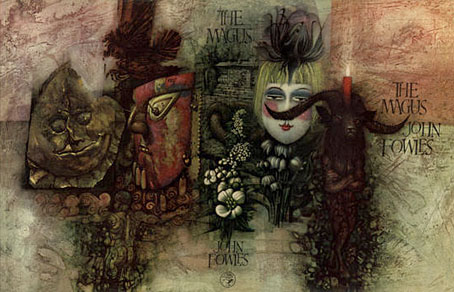
Tom Adams book covers

adams01.jpg

Dust jacket for The Magus (1966) by John Fowles.

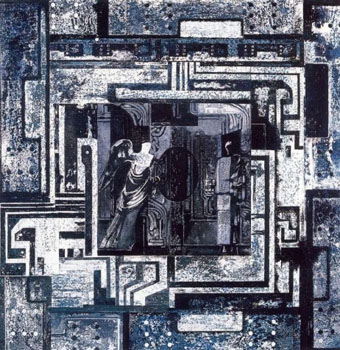
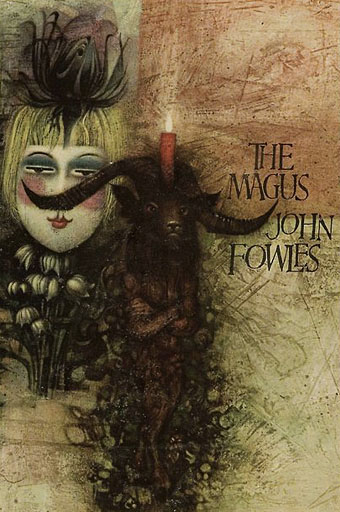
I pulled my 1982 paperback of John Fowles’ The Magus from the bookshelf recently. After flicking through the pages I decided to start re-reading it, having realised that in the thirty years which have elapsed since I first read it I couldn’t remember much at all about it. One thing I did remember, however, was the cover of the first edition, a painting and design I’d admired in the past without knowing the name of the artist responsible.
adams02.jpg

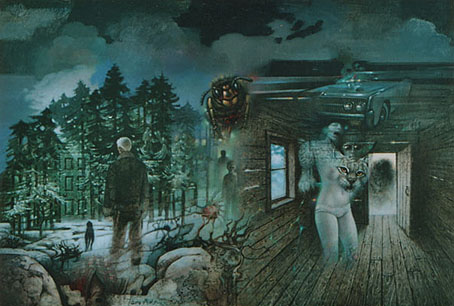
American illustrator Tom Adams is the artist in question, and looking at his painting again it further occurred to me that his cover deployed an evocative but not wholly specific assemblage of figures and objects that I’d often seen elsewhere, notably on the first edition cover of Peter Straub’s Ghost Story. So it was no great surprise to discover that Tom Adams was also responsible for that cover painting. The Fowles and Straub novels are big books which slowly reveal their layered mysteries. Adams’ approach to illustrating them strikes me as an ideal solution when neither of the novels can be easily reduced to a single image. (This hasn’t prevented subsequent designers from trying.) Fowles approved wholeheartedly of the painting but this isn’t a particularly fashionable technique at the moment, the trend being to try and condense complex narratives into a single motif.
adams03.jpg

Cover painting for Ghost Story (1979) by Peter Straub.

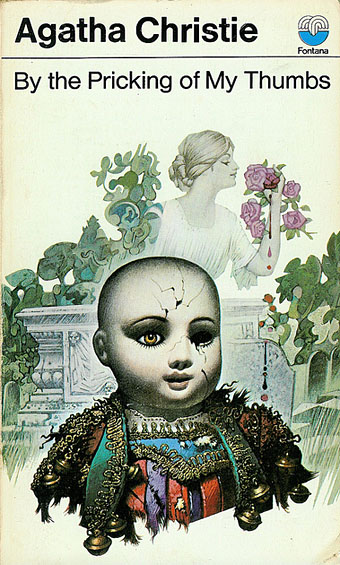
Looking for more of Adams’ art tipped me into an entire world of Agatha Christie book covers which were the artist’s main body of work for many years. Adams is understandably celebrated by Christie-philes (Paper Tiger published a book of his Christie covers in 1981) but outside Sherlock Holmes and Father Brown I’ve never had much of a taste for the classic detective story so this was a previously undiscovered niche. Here Adams sidesteps the chore of painting Christie’s meddlesome sleuths in favour of a remarkable display of grotesque Surrealism which—for a sceptic such as myself—makes the books seem potentially interesting. As with The Magus and Ghost Story there’s the same assemblage of evocative figures or objects but with an additional macabre twist. Many of these covers are so grotesque they could easily function as horror illustrations so it’s no wonder he was asked to illustrate the Straub. This Flickr page has many more examples (warning: wretched user-unfriendly Flickr layout in operation) as does this site. The artist has a website where prints of The Magus painting may be purchased.
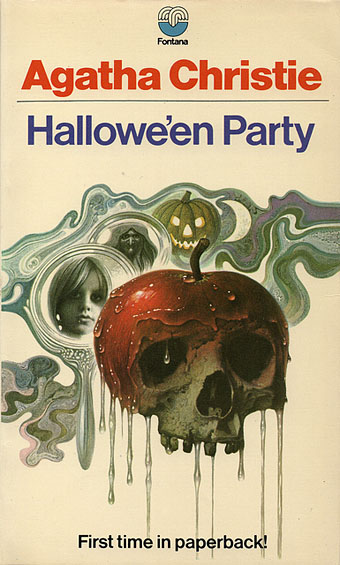
adams04.jpg

adams05.jpg

Continue reading “Tom Adams book covers”

Words and pictures

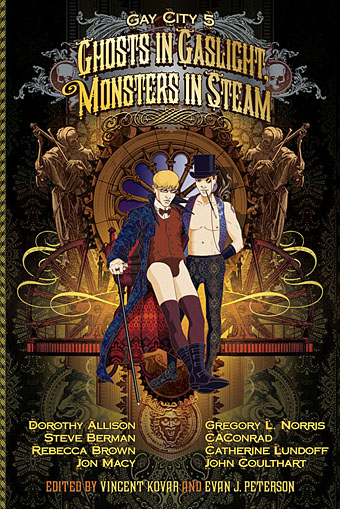
ghosts.jpg

This one has been a long while gestating. Evan J. Peterson asked me late last year to contribute a cover to a new edition of Seattle’s Gay City anthology which he was editing with Vincent Kovar. In May this year the anthology successfully covered some of its production costs with a Kickstarter fund, and the anthology will have its official launch next month (although the book is on sale now). Ghosts in Gaslight, Monsters in Steam combines a loose take on steampunk themes with spectral or horror material, and adds a queer twist. The contents are as follows:

Cover art by John Coulthart
Illustrations by M S Corley and Levi Hastings
Graphic story: Paper Lantern by Jon Macy

Poetry:
from Preternatural Conversations and Oblivious Imperialism is the Worst Kind by CAConrad
Dear Dr. Frankenstein by Jericho Brown
Anaphora as Coping Mechanism and American Dreams by Ocean Vuong
Orpheus on the 74 and The Resurrection Spell by Oscar McNary
Zombie Autopsy by Janie Miller
Moon Goddess by Imani Sims

Hybrid/Flash Fiction/Prose Poetry:
Psychopomp by Lydia Swartz
Thangs by Imani Sims
The Door, Casualties of War, and The Worst is that You Can’t Even Ask Him to Use Protection by Jeremy Halinen

Short Stories:
Demon Lover by Dorothy Allison
Monster Movie by Rebecca Brown
B.E.M.s by Gregory L. Norris
Feeding Desire by Steve Berman
Medium Méchanique by Catherine Lundoff
Study in Blue, Green, and Gold by John Coulthart
A Captive Audience by Ryan Keawekane
Splinter by Ryan Crawford
The Difference Men by Kat Smalley
Alexander’s Wrath by J L Smither
Quota by Amy Shepherd
Heart of the Labyrinth by Tony Rella

This isn’t the first occasion when I’ve produced the cover for an anthology and also contributed some fiction inside—The Thackery T. Lambshead Pocket Guide to Eccentric and Discredited Diseases included a short fiction piece—but the Gay City anthology marks the first appearance in print of anything from my ongoing Axiom project. This is a long-term endeavour which I began in March 2001 but haven’t referred to much in public, mainly because the bulk of the project to date has been written fiction. There are few words more dismaying to hear than the dread phrase “I’m writing a novel”, especially today when the activity of fiction writing seems to have undergone an exponential increase. I tend to believe that unless you’re an established author there’s little to be gained by discussing your own literary labours in public until you have some results to offer. Well, now I have.

I know some people have been curious about the Axiom project so—keeping things brief—I can say it’s two novels, one finished, the second one nearly finished. Axiom was written from 2001 to 2007, and concerns a year in the life of an invented city. It’s fantasy of a sort but closer to the world of Reverbstorm than anything you’ll find on the swords-and-dragons shelves. The idea began in the late 1990s when I was working on Reverbstorm with David Britton and realised I could easily shift the city in that book a few degrees sideways to provide a setting for my own obsessions. I’d been writing a lot of fiction in the 1980s—short stories and two unfinished novels—and wanted to return to this seriously having tired of collaborations and illustrating the work of other people. Axiom marked out some territory I wanted to explore; the new novel, Vitriol, uses the territory to stage a “psychedelic apocalypse”. The project as a whole is loose enough to evolve into other media, and eventually there should be some Axiom-related art. I’ve been working on Vitriol since August 2006 (there was some overlap while finishing the first book); my contribution to the Gay City anthology, Study in Blue, Green, and Gold, is an extract from the work-in-progress which happened to function quite well as a self-contained piece. Despite the anthology theme it’s not quite a steampunk affair but there are some steam locomotives present so it has the required flavour.

Whilst working on the new book I’ve had an agent (Leslie Gardner at Artellus) trying to sell Axiom. This would have been in print by now if the London publisher who agreed to take it 18 months ago hadn’t gone bust after they’d sent us a contract. I’ve been considering putting out a limited hardback edition of the novel, although I’m busy enough as it is, and don’t relish having to self-distribute even a small number of books. For now it’s an option that remains open.

Gay City’s own site points to Amazon for sales of Ghosts in Gaslight, Monsters in Steam so on this occasion I’ll do that too. If you’re in the Seattle area there’s a launch party on September 27th. Details here.

Update: I’ve belatedly noticed that Evan is interviewed about the anthology here.

Weekend links 174

ikuma.jpg

Dress (2012) by Nao Ikuma.

• Two of my Cthulhu artworks can currently be seen in the Ars Necronomica exhibition at the Cohen Gallery, Brown University, Providence, RI. The exhibition is part of NecronomiCon, and runs to September 13th. In related news, my steampunk illustration has been nominated in the Visual category of this year’s Airship Awards. Winners will be announced at Steamcon V in October.

• “…the story of how a small cabal of British jazz obsessives conducting a besotted affair with the style arcana of Europe and America somehow became an army of scooter-borne rock fans…” Ian Penman looks back at the culture of Mod for the LRB.

• “What is it about the writer in the First World that wants the Third World writer to be nakedly political, a blunt instrument bludgeoning his world’s ills?” Gina Apostol on Borges, Politics, and the Postcolonial.

If someone had designed a work regime perfectly suited to maintaining the power of finance capital, it’s hard to see how they could have done a better job. Real, productive workers are relentlessly squeezed and exploited. The remainder are divided between a terrorised stratum of the, universally reviled, unemployed and a larger stratum who are basically paid to do nothing, in positions designed to make them identify with the perspectives and sensibilities of the ruling class (managers, administrators, etc) – and particularly its financial avatars – but, at the same time, foster a simmering resentment against anyone whose work has clear and undeniable social value. Clearly, the system was never consciously designed. It emerged from almost a century of trial and error. But it is the only explanation for why, despite our technological capacities, we are not all working 3–4 hour days.

On the Phenomenon of Bullshit Jobs by David Graeber

Ron Rosenbaum talks to Al Pacino about all the usual stuff, and reveals some detail about the actor’s obsessive interest in Oscar Wilde’s Salomé.

• More queer history: The Brixton Fairies and the South London Gay Community Centre, Brixton 1974–6.

• At Dangerous Minds: Anthony Burgess and the Top Secret Code in A Clockwork Orange

• Every day for 100 days, Jessica Svendsen redesigned a Josef Müller-Brockmann poster.

LondonTypographica: Mapping the typographic landscape of London.

• Mix of the week: Secret Thirteen Mix 083 by Demdike Stare.

• At Strange Flowers: Alfred Kubin the writer.

Derek Jarman’s sketchbooks.

Rick Poynor on Collage Now.

• Thomas Leer: Private Plane (1978) | Tight As A Drum (1981) | Heartbeat (1985)

Les Terres du Ciel

lesterres01.jpg

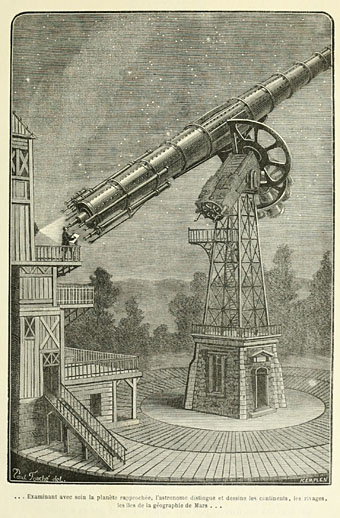
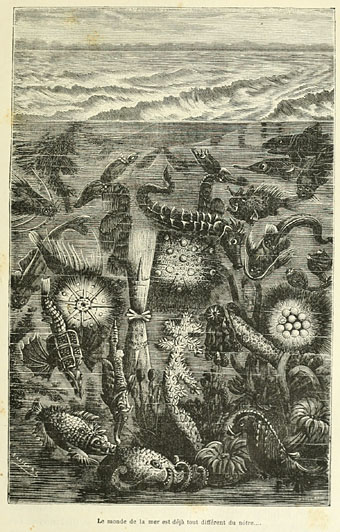
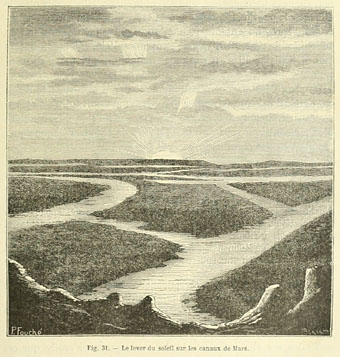
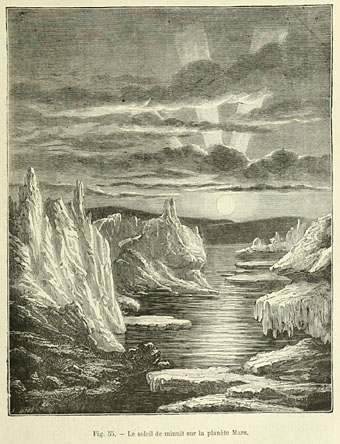
Frederic Thompson’s amusement ride attempted to give exposition visitors in 1901 the experience of a journey to the Moon; Camille Flammarion’s Les Terres du Ciel (1884) is a pictorial voyage around the solar system which includes the Moon among its ports of call. Subtitled Voyage Astronomique sur les Autres Mondes et Description des Conditions Actuelles de la Vie sur les Diverses Planètes du Système Solaire Flammarion’s study presented the science of the time but complemented this with a strange selection of illustrations ranging from serious attempts to show the surface of the other planets together with scenes of outright fantasy. Serious or not, the engraved plates are pretty good. A few of these illustrations turn up in books on the history of astronomy so—once again—I’m pleased to find their source. Flammarion’s book may be browsed here or downloaded here.

lesterres02.jpg

lesterres03.jpg

lesterres04.jpg

Continue reading “Les Terres du Ciel”

Weekend links 173

orszag.jpg

Icarus (1974–75) by Lili Ország.

• The Cabaret Voltaire albums released on the Virgin label in the 1980s have suffered the same shoddy treatment on CD as other Virgin reissues, a situation to be rectified in November with an extensive revisiting of the CV back catalogue. The long-overdue reappraisal will also include the release of Earthshaker, a collection of previously unavailable recordings from the Virgin period.

• It’s that book again: Design Observer has the preface from Lolita — The Story of a Cover Girl: Vladimir Nabokov’s novel in art and design, a book by John Bertram and Yuri Leving. At The Millions John Bertram talks to designer John Gall about the problems Lolita poses for cover designers.

• Jerry Lewis’s The Day the Clown Cried (1972) has acquired legendary status over the years for the apparent tastelessness of its subject matter—a clown in Auschwitz—and the fact that its director/star has never allowed the film to be seen in public. This week some footage arrived on YouTube.

Candy Bullets And Moon (1967), a one-off psychedelic collaboration between Don Preston and Meredith Monk.

• What’s the collective term for many bookshops? Whatever it is, there’s a lot of them in this Pinterest collection.

• At Dangerous Minds: Artist Gail Potocki’s exploration of Alice in Wonderland and the passing of time.

Anne Billson on the late Karen Black and why horror movies deserve our respect.

Tobias Carroll on the Surreal life and fiction of Leonora Carrington.

More details emerge about The Wicker Man – The Final Cut.

• Issue 35 of Arthur Magazine is now available for order.

• Graphics, drawings and collages by Jan Švankmajer.

• Every film poster designed by Saul Bass.

• Cabaret Voltaire: Just Fascination (1983) | Sensoria (1984) | I Want You (1985)