Conversations with Beckford

beckford.jpg

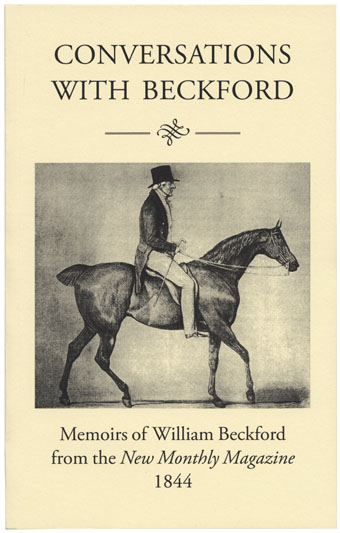
My thanks once again to Sidney Blackmore for sending me this new publication from The Beckford Society. Conversations with Beckford reprints in facsimile Cyrus Redding’s memoirs of William Beckford, a series of essays which were published in 1844 after Beckford’s death.

beckford2.jpg

Of particular interest to this folly enthusiast is a chapter entitled The Tower of the Caliph, in which Redding relates a visit to the newly-constructed Lansdown Tower which stands on Lansdown Hill outside the city of Bath. Beckford’s Tower, as it’s known today, is only half the height of the unsound structure which the fabulously wealthy Beckford built at Fonthill Abbey but it has at least survived, unlike the constructions on his old estate. The Tower and its grounds have had a chequered history since 1844 so Redding’s piece is valuable for the impression it gives of the place shortly after it was built. (The “Caliph” of the title refers to Beckford’s celebrated Gothic novel, Vathek, an Arabian Tale.) The Tower today is a museum housing some of Beckford’s art collection and furniture. Flickr has a great selection of views of the place showing how impressive the gold belvedere can be even on gloomy winter days.

Previously on { feuilleton }
The Beckford Journal
Vathek illustrated
Fonthill Abbey

Love gods

ganymede.jpg

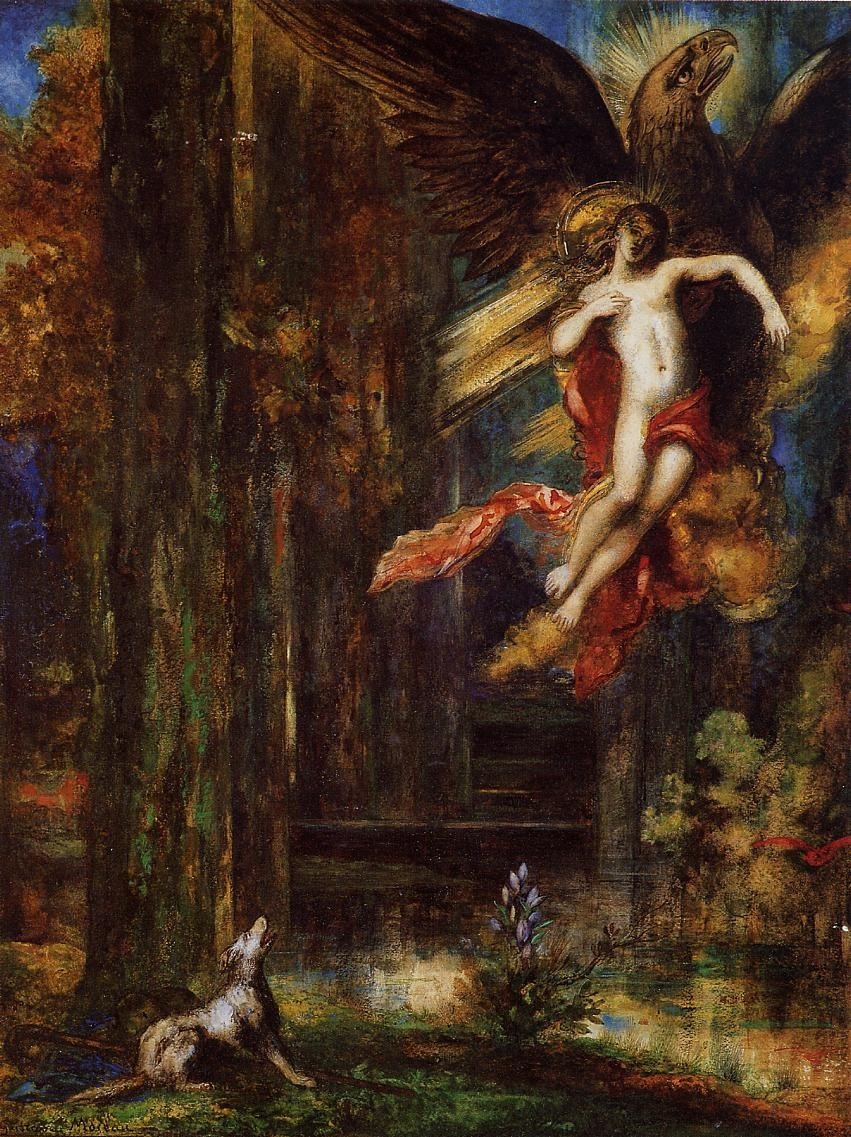
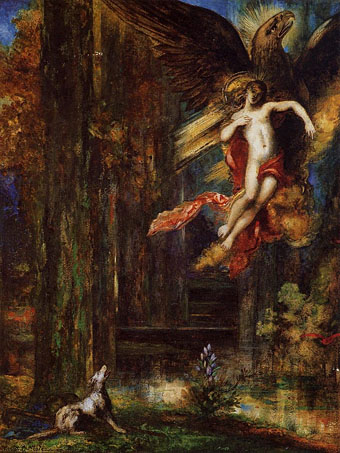
The Raising of Ganymede (1886) by Gustave Moreau.

The story of the love between Zeus, king of the gods, and Ganymede, the handsome son of the Trojan king, goes back at least three thousand years and its roots disappear into the prehistoric neolithic. (more)
hylas.jpg

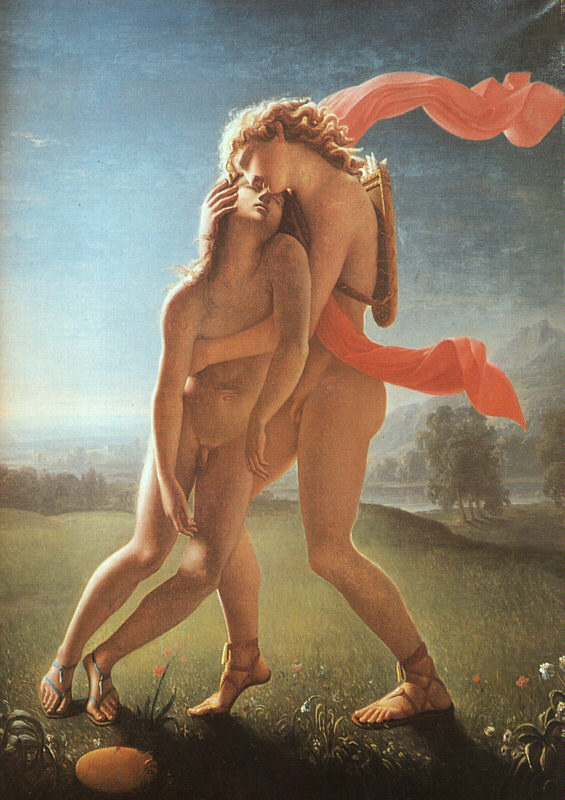
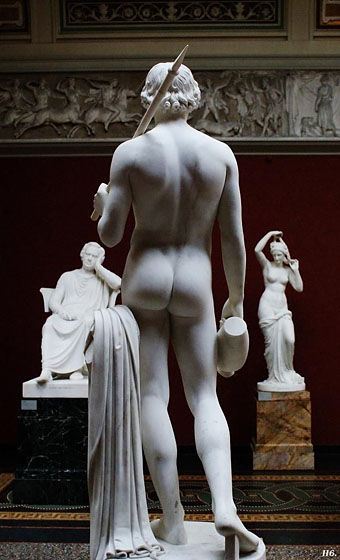
Hylas (1846) by HW Bissen.

Not for us only, Nicias, (vain the dream,)
Sprung from what god soe’er, was Eros born:
Not to us only grace doth graceful seem,
Frail things who wot not of the coming morn.
No—for Amphitryon’s iron-hearted son [Heracles],
Who braved the lion, was the slave of one:—

A fair curled creature, Hylas was his name.
He taught him, as a father might his child,
All songs whereby himself had risen to fame;
Nor ever from his side would be beguiled
When noon was high, nor when white steeds convey
Back to heaven’s gates the chariot of the day,

Nor when the hen’s shrill brood becomes aware
Of bed-time, as the mother’s flapping wings
Shadow the dust-browned beam. ‘Twas all his care
To shape unto his own imaginings
And to the harness train his favourite youth,
Till he became a man in very truth.

Theocritus, Idyll XIII: Hylas.
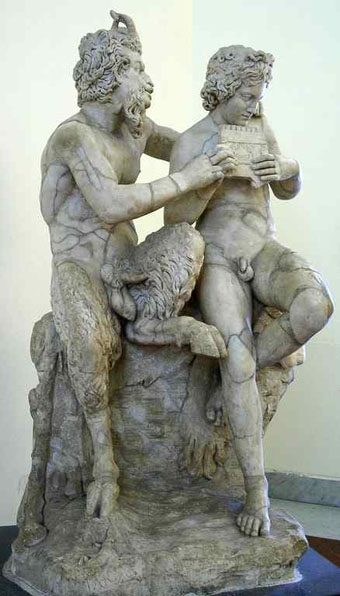
pan_daphnis.jpg

Pan teaching Daphnis to play the panpipes; Roman copy of a Greek original from the 3rd-2nd centuries BCE by Heliodoros.
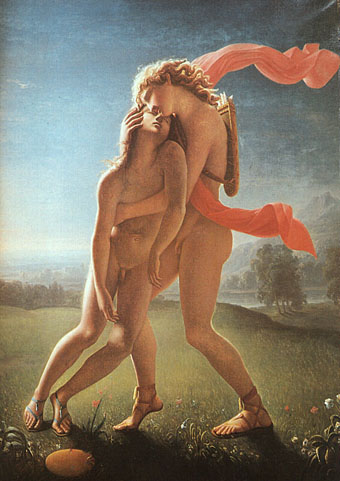
hyacinth.jpg

The Death of Hyacinthos (1801) by Jean Broc.

‘You too, Hyacinthus, of Amyclae, Phoebus would have placed in heaven, if sad fate had given him time to do so. Still, as it is, you are immortal, and whenever spring drives winter away, and Aries follows watery Pisces, you also rise, and flower in the green turf. My father, Phoebus, loved you above all others: and Delphi, at the centre of the world, lost its presiding deity, while the god frequented Eurotas, and Sparta without its walls, doing no honour to the zither or the bow. Forgetting his usual pursuits, he did not object to carrying the nets, handling the dogs, or travelling as a companion, over the rough mountain ridges, and by constant partnership feeding the flames.

‘Now, the sun was midway between the vanished and the future night, equally far from either extreme: they stripped off their clothes, and gleaming with the rich olive oil, they had rubbed themselves with, they began a contest with the broad discus. Phoebus went first, balancing it, and hurling it high into the air, scattering the clouds with its weight. Its mass took a long time to fall back to the hard ground, showing strength and skill combined. Immediately the Taenarian boy, without thinking, ran forward to pick up the disc, prompted by his eagerness to throw, but the solid earth threw it back, hitting you in the face, with the rebound, Hyacinthus.

‘The god is as white as the boy, and cradles the fallen body. Now he tries to revive you, now to staunch your dreadful wound, and now applies herbs to hold back your departing spirit. His arts are useless: the wound is incurable. Just as if, when someone, in a garden, breaks violets, stiff poppies, or the lilies, with their bristling yellow stamens, and, suddenly, they droop, bowing their weakened heads, unable to support themselves, and their tops gaze at the soil: so his dying head drops, and, with failing strength, the neck is overburdened, and sinks onto the shoulder.

Ovid’s Metamorphoses, Bk X:143-219 Orpheus sings: Ganymede; Hyacinthus

Previously on { feuilleton }
Three stages of Icarus
The end of Orpheus

Seward/Howard

burroughssphinx.jpg

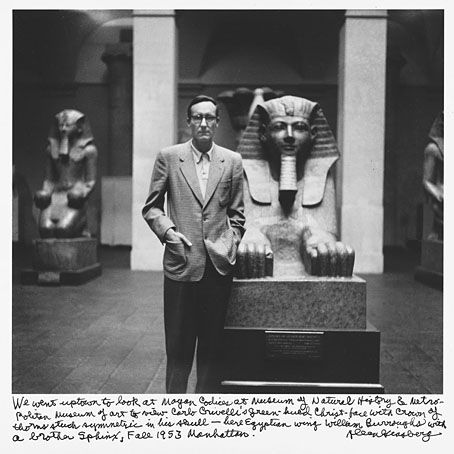
William Burroughs, New York, 1953. Photo by Allen Ginsberg.

Lonely lemur calls whispered in the walls of silent obsidian temples in a land of black lagoons, the ancient rotting kingdom of Jupiter – smelling the black berry smoke drifting through huge spiderwebs in ruined courtyards under eternal moonlight – ghost hands at the paneless windows weaving memories of blood and war in stone shapes – A host of dead warriors stand at petrified statues in vast charred black plains – Silent ebony eyes turned toward a horizon of always, waiting with a patience born of a million years, for the dawn that never rises – Thousands of voices muttered the beating of his heart – gurgling sounds from soaring lungs trailing the neon ghost writing – Lykin lay gasping in the embrace can only be reached through channels running to naked photographic process – molded by absent memory, by vibrating focus scalpel of the fishboy gently in a series of positions running delicious cold fingers “Stand here – Turn around – Bend”

The Ticket that Exploded (1962)

William Burroughs always talked favourably of Ernest Hemingway, and the famously spare style of Hemingway’s prose is evidently a style he sought himself, especially in the later works where there’s less of an emphasis on linguistic pyrotechnics. Something that always strikes me when I return to Burroughs’s earlier novels is the quality of passages like the one above which is a long way from the Hemingway style. What’s even more noticeable—and this is something which attracted me to Burroughs’s work from the outset—is the degree to which some of these passages are reminiscent of HP Lovecraft. In the case of the example above, taken from The Black Meat chapter of The Ticket that Exploded, some of this may be the work of Michael Portman who Burroughs credits as co-writer. What Portman contributed to The Black Meat and another chapter of that novel I’ve never discovered but there are plenty of other examples by Burroughs alone to show that he wasn’t incapable of this himself. The Ticket that Exploded was the first Burroughs book I read, and part of the shock and fascination came from encountering a recognisable Weird Tales-style atmosphere wrenched into inexplicable and thoroughly alien territory.

hpl.jpg

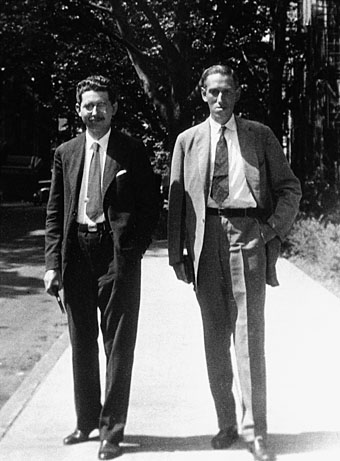
Frank Belknap Long and HP Lovecraft, New York, 1931. Photo by WB Talman.

There are others connections beyond literary style. When the Simon Necronomicon was published in 1977 Burroughs was asked to provide a blurb for the book. He wasn’t as effusive as the publishers might have hoped but the dubious volume was still advertised with his recommendation:

Let the secrets of the ages be revealed. The publication of the Necronomicon may well be a landmark in the liberation of the human spirit.

If it wasn’t for this then the extraordinary Invocation which opens Cities of the Red Night (1981) would have been diminished. Among the other “gods of dispersal and emptiness” whose names are called, Burroughs mentions “Kutulu, the Sleeping Serpent who cannot be summoned”, and “the Great Old One”, among a number of the usual Mayan gods, and several Sumerian deities whose descriptions (as with Kutulu) are taken from the pages of the Simon Necronomicon. It’s impossible to imagine Saul Bellow or John Updike opening a novel this way, just as it’s impossible to imagine many genre writers wandering into the areas that Burroughs explores elsewhere in that novel. This is one reason why Burroughs (and JG Ballard) were included in DM Mitchell’s The Starry Wisdom anthology in 1994, an attempt to expand the acceptable boundaries of Lovecraftian fiction, and also wilfully trample the fences that separate the genre and literary camps. I campaigned at the time for The Black Meat chapter to be included but Dave was set on Wind Die, You Die, We Die from Exterminator! (1973), a lesser piece although in the end it didn’t seem out of place in the book as a whole.

Elsewhere on { feuilleton }
The Lovecraft archive
The William Burroughs archive

Weekend links 198

boty.jpg

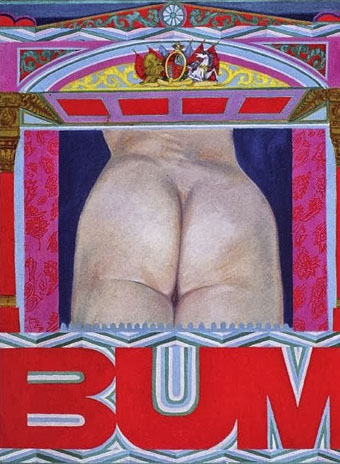
Bum (1966) by Pauline Boty.

Eleanor Birne on Pauline Boty, “the only prominent female Pop artist among a generation of famous men”. Ken Russell’s Pop Art documentary, Pop Goes the Easel (1962), which features Boty, may be seen here. Two years later Boty was back with Ken Russell playing the part of the prostitute from The Miraculous Mandarin in a film about Béla Bartók. That’s something I’d love to see. There’s more about her painting, and the work of other female Pop artists, here.

• Why Are We Sleeping? Mark Pilkington on the music world’s recurrent interest in the philosophy of GI Gurdjieff. Pilkington’s most recent Raagnagrok release with Zali Krishna, Man Woman Birth Death Infinity, was reviewed by Peter Bebergal.

• Cinematic details: Frames-within-frames in The Ipcress File (1966), and the typography of 2001: A Space Odyssey (1968).

highrise.jpg

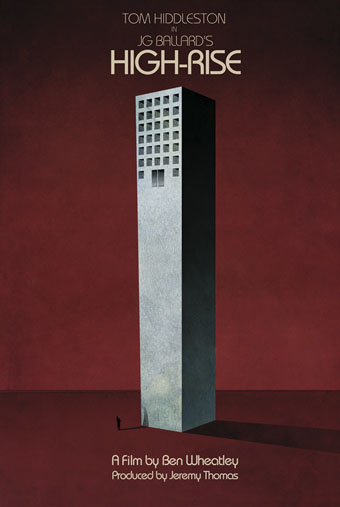
A Jay Shaw poster for Ben Wheatley’s forthcoming film of High-Rise.

• “…a large cavity must be dug in the bird’s shoulder and filled with ball bearings.” Christine Baumgarthuber on the dubious delights of The Futurist Cookbook.

• Why Tatlin Can Never Go Home Again: Rick Poynor on the difficulties of finding a definitive representation of an artwork online.

Jay Parini reviews Inside a Pearl: My Years in Paris by Edmund White. At AnOther Donatien Grau talks to White about fashion.

• At Bajo el Signo de Libra (in Spanish): the homoerotic and occasionally Surrealist art of Pavel Tchelitchew.

• At 50 Watts: Kling Klang Gloria: Vintage Children’s Books from Austria.

• The motorbike girl gangs of Morocco photographed by Hassan Hajjaj.

Geoff Manaugh on how LED streetlights will change cinema.

Stylus “is an experiment in sound, music and listening”.

• Mix of the week: Secret Thirteen mix 106 by Senking.

• At Pinterest: JG Ballard

This Is Pop? (1978) by XTC | Pop Muzik (1979) by M | Pop Quiz (1995) by Stereolab

Mr Bradly Mr Martin Hear Us Through The Hole In Thin Air

bradly1.jpg

Vimeo swarms with Burroughs-related films, many of which might not have been made had it not been for the profusion of recordings of the author reading his work. This short from 2010 is one of the better examples, a combination of live-action film and animation by Greig Johnson that crams a considerable amount of invention into five minutes. The text is from the mulch of cut-ups that formed Nova Express, the recording being one of the tracks on Burroughs’s first album of readings, Call Me Burroughs (1965). Given the film’s style and short running time it makes a good double-bill with Philip Hunt’s Ah Pook Is Here (1994).

bradly2.jpg

Elsewhere on { feuilleton }
The William Burroughs archive