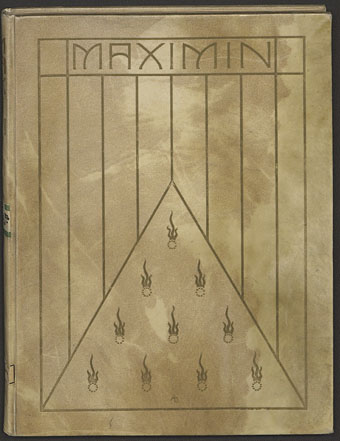
Maximin: ein Gedenkbuch by Stefan George

maximin01.jpg

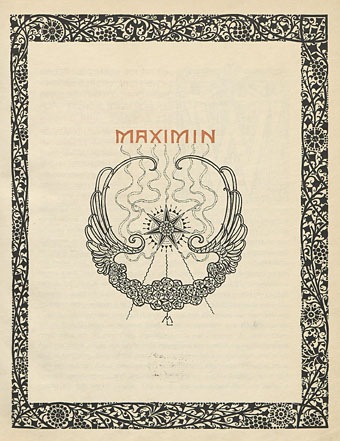
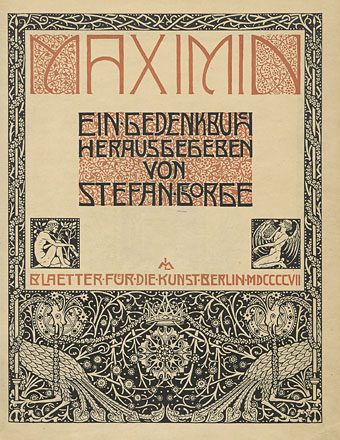
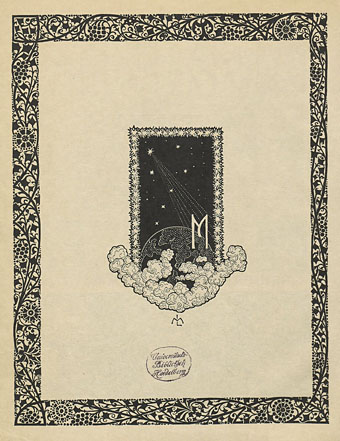
This is a strange and beautiful book, a loving paean to a dead boy-poet from another poet, Stefan George (1868–1933), published in 1907. The “Maximin” of the title was Maximilian Kronberger (1888–1904) who was around 14 when he met George; the older man was 34 at the time. George was apparently smitten by the boy, and devastated when he died from meningitis two years later. Maximin: ein Gedenkbuch (A Memorial Book) is the result, a collection of mournful poems, beautifully designed and illustrated by Melchior Lechter in that rectilinear Art Nouveau style which the artist made his own. The memory of the dead Maximin became for George a quasi-religious obsession which makes Maximin the bible of the homosocial cult that George subsequently encouraged.
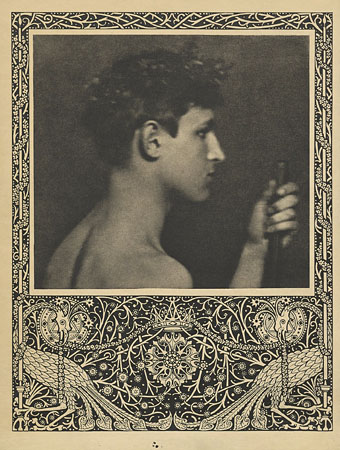
maximin02.jpg

What’s most surprising about all this behaviour is that it did nothing at all to harm his reputation, even among the Nazis who later revered his poetry. George was a contemporary of Oscar Wilde but the pair were poles apart in character, George’s chilly, high-minded aestheticism preserving him from the brickbats aimed at Wilde and others. Nonetheless, the inherent camp that results from the combination of such a remote attitude combined with flagrant boy-worship secured for George a place alongside Wilde in Philip Core’s essential Camp: The Lie that Tells the Truth (1984):

Strangely enough his overtly (if classically) homosexual verses, his preference for beautiful youth, and his severe black-clad dignity, all became immensely popular in the land of brüderschaft (brothers’ love). The camp Classicism of his ‘academy’ of the spirit, in surroundings of neo-Classical kitsch, hit just the right middle ground between Edwardian sentimentality and Hitlerian Imperialism.

Maximin: ein Gedenkbuch may be browsed or downloaded at the University of Heidelberg. There’s a more academic examination of George’s homoerotics here. Further page samples follow.
maximin03.jpg

maximin04.jpg

maximin05.jpg

Continue reading “Maximin: ein Gedenkbuch by Stefan George”

Weekend links 208

sungwon.jpg

The Blue Girl (2013) by Sungwon.

• “Meanwhile, in her parents’ room [Max] Ernst painted aardvarks eating ants and big human hands around the windows. ‘Sexual connotations, I think,’ she says shyly.” Agnès Poirier talks to Cécile Eluard about her childhood among the Surrealists.

• “Thrilling and prophetic”: why film-maker Chris Marker‘s radical images influenced so many artists. Sukhdev Sandhu, William Gibson, Mark Romanek and Joanna Hogg on the elusive director.

• At Dangerous Minds: Throbbing Gristle live in Manchester in 1980, and Brian Butler talks about the rediscovered early print of Kenneth Anger’s Lucifer Rising. There’s a trailer!

• From 1981: The Art of Fiction No. 69 at The Paris Review, an interview with Gabriel García Márquez. Related: Thomas Pynchon reviewed Love in the Time of Cholera in 1988.

• “Seven years ago, a stolen first edition of Borges’s early poems was returned to Argentina’s National Library. But was it the right copy?” Graciela Mochkofsky investigates.

• “What was Walter Benjamin doing with his shirt off in Ibiza?” Peter E. Gordon reviews Walter Benjamin: A Critical Life by Howard Eiland & Michael W. Jennings.

• A video by Marcel Weber for Måtinden, a track from Eric Holm’s Andøya album. Another album on the Subtext label that I helped design.

• More Ian Miller: Boing Boing has pages from his new book, The Art of Ian Miller, and there’s an interview at Sci-Fi-O-Rama.

Outrun Europa, a free compilation of 80s-style electronic music. There’s a lot more along those lines here.

• Praise Be! Favourite religious and spiritual records chose by writers at The Quietus.

Ralph Steadman illustrated Alice’s Adventures in Wonderland in 1973.

British Pathé is uploading 85,000 of its newsreel films to YouTube.

• Drawings by Lebbeus Woods at The Drawing Center, New York.

• At Pinterest: Ian Miller and Kenneth Anger.

Lucifer Sam (1967) by Pink Floyd | The Surrealist Waltz (1967) by Pearls Before Swine | Which Dreamed It (1968) by Boeing Duveen And The Beautiful Soup

Robert Fludd’s Temples of Music

fludd1.jpg

For the past week I’ve been downloading more of the books at the Internet Archive illustrated by Matthäus Merian. Among the hoard there’s a two-volume set of Robert Fludd’s Utriusque Cosmi, Maioris scilicet et Minoris, metaphysica, physica, atque technica Historia (1617–1626), a remarkable work which attempts to cover all the metaphysical, scientific and artistic knowledge of the time, opening modestly with a detailed description of the creation of the universe. The illustrations for these volumes by Merian and Johann de Bry are so good they’ve been plundered endlessly, not only in later books but in the general culture; I’ve swiped details myself on more than one occasion so—once again—it’s good to see an original printing with all the accompanying text, and also all the less familiar treatises and pictures.

fludd2.jpg

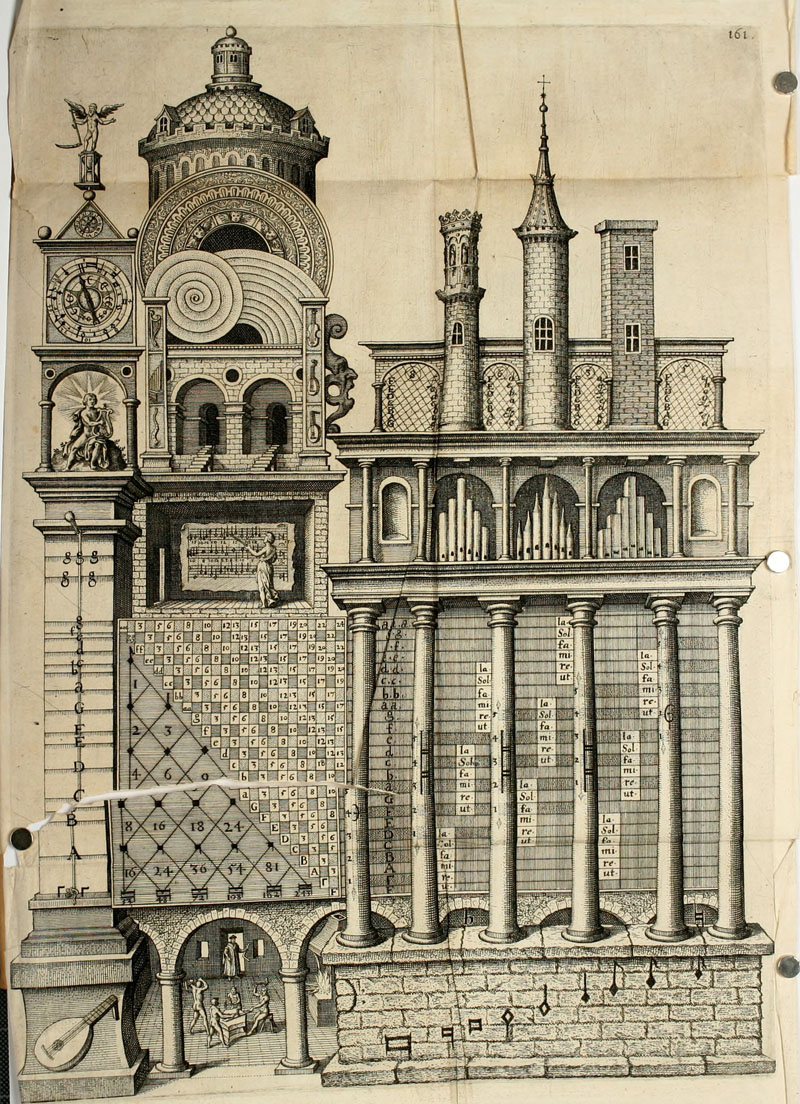
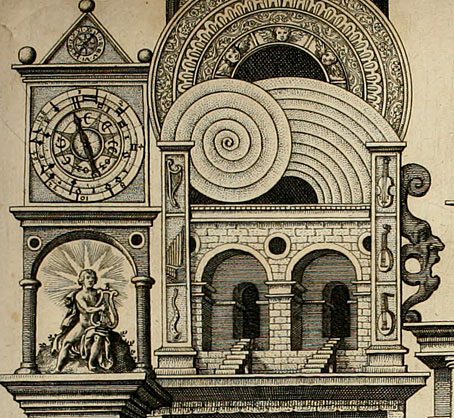
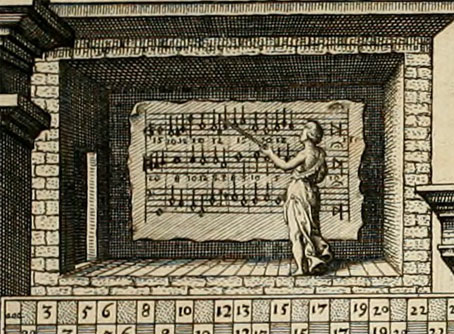
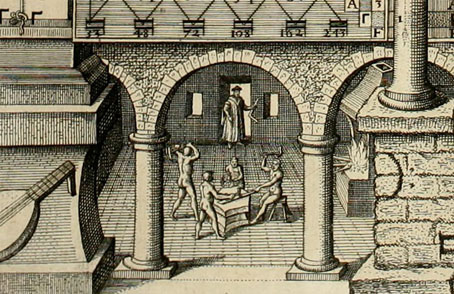
One area of Fludd’s study concerns music, a subject which Merian and De Bry illustrate using a variety of graphic devices, the most fanciful of which are the “Temples of Music” displaying the notes and divisions of the Pythagorean scale. The largest of the drawings was printed onto a fold-out sheet which explains the unfortunate tear in this copy. I love all the details on this one, some of which are rather unusual: who are the people underneath the temple in the room with the furnace? What are they doing, and why are they naked?

fludd3.jpg

fludd4.jpg

Continue reading “Robert Fludd’s Temples of Music”

Two covers

patel1.jpg

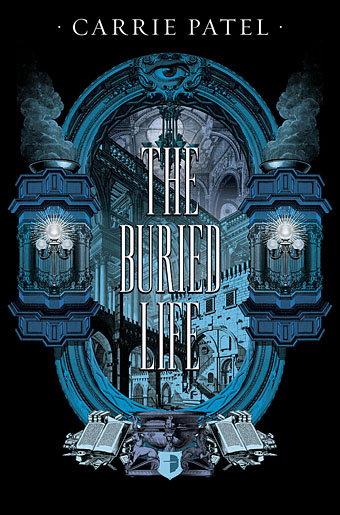
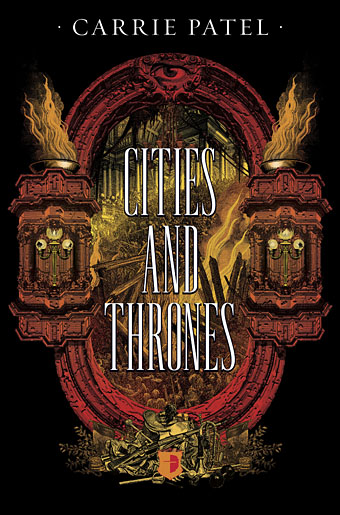
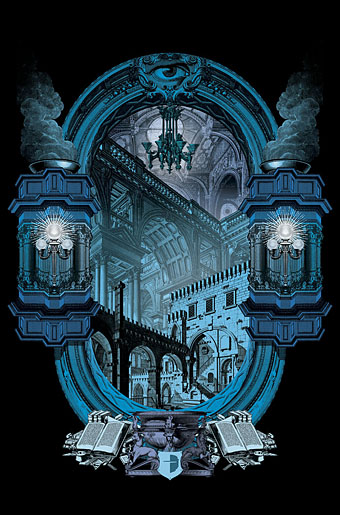
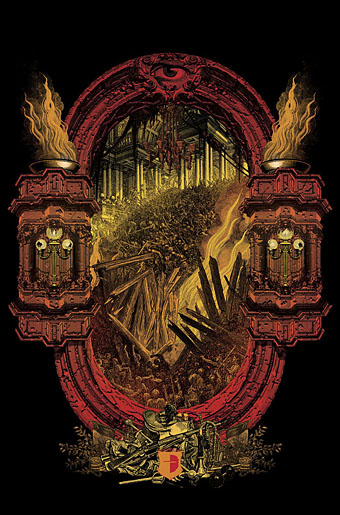
More new work of mine has been unveiled in the past few days so I can show these here. The Buried Life and Cities and Thrones are a pair of fantasy novels by new author Carrie Patel being published by Angry Robot. I was asked to provide something in an engraved style set against a black background, with imagery that reflected themes of vast, underground architecture and armed conflict.

patel2.jpg

Vast architecture of any description is something I’ve always enjoyed, the main challenge with each book came in trying to imply the architecture and events without the pictorial content becoming incoherent. Marc at Angry Robot asked for something Piranesian where the architecture was concerned. Looking over Piranesi’s non-Carceri designs didn’t turn up anything with a suitably dramatic perspective, however, so most of what you see in the first cover comes from Giuseppe Galli Bibiena’s Architetture e Prospettive (1740). The Bibienas were a family of architects and theatrical engineers who specialised in dizzying perspective views for their stage designs; Bibiena’s book was produced to preserve some of his more celebrated designs, the originals of which are now lost. I’ve had a book of these drawings for years but this is the first opportunity I’ve had to make use of them in any kind of collage.

patel3.jpg

This style of Baroque architecture doesn’t suit steampunk imagery which tends towards 19th-century urban/industrial; the plates are also rather staid scenes without the graphic flare that Piranesi gave to everything he rendered, real or imagined. But I do like those plunging perspectives, and pieces from two of the plates turned out to share both the same perspective and the same lighting direction. It’s easy to collage things into a flat view but creating a realistic sense of depth from bits and pieces can be tricky.

patel4.jpg

The frame for the second cover has more of a Piranesian quality being chipped and eroded. The typography for the titles went through several changes, the versions here show a late suggestion of mine with lettering that’s probably too thin to read well at a distance (or a small size on a web page). SF Signal has a post showing the Angry Robot versions which will probably be the final ones, together with a preview of the first book.

Previously on { feuilleton }
Aldous Huxley on Piranesi’s Prisons

The Dreamlands: A Lovecraftian film

dreamlands.jpg

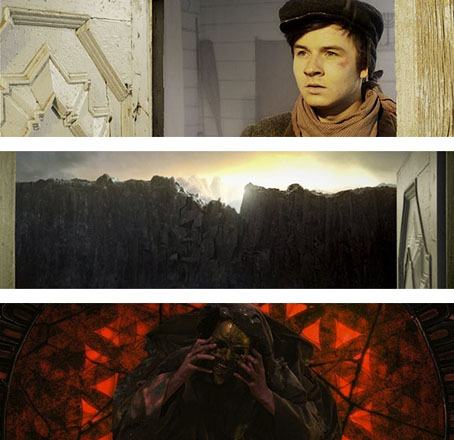
A crowd-funding goal has been announced for The Dreamlands, a feature film set in the worlds of HP Lovecraft’s Dream Cycle which, if it goes ahead, will be director Huan Vu’s second Lovecraftian feature. His first, Die Farbe (2010), is an excellent adaptation of The Colour Out of Space which impressed me with its atmosphere and its serious attitude towards the material, qualities that you can’t always rely on where horror cinema is concerned.

The Dreamlands will of necessity be more fantastical and so warrants a larger budget, hence the funding bid. I was asked to contribute to the production side of this late last year but prior commitments intervened, not least all the work I was doing on Lovecraft’s Monsters. I did find time to design the star symbol that’s being used to promote the film, however, and there’s talk at the moment of my working on some of the gifts for the funders in the higher brackets. More about that later. Watch the teasers, they’re very good.

Elsewhere on { feuilleton }
The Lovecraft archive