Parajanov posters

parajanov1.jpg

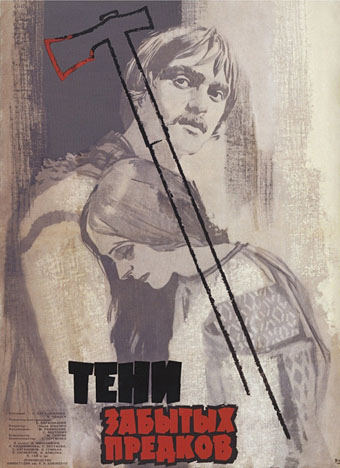
Shadows of Our Forgotten Ancestors (1964).

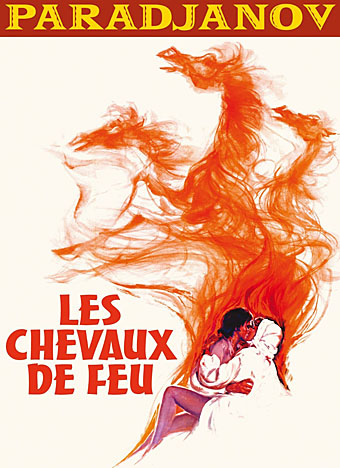
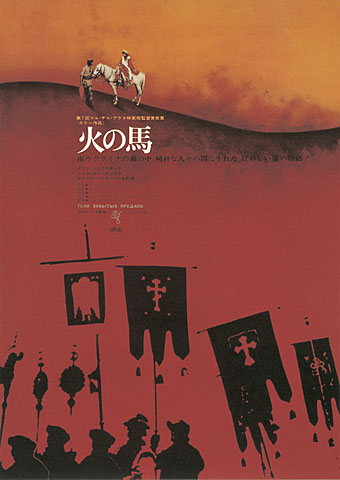
A selection of the better ones. Last week I was rewatching Sergei Parajanov’s The Colour of Pomegranates and was curious to see how it had been advertised. Shadows of Our Forgotten Ancestors is also known as Wild Horses of Fire (or Horses of Fire), after the novelette by Mykhailo Kotsiubynsky which provided the story. The Russian poster above shows the fateful axe which kills Ivan’s father at the beginning of the film, while the French and Japanese posters below play on the horses of fire in their titles.

parajanov2.jpg

parajanov3.jpg

Continue reading “Parajanov posters”

In Homage to Priapus

gay02.jpg

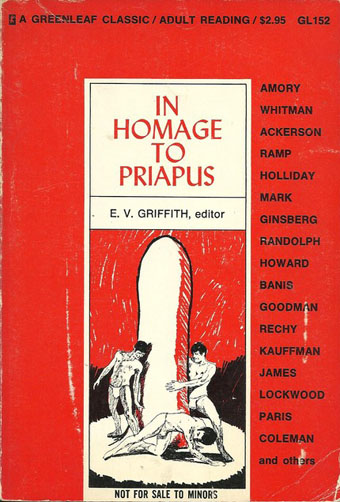
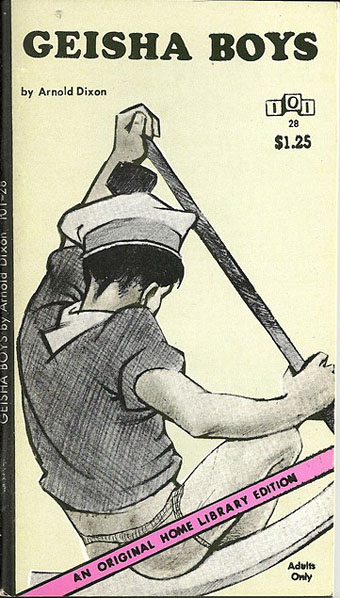
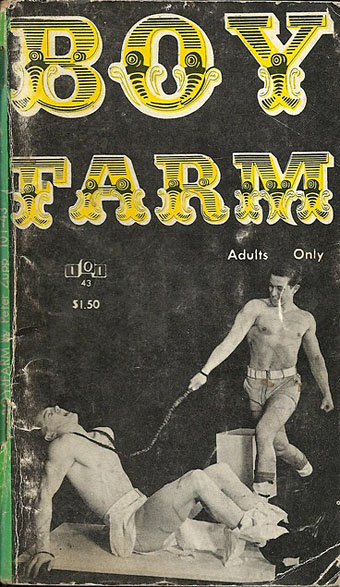
I’ve written a few things in the past about the covers of the gay pulps but decent source material—never mind the books themselves—has often been difficult to find. So it’s been good to stumble across the huge trove of covers at LibraryThing where diligent collectors have tagged and archived some very scarce publications. These are the books that flourished briefly in the US between the first flowering of gay liberation in the mid-60s to the advent of easily available hardcore porn in the mid-70s which must have made the text-only pleasures of a few years earlier seem very quaint and rather superfluous. Looking back today many of the covers of these books have a provocative silliness which is wholly absent from current titles for a gay audience. They may be crude and camp (sometimes simultaneously), and the design is often rudimentary, but they also give an insight into how gay men perceived themselves when they were starting to be more public about their desires.

Despite its cover, In Homage to Priapus looks like a fairly serious sampler of a kind you still see today. By contrast, many of the authors of the titles below were pseudonymous, some ridiculously so: “Billy Farout”. This time I’ve avoided the pulpy art styles featured at sites like Gay on the Range and Strange Sisters in favour of photo covers, odd titles or the more provocative illustrations, of which there are many examples. By coincidence, the latest post at Lambda Literary concerns the publishing of lost gay classics. One of the titles mentioned there, The Leather Boys by Gillian Freeman, can be found in the LibraryThing collection.

gay01.jpg

Don’t mention Jerry Lewis, please. I’ll think instead of this song by Heaven 17.

gay04.jpg

Whoever chose that typeface could also do with a thrashing.

Continue reading “In Homage to Priapus”

The Disappearance, a film by Stuart Cooper

disappearance1.jpg

If you’re an obsessive cineaste there’s a good chance you maintain a mental list of the films you’d like to see, the films you’d like to see again, and the films you’d like to see reissued on DVD. The vagaries of distribution and ownership often conspire to make older films fall out of sight even when they’ve been produced and promoted by major studios, have had TV screenings and so on. This was famously the case with five of Alfred Hitchcock’s features—Vertigo and Rear Window among them—which managed to remain out of circulation for two decades; more notoriously there was Stanley Kubrick’s neurotic embargo on any screening of A Clockwork Orange in the UK which meant that my generation of Kubrick-watchers had to make do with a variety of pirate VHS recordings.

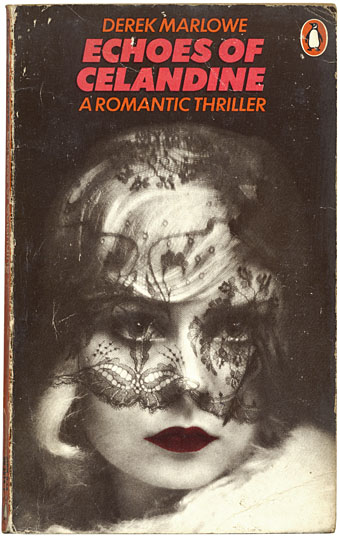
marlowe.jpg

Penguin edition, 1973. Photo by Van Pariser.

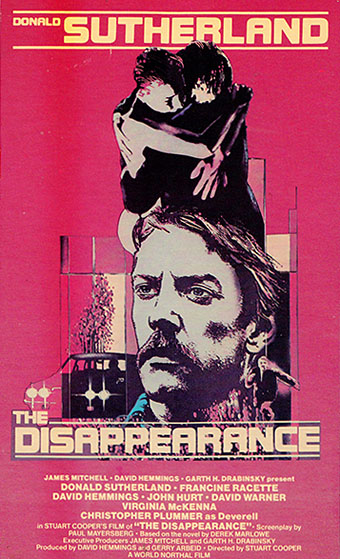
DVD reissues have chipped away at my “must see again” list with the result that Stuart Cooper’s The Disappearance (1977) recently found itself at the top of the catalogue. This film has never been as inaccessible as some: it received at least two TV screenings in the UK, and was available on VHS cassette for a time. There was also a DVD release although by the time I started looking for it the only available copies were secondhand ones commanding high prices. A year or so ago I read Derek Marlowe’s Echoes of Celandine (1970), the novel on which the screenplay is based, and as a result became more eager than ever to see the film again. Having finally watched a very poor-quality transfer of a VHS copy on YouTube I now feel sated, even if the experience was unsatisfying.

The Disappearance is one of those odd productions that ought to have all the ingredients to make a very memorable film but which never works as well as you might hope. The screenplay was by Paul Mayersberg, written between his two films with Nicolas Roeg, The Man Who Fell to Earth (1976) and Eureka (1983); there’s a great cast: Donald Sutherland, David Warner, Peter Bowles, David Hemmings (who also produced), John Hurt, Virginia McKenna, Christopher Plummer; Kubrick’s cameraman of the 1970s, John Alcott, photographed the film shortly after winning an Oscar for his work on Barry Lyndon; the source material is very good: Marlowe’s novel is described as “a romantic thriller” but when the quality of the writing easily matches any literary novels of the period such a description makes it sound more generic and pot-boiling than it is.

Continue reading “The Disappearance, a film by Stuart Cooper”

The Use and Abuse of Books

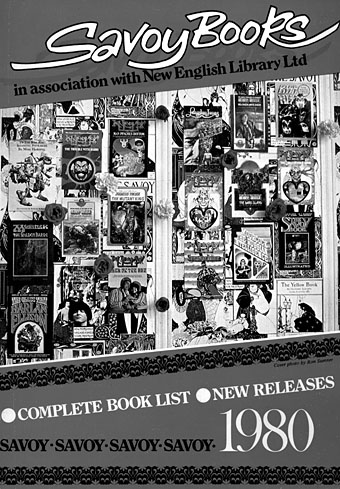
savoy.jpg

Savoy • Savoy • Savoy: The first wave of book covers pinned to the Beardsley wallpaper of the Deansgate office.

I often feel I’m in a minority in never having been desperate to see my work in a gallery. We are, after all, living in the Age of Mechanical Reproduction (thanks, Walter), and the idea of having to visit a physical location in order to see a work of art can seem like a rather antiquated affair. (Plenty of arguments counter this, of course, but I don’t create anything that needs to be experienced in situ, and I’m also not enmeshed in the art market.) So it’s been surprising this month to realise that examples of my work are currently on display in Monterey, California (the Tentacles exhibition), London (Comics Unmasked: Art and Anarchy in the UK at the British Library which ends today) and in Manchester (The Exhibition Centre for the Use and Abuse of Books at the International Anthony Burgess Foundation). If all goes according to plan, some of my steampunk book covers will also be exhibited in Beijing next month; more about that later.

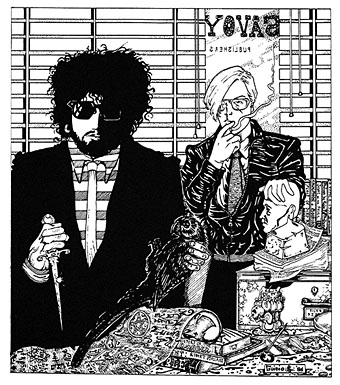
dbmb.jpg

Britton & Butterworth by Kris Guidio (1986).

The Use and Abuse of Books is a necessarily brief overview of the 40-year history of Savoy Books, a notable moment in the life of the company since this is the first time any Manchester institution has acknowledged the existence of a local publisher with such a long, varied and often controversial history. In part this is a result of the cultural histories of Manchester concentrating almost exclusively on the music scene. Many of the books and features written about Manchester arts have been produced by DJs or ex-musicians who appear tone-deaf to literary culture despite the existence of Carcanet Press (established 1969), Savoy Books, and other more recent publishers who are happy to operate outside London. (The venerable Jon Savage gets a pass here.) Carping aside, The Use and Abuse of Books describes itself thus:

Featuring text, images and rare promotional content from Savoy’s infamous 1989 publication Lord Horror, the exhibition tackles the question of whether the depiction and description of horrific acts is justified in satire. In 1992 Lord Horror was declared by Judge Gerrard Humphries as ‘a glorification of racism and violence’ whereas writer Michael Moorcock believed the book to belong to ‘a tradition of lampoon, of exaggeration. Its purpose is to show up social evils, and the evils within ourselves.’ Displaying artwork from Sinister Legends and Meng and Ecker alongside other panels from rare comics and graphic novels (including Reverbstorm), The Use and Abuse of Books also examines the relationship between text and imagery within Savoy’s publications, revealing how artwork from John Coulthart, Kris Guidio and James Cawthorn supplements and enhances the storytelling through visual references to architecture, cultural figures or specific works of art. The exhibition will be open 10am–4pm weekdays and in the evenings during events from Friday 15th August until Friday 5th September. (more)

Some of my pages from Lord Horror: Reverbstorm have been printed large-size for the walls, and there’s also a life-size cardboard figure of my Beardsley-style Lord Horror. Savoy publications past and present are on display, including some of my book designs. It’s fitting that this should be taking place under the aegis of the Anthony Burgess Foundation; Burgess was a great Joycean and a champion of two Savoy favourites: William Burroughs and JG Ballard. I can’t imagine him getting too enthusiastic about many of Savoy’s publications but I’d hope he might have appreciated the spirit of Mancunian bloody-mindedness in which they were produced.

Weekend links 221

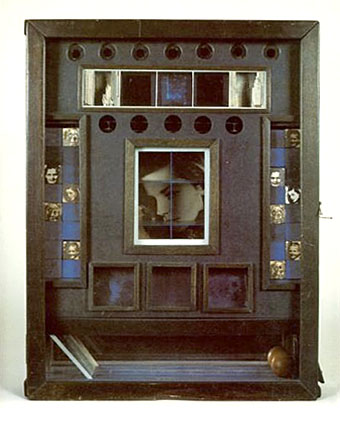
cornell.jpg

Untitled (Penny Arcade Portrait of Lauren Bacall) (1946) by Joseph Cornell.

• Having been a Bernard Szajner enthusiast for many years it’s good to see his music receiving some belated reappraisal. David McKenna talked to Szajner about his Visions Of Dune album (which is being reissued by InFiné next month), laser harps, The (Hypothetical) Prophets, and working with Howard Devoto.

• Priscilla Frank posts some big views of Marjorie Cameron’s occult paintings as a preview of the forthcoming exhibition at MOCA Pacific Design Center, Los Angeles.

• Fascinating reading in light of the recent kerfuffle over True Detective, Christopher Loring Knowles on the possible sources of HP Lovecraft’s Cthulhu Mythos.

Those who set up oppositions between the electronic technology and that of the printing press perpetuate Frollo’s fallacy. They want us to believe that the book—an instrument as perfect as the wheel or the knife, capable of holding memory and experience, an instrument that is truly interactive, allowing us to begin and end a text wherever we choose, to annotate in the margins, to give its reading a rhythm at will—should be discarded in favor of a newer tool. Such intransigent choices result in technocratic extremism. In an intelligent world, electronic devices and printed books share the space of our work desks and offer each of us different qualities and reading possibilities. Context, whether intellectual or material, matters, as most readers know.

Alberto Manguel, lucid as always, on the act and import of reading.

• “It’s time to give prog rock’s artist-in-residence Roger Dean his due,” says Amber Frost. No argument there, I did my bit in 2010.

• “Why do the covers of so many self-published books look like shit?” asks B. David Zarley.

• Mixes of the week: FACT mix 455 by Airhead, and Secret Thirteen mix 225 by Clock DVA.

• At Core77: Rain Noe chooses favourite skyscraper photos by Russian urban explorers.

• “O, Excellent Air Bag”: Mike Jay on the nitrous oxide fad of the early 19th century.

Nick Carr goes in search of Manhattan’s last remaining skybridges.

Lauren Bacall at Pinterest.

• Shaï Hulud (1979) by Zed (Bernard Szajner) | Welcome (To Death Row) (1980) by Bernard Szajner | Person To Person (1982) by The (Hypothetical) Prophets