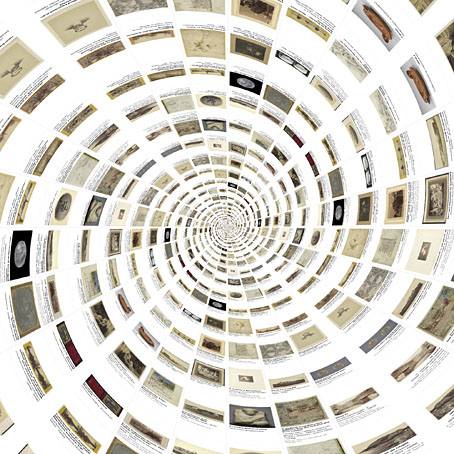
Copyright-free images

images.jpg

In recent discussions about AI ethics I’ve been seeing the same question raised by commenters, something like the following: “Okay, this stuff is bad…but if we shouldn’t use it then what can I use instead for my book cover/album cover/Substack article…?” This post is intended to provide one answer to the question, a guide to some of the more substantial alternatives for those who complain they can’t afford to hire a human being to decorate their work. Many of these archives have been around for years but searching for single images doesn’t always bring you to a useful copyright-free solution right away, especially if you’re using Google’s deteriorated service.

Wikimedia Commons. An obvious yet indispensible resource, especially for illustration research, and one that’s continually updated and improved. I only noticed recently that Wikimedia now has very large scans of Ernst Haeckel’s Kunstformen der Natur that are much better quality than the books at the Internet Archive.

The Internet Archive. And speaking of which… The Internet Archive has its own images section but for years now I’ve been mining the texts section looking for illustrated books. This isn’t an ideal solution for most purposes, not when the best material is often hidden under blank library covers, but persistence can be rewarding, especially where old engravings are concerned. Many of the 19th-century illustrations sold by stock libraries may be found here for free.

Gallica. The public face of the Bibliothèque Nationale of France, and a very useful resource despite being cursed with a slow and buggy interface. There’s also a Gallica app but you’re better off using the website.

Library of Congress. Excellent for anything to do with US history. Also a great selection of photochromes, among other things.

NYPL Digital Collections. “Explore 1,060,155 items digitized from The New York Public Library’s collections.”

Public Domain Image Archive. “Explore our hand-picked collection of 10,046 out-of-copyright works, free for all to browse, download, and reuse. This is a living database with new images added every week.”

Smithsonian Open Access & Smithsonian Image Gallery

Biodiversity Heritage Library. Animals and plants.

Wellcome Collection. Public domain medical (and related) images.

Metropolitan Museum of Art Open Access.

The Getty Museum Open Content.

The British Library Flickr Albums. A shame it’s Flickr, they really ought to have a dedicated site of their own for images.

Europeana. “Discover Europe’s digital cultural heritage.”

David Rumsey Map Collection. Maps, maps and more maps.

NASA Image and Video Library. NASA materials have always been free to use so long as you also credit their source.

ESO. ESO is the European Southern Observatory which is housed at a number of sites in the Chilean Atacama Desert. As with NASA, the high-resolution images created there are free to use so long as credit is included.

National Library of Medicine. “Images from the history of medicine.”

Pixabay. “Stunning royalty-free images & royalty-free stock.”

Pexels. “The best free stock photos, royalty free images & videos shared by creators.”

Unsplash. “All images can be downloaded and used for personal or commercial projects.”

Exotic Animal Photo Reference Repository. “Artists creating derivative or transformative works without Generative AI have blanket permission to reference these photos.”

Heidelberg Universitäts-Bibliotek: Art and satirical periodicals. An invaluable resource for European periodicals of the late 19th/early 20th centuries, with downloadable of scans of The Studio, The Yellow Book, Ver Sacrum, Pan, Jugend, and many other titles. Heidelberg is only one of many university libraries which now make parts of their collection available as free downloads. I’d love to point the way to the best of the others but I don’t have a useful list to hand. A recent discovery, however, is Polona, the site for the National Library of Poland which has a large quantity of prints and photographs as well as whole books. Happy searching!

Update: Added a few more links.

Weekend links 759

martin.jpg

Chance and Order, Change 6 (Monastral Blue) (1972) by Kenneth Martin.

• At Public Domain Review: Some of the media which will be entering the public domain (in the USA) in 2025, including links to Standard Ebooks for the book titles.

• At Wormwoodiana: Mark Valentine’s regular report on the state of secondhand bookshops in Britain.

• At Colossal: Beams of light lance monumental architecture in Jun Ong’s astral installations.

• At Popular Mechanics: “A scientist proved paradox-free time travel is possible”.

• An interview with Alice Coltrane from 1981 for Piano Jazz Radio (NPR).

• Read 19 issues of Arthur magazine in PDF format. More coming soon!

• At Spoon & Tamago: Japanese Designer New Year’s cards of 2025.

• At the BFI: Pamela Hutchinson on 10 great films of 1925.

Astral Traveling (1973) by Lonnie Liston Smith & The Cosmic Echoes | Astral Altar (The Gateway Of Legba) (1994) by Dub Terror Exhaust | Astral Melancholy Suite (2022) by Ghost Power

Weekend links 758

laloy.jpg

Monstrum in animo (1955) by Yves Laloy.

• This week’s obligatory Bumper Book of Magic links: Alan Moore World has more of my ongoing comments about the creation of the book, while Séamas O’Reilly talked to Alan about the book itself and its connections with The Great When. The latter piece lowered my already low opinion of the late Genesis P-Orridge.

• At Timeless: A reprint of Bright Lights and Cats With no Mouths by John Balance. Still in print is The Cupboard Under the Stairs, a selection from JB’s notebooks.

• If you enjoy sleight-of hand magic—and I most certainly do—then Ricky Jay & His 52 Assistants (1996) is 58 miraculous minutes by a master of the art.

• Mixes of the week: Winter Solstice 6 at Ambientblog; a mix for The Wire by Rafael Toral; and Reflection on 2024 at a Strangely Isolated Place.

• “Whatever the reason, there is something sorrowful about the disposal of art, whatever the perceived quality,” says Steven Heller.

• New music: The Path Of The Elder Ones by Nerthus.

Bright Lights (1959?) by Wade Curtiss & The Rhythm Rockers | Bright Lights, Big City (1961) by Jimmy Reed | I Want To See The Bright Lights Tonight (1974) by Richard & Linda Thompson

Weekend links 757

froebekapteyn.jpg

The Breath of Creation (c. 1926–34) by Olga Fröbe-Kapteyn.

• At Wormwoodiana: “…Gresham was well-read enough to know that while magic can be more than a MacGuffin in a fantasy story, neither fantasy nor thriller fiction lets magic unsettle readers much. […] Even when it is good, the supernatural is never safe in a Williams story. Not conventional fantasy by half.” G. Connor Salter on William Lindsay Gresham’s enthusiasm for Charles Williams’ novels.

• At Harper’s Magazine: Christopher Tayler reviews Lawrence Venuti’s translations of Dino Buzzati’s Il deserto dei Tartari (now titled The Stronghold) which was published last year, and The Bewitched Bourgeois: Fifty Stories which will be out in January.

Dennis Cooper’s favourite fiction, poetry, non-fiction, film, art, and internet of 2024. Thanks again for the link here!

• The Approach to J.L. Borges: A Borgesian pastiche in homage to the creator of Ficciones by Ed Simon.

• “HP Lovecraft meets Fafhrd and The Grey Mouser”: an essay from 1992 by Fritz Leiber.

Can performing live on The Old Grey Whistle Test in January, 1974.

• DJ Food says “Let’s have some psychedelia”.

• RIP Zakir Hussain.

Creation Dub 1 (1977) by Lee Perry & The Upsetters | Threat To Creation (1981) by Creation Rebel/New Age Steppers | Theme from ‘Creation’ (1992) by Brian Eno

In the Hands of Madmen

madmen.jpg

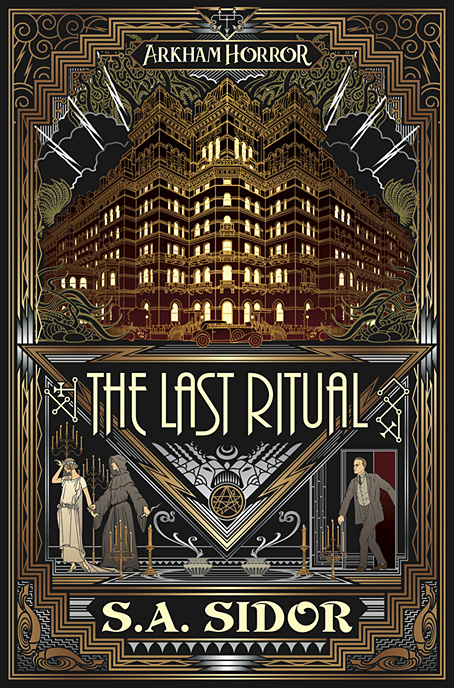
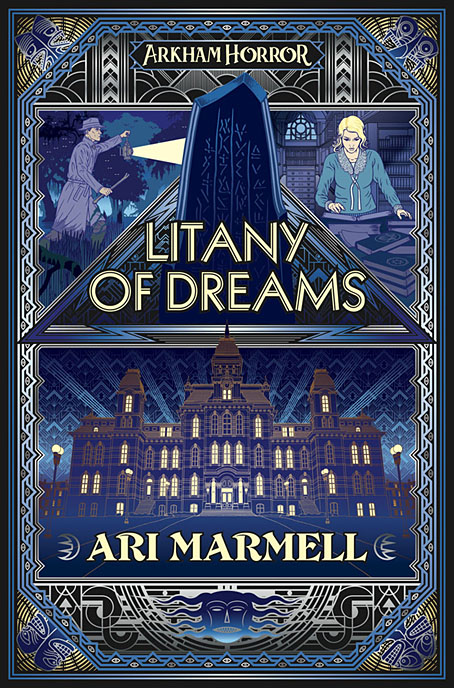
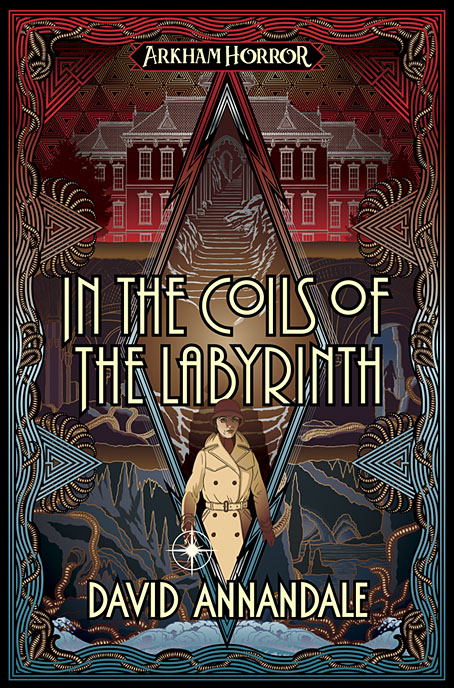
My latest cover for the Arkham Horror series from Aconyte continues the Art Deco trend of the other books in this series while also recycling some of the art from the previous covers. In the Hands of Madmen is an omnibus collection of three previously-published novels for which I was given the tricky task of combining portions of three covers into a single design. This wouldn’t be so difficult in other cases but my Arkham Horror covers have been heavily structured, with borders within borders, background patterns and isolated details. I was fortunate that two of the books in the new volume had cover designs that were reflections of each other which could be welded together and laid over the third cover without too much trouble. The original covers are presented below for comparison.

sidor.jpg

litany.jpg

coils.jpg

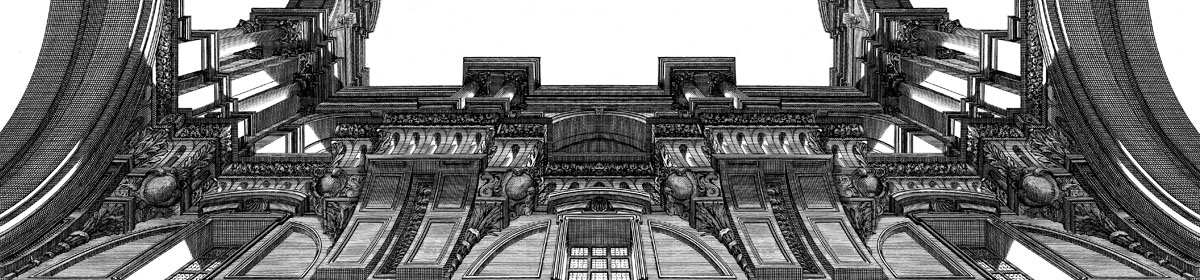
My last Arkham Horror cover, Herald of Ruin, featured a drawing of a fantastic city which was mostly covered over in the final assembly. The new one does the same with a Deco grille design that I worked up from a photo of a grille in the Squibb Building in New York City.

squibb.jpg

The design is more visible on the back cover so the effort wasn’t entirely wasted. When I’m working on covers like these I prefer to copy (or adapt) authentic period designs when I can. You can find no end of Deco motifs in the form of clip-art but they tend to be Deco-ese, lacking the invention you find in the original designs. I like this grille, it reminds me of a printed circuit. I may use it again one day.

Elsewhere on { feuilleton }
The Lovecraft archive

Previously on { feuilleton }
Herald of Ruin
The Ravening Deep
Diamonds
The Devourer Below
Litany of Dreams
The Last Ritual