
Weekend links 212

non-format.jpg

Poster for the recent Ballard-themed Only Connect Festival of Sound in Oslo. Design by Non-Format.

Bulldozer by Laird Barron was my favourite piece in Lovecraft’s Monsters, the recent Tachyon anthology edited by Ellen Datlow that I designed and illustrated. So it’s good to hear that Nic Pizzolato, writer of the justly-acclaimed HBO series True Detective, is among Barron’s readers. True Detective, of course, created a stir for referencing Robert Chambers’ weird fiction in a police procedural. The series is out now on DVD and Blu-ray, and I can’t recommend it too highly.

• Citation-obsessed Wikipedians don’t believe Hauntology is a genuine musical genre, a sentiment which will probably surprise some of its practitioners. Whatever the merits of the argument, I rather like the idea of a musical form that resists strict definition.

• “This year, in order to do things differently, I will make a conscious effort to separate the man from his writing.” Giovanna Calvino, daughter of Italo Calvino, remembers her father.

With ideology masquerading as pragmatism, profit is now the sole yardstick against which all our institutions must be measured, a policy that comes not from experience but from assumptions – false assumptions – about human nature, with greed and self-interest taken to be its only reliable attributes. In pursuit of profit, the state and all that goes with it is sold from under us who are its rightful owners and with a frenzy and dedication that call up memories of an earlier iconoclasm.

Alan Bennett delivers a sermon.

Zarina Rimbaud-Kadirbaks, aka Dutch Girl In London, reviews the Chris Marker exhibition that’s currently running at the Whitechapel Gallery, London.

• Exteriorizing the Inner Realms: Christopher Laursen talks to Phantasmaphile and Abraxas magazine‘s Pam Grossman about occult art, past and present.

• The Beast is back: Erik Davis talks to Gary Lachman about his new book, Aleister Crowley: Magick, Rock and Roll, and the Wickedest Man in the World.

• The body as factory: anatomy of a New Scientist cover image. Rick Poynor on the recurrent use of a familiar visual metaphor.

• Mix of the week without a doubt is FACT Mix 445 by Stephen O’Malley, a three-hour behemoth.

• Jennifer in paradise: Photoshop developer John Knoll on the story of the first Photoshopped image.

• The trailer for Grandfather of Gay Porn, a documentary about Peter de Rome by Ethan Reid.

Giorgio’s Theme is a new piece of electronic music by Giorgio Moroder.

Agender, a series of androgynous photo-portraits by Chloe Aftel.

• RIP Little Jimmy Scott

Evil Spirits

Chase (1978) by Giorgio Moroder | Call Me (1980) by Blondie | The Apartment (1980) by Giorgio Moroder
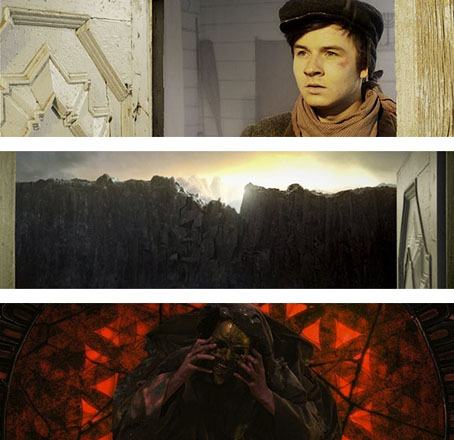
The Dreamlands: A Lovecraftian film

dreamlands.jpg

A crowd-funding goal has been announced for The Dreamlands, a feature film set in the worlds of HP Lovecraft’s Dream Cycle which, if it goes ahead, will be director Huan Vu’s second Lovecraftian feature. His first, Die Farbe (2010), is an excellent adaptation of The Colour Out of Space which impressed me with its atmosphere and its serious attitude towards the material, qualities that you can’t always rely on where horror cinema is concerned.

The Dreamlands will of necessity be more fantastical and so warrants a larger budget, hence the funding bid. I was asked to contribute to the production side of this late last year but prior commitments intervened, not least all the work I was doing on Lovecraft’s Monsters. I did find time to design the star symbol that’s being used to promote the film, however, and there’s talk at the moment of my working on some of the gifts for the funders in the higher brackets. More about that later. Watch the teasers, they’re very good.

Elsewhere on { feuilleton }
The Lovecraft archive

Lovecraft’s Monsters unleashed

lm1.jpg

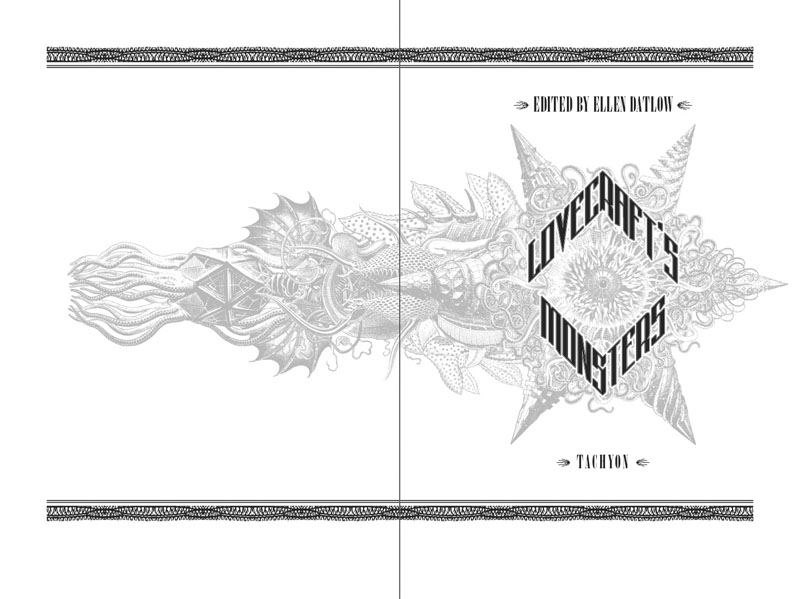
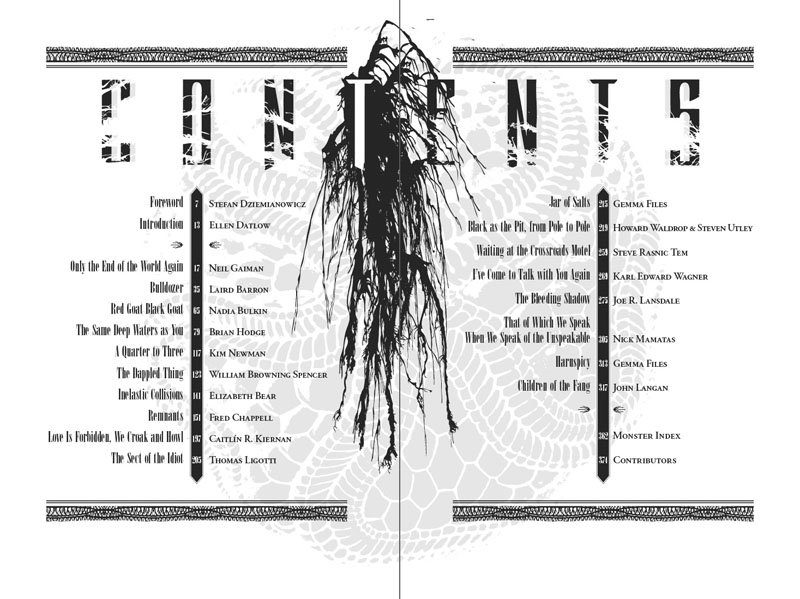
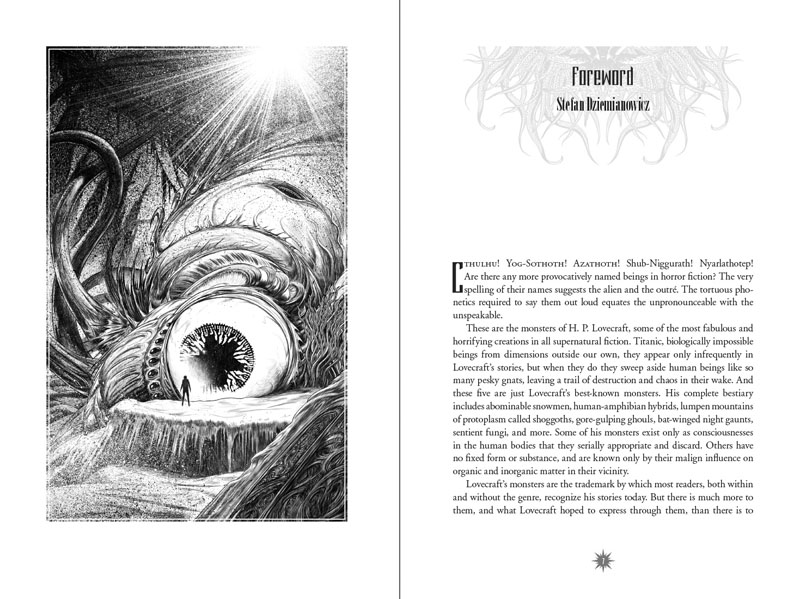
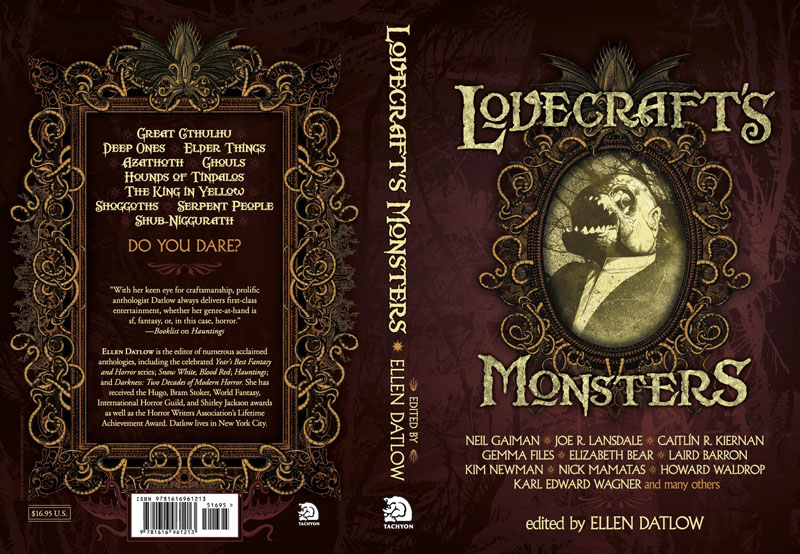
I posted my illustrations for this anthology back in December, after which Tachyon also asked me to create a cover for the book, something that hadn’t been planned at the outset. Lovecraft’s Monsters, edited by Ellen Datlow, is in the shops this month so here’s the cover and a few of my page layouts from the interior. I’m very pleased with this one so it’s been good to hear it’s been selling well already, and picking up positive reviews. My illustrations may be seen at large size here while the book itself should be available via all the usual outlets. If you insist on shopping in a river filled with piranhas then here’s a link. (That fish head on the cover is based on a piranha as it happens.)

The big Lovecraft collection from Centipede Press, A Mountain Walked, was also supposed to be out this month but the release has been bumped (again) to May 2014. It’s a huge volume so I’m not surprised if it’s taking longer than expected.

lm2.jpg

lm3.jpg

lm4.jpg

Elsewhere on { feuilleton }
The Lovecraft archive

Seward/Howard

burroughssphinx.jpg

William Burroughs, New York, 1953. Photo by Allen Ginsberg.

Lonely lemur calls whispered in the walls of silent obsidian temples in a land of black lagoons, the ancient rotting kingdom of Jupiter – smelling the black berry smoke drifting through huge spiderwebs in ruined courtyards under eternal moonlight – ghost hands at the paneless windows weaving memories of blood and war in stone shapes – A host of dead warriors stand at petrified statues in vast charred black plains – Silent ebony eyes turned toward a horizon of always, waiting with a patience born of a million years, for the dawn that never rises – Thousands of voices muttered the beating of his heart – gurgling sounds from soaring lungs trailing the neon ghost writing – Lykin lay gasping in the embrace can only be reached through channels running to naked photographic process – molded by absent memory, by vibrating focus scalpel of the fishboy gently in a series of positions running delicious cold fingers “Stand here – Turn around – Bend”

The Ticket that Exploded (1962)

William Burroughs always talked favourably of Ernest Hemingway, and the famously spare style of Hemingway’s prose is evidently a style he sought himself, especially in the later works where there’s less of an emphasis on linguistic pyrotechnics. Something that always strikes me when I return to Burroughs’s earlier novels is the quality of passages like the one above which is a long way from the Hemingway style. What’s even more noticeable—and this is something which attracted me to Burroughs’s work from the outset—is the degree to which some of these passages are reminiscent of HP Lovecraft. In the case of the example above, taken from The Black Meat chapter of The Ticket that Exploded, some of this may be the work of Michael Portman who Burroughs credits as co-writer. What Portman contributed to The Black Meat and another chapter of that novel I’ve never discovered but there are plenty of other examples by Burroughs alone to show that he wasn’t incapable of this himself. The Ticket that Exploded was the first Burroughs book I read, and part of the shock and fascination came from encountering a recognisable Weird Tales-style atmosphere wrenched into inexplicable and thoroughly alien territory.

hpl.jpg

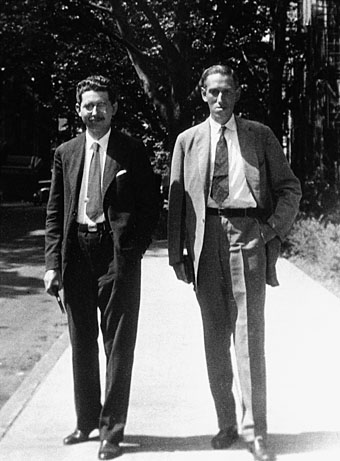
Frank Belknap Long and HP Lovecraft, New York, 1931. Photo by WB Talman.

There are others connections beyond literary style. When the Simon Necronomicon was published in 1977 Burroughs was asked to provide a blurb for the book. He wasn’t as effusive as the publishers might have hoped but the dubious volume was still advertised with his recommendation:

Let the secrets of the ages be revealed. The publication of the Necronomicon may well be a landmark in the liberation of the human spirit.

If it wasn’t for this then the extraordinary Invocation which opens Cities of the Red Night (1981) would have been diminished. Among the other “gods of dispersal and emptiness” whose names are called, Burroughs mentions “Kutulu, the Sleeping Serpent who cannot be summoned”, and “the Great Old One”, among a number of the usual Mayan gods, and several Sumerian deities whose descriptions (as with Kutulu) are taken from the pages of the Simon Necronomicon. It’s impossible to imagine Saul Bellow or John Updike opening a novel this way, just as it’s impossible to imagine many genre writers wandering into the areas that Burroughs explores elsewhere in that novel. This is one reason why Burroughs (and JG Ballard) were included in DM Mitchell’s The Starry Wisdom anthology in 1994, an attempt to expand the acceptable boundaries of Lovecraftian fiction, and also wilfully trample the fences that separate the genre and literary camps. I campaigned at the time for The Black Meat chapter to be included but Dave was set on Wind Die, You Die, We Die from Exterminator! (1973), a lesser piece although in the end it didn’t seem out of place in the book as a whole.

Elsewhere on { feuilleton }
The Lovecraft archive
The William Burroughs archive

Polypodes

jianfu.jpg

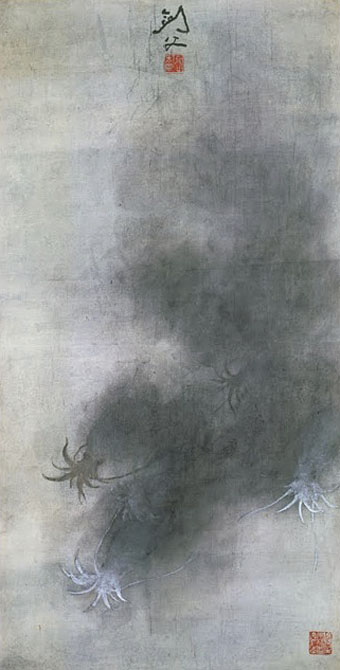
Sepia (no date) by Gao Jianfu.

Quelquefois, dans une nuit d’orage, pendant que des légions de poulpes ailés, ressemblant de loin à des corbeaux, planent au-dessus des nuages, en se dirigeant d’une rame raide vers les cités des humains, avec la mission de les avertir de changer de conduite, le caillou, à l’œil sombre, voit deux êtres passer à la lueur de l’éclair, l’un derrière l’autre; et, essuyant une furtive larme de compassion, qui coule de sa paupière glacée, il s’écrie: «Certes, il le mérite; et ce n’est que justice.» Après avoir dit cela, il se replace dans son attitude farouche, et continue de regarder, avec un tremblement nerveux, la chasse à l’homme, et les grandes lèvres du vagin d’ombre, d’où découlent, sans cesse, comme un fleuve, d’immenses spermatozoïdes ténébreux qui prennent leur essor dans l’éther lugubre, en cachant, avec le vaste déploiement de leurs ailes de chauve-souris, la nature entière, et les légions solitaires de poulpes, devenues mornes à l’aspect de ces fulgurations sourdes et inexprimables.

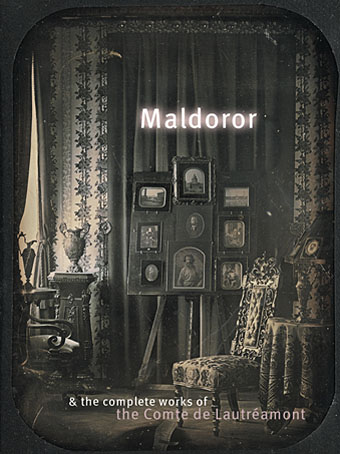
Les Chants de Maldoror (1869) by the Comte de Lautréamont

maldoror.jpg

Sometimes on a stormy night while legions of winged squids (at a distance resembling crows) float above the clouds and scud stiffly towards the cities of the humans, their mission to warn men to change their ways—the gloomy-eyed pebble perceives amid flashes of lightning two beings pass by, one behind the other, and, wiping away a furtive tear of compassion that trickles from its frozen eye, cries: “Certainly he deserves it; it’s only justice.” Having spoken thus it reverts to its timid pose and trembling nervously, continues to watch the manhunt and the vast lips of the vagina of darkness whence flow incessantly, like a river, immense shadowy spermatozoa that take flight into the dismal aether, the vast spread of their bat’s wings obscuring the whole of nature and the lonely legions of squids—grown downcast viewing these ineffable and muffled fulgurations.

Translation by Alexis Lykiard, 1970

pennington-cthulhu.jpg

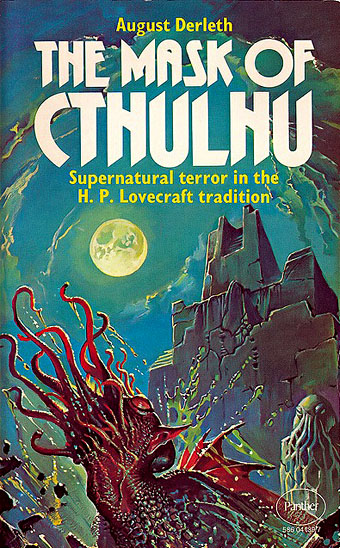
The Mask of Cthulhu, 1976 paperback reprint. Cover art by Bruce Pennington.

Above these apparent hieroglyphics was a figure of evidently pictorial intent, though its impressionistic execution forbade a very clear idea of its nature. It seemed to be a sort of monster, or symbol representing a monster, of a form which only a diseased fancy could conceive. If I say that my somewhat extravagant imagination yielded simultaneous pictures of an octopus, a dragon, and a human caricature, I shall not be unfaithful to the spirit of the thing. A pulpy, tentacled head surmounted a grotesque and scaly body with rudimentary wings; but it was the general outline of the whole which made it most shockingly frightful. Behind the figure was a vague suggestion of a Cyclopean architectural background.

The Call of Cthulhu (1928) by HP Lovecraft

Previously on { feuilleton }
Ulysses versus Maldoror
Maldoror
Vampyroteuthis Infernalis by Vilém Flusser
Books of blood
Magritte’s Maldoror
Frans De Geetere’s illustrated Maldoror
Maldoror illustrated