Weekend links 174

ikuma.jpg

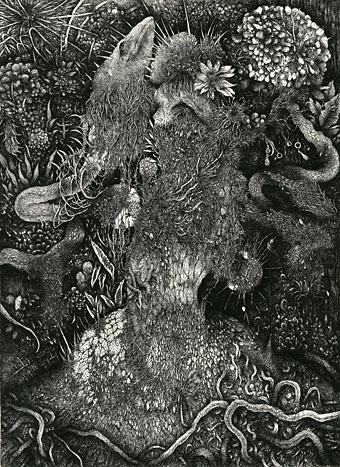
Dress (2012) by Nao Ikuma.

• Two of my Cthulhu artworks can currently be seen in the Ars Necronomica exhibition at the Cohen Gallery, Brown University, Providence, RI. The exhibition is part of NecronomiCon, and runs to September 13th. In related news, my steampunk illustration has been nominated in the Visual category of this year’s Airship Awards. Winners will be announced at Steamcon V in October.

• “…the story of how a small cabal of British jazz obsessives conducting a besotted affair with the style arcana of Europe and America somehow became an army of scooter-borne rock fans…” Ian Penman looks back at the culture of Mod for the LRB.

• “What is it about the writer in the First World that wants the Third World writer to be nakedly political, a blunt instrument bludgeoning his world’s ills?” Gina Apostol on Borges, Politics, and the Postcolonial.

If someone had designed a work regime perfectly suited to maintaining the power of finance capital, it’s hard to see how they could have done a better job. Real, productive workers are relentlessly squeezed and exploited. The remainder are divided between a terrorised stratum of the, universally reviled, unemployed and a larger stratum who are basically paid to do nothing, in positions designed to make them identify with the perspectives and sensibilities of the ruling class (managers, administrators, etc) – and particularly its financial avatars – but, at the same time, foster a simmering resentment against anyone whose work has clear and undeniable social value. Clearly, the system was never consciously designed. It emerged from almost a century of trial and error. But it is the only explanation for why, despite our technological capacities, we are not all working 3–4 hour days.

On the Phenomenon of Bullshit Jobs by David Graeber

Ron Rosenbaum talks to Al Pacino about all the usual stuff, and reveals some detail about the actor’s obsessive interest in Oscar Wilde’s Salomé.

• More queer history: The Brixton Fairies and the South London Gay Community Centre, Brixton 1974–6.

• At Dangerous Minds: Anthony Burgess and the Top Secret Code in A Clockwork Orange

• Every day for 100 days, Jessica Svendsen redesigned a Josef Müller-Brockmann poster.

LondonTypographica: Mapping the typographic landscape of London.

• Mix of the week: Secret Thirteen Mix 083 by Demdike Stare.

• At Strange Flowers: Alfred Kubin the writer.

Derek Jarman’s sketchbooks.

Rick Poynor on Collage Now.

• Thomas Leer: Private Plane (1978) | Tight As A Drum (1981) | Heartbeat (1985)

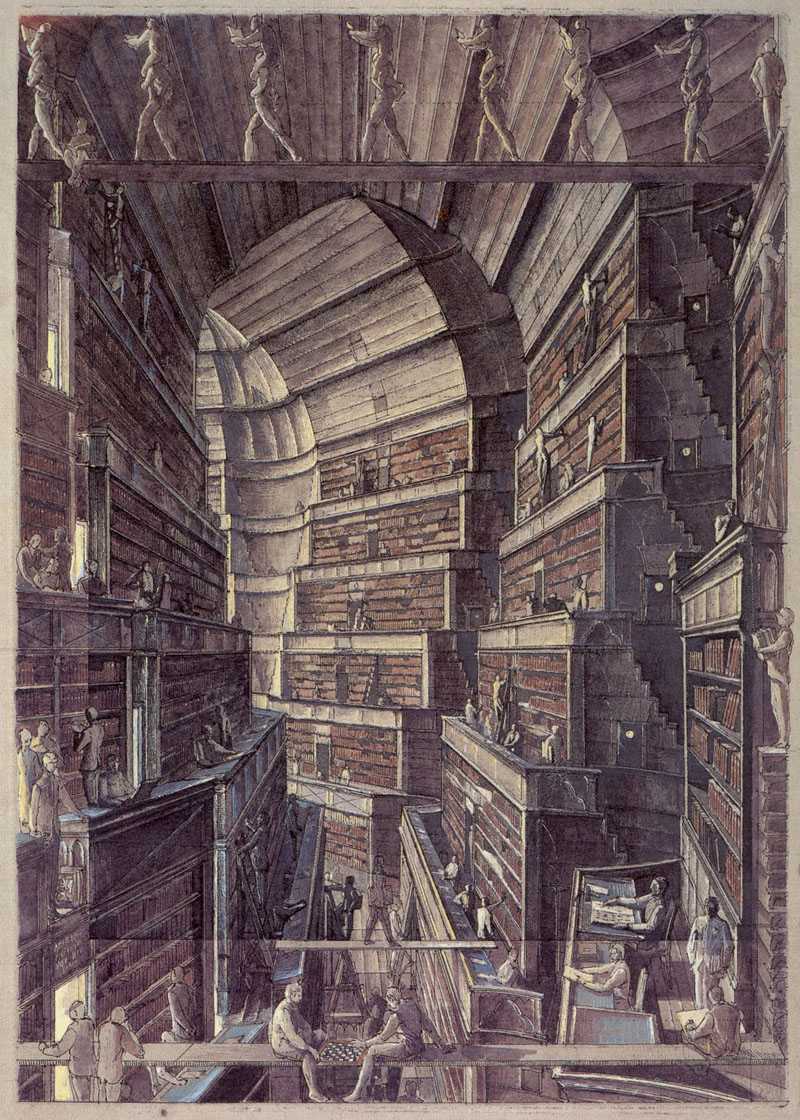
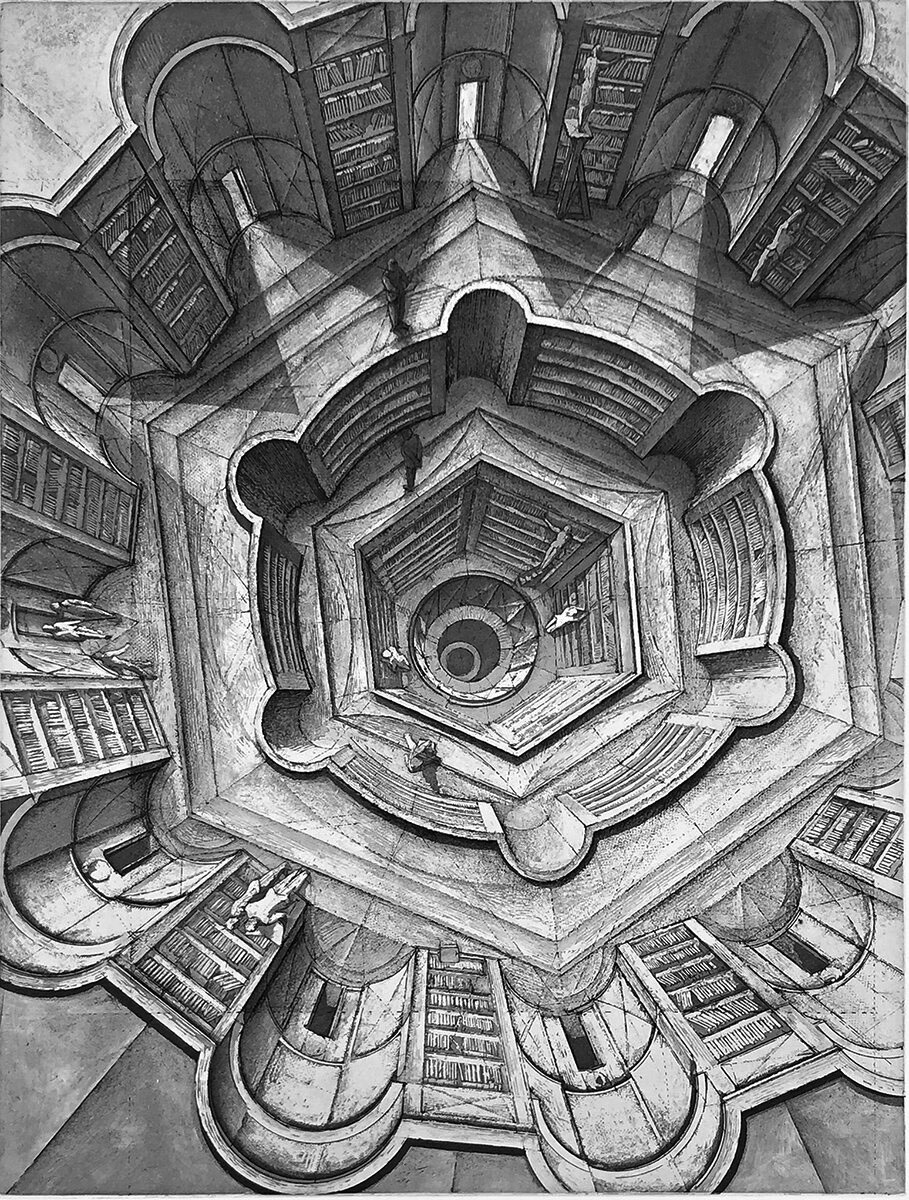
The Library of Babel by Érik Desmazières

library1.jpg

The print work of French artist Érik Desmazières has featured here on several occasions, and I’ve also had reason to mention more than once his aquatints and etchings which illustrate Jorge Luis Borges’ celebrated short story The Library of Babel (1941). The prints were produced in 1997, with a small book edition being published in 2000. Copies of the volume now sell for upwards of $100, and at a mere 36 pages this somewhat exceeds my acquisitiveness threshold; hence this post which gathers some of the better online reproductions, one or two of which have only come to light in the past couple of years.

library2.jpg

Borges’ description of the architecture of the Universe-size Library is sketchy so Desmazières opens out some of the spaces to give a Piranesian sense of space to what would otherwise be little more than views of the same small rooms and corridors, endlessly repeating. MC Escher could have made something of those infinite perspectives—the hexagonal chambers are the closest to the story descriptions—but the larger rooms convey without words an impression of colossal spaces filled with nothing but people and an infinitude of books. The volumes that Borges describes contain few illustrations but one of them at least would describe this very book. Another would describe this book with a minor variation in one of the plates; another would describe MC Escher’s depictions of the Library, and Piranesi’s, and Salvador Dalí’s, and yours, and mine, and on and on…

library3.jpg

library4.jpg

library5.jpg

library6.jpg

library7.jpg

library8.jpg

library9.jpg

library10.jpg

library11.jpg

library12.jpg

Elsewhere on { feuilleton }
The etching and engraving archive

Previously on { feuilleton }
Les lieux imaginaires d’Érik Desmazières
The art of Érik Desmazières

Weekend links 143

empire.jpg

Ai No Corrida poster design by Egil Haraldsen (2001).

• “Back then, publishing an interview with Félix Guattari alongside little chats with rough trade and street walkers was unheard of — it still is for the most part.” BUTT on Kraximo, a gay Greek magazine of the 1980s.

13 books for 2013: A selection of forthcoming titles at Strange Flowers which so closely aligns with my preoccupations that I worry he’s reading my mind.

• “The Macaulay Library is the world’s largest and oldest scientific archive of biodiversity audio and video recordings.”

• A free BitTorrent Robert Anton Wilson audio and video pack. See also the RAW files at the Internet Archive.

beijing.jpg

The Pangu Building, Beijing, January 12th, 2013. Blade Runner arrives six years early.

Wired celebrates 100 years of Edward Johnston’s typeface for the London Underground.

Borges’ translation of Ulysses. Or of the last page of Ulysses as a translation of Ulysses.

0181, a new album by Four Tet, can be heard in full at SoundCloud.

• The Edge question for 2013: “What should we be worried about?

JG Ballard documentaries at Ubuweb.

Unlocking Dockstader.

• RIP Nagisa Oshima.

Ai No Corrida (1980) by Quincy Jones | Empire Of The Senses (1982) by Bill Nelson | Forbidden Colours (1983) by David Sylvian & Riuichi Sakamoto

Weekend links 136

tintenfisches.jpg

Der Triumph des Tintenfisches from Meggendorfer-Blätter (c. 1900). Via Beautiful Century.

Much dismay this week at the news that Coilhouse—the web and print magazine founded in 2008 by Nadya Lev, Meredith Yayanos and Zoetica Ebb—was closing its doors for the foreseeable future. I always loved what they were doing, and was delighted when S. Elizabeth interviewed me for the website two years ago. Looking at the list of their featured articles is like seeing the contents of my head laid bare. Have a browse and see what you may have missed. And fingers crossed they return soon.

• “I think we are just used to seeing naked women because they are used as objects of desire in advertisements and TV. Naked men are not that common—we are not used to seeing a penis. I think that is the main problem for people.” The shock of the (male) nude.

Michael Clarke asks “What Can Publishers Learn from Indie Rock?” Also: Michelle Dean on the value of used books.

Queers find themselves on both sides of the free speech question. Those of us who are writers want the freedom to write and say what we want. I know I do. Yet a preponderance of LGBT people have become part of the larger wave of those who would limit free speech. Because while we want to be able to say whatever we want about “them,” we do not want “them” to say whatever they want about us.

Victoria Brownworth on The Case Against Censorship

• Caspar Henderson re-reads The Book of Imaginary Beings by Jorge Luis Borges.

One hundred classic minimalism, electronic, ambient and drone recordings.

• BLDGBLOG visits the Chand Baori stepwell in Abhaneri, India.

Brion Gysin’s Dreamachine is launched in the UK.

Ken Hollings visits Ludwig II’s Venus Grotto.

• A guide to Meredith Monk‘s music.

• RIP Boris Strugatsky.

Maldorora: a Tumblr.

Stalker: Meditation (1979) by Edward Artemiev | Undulating Terrain (1995) by Robert Rich & B. Lustmord | Stalker (2004) by Shackleton.

Vampyroteuthis Infernalis by Vilém Flusser

vampyroteuthis.jpg

Cover design by Michel Vrana.

This, then, is the book that arrived a fortnight ago when I just happened to be in the midst of a week of tentacle posts. Vampyroteuthis Infernalis: A Treatise, with a Report by the Institut Scientifique de Recherche Paranaturaliste was originally published in Germany in 1987. This new edition is the first translation into English (by Valentine A. Pakis) published by the University of Minnesota Press in their Posthumanities series. It’s 100 pages long with a supplement of squid illustrations by Louis Bec. It is, to say the least, an odd book:

Part scientific treatise, part spoof, part philosophical discourse, part fable, Vampyroteuthis Infernalis gives its author ample room to ruminate on human—and nonhuman—life. Considering the human condition along with the vampire squid/octopus condition seems appropriate because “we are both products of an absurd coincidence…we are poorly programmed beings full of defects,” Flusser writes. Among other things, “we are both banished from much of life’s domain: it into the abyss, we onto the surfaces of the continents. We have both lost our original home, the beach, and we both live in constrained conditions.”

I’m not familiar with Flusser’s other work since I read few academic texts but it seems safe to assume that Vampyroteuthis Infernalis is an exception among the author’s volumes of media and communication theory. The tone is light but not overly comic unless you regard as inherently amusing Flusser’s analysis of an obscure cephalopod—the Vampyroteuthis Infernalis (the name translates as “vampire squid from hell”)—as a useful tool for studying the human condition. The study so far as it goes is along the lines of some of the essays by Jorge Luis Borges rather than any lengthy disquisition, looking at the squid’s existence from a number of angles in order to draw comparisons with human life. You wouldn’t think it easy to talk about “squid culture” or “squid politics” but Flusser manages:

…we are able to imagine cultural structures (“Utopias”) in which even our biological constraints are done away with. The vampyroteuthis cannot fathom Utopias, for the structure of its society is not a cultural product (it is not a “factum”) but rather a biological given (a “datum”). When it engages in politics, it does so against its own “nature”—it commits a violent act against itself. In the end, however, is not all human political activity contra nature?

And so on. In Borges terms (for me he’s the obvious touchstone) the book is reminiscent of the Chronicles of Bustos Domecq (1967), a series of deadpan essays about absurd cultural developments credited to one “H. Bustos Domecq” but written by Borges and Adolfo Bioy Casares. Flusser lived in Brazil for a number of years so Borges may have been an inspiration. Like Borges, Flusser is learned enough to write convincingly about his subject before he starts evading the reader’s grasp. The opening of Vampyroteuthis Infernalis is a creditable and informative run through the Octopoda taxonomy; later we have references and terminology from Heidegger, and Wilhelm Reich makes a surprising appearance. Many of the parallels are ingenious, such as when Flusser compares our electronic media—the glowing screens of televisions and computer monitors—to the glowing chromatophors on the skin of the squid which the animal uses to communicate in the lightless depths of the sea. Flusser ends on another Borgesian note, describing his “fable” as offering “an image of the self reflected between two facing mirrors”. Perhaps that’s the best way to regard this book: a continual play of reflections all of which would vanish if one of the mirrors were removed.

Those who wish to lose themselves in the reflections can order the book in hardback or paperback direct from the University of Minnesota Press. Elsewhere there’s a fair amount of Vampyroteuthis Infernalis footage on YouTube which reveals the animal in question to be as wonderfully strange as its name would imply.

Previously on { feuilleton }
Le Poulpe Colossal
Fascinating tentacula