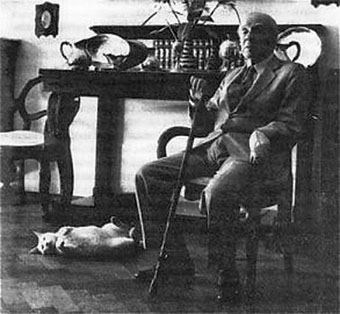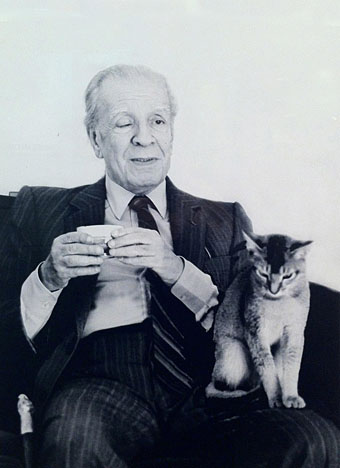
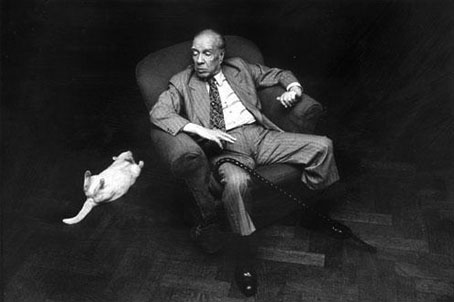
Borges and the cats

borges1.jpg

To a cat

Mirrors are not more wrapt in silences
nor the arriving dawn more secretive;
you, in the moonlight, are that panther figure
which we can only spy at from a distance.
By the mysterious functioning of some
divine decree, we seek you out in vain;
remoter than the Ganges or the sunset,
yours is the solitude, yours is the secret.
Your back allows the tentative caress
my hand extends. And you have condescended
since that forever, now oblivion,
to take love from a flattering human hand.
You live in other time, lord of your realm —
a world as closed and separate as dream.

Jorge Luis Borges (translated by Alastair Reid, 1977)

There are many tigers in the writings of Borges—the poem above is from a collection entitled The Gold of the Tigers—so it’s no surprise that the author would pay his respects to their domestic relatives. Regarding translations (and this is something I’ve noted before), those by Anthony Kerrigan, Alastair Reid, Norman Thomas di Giovanni and others were made with the author’s approval, and sometimes with his collaboration. The more recent translations by the Borges estate are poor in comparison.

Many more photos of cats with their writers may be seen here.

borges4.jpg

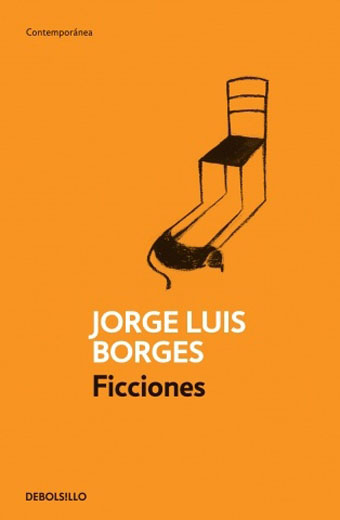
Grove Press, 1994.

borges2.jpg

borges5.jpg

Debolsillo, 2011.

borges6.jpg

Previously on { feuilleton }
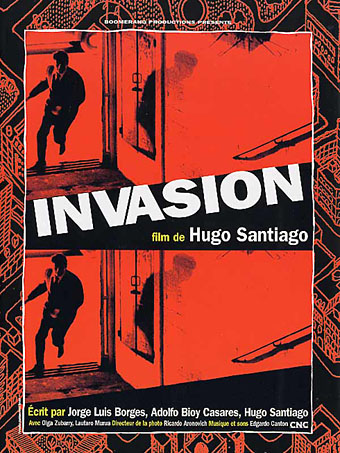
Invasion, a film by Hugo Santiago
Spiderweb, a film by Paul Miller
The Library of Babel by Érik Desmazières
Books Borges never wrote
Borges and I
Borges documentary
Borges in Performance

Invasion, a film by Hugo Santiago

invasion1.jpg

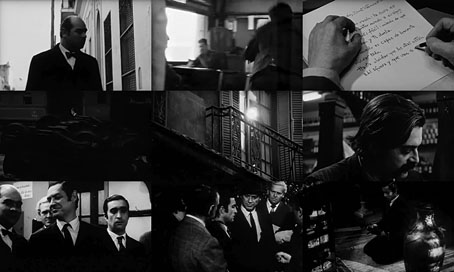
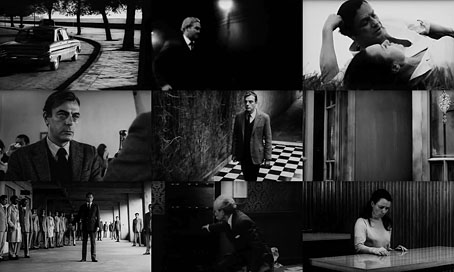
From a film adapted from Borges to a film co-written by the man himself. Invasion (1969) is not to be confused with the British science fiction film of the same name made three years earlier, this is an Argentinian production and a much stranger piece of work. Hugo Santiago is an Argentinian director who moved to France where he worked for a while as assistant to Robert Bresson before establishing himself with this debut feature. Borges’ co-writer was his friend and regular collaborator Adolfo Bioy Casares.

I’ve not watched this yet, the two copies on YouTube are in Spanish with no subtitles but this is a blog with an international readership so there’s no need to exclude it on that account. Even without subtitles the film is visually intriguing, possessed of a moody and enigmatic style which online reviewers compare favourably to Antonioni and some of the Nouvelle Vague directors.

invasion2.jpg

In 1957, a small group of middle-aged men fight a clandestine battle against forces quietly invading and taking control of their city, Aquilea. Enigmatic in its story-telling, Hugo Santiago’s once-lost film obscures the motivations of either side, leaving only a series of moves and counter-moves that evokes past dictatorial oppression and those still to come.

This post at Make Mine Criterion—a site dedicated to potential Criterion DVD releases—goes into considerable detail examining the film they describe as “part fantasy, part science fiction, part political thriller”. Given this and the rest of the film’s evident qualities it’s surprising it isn’t better known. I only have one Borges biography, The Man in the Mirror of the Book (1996) by James Woodall, but there’s no mention in there of Santiago’s film or of The Others (1974), a later Santiago feature that was also scripted by Borges and Bioy Casares. For those wishing to pursue the film further there are subtitles available if you can be bothered searching for them then trying to synch them up with a YT rip. It might be better to look for a Spanish DVD and hope it has a good choice of subtitles.

invasion3.jpg

Previously on { feuilleton }
Spiderweb, a film by Paul Miller
The Library of Babel by Érik Desmazières
Books Borges never wrote
Borges and I
Borges documentary
Borges in Performance

Spiderweb, a film by Paul Miller

spiderweb.jpg

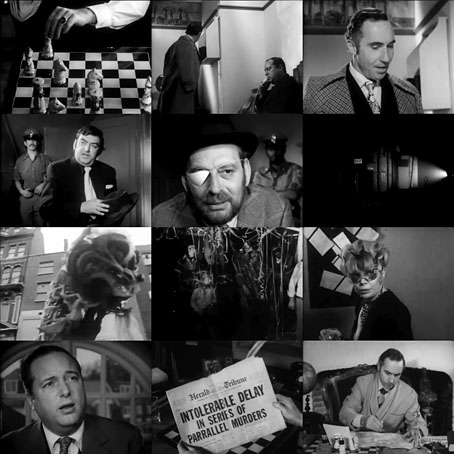
The Spider’s Stratagem (1970) is Bernardo Bertolucci’s adaptation of the Jorge Luis Borges story The Theme of the Traitor and the Hero; Death and the Compass (1992) is Alex Cox’s adaptation of the story Death and the Compass by the same author; Spiderweb (1977) is an earlier adaptation of Death and the Compass which is both shorter than Cox’s film, and also a more successful Borgesian drama.

Borges’ story plays Kabbalistic games with the familiar shapes of detective fiction, creating its frisson in the tension between an elaborate murder mystery and the intellectual puzzle which leads to its solution. In Cox’s extended version this is presented in an overbearing style reminiscent of Terry Gilliam at his most exasperating; despite a decent cast it’s also rather poorly directed in places. By contrast, Paul Miller’s adaptation runs for 30 minutes and conveys the story very smartly and efficiently. The setting is “Borghesia” rather than Argentina but the general style is that of a Hollywood detective story, American accents and all. The always reliable Nigel Hawthorne plays the cerebral detective Erik Lönnrot. Considering this was a graduation film it’s an excellent piece of work which the director himself has made available on YouTube. Watch it here.

Previously on { feuilleton }
The Library of Babel by Érik Desmazières
Books Borges never wrote
Borges and I
Borges documentary
Borges in Performance

Weekend links 208

sungwon.jpg

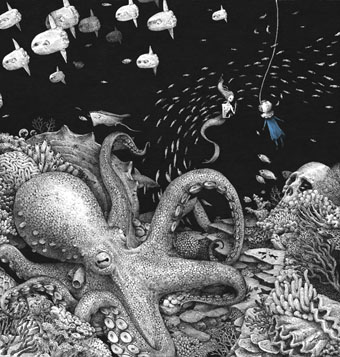
The Blue Girl (2013) by Sungwon.

• “Meanwhile, in her parents’ room [Max] Ernst painted aardvarks eating ants and big human hands around the windows. ‘Sexual connotations, I think,’ she says shyly.” Agnès Poirier talks to Cécile Eluard about her childhood among the Surrealists.

• “Thrilling and prophetic”: why film-maker Chris Marker‘s radical images influenced so many artists. Sukhdev Sandhu, William Gibson, Mark Romanek and Joanna Hogg on the elusive director.

• At Dangerous Minds: Throbbing Gristle live in Manchester in 1980, and Brian Butler talks about the rediscovered early print of Kenneth Anger’s Lucifer Rising. There’s a trailer!

• From 1981: The Art of Fiction No. 69 at The Paris Review, an interview with Gabriel García Márquez. Related: Thomas Pynchon reviewed Love in the Time of Cholera in 1988.

• “Seven years ago, a stolen first edition of Borges’s early poems was returned to Argentina’s National Library. But was it the right copy?” Graciela Mochkofsky investigates.

• “What was Walter Benjamin doing with his shirt off in Ibiza?” Peter E. Gordon reviews Walter Benjamin: A Critical Life by Howard Eiland & Michael W. Jennings.

• A video by Marcel Weber for Måtinden, a track from Eric Holm’s Andøya album. Another album on the Subtext label that I helped design.

• More Ian Miller: Boing Boing has pages from his new book, The Art of Ian Miller, and there’s an interview at Sci-Fi-O-Rama.

Outrun Europa, a free compilation of 80s-style electronic music. There’s a lot more along those lines here.

• Praise Be! Favourite religious and spiritual records chose by writers at The Quietus.

Ralph Steadman illustrated Alice’s Adventures in Wonderland in 1973.

British Pathé is uploading 85,000 of its newsreel films to YouTube.

• Drawings by Lebbeus Woods at The Drawing Center, New York.

• At Pinterest: Ian Miller and Kenneth Anger.

Lucifer Sam (1967) by Pink Floyd | The Surrealist Waltz (1967) by Pearls Before Swine | Which Dreamed It (1968) by Boeing Duveen And The Beautiful Soup

Weekend links 192

fournier.jpg

“Chloromgonfus detectis, a dragonfly that can detect volatile pollutants.” A speculative insect by artist Vincent Fournier.

• “…a modern taxonomist straddling a Wellsian time machine with the purpose of exploring the Cenozoic era…” Butterflies tied together Vladimir Nabokov’s home, science, and writing, says Mary Ellen Hannibal.

• More ghosts: Kira Cochrane on the Victorian tradition of the Christmas ghost story, and Michael Newton on why Jack Clayton’s The Innocents (1961) remains one of the very best ghost films. No argument there.

• Should you require further persuasion, Daniel Barrow reviews I Am The Center: Private Issue New Age Music In America 1950-1990, an album still receiving heavy rotation in these quarters.

Swords, daggers—weapons with a blade—retained a mysterious, talismanic significance for Borges, imbued with predetermined codes of conduct and honor. The short dagger had particular power, because it required the fighters to draw death close, in a final embrace. As a young man, in the 1920s, Borges prowled the obscure barrios of Buenos Aires, seeking the company of cuchilleros, knife fighters, who represented to him a form of authentic criollo nativism that he wished to know and absorb.

The Daggers of Jorge Luis Borges by Michael Greenberg

The Junky’s Christmas (1993): a seasonal tale from William Burroughs turned into a short animated film by Nick Donkin and Melodie McDaniel.

• Mixes of the week: Secret Thirteen Mix 101 by Jan Jelinek, and The Conjuror’s Hexmas by Seraphic Manta.

• Meet the 92-year-old Egyptian [Halim El-Dabh] who invented electronic music.

The Mysterious Lawn Home of Frohnleiten, Austria.

The Peacock Room at Sammezzano Castle in Italy.

The Quay Brothers’ Universum.

Alan Bennett‘s diary for 2013.

Butterfly (1968) by Can | Butterfly (1974) by Herbie Hancock | Butterfly (1998) by Talvin Singh