Centaurs

centaur1.jpg

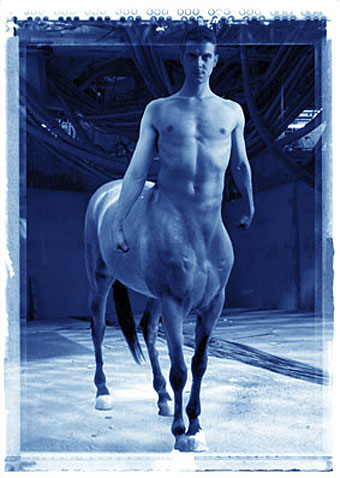
Elatus from Pandaemonium I (Centaurs) (2010) by David Trullo.

One of a series of centaur portraits by Spanish artist David Trullo. Placing characters from Classical mythology in contemporary settings makes a change. The title Pandaemonium I implies further series so I’m curious to see how Trullo follows these.

centaur2.jpg

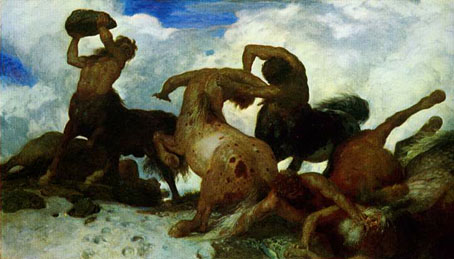
Battling Centaurs (1873) by Arnold Böcklin.

Centaurs had a flush of popularity in Germanic art of the 19th century; Franz Stuck painted them a number of times and Jugend magazine is littered with many often grotesque representations. I’ve never seen an explanation for this resurgence of interest. Is it because a man/horse hybrid is a potent symbol of masculine power? Arnold Böcklin’s painting is one of the better examples and suits its title more than Michelangelo’s famous sculpture in which the hybrids are lost in a tangle of writhing bodies.

Previously on { feuilleton }
Mermaids
The Masks of Medusa

Weekend links 20

wulfing.jpg

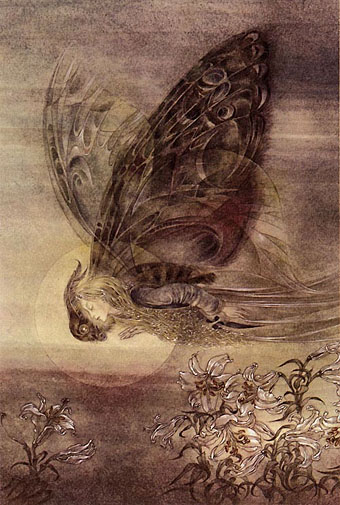
Transfiguration (1952) by Sulamith Wülfing.

• Observatory posted photos of its Lovecraft art exhibition; see if you can spot my pics. Related: Write Club has more photos. Also, A Word From Our Sponsor.

Taking the broooooaaaaad view of things: A Conversation with James Grauerholz on William S. Burroughs and Magick. Related: Beat Memories—The Photographs of Allen Ginsberg.

• Adam Curtis on BP and the Axis of Evil; how the the Anglo-Iranian Oil Company became British Petroleum and helped give Iran over to the Ayatollahs.

• The Quietus interviews Peter Christopherson (TG, Coil, etc) and Dr John.

The Strange World of Adolf Hoffmeister at A Journey Round My Skull.

An Artists’ Dialogue On CocoRosie’s Grey Oceans at Stereogum.

Werner Herzog and David Lynch combine their talents.

Jon Savage on The Residents versus The Beatles.

• BUTT magazine interviews James Bidgood.

• The Daily Drop Cap.

The Gay Rub.

Can on German TV in 1971.

The Midsummer Chronophage

chronophage.jpg

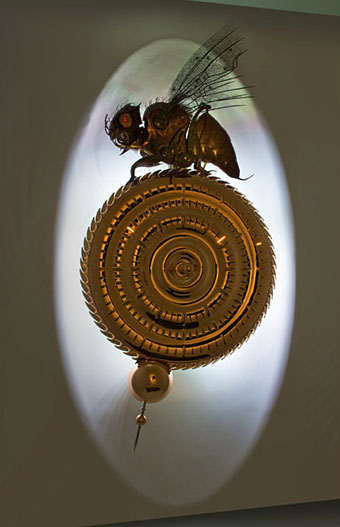
The Midsummer Chronophage.

John C Taylor’s Corpus Chronophage—the extraordinary mechanical clock surmounted by a time-devouring monster—was featured here following news of its installation at Corpus Christi College, Cambridge, in 2008. Two years later its creator is ready to unveil a new clock which he calls The Midsummer Chronophage.

The Midsummer Chronophage pays homage to the 18th century clockmaker John Harrison, inventor of the marine chronometer and the ‘grasshopper’ escapement, a low-friction mechanism for converting pendulum motion into rotational motion. The Midsummer Chronophage takes the grasshopper escapement out of the clock and presents it on the outside as a sculpture. The mythical creature is also the world’s largest grasshopper escapement.

The face of The Midsummer Chronophage is a 24 carat gold-plated steel disc almost 1.5M in diameter, polished to resemble a pond of liquid metal with ripples that allude to the Big Bang. It was created by a series of underwater explosions.

The Midsummer Chronophage has no hands or numbers but displays time by aligning slits in discs behind the clock face back lit with blue LEDS; these slits are arranged in three concentric rings displaying hours, minutes and seconds.

Dr Taylor’s new clock can be seen at London’s Masterpiece Fair from 23rd of June. For those outside London there are more pictures of the device here, and videos of the Corpus Clock in action here.

Previously on { feuilleton }
Andrew Chase’s steel cheetah
Another Midsummer Night
The Corpus Clock
A Midsummer Night’s Dadd
William Heath Robinson’s Midsummer Night’s Dream
The Bowes Swan

Weekend links 19

smith.jpg

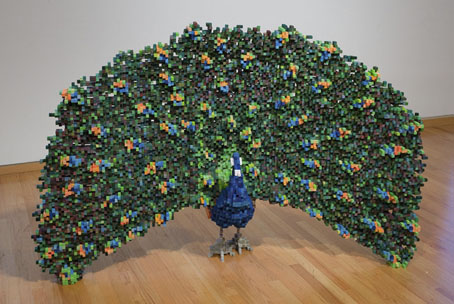
Peafile (2006) by Shawn Smith; plywood, ink, acrylic paint.

Surreal Friends, an exhibition of work by Leonora Carrington, Remedios Varo and Kati Horna at the Pallant House Gallery, Chichester, UK. Related: The surrealist muses who roared, Leonora Carrington and other women Surrealists profiled.

Landscapes From a Dream: How the Art of David Pelham Captured the Essence of JG Ballard’s Early Fiction. A graphic design essay at Ballardian.

• “(T)he significant thing is not the behaviour of the players but the attitude of the spectators: and, behind the spectators, of the nations who work themselves into furies over these absurd contests, and seriously believe — at any rate for short periods — that running, jumping and kicking a ball are tests of national virtue. (…) It is the most violently combative sports, football and boxing, that have spread the widest. There cannot be much doubt that the whole thing is bound up with the rise of nationalism — that is, with the lunatic modern habit of identifying oneself with large power units and seeing everything in terms of competitive prestige.” The Sporting Spirit by George Orwell, December 1945.

• One of my cult pop albums from the 1980s, A Secret Wish by Propaganda, is reissued in a 25th anniversary edition next month. I no doubt have most of the bonus tracks already but the prospect is still irresistible.

Tangier Cut-Up, an uncollected piece by William Burroughs from Esquire, September 1964.

Ghostwriter —  The Continuing Adventures Of The Strange Sound Association.

Faust And Last And Always: Germany’s Most Radical Rock Group Talk.

Hollingsville at Resonance FM. Related: Graphic Design on the Radio.

iPad Publishing No Savior for Small Press, LGBT Comics Creators.

The Largest Oil Spills in History, 1901 to Present.

1948 Buick Streamliner by Norman E Timbs.

Neville Brody’s work on display in Tokyo.

Dr Mabuse (1984) by Propaganda; Vladek Sheybal, cowled monks, Fritz Lang references and Anton Corbijn directing.

Hermann Obrist: Art Nouveau Sculptor

obrist.jpg

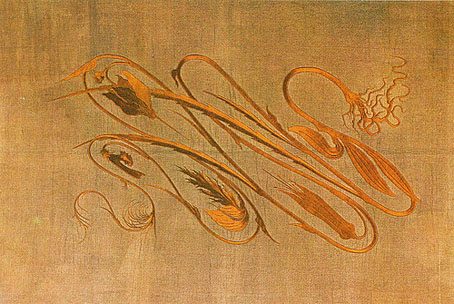
Cyclamen (1895).

An exhibition close enough for me to easily visit, Hermann Obrist: Art Nouveau Sculptor is a display of work by the German artist at the Henry Moore Institute, Leeds. Obrist (1863–1927) is featured in numerous histories of Art Nouveau for his Cyclamen wall-hanging of 1895, also known as The Whiplash on account of its writhing curves. This and other stylised studies Obrist made of natural forms were very influential. The gallery site only shows us one of the items on display (so much for advertising) but the trusty A Journey Round My Skull has further examples of the artist’s work.

Hermann Obrist: Art Nouveau Sculptor runs to 29th August, 2010.

Previously on { feuilleton }
Atelier Elvira
Karl Blossfeldt