Three Fragments of a Lost Tale

frame.jpg

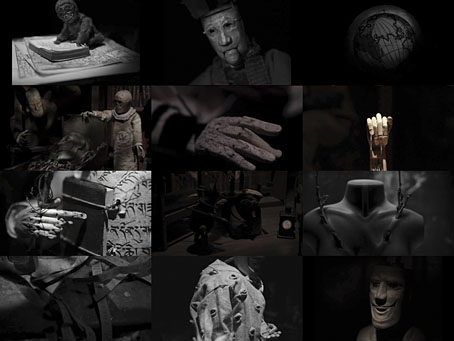
I hadn’t come across sculptor John Frame’s animated work before so my thanks to John Burridge for the recommendation. Three Fragments of a Lost Tale is part of a larger project, The Tale of The Crippled Boy, which is described at Frame’s website. Being a collection of fragments, this film is necessarily mysterious although I seldom worry about that. One quality of animation I’ve always enjoyed is its ability to convey the disjunctions and strange atmospheres of dream states, something it often does more effectively than anything else.

Previously on { feuilleton }
Brothers Quay scarcities
Achilles by Barry JC Purves
The Torchbearer by Václav Švankmajer

Virgil Finlay’s Tarzan

finlay.jpg

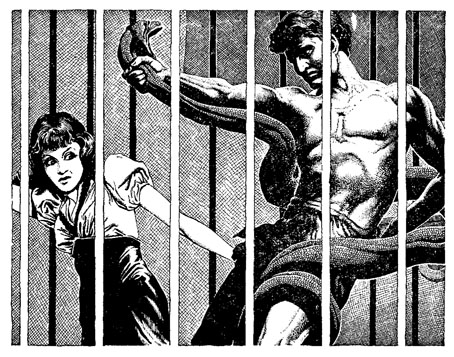
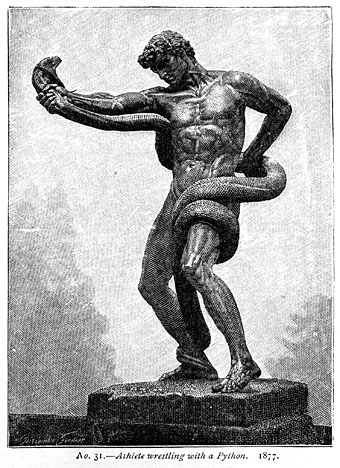
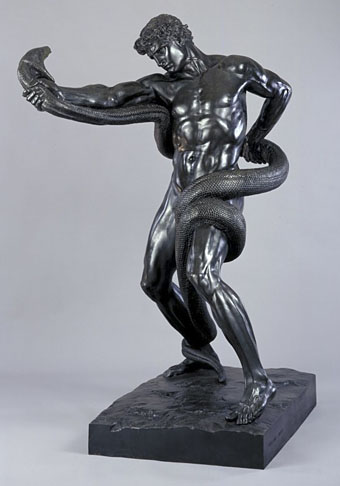
Thanks are due to Ty Reutel for alerting my attention to this one. I’d no idea that the great Virgil Finlay had illustrated Tarzan but here’s the proof, one half of an interior drawing for The Quest of Tarzan in Argosy Weekly for 1941. That’s the first surprise, the second, of course, was that Finlay had copied Frederic Leighton’s Athlete Wrestling with a Python (1877) ( below), a sculpture which has been a subject of discussion here recently. I’ve mentioned before my including Leighton’s work in one of my Lovecraft adaptations; I referred to many other artworks in those stories but never made any direct reference to Virgil Finlay even though he was the original illustrator of Lovecraft’s The Haunter of the Dark when it was first published in Weird Tales in 1936. Finlay’s illustrations for that story later appeared with some of my own in the enormous Centipede Press collection of Lovecraft art so it’s strange to find that we were also led to the same Leighton sculpture.

Tarzan illustration has been in my thoughts for the past few weeks while I’ve been at work (again!) on the collected Reverbstorm, many pages of which played variations on Burne Hogarth’s comic adaptations of the Tarzan stories. Reverbstorm is at long last very close to being finally, absolutely finished, and ready for printing in a single definitive volume. No production schedule just yet but any news will be announced here.

leighton4.jpg

Previously on { feuilleton }
Frederic Leighton’s sculptures
Virgil Finlay’s Salomé
Die Farbe and The Colour Out of Space
Lovecraft’s favourite artists revisited
Angelo Colarossi and son
The monstrous tome
Men with snakes

The recurrent pose 47

leighton3.jpg

After subjecting Frederic Leighton to undignified speculation yesterday, his work is now ushered into the homoerotic environs of the Recurrent Pose Archive. These engravings are from a Leighton-themed edition of The Art Annual which is undated but which refers to The Sluggard as being a work in progress so that would date it to 1894 or 95. Despite throwing barbs at Leighton, I bought the bound copy of four issues mainly for the feature on the artist’s work and his extraordinary home. The three other artists represented—Millais in his horribly dull post-PRB phase, Alma-Tadema and Meissonier—can’t compete with Leighton’s academic flamboyance.

Cymon And Iphigenia (1884) can be seen in all its splendour at the Google Art Project, not the only painting of Leighton’s where the depiction of drapery seems to be the principal concern. The figure caught in the Flandrin pose is robed and tucked away in the background.

leighton4.jpg

Frederic Leighton’s sculptures

leighton1.jpg

An Athlete Wrestling with a Python (1877).

The python wrestler by Frederic Leighton (1830–1896) has appeared here before, and it’s one sculpture that always catches my eye for having appeared in my adaptation of The Call of Cthulhu in 1988. It’s now one of the Leighton works available for close viewing at the Google Art Project although only from a single angle, something that seems a flaw in web presentation of three-dimensional art.

leighton2.jpg

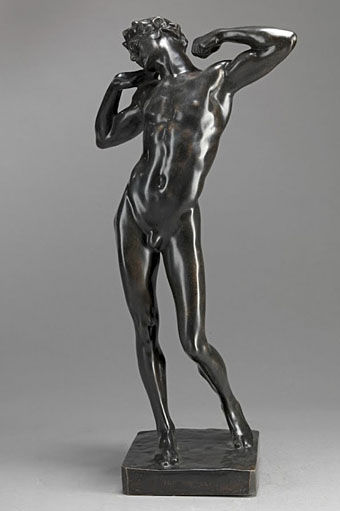
The Sluggard (c. 1895).

In the same collection is a copy of Leighton’s The Sluggard from the Yale Center for British Art. What’s notable about this piece is that it’s generally offered as Exhibit A for the homo-prosecution during discussion of the artist’s sexuality. The Sluggard to which most people refer is the life-size bronze which is a lot more robust and muscular than this lithe and twinky specimen. According to a note at the V&A Yale’s copy is one of many cast from the clay model for the life-size version. What was excused at the time as a late Victorian exercise in contrapossto looks even more camp—in the Philip Core definition—than the finished piece which makes me wonder whether Leighton beefed up the original to disguise something. Core defined camp as “the lie that tells the truth”; camp art always pretends to be one thing whilst simultaneously telegraphing a very different message about its creator. Leighton’s sexuality is a source of continual speculation which means it’s unlikely now to be resolved in any direction, and the artist himself would loathe our prurience, but it’s only by reappraising works in this way that we’re able to show that gay people didn’t magically erupt via some process of spontaneous generation in 1967. If Leighton had any dalliances whilst holidaying in the gay resort of Capri then he was perfectly circumspect. Back at home, as a President of the Royal Academy he had a rather pompous and remote reputation, being memorably described by Violet Paget as “something between an Olympian Jove and a head waiter.” For more camp, see The Narcissus Hall in the artist’s incredibly lavish home, Leighton House in London, where 1st Baron Leighton, PRA, lived splendidly alone.

Previously on { feuilleton }
Angelo Colarossi and son
Men with snakes

The Secret Life of Edward James

james1.jpg

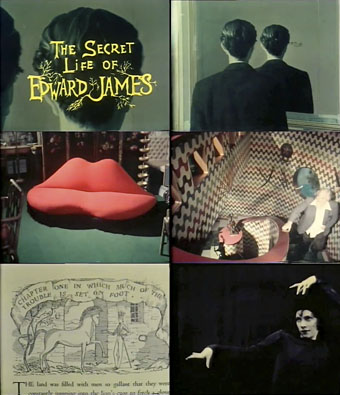
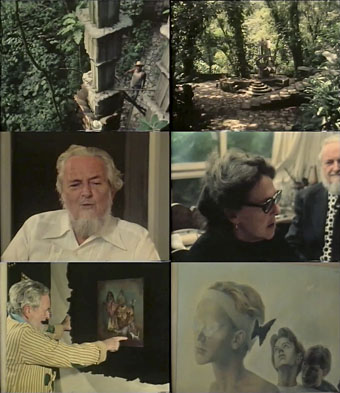
From the earliest days of YouTube there were two films about Surrealist art that I’d been hoping would one day be posted somewhere so I could watch them again. One was José Montes-Baquer’s collaboration with Salvador Dalí, Impressions de la Haute Mongolie – Hommage á Raymond Roussel (1976), which eventually turned up at Ubuweb; the other was Patrick Boyle’s The Secret Life of Edward James, a 50-minute documentary about the wealthy poet and Surrealist art patron that was screened once, and once only, on the UK’s ITV network in 1978. Boyle’s film, which was narrated by James’ friend and fellow Surrealism enthusiast, George Melly, was my first introduction to a fascinating figure who was one of the last—if not the last—of the many eccentric aristocrats that these islands have produced. I knew James’ name from Surrealist art books where the Edward James Foundation was credited as the owner of paintings by Magritte and Dalí, but had no idea that James was the model for three of Magritte’s paintings, including La reproduction interdite (1937); or that he’d abandoned his huge ancestral home to create a Surrealist house at nearby Monkton, and had also commenced the construction of a concrete fantasia, Las Pozas, in the heart of the Mexican jungle at Xilitla. Boyle’s film explores all of this in the calm and uncondescending manner that used to be a staple of UK TV documentaries. I’ve been telling people about this film for years, hoping that somebody might have taped it (unlikely in 1978) but no-one ever seemed to have seen it.
james2.jpg

In 1986, two years after James’ death, Monkton was up for sale so Central TV sent George Melly and director Patrick Boyle to revisit the place. Monkton, A Surrealist Dream, was the result, a 26-minute documentary which relied heavily on the earlier film to fill out the details of James’ life. The original resurfaced for me again, albeit briefly, in Brighton in 1998. A Surreal Life: Edward James (1907–1984) was an exhibition at the Brighton Museum & Art Gallery that featured many works from the James art collection, including major pieces by Leonora Carrington (who appears in Boyle’s film), Dalí, Leonor Fini, Magritte, Picasso, Dorothea Tanning, Pavel Tchelitchew and others. A tape of the 1978 documentary was showing on a TV in one part of the exhibition but the people I was with were reluctant to stand around for an hour so all I got to see was a minute or so of Edward in his jungle paradise. Happily we’re all now able to watch this gem of a film since it was uploaded to YouTube earlier this month (my thanks to James at Strange Flowers for finding it!).
james3.jpg

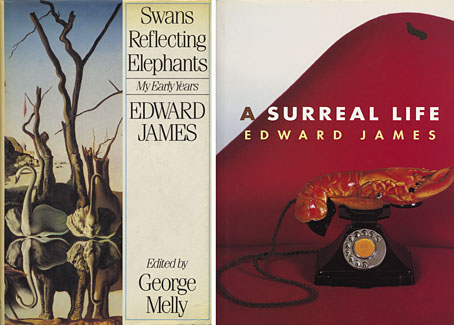
For anyone whose interest is piqued by all of this, two books are worth searching for: Swans Reflecting Elephants, My Early Years (1982) is an autobiography which George Melly compiled from conversations with its subject (and which apparently finished their friendship). James’ propensity for invention means it can’t always be trusted but then that’s the case with many memoirs. A Surreal Life: Edward James (1998) is the 160-page exhibition catalogue which explores James’ life and aesthetic obsessions in a series of copiously-illustrated essays. Both books can be found relatively cheaply via used book dealers.

Previously on { feuilleton }
Las Pozas panoramas
René Magritte by David Wheatley
Soft Self-Portrait of Salvador Dalí
Mongolian impressions
Hello Dali!
Return to Las Pozas
Dirty Dalí
Impressions de la Haute Mongolie revisited
Las Pozas and Edward James