Minotaure, 1933–1939

minotaure35.jpg

Art by Diego Rivera for the Mexican supplement in Minotaure no. 13.

I was tempted to title this one Minotaure! since I’ve been searching for copies of the magazine in question for many years. I’m certain I went looking in all the usual sources last year in the run-up to the Surrealist centenary, without success. Anyway, here they all are at last, a complete run of one of the major Surrealist periodicals.

Minotaure was notable for a number of reasons, first among them the publisher, Albert Skira, whose resources enabled the production of a very desirable item, with good design, colour prints in each issue, and plenty of photos and other artwork throughout. The Surrealist publications of the 1920s had been historically important but all of them were monochrome documents with few pictures and few pages. Minotaure had the production values of a quality magazine and an impressive roster of artists and writers to fill each issue. Skira and editor E. Tériade originally intended their periodical to cover a wide range of art, past and present, but with most of the early contributors being members of André Breton’s Surrealist circle the magazine quickly became a showcase for Surrealist art and theorising. The first issue featured a cover by Pablo Picasso, with more Picasso artwork inside. Subsequent issues had covers by leading Surrealist artists–Dalí, Ernst, Magritte, Masson–which captured the movement at a time before Breton’s persistent expulsions hollowed out the original group. Breton writes in nearly all the issues but was forbidden from using Minotaure as a political platform (the previous Surrealist journal had been the very political Le Surréalisme au service de la révolution), a restriction he kept to. His manner was often dictatorial but he always had an eye for the main chance, or the bonne chance in this case.

The written contents of Minotaure are mostly in French but the pictorial matter is worth seeing even if much of it is very familiar today. Among the written highlights are two essays by Salvador Dalí, the first on the “edible” nature of Art Nouveau architecture, with an emphasis on the work of Gaudí; the second about Pre-Raphaelite painting. It’s understandable that Dalí would be attracted by the meticulous realism of early Millais and William Holman Hunt but I didn’t know his essay included an analysis of Hunt’s The Hireling Shepherd, a painting I look at every time I’m in the Manchester Art Gallery. Elsewhere there are articles about automatism, mediumship, the decalcomania technique in painting, the esoteric symbolism of the alchemists, naive or untutored art, and plenty of single-page items and visual novelties. Photography by Man Ray and Brassaï is a recurrent feature. Skira’s magazine established a template which the two American Surrealist periodicals of the 1940s, View and VVV, did their best to follow. Now that Minotaure is freely available I’ll be waiting impatiently for complete runs of its followers to turn up somewhere.

(Note: some of the copies linked below have had their colour prints removed.)


Minotaure no. 1 (1933)

minotaure01.jpg

Cover art by Pablo Picasso.

minotaure02.jpg

minotaure03.jpg


Minotaure no. 2 (1933)

minotaure04.jpg

Cover art by Gaston-Louis Roux.

Continue reading “Minotaure, 1933–1939”

Weekend links 770

finlay.jpg

Abstraction #51 (1965) by Virgil Finlay.

• “I think the world venerates him as this deeply religious composer who tackles eternal themes in his music, but I think it’s also good to remember that he also has a playful experimental side.” Maria Juur discussing Estonian composer Arvo Pärt in a review by Geeta Dayal of a new recording of four Pärt compositions.

• “Rubycon feels like an epic soundtrack to a great lost film…” Jeremy Allen on the 50th anniversary of a Tangerine Dream album that’s always been a favourite of mine.

• At the Internet Archive: Browse the catalogue for a forthcoming auction of rare books and artworks from The Library of Barry Humphries.

• At Public Domain Review: Through a Glass Lushly: Michalina Janoszanka’s reverse paintings (ca. 1920s).

• At Colossal: “Vintage postcard paintings by David Opdyke demonstrate an ecological future in peril“.

• At the BFI: Michael Brooke offers suggestions for ten great Slovak New Wave films.

• DJ Food unearthed four sheets of Dave Roe wrapping paper from 1968.

• New music: Doppelgänger by Ian Boddy & Harald Grosskopf.

Ten minutes of Sun Ra and the Arkestra on French TV in 1969.

Depictions of Atlantis in retro science fiction art.

• Old music: Flora (1987) by Hiroshi Yoshimura has been reissued.

Atlantis (1961) by The Blue Bells | Atlantis (1969) by Donovan | Atlantis (1971) by Deuter

De Nerée and Luisa Casati

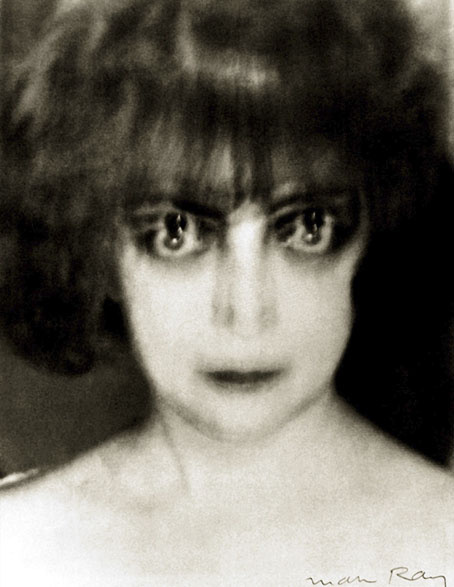
casati6.jpg

Luisa Casati (1922) by Man Ray.

Today’s post is another in the series of irregular art essays by Sander Bink. The subject this time is Luisa Casati (1881–1957), the Italian heiress who burnt through a fortune living extravagantly while being drawn or painted by many of the most notable artists of her time. (I did my own very stylised portrait of the Marchesa for Bruce Sterling’s Pirate Utopia, a novel where Casati briefly appears among the cast of real and fictional characters.) As before with Sander’s posts, Carel de Nerée tot Babberich is one of the artists under discussion. Thanks, Sander!

* * *

casati1.jpg

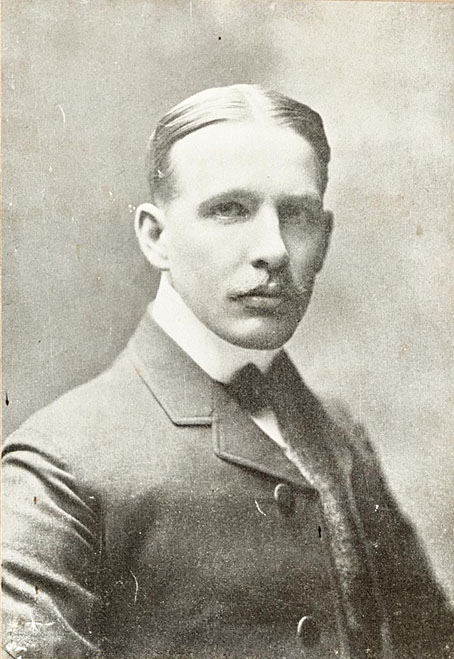
Carel de Nerée around 1905.

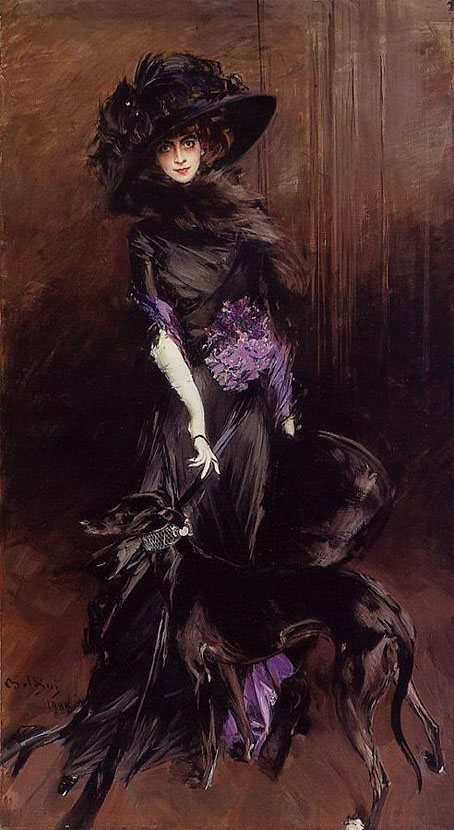
Many artists have paid homage to the ‘living artwork’ and legendary fashion icon Luisa Casati. Artists such as Man Ray, Paul-César Helleu, Giovanni Boldini, Léon Bakst, Kees van Dongen, Alastair, Romaine Brooks and Giacomo Balla have immortalised her. Legend has it that a certain fascinating Dutch artist should also be added to this list: Carel de Nerée tot Babberich (1880–1909). (Previously: 1 & 2)

casati5.jpg

Luisa Casati with Greyhound (1908) by Giovanni Boldini. Private collection.

By 1930, Casati’s decadent and luxurious lifestyle had left her millions in debt. To escape her creditors, she moved to London. In the years before her death in 1957, she was seen scavenging for food in rubbish bins. In these final years, she naturally preferred to look to the past rather than the present, making lists of all those who had portrayed her then fading glory. Remarkably, one of these features De Nerée. Scot D. Ryersson and Michael Yaccarino, in their classic biography Infinite Variety: The Life and Legend of the Marchesa Casati, write about this period:

Whereas her evenings were absorbed by occult passions, the Marchesa spent part of her days writing lists. One was an inventory of the renowned personages she had known. There were others cataloguing the many artists, famous and lesser known, who had represented her. The difficulty of creating a comprehensive index of contributors to the ‘Casati Gallery’ is compounded both by Luisa’s incomplete and inaccurate records and by the lack of information concerning the minor portraitists, such as Mrs. Leslie Cotton and Karel de Nerée tot Babberich and those who were simply wealthy dilettantes. Boldini, John, van Dongen, and Epstein are noted alongside Hohenlohe, Nikolai Riabushinsky, theatrical designer Oliver Messel, and Eduardo Chicharro, director of the Spanish Academy of Fine Art in Rome.

The footnote to this paragraph states:

Christophe Henri Karel de Nerée tot Babberich (1880–1909) was a little-known Dutch artist whose pen and ink work is highly reminiscent of Martini and Alastair. Although there is little material documenting Casati’s association with or influence on the artist, many of the highly stylized and bizarre female subjects of his drawings share a more than coincidental resemblance to the Marchesa.

De Nerée did, indeed, draw several dark-eyed female figures in extravagant dresses, all of which could easily pass for a portrait of Casati. In the book The Marchesa Casati: Portraits of a Muse (2009), Ryersson and Yaccarino give an overview of all the works of art based on Casati. A drawing by De Nerée of a very slender figure with dark eyes is identified as a portrait of Casati and dated 1905.

casati9.jpg

Het schone beeld (The beautiful image, 1900–01) by Carel de Nerée. Private Collection. Estate of Barry Humphries.

The authors were not 100% sure of this identification, but due to the almost complete lack of documentation on De Nerée’s life and work at the time, they chose this drawing. In an email to me in 2010, the authors withdrew this identification because of this lack of documentation. It is actually a drawing dating from 1900–01, based on a story by Henri Borel. Of course, we immediately set about trying to find out which of De Nerée’s drawings could be a portrait of Casati.

In their email, Ryersson and Yaccarino give some more information:

In the papers left behind by the Marchesa, after her death in 1957, was a list she had made herself of those artists who had done her portraits. Babberich was on that list. His portrait of her, done in pencil, was from around 1905. We do not know how they met, but the Marchesa travelled frequently and extensively and was fond of the work of such symbolist artists as Alberto Martini, Gustav Mossa, and Alastair, so it is not surprising that Babberich caught her attention somehow.

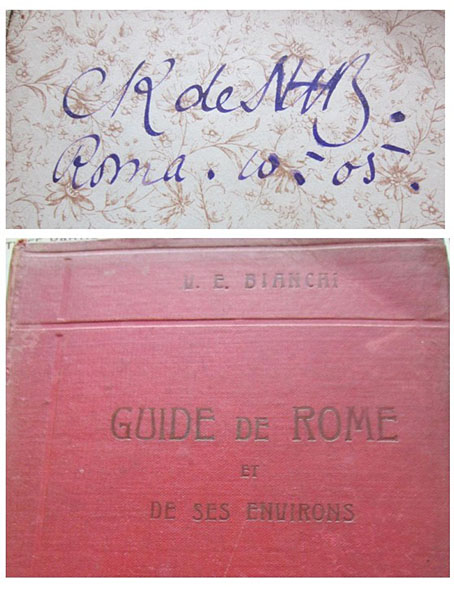
De Nerée and Casati make an excellent match indeed. ‘She was only too pleased to promote artists whose aesthetic she felt an affinity with, and those whose work was so contrary to popular taste’, Ryersson and Yaccarino write in Portraits of a Muse. In 2015, I began working on what has now become the first full-length biography of De Nerée. Research showed that De Nerée actually deregistered from The Hague in October 1905 in order to settle in Rome.

casati3.jpg

Rome travel guide with De Nerées’ annotation “Roma, October 1905”. Private collection.

One reason for this was that, from 1905, De Nerée’s life was increasingly set in the aristocratic and very wealthy circles of southern Europe. In 1907, for example, he met Gabriel d’Annunzio, a lover of Casati’s, in Florence. Perhaps he had met him before. And in 1908, for example, he drew a portrait of Baroness Clementine Maria von Reuter (1855–1941), daughter of the wealthy Baron Paul von Reuter (1816–1899), founder of Reuters news agency. (Private collection, Netherlands).

Continue reading “De Nerée and Luisa Casati”

Weekend links 768

glitch.jpg

The Mona Lisa as it looks run through the Random Pixelate setting in Glitch Lab.

• “We don’t have enough Dada in this world of too much data. Something is needed to break-through the over-curated simulacrum that is the online world in order to let in a bit of non-artificial light. One way to make a break is through the deliberate cultivation of the glitch.” Justin Patrick Moore on circuit-bending, glitch music and Surrealist composition.

• The seventh installment of Smoky Man’s exploration of The Bumper Book of Magic has been posted (in Italian) at (quasi). There’s an extract in English at Alan Moore World.

• New music: Remember The Clouds by Philippe Deschamp, and Requiem For The Ontario Science Centre by Tony Price.

• Michael Brooke offers suggestions for where to begin with Polish film director Wojciech Has

• At Printmag: A new book shares the artistic odyssey of Iranian designer Farshid Mesghali.

The Letraset Graphic Materials Handbook for the year 1987.

• Steven Heller’s font of the month is Cubo.

• Yet more Polish film posters.

A cat’s eye view of Japan.

• RIP Roy Ayers.

Glitch (1993) by Moody Boyz | Glitch (1994) by Autechre | Glitch (2011) by Brian Eno And The Words Of Rick Holland

Weekend links 765

fini.jpg

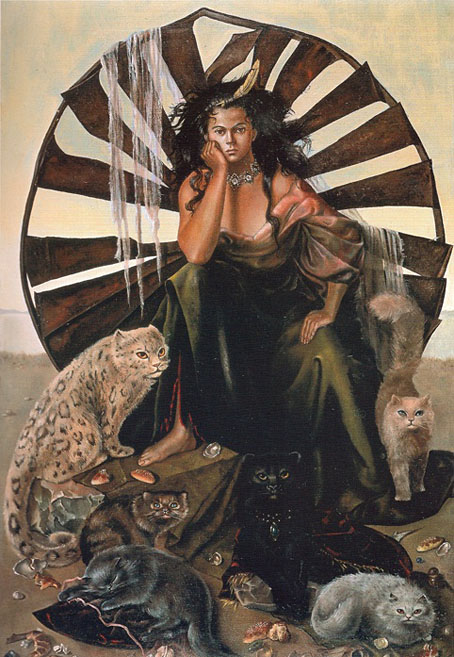
An Ideal Life (1950) by Leonor Fini.

• “…there has not been anything like a general, systematic discussion of what other, semantically different kinds of languages there can be, and the philosophical consequences of this. If reality has a certain structure, it would be a miracle if familiar languages contain all the resources to capture this structure.” Matti Eklund on the potential nature of alien languages.

• “As cats evolved from feral ratters into beloved Victorian companions, a nascent pet-food economy arose on the carts of so-called ‘cat’s meat men’. Kathryn Hughes explores the life and times of these itinerant offal vendors, their intersection with a victim of Jack the Ripper, and a feast held in the meat men’s honour, chaired by none other than Louis Wain.”

• Kinoteka, the UK’s Polish Film Festival, revealed its 2025 programme this week. Among the events will be a screening of the new Quay Brothers film, Sanatorium Under the Sign of the Hourglass (extract), at BFI Imax in London. Also in London (and with free entry), Swedenborg House will be hosting an exhibition of the Quays’ film decors.

• In a recent comment here I said that some of Charles Williams’ metaphysical novels were like John Buchan thrillers with an occult twist. At Wormwoodiana G. Connor Salter investigates the possible connections between the two writers.

Alice Coltrane & Carlos Santana, 1974: Lossless downloads of previously unissued recordings from the Illuminations album and a live set with John McLaughlin at San Francisco’s Kabuki Theater.

• “‘The Köln Concert is the hit he wants to disown’: why Keith Jarrett shunned two new films about his unlikely masterpiece.”

• New music: Shards by Tim Hecker; and Some Other Morning by Memory Effect.

• Mix of the week: DreamScenes – February 2025 at Ambientblog.

• At Colossal: Outdoor light installations by Lachlan Turczan.

• Galerie Dennis Cooper presents…Paul Laffoley.

Cat’s Eye (1977) by Van Der Graaf | Cat’s Eye (2015) by Patrick Cowley | No Cat’s Eyes (2017) by The Belbury Circle