Rebel Ready-Made

duchamp1.jpg

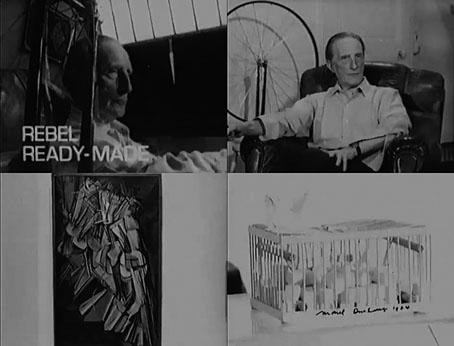
I think I spotted across this one while searching for more Robert Hughes, in which case I offer grudging thanks to the algorithms of the Great Panopticon. If you’ve ever seen Marcel Duchamp talking about his work in an arts documentary then it’s probable that the clip will have been taken from this film. (The Shock of the New is no exception.) Rebel Ready-Made was directed by Tristram Powell for a short-lived BBC arts series, New Release, and broadcast in June 1966 to coincide with a major Duchamp retrospective at the Tate Gallery, London. It’s fascinating for number of reasons, mostly the way that Duchamp is happy to talk about his sporadic art career, an occupation that in its mature phase consisted of spasms of invention followed by increasing boredom and a wandering off to do something else. The ease with which he did all this—the inventions which in other hands would have fuelled entire careers, and then the eventual abandonment of the whole art game—always made a sly mockery of the self-importance that sustained the art world in the 20th century.

duchamp2.jpg

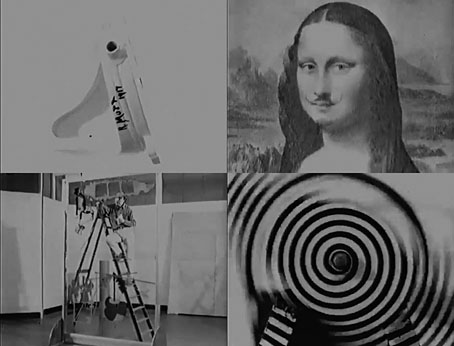
Elsewhere in the film you get praise for Duchamp from Robert Rauschenberg and John Cage, plus the artist’s friend Richard Hamilton, seen briefly painting the replica of The Large Glass that appeared in the Tate exhibition as a substitute for the fragile original. This has been my favourite of Duchamp’s works since I saw the replica in the Tate a decade later. Having a duplicate stand in for the original isn’t such an unusual thing for Duchamp when most of his ready-made sculptures are also copies, the “originals” having been lost or destroyed shortly after their first exhibitions. From the 1930s on, Duchamp had also been making multiple copies of all his works in miniature for the various iterations of the Boîte-en-valise, or portable museum.

Tristram Powell was lucky to capture the artist being so talkative at such a late date. Two years after this Duchamp was dead, although there was one last surprise in store. Jasper Johns referred to Étant donné as “the strangest work of art in any museum”. Duchamp never acknowledged the existence of this life-size peepshow while he was alive, preferring it to be announced to the public only after his death, which is what happened in 1969. There are no replicas of this one; if you want to see it (or the parts of it the artist allows you to see) you have to go to Philadelphia and peer through the holes in the door.

Previously on { feuilleton }
Televisual art
Chance encounters on the dissecting table
The Witch’s Cradle by Maya Deren
Audio Arts
8 x 8: A Chess Sonata in 8 Movements
Anémic Cinéma
Dreams That Money Can Buy
Entr’acte by René Clair
View: The Modern Magazine

Michel Henricot, 1936–2022

henricot1.jpg

Deux Personnages (1974).

Jan of JKK Fine Arts was in touch this week to inform me that the French artist Michel Henricot died in February, a month before the opening of an exhibition of his work organised by JKK Fine Arts for the International Cultural Centre in Cracow, Poland.

henricot2.jpg

Le Voyageur IV (1996).

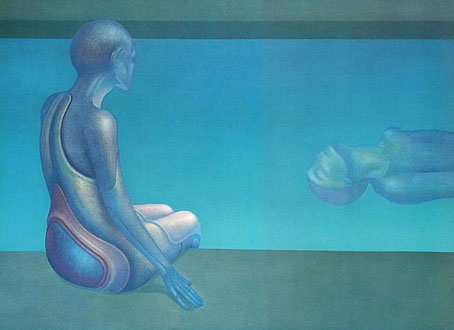
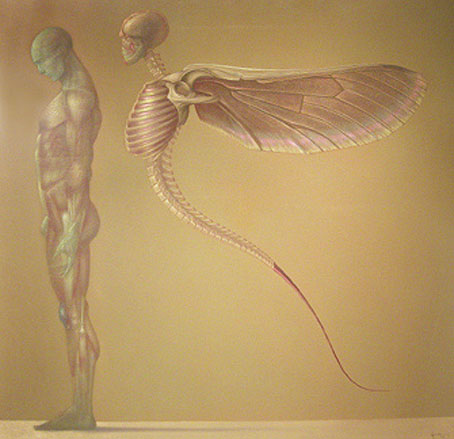
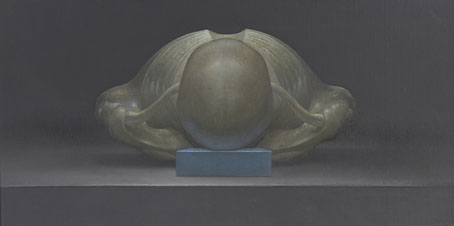
I first encountered Henricot’s work in the pages of OMNI magazine where he was one of several featured artists who can be grouped together as “fantastic realists”—Ernst Fuchs, Mati Klarwein, HR Giger, Robert Venosa, Rudolf Hausner, De Es Schwertberger—although the label wouldn’t have necessarily been agreed to by any of them apart from Fuchs and Hausner, both of whom were members of the Vienna School of Fantastic Realism in the 1960s. Henricot’s sombre and obsessive figure studies were a good fit for the magazine, with the science fiction context lending his paintings suggestions of the futuristic or alien that might otherwise be absent in the empty space of an art gallery.

henricot3.jpg

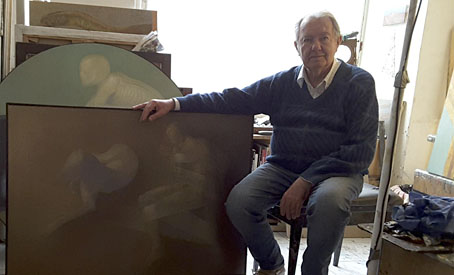
The artist photographed by Jan K. Kapera.

Despite such a high-profile showcase Henricot’s work has never been as visible as his more famous contemporaries so I’m grateful to Jan for supplying additional information, including the artist’s actual birth date, 8th July, 1936, rather than the erroneous dates found all over the internet. Henricot was friends with Leonor Fini, an artist whose work was also preoccupied with the human figure, often just as stylised and set against featureless monochrome backgrounds. Like Henricot, Fini’s art gets tagged as Surrealist even though her own obsessive paintings evolved away from any particular school. Henricot’s Les Promeneuses (1954) was definitely reaching for a Dalínean/Delvaux-like quality, but if his mature work belongs anywhere it’s with that small collection of French artists who don’t comprise any defined movement but who share a taste for the fantastic, the strange and the inexplicable: Sibylle Ruppert, Jean-Marie Poumeyrol, Jean-Pierre Ugarte, Gérard Trignac, Erik Desmazières, Jean-Paul Faccon, Pierre Clayette, Raymond Bertrand, Roland Cat, Gilles Rimbault, Jean-Michel Mathieux-Marie, and others. If I was given the opportunity to put together an art show for a French gallery (or even the Pompidou Centre…), these are some of the artists I’d choose.

henricot4.jpg

Le Silence (1979).

Henricot will be running at the International Cultural Centre, Cracow, until the end of April.

Elsewhere on { feuilleton }
The fantastic art archive

Previously on { feuilleton }
Saint Sebastian in NYC
The art of Michel Henricot

Weekend links 615

tesla.jpg

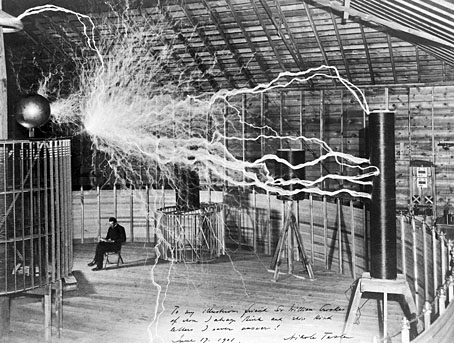
Tesla does the Astro. Hunter Dukes at Public Domain Review examines the promotion of Nikola Tesla’s ideas via this famous photograph.

• Coming soon from Side Real Press: Kokain—The Modern Revue, a magazine produced in Vienna that ran for five issues during 1925. “Original copies are so rare that it scarcely appears in any of the literature relating to the Weimar period and its contents have remained almost entirely ignored and certainly untranslated. Until now.”

• “Magritte had gotten this far in life by refusing to obey anyone, and in a way his disobedience proved that he understood Surrealism better than the leader of the Surrealists.” Jackson Arn reviewing Magritte: A Life by Alex Danchev.

• “Go as far into your dream as possible and find your own unique voice.” Meredith Monk (again) talking to Elizabeth Aubrey.

• Coming soon from Strange Attractor: City of the Beast: The London of Aleister Crowley by Phil Baker.

• At Spoon & Tamago: The natural world springs to life in kirie paintings by Tamami Kubota.

Antonia Mufarech on why sunflowers are Ukraine’s national flower.

• At Dennis Cooper’s: Etienne-Louis Boullée’s unbuildable tombs.

• Mix of the week: I Can’t Go For That by The Ephemeral Man.

• New music: Triumph Of The Oak by The Lord.

• RIP Philip Jeck.

Tesla (1997) by Jimi Tenor | Tesla (2011) by They Might Be Giants | Tesla Coil (2016) by Xhei

Televisual art

sotn1.jpg

A few words of praise for The Shock of the New, Robert Hughes’ eight-part TV series about art in the 20th century. Not that it’s ever been lacking in praise—it was lauded from the outset back in 1980—but, having read the book of the series twice, then dipped back into it on regular occasions, it occurred to me recently that I’d not seen the series itself for a very long time.

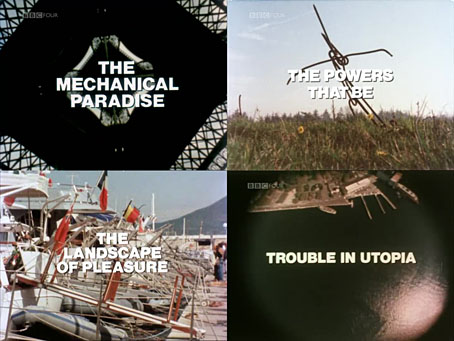
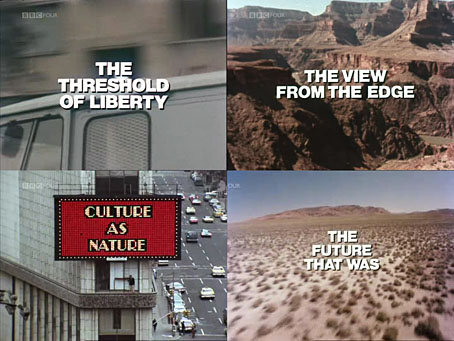
If you don’t know—and is anyone today really unaware of this?—Hughes was commissioned by the BBC and his employers at TIME magazine to travel the world presenting a history of modern art from the 1880s to the end of the 1970s. The series was part of a run of costly co-productions that flattered viewers with colour television sets (still a luxury item in the UK) while engaging the intellect; Kenneth Clarke’s Civilisation, Jacob Bronowski’s The Ascent of Man and David Attenborough’s Life on Earth established the template that Hughes was required to follow. If you have the time and the money, the globetrotting is the easy part of an enterprise such as this. Much more difficult is making sense of the increasingly fragmented development of art in a century of two world wars and rapid technological change. Hughes did this by selecting a single route of evolution for each episode, often missing out significant artists or entire movements, then winding back the clock in the following episode to trace a different route that included the neglected names. Some of them, anyway. In the introduction to the book he admits the difficulty of trying to summarise a century of complex aesthetic activity and philosophy in a mere eight hours. The book is inevitably much more thorough, making the TV series seem like a sketch beside it; but there are good sketches and bad ones, and this one is exceptional.
sotn2.jpg

Hughes had an enviable talent for lucid explanation, an ability to tell you what was important about an artist or an idiom or an artistic development in a few simple, memorable sentences, free of jargon or the obfuscation that bedevils art criticism. This is best seen in his collected reviews from TIME magazine, Nothing if Not Critical (1991), which offers bite-sized appraisals of individual artists or group shows, from the Renaissance to the present day. Difficult to do well when you’re limited to a few hundred words, near impossible when you have to explain something using a minimum of words while simultaneously talking to a camera and walking down a busy Paris street. Some of his statements, like the following one, have been lodged in my memory for years:

A Rodin in a parking lot is still a misplaced Rodin, but this in a parking lot is just bricks.

“This” being Carl Andre’s oblong of 120 firebricks, Equivalent VIII, a minimalist sculpture that caused a huff of outrage from the philistine British tabloids in the 1970s. Hughes’ comment occurs when he examines the way that galleries in the same decade became frames for creations such as Andre’s, works that wouldn’t be recognised as art without the building they were situated in.
sotn3.jpg

The explication is very familiar but I’d forgotten about all the foreign travel. This seems profligate at times although it’s only the same as David Attenborough flying to a remote jungle to film a lemur or a lizard. Paintings and sculptures seen in their natural habitats, as it were, together with the locations that inspired them: van Gogh’s Arles, Matisse’s Côte d’Azur, de Chirico’s Turin, and so on. One of the axioms of Hughes’ criticism, repeated here as elsewhere, was that art has to be studied in situ, not appraised via mediated representations, whether that means halftone dots in a book, 16mm film delivered by cathode ray tube, or a gallery website. It’s an attitude I sympathise with even though I don’t visit galleries very often. Sculptures have a physical presence that doesn’t reproduce at all, while paintings are more subtle or more dramatic or more detailed or more dimensioned when you’re standing in front of them. Piranesi’s prints are big; William Blake’s paintings are very small; Max Ernst’s engraving collages are not only smaller than you expect but they’re also toned by age; Picasso’s canvases reveal the direction his brush was travelling when he painted a line in a single stroke…
sotn4.jpg

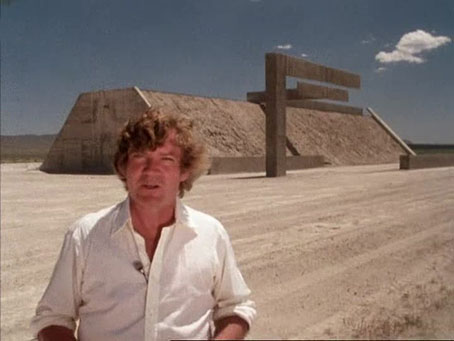
Hughes and Complex One, an artwork that few people are allowed to visit.

Something else I’d forgotten about was the artist interviews in the later programmes, especially those with land artists Michael Heizer and Walter De Maria. The final episode in the series examines the collapse of the idea of the avant-garde, with land art being presented as work that can’t be bought by wealthy collectors or appropriated by mass media. Hughes treks into the Nevada desert to see Heizer’s Complex One which at the time was all that existed of the massive site known today as City; Walter De Maria is seen walking through The Lightning Field in New Mexico accompanied by synthesizer chords from Jean-Michel Jarre’s Equinoxe. Electronic music abounds in this series, from Peter Howell’s clanging Radiophonic theme, to extracts from albums by Tangerine Dream and Brian Eno, Music For Films being a popular choice with TV producers at the time. It’s notable that the phrase “the shock of the new” only occurs once, near the very end, possibly as a capitulation to the BBC who Hughes says chose the title for him. In a later book, Things I Didn’t Know: A Memoir (2006), you’ll find another of those memorable statements:

Some new works of art have values of some kind or another. Others, the majority, have little or none. But newness as such, in art, is never a value.

I’m following this with a re-viewing of Hughes’ multi-part American Visions (1996), a history of American culture that I’ve not seen since its first broadcast. The Shock of the New is all over YouTube if you require it, also at the Internet Archive. The series took three years to create and was broadcast at 8:00pm on Sunday evenings to an audience of millions. They really don’t make them like this any more.

Previously on { feuilleton }
Robert Hughes, 1938–2012
Land art

Weekend links 612

remps.jpg

Cabinet of Curiosities (c. 1690s) by Domenico Remps.

• “…the human voice is an astonishing landscape”. Jeremy Allen on Desert Equations: Azax Attra (1986) by Sussan Deyhim & Richard Horowitz, an album which is being reissued by Crammed Discs with bonus tracks and an inexplicably rearranged track list. Good as it is, their follow-up release from 1996, Majoun, is even better, and might be better known if it hadn’t been so thoroughly abandoned by Sony Classical.

• “On view through May 29, By Her Hand: Artemisia Gentileschi and Women Artists in Italy, 1500–1800 showcases masterpieces done by 17 Italian women to make the case for a broader view of women’s participation in the Italian Renaissance.” Nora McGreevy reports.

• “We had a far more profound effect on society than we really understood, and some of us paid for that”: Jane Lapiner and David Simpson of the San Francisco Diggers talking to Jay Babcock in another installment of Jay’s verbal history of the hippie anarchists.

• “Close your eyes and you could almost imagine it’s the muffled screams of a ghost trapped in a bottle.” Daryl Worthington on 25 years of The Ballasted Orchestra by Stars Of The Lid.

• More Dangerous Visions and New Worlds: Mike Stax talks with Michael Moorcock about music, science fiction, politics, and their intersections in the 1960s.

• “Cormac McCarthy to publish two new novels.” Oboy oboy.

• At Dennis Cooper’s: Larry Gottheim Day.

Metal Machine Music For Airports

Marginalia Search

Music For Meditation I (1973) by Eberhard Schoener | Music For Evenings (1980) by Young Marble Giants | Music for Twin Peaks Episode #30 (Part I) (1996) by Stars Of The Lid