Dalí and Film

dali1.jpg

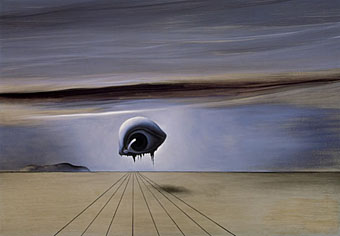
Study for the Dream Sequence in Spellbound by Salvador Dalí (1945).

A new exhibition exploring Salvador Dalí’s connections with cinema begins at Tate Modern this weekend. Interesting seeing Dalí’s gradual reappraisal by the art establishment after years of dismissal but then it is nearly twenty years after his death.

dali2.jpg

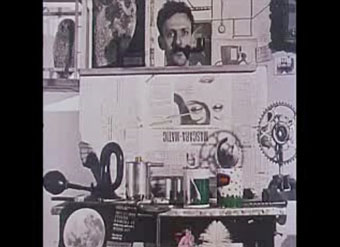
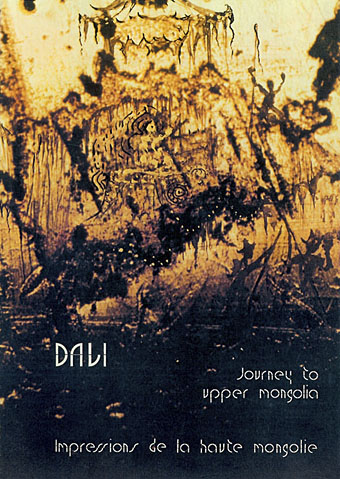
One welcome result of this event is an interview in the Tate’s online magazine with film director José Montes Baquer whose Dalí collaboration, Impressions of Upper Mongolia, Hommage to Raymond Roussel, I wrote about last year. This is the only substantial discussion of this curious film I’ve seen anywhere so it’s fascinating to discover that it came about as a result of Dalí urinating on a pen.

He said: “In this clean and aseptic country, I have been observing how the urinals in the luxury restrooms of this hotel have acquired an entire range of rust colours through the interaction of the uric acid on the precious metals that are astounding. For this reason, I have been regularly urinating on the brass band of this pen over the past weeks to obtain the magnificent structures that you will find with your cameras and lenses. By simply looking at the band with my own eyes, I can see Dalí on the moon, or Dalí sipping coffee on the Champs Élysées. Take this magical object, work with it, and when you have an interesting result, come see me. If the result is good, we will make a film together.”

The interview also includes a few more tantalising glimpses of the film’s images and in the same magazine there’s a piece by Roy Disney remembering Dalí’s encounter with his uncle, Walt.

Previously on { feuilleton }
Ballard on Dalí
Fantastic art from Pan Books
Penguin Surrealism
The Surrealist Revolution
The persistence of DNA
Salvador Dalí’s apocalyptic happening
The music of Igor Wakhévitch
Dalí Atomicus
Las Pozas and Edward James
Impressions de la Haute Mongolie

My pastiches

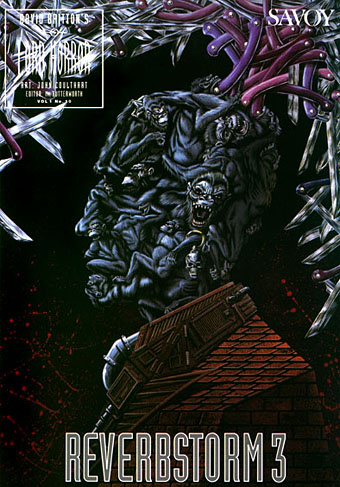
rev3cov.jpg

Lord Horror: Reverbstorm #3 (1992).

Following from the post about an art forgery exhibition (and Eddie Campbell discussing his American Gothic cover for Bacchus), I thought I’d post some of my own forgeries, or pastiches as we call them when no deception is intended.

Reverbstorm was the Lord Horror comic series I was creating with David Britton for Savoy in the 1990s. The Modernist techniques of collage (as in the work of Picasso and others) and quotation (as in TS Eliot’s The Waste Land) became themes in themselves as the series developed, so it seemed natural to imitate the styles of various artists as we went along. Pastiche is also a chance to flagrantly show off, of course, and I can’t deny that this was also one of my impulses here.

Issue #3 of Reverbstorm had marauding apes as its theme, from the Rue Morgue to Tarzan and King Kong, so I had the idea of doing an ape cover in the style of the celebrated paintings by Giuseppe Arcimboldo (1527–1593) which make human heads out of fruit, flowers or animals. Easy enough to have the idea but making it work took a lot of effort and required careful sketching beforehand, something I rarely do. The painting was gouache on board, a medium I’d been using for years and this was about the last gouache work I did before switching to acrylics.

Continue reading “My pastiches”

The South Bank Show: Francis Bacon

bacon.jpg

Non-Brits may not be aware that The South Bank Show is a long-running arts programme (or “show”, as Americans prefer) and the last bastion of cultural broadcasting on the otherwise completely moribund ITV channel. Over the years the SBS has produced some great documentaries and this one from 1985 is particularly good, capturing artist Francis Bacon in fine form, both as combative critic and sozzled pisshead when he and presenter Melvyn Bragg drink too much wine in a restaurant. Highlights include his funny dismissal of Mark Rothko whilst viewing paintings at the Tate, their tour of his cramped studio, and his drunken pronunciation of the word “voluptuous” when describing Michelangelo’s male figures.

I taped this programme when it was repeated after Bacon’s death in 1992 but you lucky people can now see and download it from Ubuweb. (Their note says the SBS is a BBC production but this is incorrect.)

Part of The South Bank Show series, David Hinton directs this documentary about British painter Francis Bacon, known for his horrifying portraits of humanity. The program consists of a series of conversations between Bacon and interviewer Melvyn Bragg, starting with commentary during a side-show presentation at the Tate Gallery in London. Later in the evening, Bacon is followed through various bars hanging out, drinking, and gambling. In another segment, Bacon provides a tour of his painting studio and a glimpse at his reference photographs of distorted humans. The artist discusses his theories, influences, and obsessions. This title won an International Emmy Award in 1985.

This isn’t necessarily the best Bacon interview, that accolade would probably have to go to the 1984 Arena documentary (which was a BBC production) Francis Bacon: The Brutality of Fact where FB is interviewed by art critic and long-time supporter David Sylvester. Sylvester interviewed Bacon many times over twenty years or so and Thames & Hudson printed the Arena interview along with several of their other talks in Sylvester’s book of the same name. Essential reading for anyone interested in the artist’s work.

Bacon’s work has affected my own on a number of occasions. The cover to Reverbstorm #4 borrowed the carcass from his Painting (1946); some of the paintings I was doing in 1997 (like this one and this one) are distinctly Bacon-esque and we used two of his paintings on the cover design for Savoy’s edition of The Killer (Dave Britton’s idea on that occasion).

His work remains popular for the over-inflated art market. Sketches and unfinished paintings that he was throwing out, and detritus like discarded cheque books, sold for nearly a million pounds last month. And earlier this week his Study from Innocent X (1960) went for $52.6m in a New York auction. Bacon once said that “some artists leave remarkable things which, a hundred years later, don’t work at all. I have left my mark; my work is hung in museums, but maybe one day the Tate Gallery or the other museums will banish me to the cellar—you never know.” I think we can assume this won’t be happening for a while yet.

Elsewhere on { feuilleton }
The gay artists archive

Previously on { feuilleton }
T&H: At the Sign of the Dolphin
20 Sites n Years by Tom Phillips

The Art of Deception

myatt.jpg

Harlequin Disturbs Sleeping Fish by John Myatt
in the style of Joan Miró (no date).

Fakes and Forgeries: The Art of Deception is an exhibition at the Bruce Museum, Connecticut, running from May 12th–September 9th 2007.

For its major spring/summer exhibition, the Bruce Museum explores a subject that is exceptionally topical in today’s art world. Fakes and Forgeries: The Art of Deception presents 60 examples of Western paintings, works on paper, sculpture and decorative arts that have been recognized as imposters, including examples of the rarest and most famous deceptive works.

Fakes and Forgeries: The Art of Deception reveals the strategies and techniques of the world’s most successful forgers and exposes the extraordinary lengths to which they went to produce authentic-looking artworks. It also addresses techniques used to expose these deceptions, including X-ray fluorescence, pigment analysis, spectrography, dendrochronology, and carbon dating.

The exhibition presents Western painting and sculpture that has been faked from all periods of art, starting with fakes from antiquity and moving chronologically through the Middle Ages, Renaissance and Baroque eras, exposing forgeries ranging from medieval sculpture and quattrocento gold backs to the rare art of Vermeer.

meergeren.jpg

Christ and His Disciples at Emmaus by Han van Meegeren
in the style of Jan Vermeer (1937).

What exactly is a fake or a forgery? Perhaps the biggest problem in this field is the complexity of determining what constitutes an authentic work versus a vast array of faked, forged, copied, attributed, misattributed and replicated work. A fake is a work that replicates an existing work of art; it may be a deliberate deception or simply not the real thing. A forgery is a work that mimics the style of an artist or replicates his signature in a deliberate attempt to deceive.

Paintings in this exhibition that have fake signatures include forgeries of Edouard Manet, Juan Gris, and Giorgio de Chiricio; the etching Le Bain purportedly by Picasso also bears a forged signature. One of the show’s highlights is Han van Meegeren’s legendary forgery, Christ and His Disciples at Emmaus, in the style of Johannes Vermeer, which is arguably the most famous forgery in the world.

Bruce Museum
One Museum Drive
Greenwich
CT 06830
USA