Weekend links 186

mutu.jpg

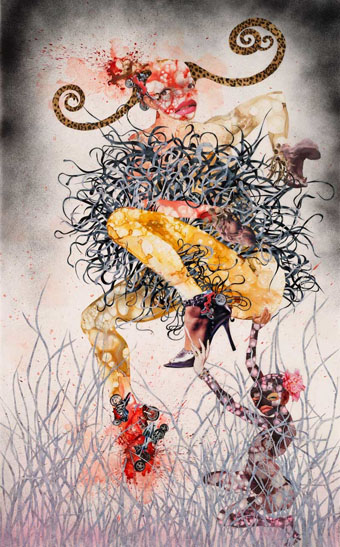
One Hundred Lavish Months of Bushwhack (2004) by Wangechi Mutu.

I wouldn’t be so bold as to call Benjamin Noys’ contribution to the recent The Weird conference at the University of London a highlight, but it was a surprise to find Lord Horror in general and the Reverbstorm book in particular being discussed alongside so many noteworthy offerings. Noys’ piece, Full Spectrum Offence: Savoy’s Neo-Weird, is now available to read online, a very perceptive examination of the tensions between the Old Weird and the New.

• Le Transperceneige is a multi-volume bande dessinée of post-apocalypse science fiction by Jacques Lob & Jean-Marc Rochette. Snowpiercer is a film adaptation by Korean director Bong Joon-ho featuring John Hurt, Jamie Bell, Chris Evans and Tilda Swinton. Anne Billson calls the director’s cut an “eccentric masterpiece” so it’s dismaying to learn that the film is in danger of being hacked about by the usual rabble of unsympathetic Hollywood distributors.

• This month marks the 100th anniversary of the publication of Proust’s À la recherche du temps perdu. Public Domain Review posted some of the paintings mentioned in Swann’s Way (or The Way by Swann’s as the latest translation so inelegantly has it).

How the Paris World’s Fair brought Art Nouveau to the Masses in 1900: a huge picture post about my favourite exposition.

• Mix of the week: “Sport of Kings” Mix by Ricardo Donoso. Related: Paul Purgas on five favourite records.

Ernst Reichl: the man who designed Ulysses. Related: Hear all of Finnegans Wake read aloud over 35 hours.

• “Why does Alain de Botton want us to kill our young?” A splendid rant by Sam Kriss.

• Love’s Secret Ascension: Peter Bebergal on Coil, Coltrane & the 70th birthday of LSD.

• Malicious Damage: Ilsa Colsell on the secret art of Joe Orton & Kenneth Halliwell.

• Just Say No to the Bad Sex Award, or the BS Award as Tom Pollock calls it.

• Lauren O’Neal’s ongoing PJ Harvey Tuesdays: One, Two, Three and Four.

Neville Brody on the changing face of graphic design.

A Brief History of the London Necropolis Railway.

Des Hommes et des Chatons: a Tumblr.

• At Pinterest: Androgyny

• Virgin Prunes: Pagan Lovesong (vibeakimbo) (1982) | Caucasian Walk (1982) | Walls Of Jericho (live at The Haçienda, Manchester, 1983; I’m in that audience somewhere)
Weekend links 185

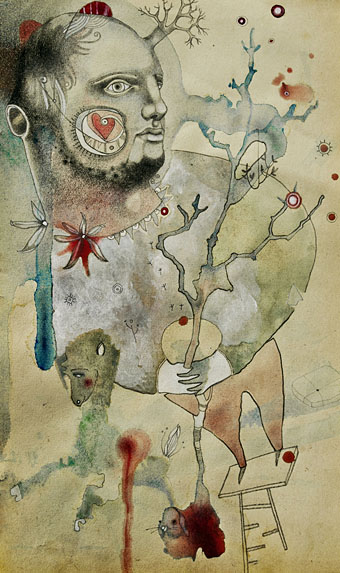
rondelli.jpg

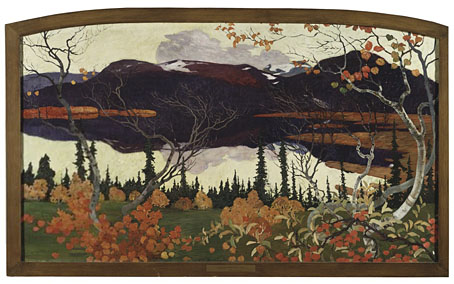
L’uomo che piantava gli alberi (2013) by Sofia Rondelli. Via Form Is Void.

• I’m looking forward to hearing the new album by Chrome Hoof, a band whose ambition and attitude makes many of their contemporaries seem lukewarm at best. Mick Middles gets to grips with Chrome Black Gold here. John Doran interviewed the group in 2010, a piece which includes a Chrome Hoof mix of tracks by other artists.

Jay Roberts: “I was a young Marine scout sniper, definitely his type. And for a single, unforgettable afternoon, Orange County’s most notorious serial killer coaxed me into a place from which many didn’t escape.”

Jonathan Meades: “Why I went postal … and turned my snaps into postcards.” “Meades isn’t your average architectural fanboy,” says Rachel Cooke who went to talk to him at his home in Marseille.

“Faced with a Nabokov novel,” Zadie Smith writes, “it’s impossible to rid yourself of the feeling that you’ve been set a problem, as a chess master sets a problem in a newspaper.” Certainly, while Humbert asks the reader “not to mock me and my mental daze”, the suspicion is that the power dynamic in his tale is a little different.

Tim Groenland on the difficulties of writing, publishing and reading Lolita.

Cosmic Machine is a double-disc collection of French electronic music from the 1970s & 1980s. Justice enthuse about the music here where you can also preview the tracks.

The Midnight Channel, Evan J. Peterson’s horror-poetry homage to the VHS era, is available now from Babel/Salvage. There’s a trailer here.

• “Our age reveres the specialist but humans are natural polymaths, at our best when we turn our minds to many things,” says Robert Twigger.

• Another musical Chrome: Richard Metzger on newly resurrected recordings by one of my long-time cult bands.

• Hermes Trismegistus and Hermeticism: An interview with Gary Lachman.

• A stunning set of photos of London in the sweltering summer of 1976.

Pye Corner Audio live at The Outer Church, Madrid, November 2013.

Judee Sill, the shockingly talented occult folk singer time forgot.

• Designer Jonathan Barnbrook answers twenty questions.

• Don’t trust the painting: Morgan Meis on René Magritte.

Laurie Anderson’s farewell to Lou Reed.

Philippe Druillet at Pinterest.

• The Chrome Plated Megaphone Of Destiny (1968) by The Mothers of Invention | March Of The Chrome Police (1979) by Chrome | Chrome (1981) by Debbie Harry

Ignacio Goitia interviewed

goitia.jpg

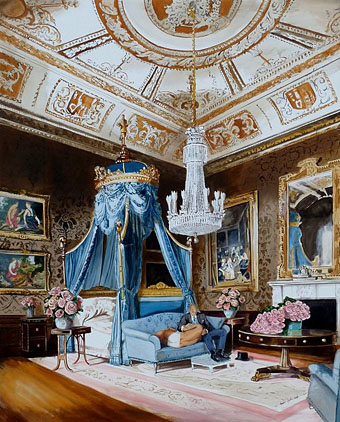
Acrílico sobre tela (My Other Self, 2009).

Back in 2010 I wrote the following about Ignacio Goitia:

Ignacio Goitia is a Spanish artist whose depictions of opulent aristocracy manage to be subversively homoerotic thanks to the addition of figures we can interpret as boyfriends, sex slaves or wish-fulfilling phantasms; Ludwig II would no doubt approve of the sentiment even if he disagreed with some of the decor.

Earlier this year John Wisniewski sent me a short interview he’d done with Mr Goitia which I’m ashamed to say it’s taken me this long to post. My apologies to John and Ignacio. (I’d have been tempted to ask what’s with all the giraffes?)

*

John Wisniewski: When did you begin drawing and painting?

Ignacio Goitia: I have always, since I can recall, loved drawing and painting. When I was a child, I would spend endless hours with my colour paints, and as soon as I was able, I enrolled myself to different art schools and academies.

Later on I got accepted in the Superior Beaux Art faculty at the University of the Basque Country in Bilbao. Since I finished those five years of University, this is all I have been doing, paint.

JW: When was your first art exhibition? What was the reaction to your work?

IG: Since my first exhibition, the public reaction to my work, has been in general, very positive, although, there is always the sceptics, that relate modernity with abstraction and minimalism, conceptualism… Despite this, with the passing of the years, my work has gained many followers in those circles. In all my exhibits the amount of people that has made an effort to visit them, its been quite large.

JW: What inspires you to paint or draw? How do you choose a subject?

IG: My first source of inspiration are my travels. I find it photographing the buildings, monuments, streets and people that catch my attention. I am passionate about architecture, and love discovering in it, the evolution of human thought.

Once in my studio, I select the sceneries that better adapt to the concept that I wish to express. After that, I start introducing the people and subjects, distributing them in the different spaces, until I get the adequate composition that better express my thought. This work of preparation and distribution, is a process that takes several days.

JW: Do you hope to exhibit your work in the USA at sometime? What do you think the reception will be for your work in the USA?

IG: I have exhibited during Art Basel Week in the HACS gallery in Miami in the Year 2007 and 2008. The reception was very good.

I am also participating with a good chance in the Creatives Rising project with See Me and will be featured in the digital projections over facades in NYC next October. We are in the process for an exhibit in Miami and NYC in the near future. Most of the people that I have been dealing in the USA are having a very positive and enthusiastic response.

JW: How is your painting uniquely Spanish and how is it universal?

IG: I think being born in Spain and specifically in the Basque Country has influenced in some of my work, but is something that is not in the back of my mind, and it is not a source of thought when I paint. The scenarios that I create are inspired in many places around the world, and the subjects could belong to different nationalities.

It’s also true, that I have also use as backdrop, cities like Bilbao or Madrid, and there are blinks of folklore and culture belonging to the Basque country or Spain, and I introduce them in some of my work, but not often. I consider my paintings something less related to a particular culture, or universal, there are something more personal and an individual thought on how I see the world, as a result of my own interests and ideas. •

Elsewhere on { feuilleton }
The gay artists archive

Witches

witches02.jpg

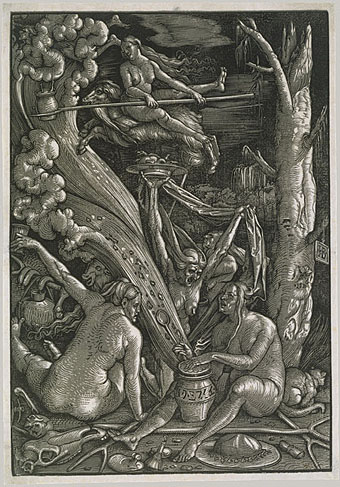
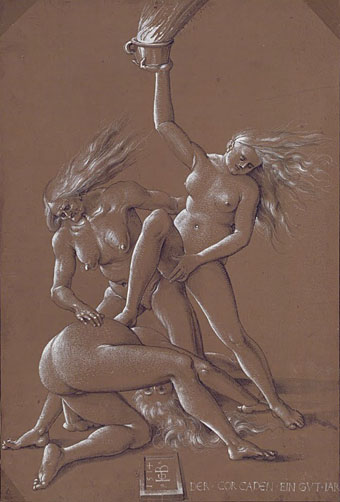
Scene of Witchcraft (1510) by Hans Baldung Grien.

Earlier this year Pam Grossman declared 2013 to be the Year of the Witch, so in honour of that (and the season) here’s a handful of sorceresses through the ages. Most can be found in higher quality at the Google Art Project but a couple are from other sources. I’ve taken the liberty of attributing the drawing below to Hans Baldung Grien, not Albrecht Dürer as Google has it. Not only is this the attribution I’ve always seen for this picture but Baldung’s “HBG” monogram is clearly visible beneath the sprawling woman.

witches01.jpg

New Year’s Greeting with Three Witches (1514) by Hans Baldung Grien.

witches03.jpg

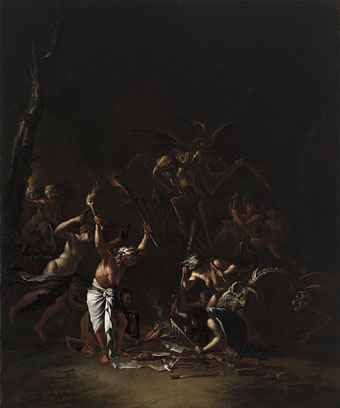
The Witches’ Sabbath (c.1640–1649) by Salvator Rosa.

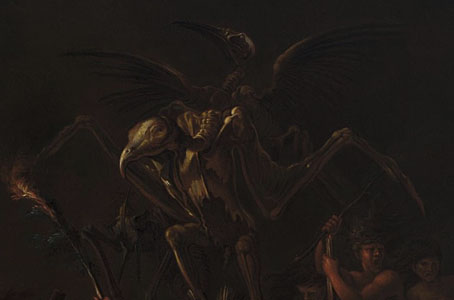
Salvator Rosa specialised in lurid depictions of bandits, executions and—as here—witches. The excessive imagery appealed to later generations, especially the Romantics. This painting is even more grotesque than usual with its flayed-bird abominations (below) looming out of the shadows.

witches04.jpg

Continue reading “Witches”