Emshwiller illustrates Bester

emshwiller01.jpg

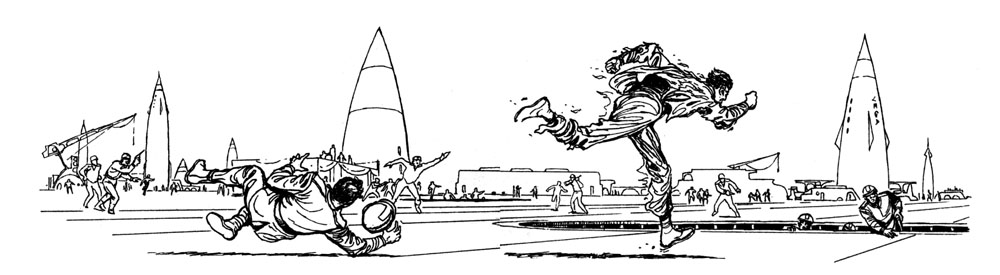
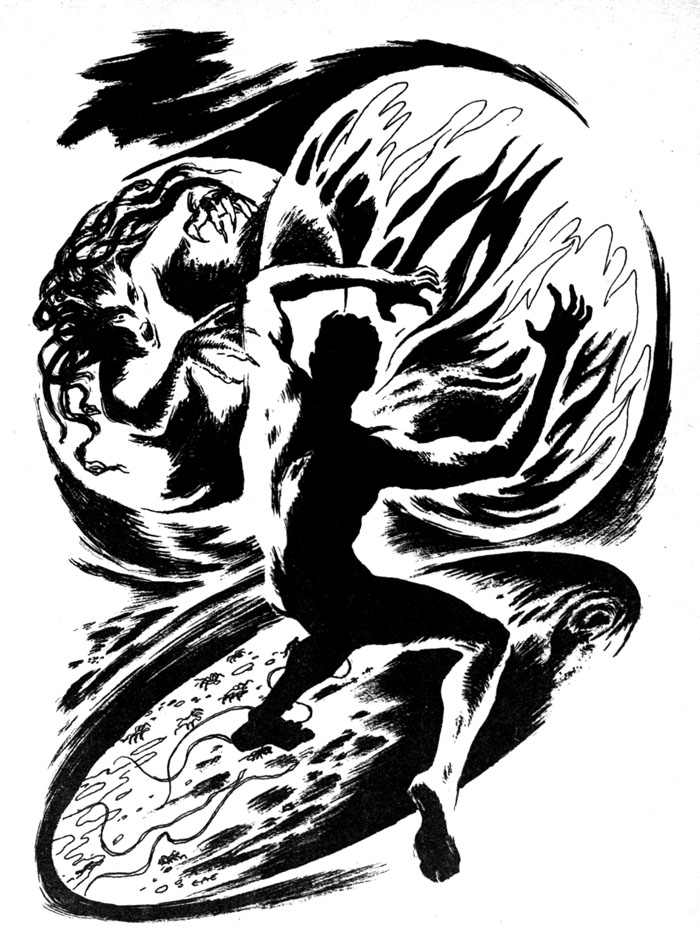
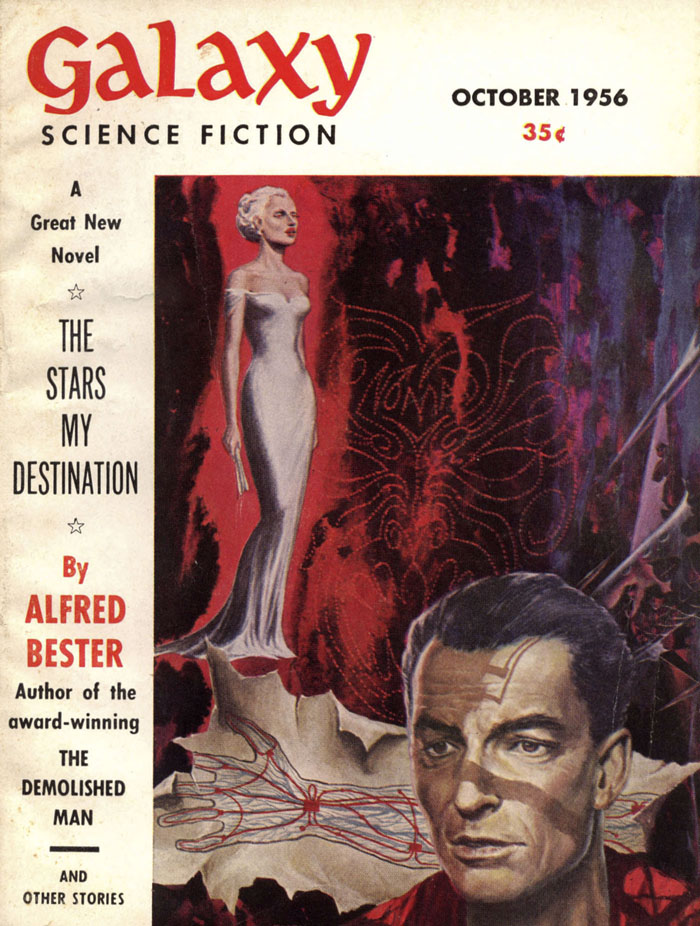
Having finished reading The Count of Monte Cristo I thought I’d, er jaunt from the 1840s into the far future by revisiting Alfred Bester’s Dumas-derived The Stars My Destination. I prefer the alternate title to Bester’s novel, Tiger! Tiger!, but Stars… is the one that’s more commonly used, with the unfortunate side-effect of making the book sound like a typical space opera of the 1950s. The story may begin in space but most of it takes place on Earth in the 24th century. Bester borrows the revenge theme and a couple of other details from The Count of Monte Cristo but wisely resists any attempt to imitate the labyrinthine plotting of the Dumas novel.
emshwiller02.jpg

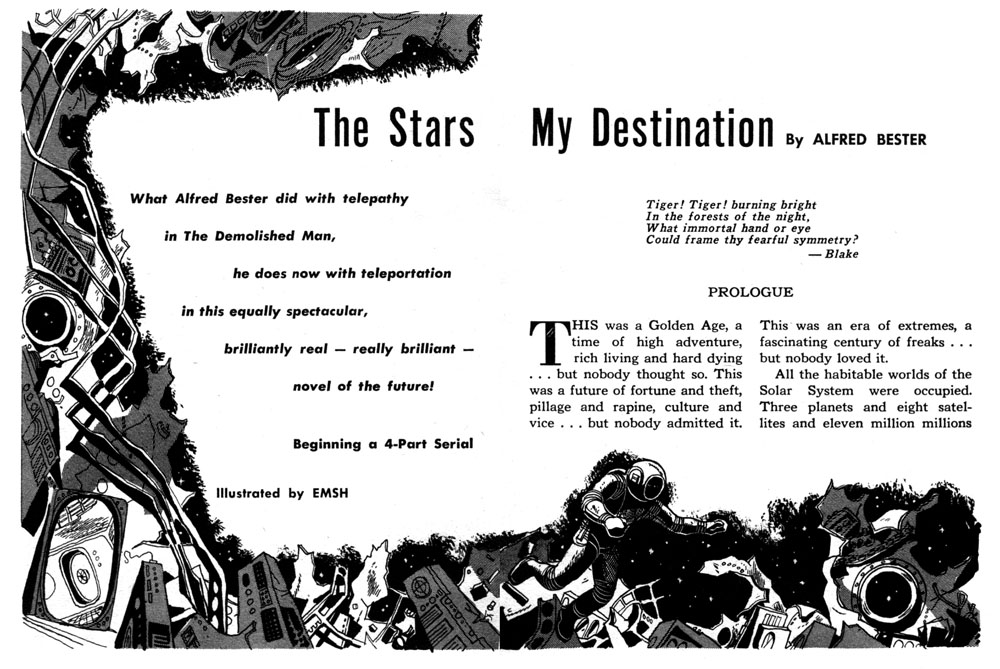
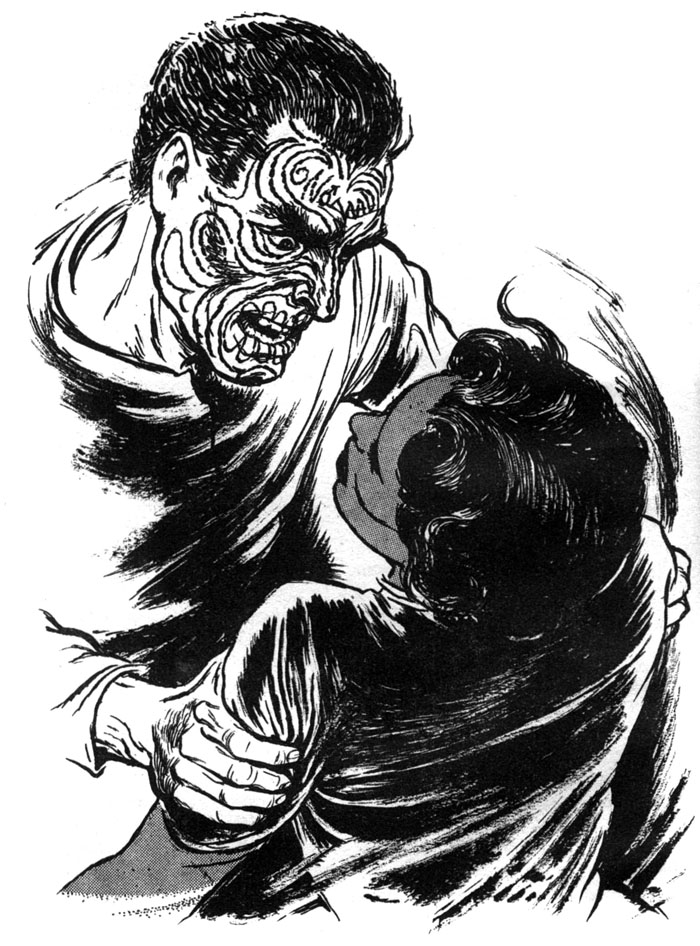
Before publication in book form, the story was serialised in four parts in Galaxy magazine, from October 1956 to January 1957; Ed “Emsh” Emshwiller illustrated each instalment as well as the cover of the debut issue. I’ve said before that one of the great benefits of being able to browse old magazines online is having the opportunity to turn up neglected illustrations like these. Bester’s novel has long been regarded as a genre classic—Michael Moorcock and William Gibson both refer to it as a favourite—but its print editions haven’t generated many memorable covers. Here we have Emshwiller illustrating the entire story, and doing an excellent job, yet his drawings have been buried for years.
emshwiller03.jpg

For the purposes of this post I’ve removed the text surrounding some of the illustrations in order to highlight the drawings. The original printings, plus the full text of the serialised story, may be found at the links below:

Galaxy, October 1956
Galaxy, November 1956
Galaxy, December 1956
Galaxy, January 1957

emshwiller04.jpg

emshwiller05.jpg

Continue reading “Emshwiller illustrates Bester”

Weekend links 640

ewers-wunderwald.jpg

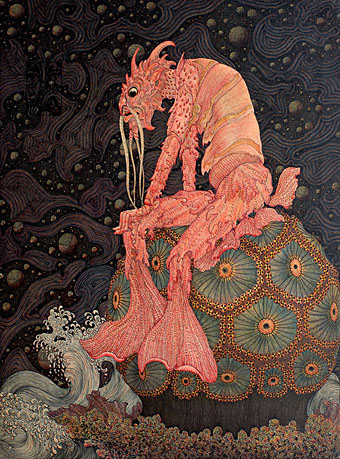
Aquarius (1910–1914) by Ilna Ewers-Wunderwald.

• “…they created a unique Afro-Caribbean soundscape—Battiste’s exceptional skills saw him use the studio as an instrument, voices flutter in and out, instruments shiver and shriek, over which Rebennack mutters and chants, a shaman of sorts.” Garth Cartwright on the life and works of Mac Rebennack, better known to the world as Dr John.

• Issue 3 of Man Is The Animal: A Coil Zine is now available for pre-order. I contributed to this one with a piece entitled “Singularities of Art and Nature”, an examination of the Coil discography via the Wunderkammer concept and the Musaeum Clausum of Thomas Browne.

• Among the recent arrivals at Standard Ebooks, the home of free, high-quality, public-domain texts, is Arthur Machen’s episodic and influential horror novel The Three Imposters (1895).

Media History Digital Library: “A free online resource, featuring millions of pages of books and magazines from the histories of film, broadcasting, and recorded sound.”

• At Dennis Cooper’s: Shall I, Jean Eugène Robert-Houdin, conjurer, introduce myself to you, viewer? And why not?

• At Public Domain Review: The Blood Collages of John Bingley Garland (ca. 1850–60).

• Mix of the week: Endymion, an autumnal ambient mix by The Ephemeral Man.

• “New Webb image captures clearest view of Neptune’s rings in decades.”

• New music: Of Endless Light by Cleared.

• RIP jazz giant Pharoah Sanders.

Conjuration (1977) by Tangerine Dream | Necronomicon—Conjurations (2004) by John Zorn | A Boy Called Conjuror (2020) by Teleplasmiste

Ralph Steadman, 1977

steadman1.jpg

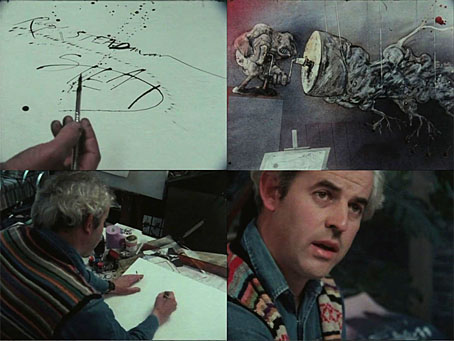
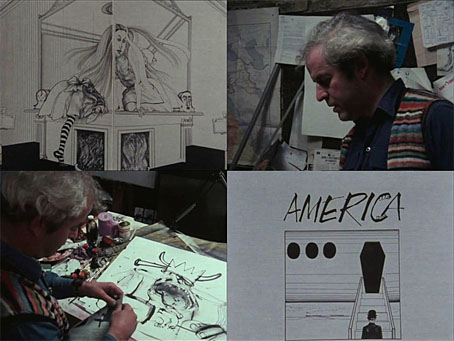
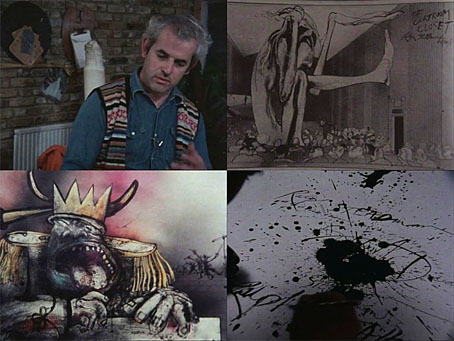
This is the kind of thing I like to see: 35 minutes of an artist doing nothing but drawing or talking about drawing. Michael Dibb’s profile of Ralph Steadman is the earliest BBC portrait of the artist, made for the long-running Arena arts series. Arena was launched in 1975 but films from the series prior to 1980 are rare things on the internet. This one concentrates on Steadman’s creation of a drawing for a new book, The Cherrywood Cannon, an anti-war story by Dimitri Sidjanski. In between work on the drawing Steadman describes how he approached illustrating Alice Through the Looking-Glass, and his drawings of the Patty Hearst trial, before repairing to the local pub where he sketches the regulars. Hunter S. Thompson only receives a passing mention, which may surprise some viewers; if it’s Thompson you’re after then you’ll want to see Fear and Loathing on the Road to Hollywood, the 1978 Omnibus profile of the writer which features Steadman again, plus many more of his drawings.

steadman2.jpg

The Arena film is relatively short but valuable for the insight it gives into Steadman’s technique: no preliminary drawing, for example, he starts with ink on a blank sheet of paper. I was amused to see him using a spray diffuser to fill in the background. This is a kind of lung-powered airbrush, an angled tube which you place in your bottle of ink then blow through to create spray effects. I used one myself for a while as a rougher (and cheaper) alternative to an airbrush, before graduating to using old toothbrushes which are easier to control when spattering ink. I’d always assumed that Steadman used an airbrush himself but seeing his loose approach to sketching it makes sense that he’d like the grainier, less predictable textures created by a diffuser.

steadman3.jpg

Michael Dibb’s film is at the producer’s Vimeo channel together with many other excellent documentaries, including John Berger’s landmark Ways of Seeing series.  Vimeo changed its policies recently, insisting that you sign in if you want to see something that hasn’t been rated by the user (ie: most of the things there). This can be avoided by using the mobile Vimeo app, an option which also gives you better search facilities.

Elsewhere on { feuilleton }
The illustrators archive

Previously on { feuilleton }
Ralph Steadman record covers
Beardsley and His Work

Weekend links 639

alphaville.jpg

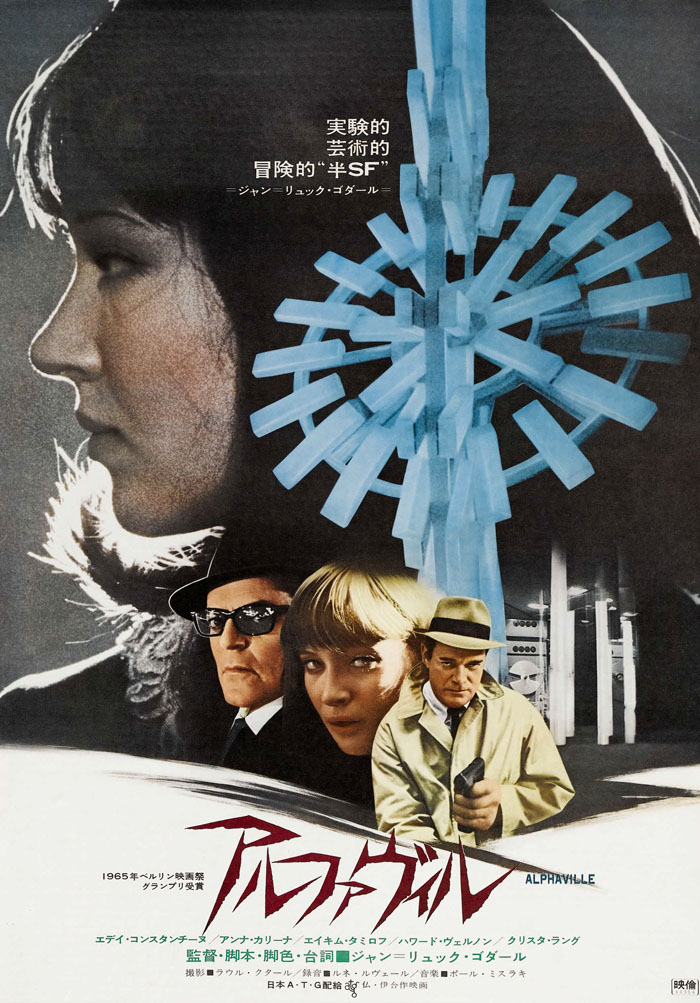
Japanese poster for Alphaville (1965).

Peter Bogdanovich: I think we’d better have your thoughts on Godard.

Orson Welles: Well, since you’re so very firm about it. He’s the definitive influence if not really the first film artist of this last decade, and his gifts as a director are enormous. I just can’t take him very seriously as a thinker—and that’s where we seem to differ, because he does. His message is what he cares about these days, and, like most movie messages, it could be written on the head of a pin. But what’s so admirable about him is his marvellous contempt for the machinery of movies and even movies themselves—a kind of anarchistic, nihilistic contempt for the medium—which, when he’s at his best and most vigorous, is very exciting.

• RIP JLG. I was watching Alphaville again just two weeks ago after a DVD turned up in the local charity shop. Still the only Godard film I like 100% but “liking” seems beside the point. His influence today is everywhere, so fully absorbed into the language of cinema that people barely notice it.

• “The things that cause my gaze to linger are usually the portraits or landscapes that spark a feeling of unease, disquiet and discomfort. A shadow amongst the summer trees, a lurking silhouette reflected in a perfect blue iris, a vibrant flower in the early stages of decay.” S. Elizabeth talking to Beautiful Bizarre about her new book, The Art of Darkness: A Treasury of the Morbid, Melancholic and Macabre.

• Allow John Waters (again) to dictate your film viewing with a Letterboxd list of his favourite films, based on comments in his writings and interviews. On the subject of Godard, Waters’ Crackpot book contains a whole chapter about Hail Mary.

• Astor’s Electrical Future: Iwan Rhys Morus explores a vision of the year 2000 recounted in A Journey in Other Worlds (1894), a “scientific romance” by John Jacob Astor IV, with illustrations by Daniel Carter Beard.

• Strange Attractor has announced a Kickstarter campaign to fund the publication of an Austin Osman Spare Tarot deck.

• At Wormwoodiana: The Parrot, the Unicorn and the Golden Dragon: Some 17th Century Booksellers’ Signs.

• At Bandcamp: Andy Thomas on Chris Watson‘s post-Cabaret Voltaire career in nature recordings.

• A new outlet for cinematic obscurities: Radiance Films.

Alphaville (1978) by Klaus Schulze | Alphaville (1979) by The Monochrome Set | Alphaville (1999) by Scanner

Leslie Megahey, 1944–2022

megahey.jpg

TV producer & film director Leslie Megahey died at the end of August but the news has taken a while to filter through to these pages where his BBC TV productions have been the subject of several posts. My recurrent comments about his work were effusive enough for him to send me a handwritten note of thanks a few years ago, plus a promotional card for one of the films in the Artists and Models series. If more of his productions had been available online or on disc I would have written something about them as well, but old television, especially the documentary variety, remains persistently inaccessible to future audiences.

There are biographical details in the link above so what follows is a list of the Megahey productions that, for this viewer at least, made his name one to look out for in the TV listings. Some of these are on YouTube, a couple are available on disc, while the rest have yet to resurface anywhere. Everything here is highly recommended…if you can find it.

Omnibus: All Clouds are Clocks (1976/1991): An hour-long interview with composer György Ligeti. I caught this one on its updated rebroadcast in 1991 when Megahey revisited Ligeti to see what directions his career had taken over the past 15 years. Currently unavailable.

Schalcken the Painter (1979): Another Omnibus film, and a ghost story (after Sheridan Le Fanu) that’s as good as any of the BBC’s MR James adaptations. Released on (Region B) blu-ray & (Region 2) DVD by the BFI.

Arena: The Orson Welles Story (1982): A two-part interview (165 minutes in total) which caught Welles in a rare mood when he was happy to talk at length about his career. The TV equivalent of the huge book of Peter Bogdanovich conversations. Part One | Part Two

Artists and Models (1986): Three drama/documentaries about French painters: David, Ingres and Géricault.

Cariani and the Courtesans (1987): Another historical drama about an artist, Giovanni Cariani (c. 1490–1547). Very much in the mould of Schalcken the Painter but without the supernatural element. Currently unavailable.

Duke Bluebeard’s Castle (1988): The best film version of Bartók’s opera. The Region 1 DVD by Kultur seems to be deleted but is worth seeking out for having removable subtitles. There’s a copy at YouTube.

The Complete Citizen Kane (1991): A 90-minute documentary about Welles’ film using extracts from the Arena interviews and the Megahey produced TV series The RKO Story, plus new material. No longer on YouTube (or anywhere else) due to a copyright complaint. This is why I’m always saying you should download these things as soon as you find them.

The Hour of the Pig (1993): A feature film about a medieval animal trial, this one was hacked around by Miramax then released in the US as The Advocate where it flopped. The hard-to-find UK version turned up on YouTube a few days ago.

Previously on { feuilleton }
Men and Wild Horses: Théodore Géricault
The Complete Citizen Kane
Schalcken the Painter revisited
Le Grande Macabre
Leslie Megahey’s Bluebeard