Weekend links 706

jardine.jpg

Sea Change (c.1966) by George Wallace Jardine.

A paucity of links this week thanks to the Xmas blight which reduced my RSS feed to a wasteland of no activity at all or too many of those lazy listicles devoted to “our top ten things of the year”. There was, however, this from Simon Reynolds:

I miss the inter-blog chatter of the 2000s, but in truth, connectivity was only ever part of the appeal. I’d do this even if no one read it. Blogging, for me, is the perfect format. No restrictions when it comes to length or brevity: a post can be a considered and meticulously composed 3,000-word essay, or a spurted splat of speculation or whimsy. No rules about structure or consistency of tone. A blogpost can be half-baked and barely proved: I feel zero responsibility to “do my research” before pontificating. Purely for my own pleasure, I do often go deep. But it’s nearer the truth to say that some posts are outcomes of rambles across the archives of the internet, byproducts of the odd information trawled up and the lateral connections created.

Setting aside the inter-blog conversation, which I was never very interested in, Reynolds articulates precisely why I still enjoy posting things here. I also agree with his comments about the psychological constraints that doing the same for Substack or similar would impose: a paying readership creates responsibilities that would make the whole thing feel like another form of work rather than play. To Reynolds’ comments I’d add that I also enjoy having a tiny area of the internet over which I exercise complete control. If I fall out with my webhost, as I did in the summer, I can move the entire site to a new location.

Reynolds expanded on his article at his regular forum, blissblog, where he examines the current state of the thing that people used to call the blogosphere. My thanks to Simon for including this place in his list of diehard operatives. I can’t say I’ve noticed the younger generations picking up the habit (then again, I haven’t really been looking…) but the small percentage of any generation who want to do more than simply follow the herd will always find outlets for their interests. And the tools for doing this have never gone away. This particular medium may not suit most people, but for those who can accommodate themselves to the format it’s a better way to spend your time than marinating your soul in the corrosive sump of social media.

• Elsewhere: Among other things, 2024 will be the year that the earliest manifestation of Walt Disney’s ubiquitous rodent enters the public domain in the USA. Jennifer Jenkins lists some of the more prominent books, films, songs, etc that will be following suit.

• At Open Culture: The Beautiful Anarchy of the Earliest Animated Cartoons.

• At Dennis Cooper’s: Another day for Shirley Clarke.

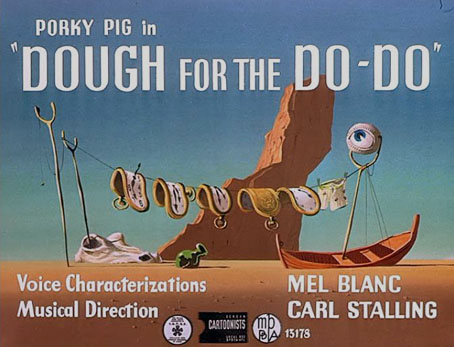
Suspended Animation (1980) by Bernard Szajner | Animation (1983) by Cabaret Voltaire | Reanimation (1996) by Bill Laswell feat. DJ Rob Swift

The Great Transparent Ones

herold1.jpg

Le Grand Transparent (1947) by Jacques Hérold.

The Great Transparent Ones

Man is perhaps not the centre, the cynosure of the universe. One can go so far as to believe that there exist above him, on the animal scale, beings whose behaviour is as strange to him as his may be to the mayfly or the whale. Nothing necessarily stands in the way of these creatures’ being able to completely escape man’s sensory system of references through a camouflage of whatever sort one cares to imagine, though the possibility of such a camouflage is posited only by the theory of forms and the study of mimetic animals. There is no doubt that there is ample room for speculation here, even though this idea tends to place man in the same modest conditions of interpretation of his own universe as the child who is pleased to form his conception of an ant from its underside just after he has kicked over an anthill. In considering disturbances such as cyclones, in face of which man is powerless to be anything but a victim or a witness, or those such as war, notoriously inadequate versions of which are set forth, it would not be impossible, in the course of a vast work over which the most daring sort of induction should never cease to preside, to approximate the structure and the constitution of such hypothetical beings (which mysteriously reveal themselves to us when we are afraid and when we are conscious of the workings of chance) to the point where they become credible.

I think it necessary to point out that I am not departing appreciably from Novalis’ testimony: “In reality we live in an animal whose parasites we are. The constitution of this animal determines ours and vice versa,” and that I am only agreeing with a thought of William James’s: “Who knows whether, in nature, we do not occupy just as small a place alongside beings whose existence we do not suspect as our cats and dogs that live with us in our homes?” Even learned men do not all contradict this view of things: “Perhaps there circle round about us beings built on the same plan as we are, but different, men for example whose albumins are straight,” said Émile Duclaux, a former director of the Pasteur Institute (1840–1904).

A new myth? Must these things be convinced that they result from a mirage or must they be given a chance to show themselves?

André Breton, Prolegomena to a Third Surrealist Manifesto, or Not, 1942

herold2.jpg

Le Grand Transparent (1947) by Jacques Hérold.

Elsewhere on { feuilleton }
The Surrealism archive

Previously on { feuilleton }
The Execution of the Testament of the Marquis de Sade by Jean Benoît
Chance encounters on the dissecting table
The Marvellous
Surrealist cartomancy

Weekend links 705

adnams.jpg

The Seven Lamps (c.1956) by Marion Elizabeth Adnams.

• At Spoon & Tamago: All 54 playing cards reinterpreted through still-life photography by Yuni Yoshida.

• At Colossal: Photographer Mikko Lagerstedt illuminates the magical solitude of the Nordic winter.

• At 3:AM Magazine: Alexander B. Joy explores the 9th minute of Andrei Tarkovsky’s Solaris.

• At Dennis Cooper’s: The Seven Godlike Books of James McCourt.

• Mix of the week: Winter Solstice 5 at Ambientblog.

Entries for the RSPCA Young Photographer 2023.

Artmaker Blog curated by Bruce Sterling.

• New music: Earth Drone by The Owl.

Ace Of Spades (1965) by Link Wray | Jack Of Diamonds (1966) by The Daily Flash | Pack Of Cards (1970) by Nat Cole

Georges de Feure’s Gate of Dreams

defeure01.jpg

The gate in question, La Porte des Rêves (1899), is a collection of stories by Symbolist writer Marcel Schwob, illustrated in its first edition by Georges de Feure (1868–1943). The collection is actually a kind of “best of Schwob”, being compiled from stories which had already appeared a few years before in other collections. Both Schwob and de Feure were French, and the artist is one of the few whose work may be found in collections of Symbolist art as well as books about Art Nouveau design; you’d think there’d be many more among the conterminous movements but this isn’t the case.

defeure02.jpg

Women are a persistent subject in de Feure’s work, especially the sinister variety who were a staple in fin-de-siècle fiction. Some of these may be found in La Porte des Rêves which features a larger quantity of de Feure’s black-and-white drawing than I’ve seen elsewhere. In a reversal of my usual preferences, I prefer de Feure’s colour work, but anything of his is worth seeing. For a taste of Marcel Schwob’s approach to writing, which included textual collage, see this interview with translator Kit Schluter.

defeure03.jpg

A triple-page spread.

defeure04.jpg

defeure05.jpg

Continue reading “Georges de Feure’s Gate of Dreams”

The Parade and Baron Verdigris

parade01.jpg

Design by Paul Woodroffe.

The Parade, subtitled An Illustrated Gift Book for Boys and Girls, is something that children with wealthy parents or relatives might have received as a Christmas present in December 1897. The contents are an unusual mix of fairy tales, frivolous seasonal fare—A Christmas Mummery, complete with songs and music—and adventure stories set in other parts of the world. The collection was edited by Gleeson White, an art critic whose former position as editor of The Studio magazine explains the very Studio-friendly choice of illustrators.

parade02.jpg

The design on the title page is a curious piece by Aubrey Beardsley, one with less authority than the most of the other drawings he was producing in his penultimate year. Those dots filling out the arabesque plant forms are the kinds of things that amateurs do when they’re uncertain about whether or not to decorate a design. The tendril which terminates in a tasselled confection is, however, a typical example of the artist’s bizarre invention, the kind of caprice that used to infuriate the critics who disliked his work. Beardsley’s career had been launched four years earlier with a profile in The Studio, but by 1897 he was often struggling for money after being fired from The Yellow Book in the wake of the Oscar Wilde scandal. Gleeson White is to be commended for supporting him at a time when many others refused to do so.

parade03.jpg

L. Leslie Brooke.

Elsewhere in The Parade there are contributions both written and pictorial from Beardsley’s friend, Max Beerbohm; also a story by Richard Burton, a writer you wouldn’t usually expect to find in a book aimed at children. The list of illustrators includes Charles Robinson, Laurence Housman and Manchester’s own Alfred Garth Jones. Beardsley didn’t draw anything else for The Parade but he’s mentioned again in a list of titles advertised in the book’s final pages as having provided a frontispiece for Baron Verdigris, “A Romance of the Reversed Direction” by one Jocelyn Quilp. The title was unfamiliar, and I wasn’t sure at first whether I’d seen the illustration, but the drawing shown below appears in two of my Beardsley books—albeit at small sizes—including the copious Brian Reade collection from 1967.

beardsley.jpg

“Baron Verdigris” sounds like a minor character from Michael Moorcock’s Dancers at the End of Time trilogy, while the improbable “Jocelyn Quilp” turns out to be a nom de plume of Halliwell Sutcliffe whose book is described as a “singular novella, a curious amalgam of parodies based on a time-travelling theme“; shades of the Dancers again. It’s tempting to think that this may be the sole example of Aubrey Beardsley illustrating science fiction (or something like it)—the book is generic enough to be listed at ISFDB—but Brian Reade describes the story as “pseudo-mediaeval and facetious”, “dedicated to ‘Fin-de-Siécle-ism, the Sensational Novel, and the Conventional Drawing-Room Ballad'”. That does at least explain the peculiarities of the drawing. Maybe the Moorcock comparison is an apt one after all.

More illustrations from The Parade:

parade04.jpg

Charles Robinson.

parade05.jpg

Léon V. Solon.

Continue reading “The Parade and Baron Verdigris”