The art of Harold Hitchcock

hitchcock.jpg

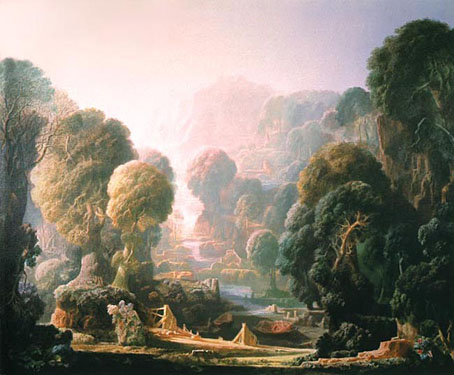
Sunrise in a Valley (1974).

It’s difficult to say whether the work of Harold Hitchcock (born 1914) is rarely seen in his native country because of those British art critics who’ve often regarded fantastic or sacred themes with suspicion—or whether it’s merely because people find his work to be bad. Sometimes the latter accusation appears to be a disguise for the former belief, especially among those who follow the pack rather than drawing their own conclusions. At times the English Channel has acted as an aesthetic as well as a physical barrier. British art never quite got to grips with Surrealism, despite the best efforts of Roland Penrose and others, while Symbolism was almost exclusively a Continental movement whose existence was largely expunged from later art histories; the 1959 Penguin Dictionary of Art and Artists, for instance, has entries for minor groupings such as the Hudson River School and the Nazarenes, but no entry at all for Symbolism. Fantasy was allowable in illustration but not elsewhere; no wonder Mervyn Peake took up writing.

So much for polemic. Hitchcock’s work comprises very detailed landscapes that present a Claude Lorraine-like approach to light with more Modernist forays reminiscent of Expressionist painters such as Franz Marc. His fanciful works remind me of his Surrealist contemporary Leonora Carrington, with their creation of a self-contained, often naive, private world. Hitchcock lives in South Devon and was still active three years ago when the BBC reported his 90th birthday. The American exhibition mentioned in that news story took place at the Phillips Gallery, Carmel, CA and their site has three pages of (rather blurred) examples of his luminous work.

Update: The official Harold Hitchcock site

Harold Hitchcock by Leonard Hitchcock
Catching the Light by Emmanuel Williams

Elsewhere on { feuilleton }
The fantastic art archive

Penguin Labyrinths and the Thief’s Journal

labyrinths1.jpg

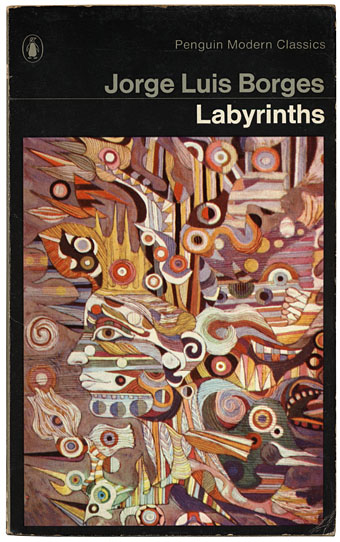
Detail from La Havane by René Portocarrero; photo by C. Marker.

This week’s book finds are a pair of titles I hadn’t come across before in these particular editions, another haul from the vast continent that is the Penguin Books back catalogue. Labyrinths I’ve had for years in a later edition (see below) but the cover of this one seems more suited to Borges (as much as he can be illustrated) than the somewhat bland Surrealism of illustrator Peter Goodfellow. René Portocarrero (1912–1985) was a Cuban painter with a post-Picasso style who specialised in hallucinogenic profiles like the one here. And it’s a guess but I’d bet the “C. Marker” who photographed the painting is French filmmaker Chris Marker (who I compared to Borges last year), director of La Jetée and Sans Soleil. Marker worked as a photo-journalist for many years and made a documentary entitled ¡Cuba Sí! in 1961.

Continue reading “Penguin Labyrinths and the Thief’s Journal”

Winsor McCay’s Hippodrome souvenirs

hippodrome.jpg

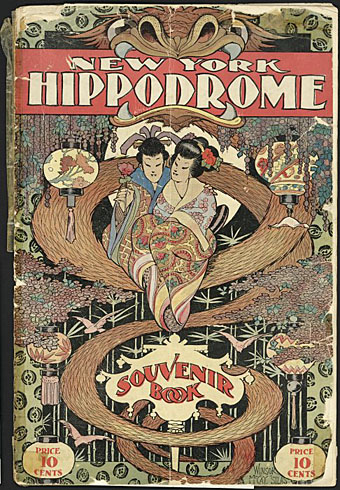
A cover design by the great cartoonist and pioneer animator. Typical of a compulsive fantasist to add a huge dragon head to an otherwise regulation piece of Chinoiserie. No date or any indication as to whether McCay’s work was also featured inside but there’s another design of his for the same establishment here. The latter version could almost be a page from Little Nemo in Slumberland.

Bud Plant’s Winsor McCay page

Elsewhere on { feuilleton }
The illustrators archive

Piranesi as designer

piranesi1.jpg

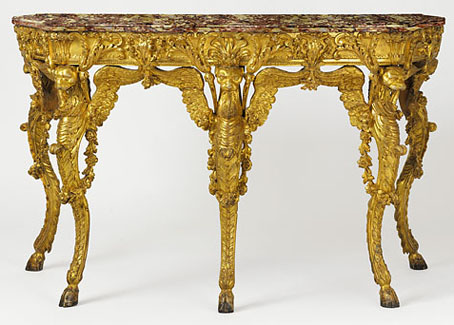
Pier table for Cardinal Rezzonico (c. 1768).

This ostentatious object is on display at the Cooper-Hewitt National Design Museum in an exhibition devoted to Piranesi’s work as a designer. Piranesi (whose work adorns the current {feuilleton} header) is far more well-known for his Carceri d’Invenzione and Vedute di Roma prints than for his furniture design, of course, so this exhibition addresses a side of the artist/architect which is rarely explored outside the more extensive books about his work. I’d seen this table before in black and white photographs in John Wilton-Ely’s substantial monograph, The Mind and Art of Giovanni Battista Piranesi (1978) but those photos don’t fully convey its lavish (some might say gaudy) effect.

The exhibition runs from September 14, 2007–January 20, 2008. From the Cooper-Hewitt site:

This exhibition examines the artist’s role in the reform of architecture and design from the 18th century to the present. This is the first museum exhibition to show Piranesi’s full range and influence as a designer of architecture, elaborate interiors and exquisite furnishings. On view will be etchings, original drawings and prints by Piranesi, as well as a selection of three-dimensional objects. In addition to his better-known architectural projects, Piranesi also designed fantastic chimneypieces, carriage works, furniture, light fixtures and other decorative pieces. The exhibition is co-curated by Dr. Sarah E. Lawrence, director, Master’s Program in the history of decorative arts and design, Cooper-Hewitt, National Design Museum, and John Wilton-Ely, professor emeritus, University of Hull.

piranesi2.jpg

Diverse Maniere…, Open to Chimneypiece: Griffon Monopods on the Jambs (1769).

The original table design appeared in Diverse Maniere, a collection of prints showing design for clocks, furniture and fireplaces. Many of these are the most bizarre and detailed inventions in Piranesi’s corpus, especially the elaborate Egyptian-themed fireplaces. Very few of these confections were built at all but a number of the prints are in the exhibition and can be seen at its very elegant website.

NYT feature on Piranesi and the Cooper-Hewitt exhibition

Elsewhere on { feuilleton }
The etching and engraving archive

Last Suppers and last straws

folsom.jpg

Hardly a week passes without the religious right in America getting their knickers in a twist over some new iniquity, a condition so commonplace that new outbreaks are barely worth acknowledging. However, this week’s storm in a teacup caught my attention for being art-related.

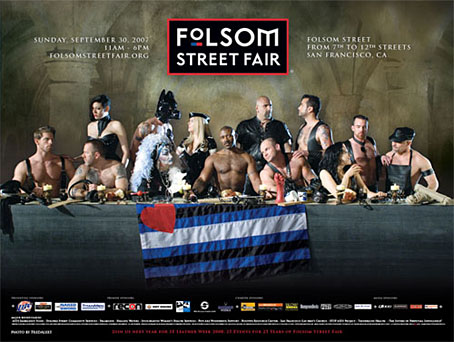
If there’s one thing certain American Christians have in common with Muslim fundamentalists, it’s the habit of reacting to anything remotely gay with all the composure of caged baboons being prodded with sharp sticks. The pointed implement on this occasion has been the poster for the Folsom Street Fair, an annual Leather Pride/BDSM event held in San Francisco. The photograph by FredAlert (site NSFW) continues what’s become a minor tradition in artistic parody by working a variation on Leonardo da Vinci’s The Last Supper (1498), with leather girls and guys for the disciples and a black man in the place of Leonardo’s Jesus. The flag on the table is a Leather Pride flag. The intent behind the poster was explained by Andy Cooper, one of the event’s organisers:

There is no intention to be particularly pro-religion or anti-religion with this poster; the image is intended only to be reminiscent of the Last Supper painting. It is a distinctive representation of diversity with women and men, people of all colors and sexual orientations.

(…)

We hope that people will enjoy the artistry for what it is—nothing more or less. Many people choose to speculate on deeper meanings. This is one artist’s imagining of the Last Supper, and we have made it our own. The irony is that da Vinci was widely considered to be homosexual. In truth, we are going to produce a series of inspired poster images over the next few years. Next year’s poster ad may take inspiration from American Gothic by Grant Wood or Edvard Munch’s The Scream or even The Sound of Music! I guess it wouldn’t be Folsom Street Fair without offending some extreme members of the global community, though.

To judge by the splenetic frothing of groups such as the Concerned Women for America, it seems they managed a double helping of offence this year. The CWA see a deliberate attack on their religion, something I can’t see at all. While the reaction may seem to be harmless bluster, it should be noted that groups such as CWA and the more substantial American Family Association receive a lot of money via donations from supporters. Moral panics and perennial threats to civilisation have become a means to drum up additional support (ie: cash) to safeguard what they claim are Christian values. And gay people/rights/events have become a convenient whipping boy (so to speak) for fund-raising. As Joe Murray, ex-staff attorney for the American Family Association writes, this is now a multi-million dollar business:

It is not coincidental that the road to Hell is paved with the best of intentions, thus while one hopes that conservative leaders, such as Don Wildmon, began their crusade motivated by morality, it appears that a number of them have been hypnotized by the siren song of the almighty dollar.

Christian activism has become a lucrative business. According to its 990 form, the AFA took in millions. Arguably, such revenue was made possible by sending out “Action Alerts” warning homosexuals will throw Christians in jail under the hate crimes bill. Such rhetoric is misleading at best, dishonest at worse.

How does one protect Christianity? Send money. Call it cash-back Christianity…

Public complaints about blasphemy or other slights are always double-edged. Without the outrage I probably wouldn’t have noticed the Folsom poster, despite reading gay news blogs every day. But thanks to the CWA this isn’t the only blog now replicating the picture or showing similar examples of alleged Leonardo abuse. It hardly needs pointing out that the two other paintings mentioned in the Folsom Street Fair statement are also very popular as parody subjects and parody doesn’t work at all if the original reference isn’t well-known. Leonardo’s two most famous works are the Mona Lisa and The Last Supper and the latter proves attractive for parodists by being a group scene presented in tableaux form. The Last Supper, American Gothic and Michelangelo’s Creation of Adam must be the three most-parodied paintings in art history; many of the Last Supper variations?including versions by Salvador Dalí and Andy Warhol?are very well-known and have been around for years.

Continue reading “Last Suppers and last straws”