Secret Lives of the Samurai

shimizu.jpg

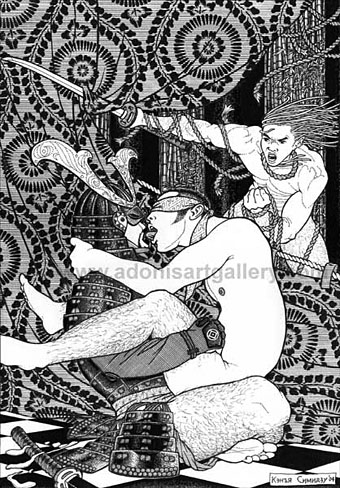
Kiss of Death (2007).

From a series of marvellous homoerotic ink drawings by Kenya Shimizu. The artist seems to have no web presence at all, unfortunately, aside from three pages of work for sale at London’s Adonis Art Gallery. Most of the pictures there are hardcore images so if you don’t want to see any of that, don’t look. His paintings are as good as his drawings but I typically prefer the black and white work, especially since there’s a slight Beardsleyesque feel to some of them—or is it merely the Japanese line which Beardsley borrowed? Nice to see a variety of cum shots as well; the first drawing in the Samurai series, Release, is even a bukkake scene, something you rarely see in gay art.

Kenya Shimizu was born in Fukui Prefecture in Japan, 1976. Kenya Shimizu devoted himself early on to mastering the techniques of his art.  His homo-erotic fantasies (pen and ink) – very much in the Japanese erotic tradition – are brilliant compositions executed with panache and great skill.  His paintings on gold and silver leaf, are masterpieces of watercolour workmanship;  His watercolours of modern Japan – reveal and portray the present-day homo-erotic fantasies of the ‘salarymen’ and students of today’s Japan.

Within recent years, one of the leading Japanese practitioners of homo-erotic painting – Sadao Hasegawa – sadly died.  Now a worthy successor has come onto the scene.

Elsewhere on { feuilleton }
• The gay artists archive

Previously on { feuilleton }
• The art of Sadao Hasegawa, 1945–1999
• The art of Takato Yamamoto
• The art of ejaculation
The art of Pierre Clayette, 1930–2005

clayette1.jpg

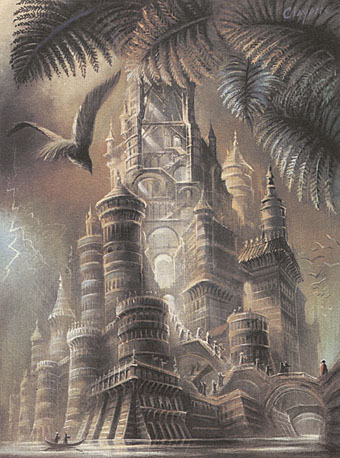
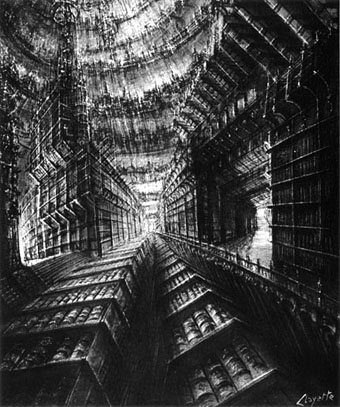
The Library of Babel (no date).

Another French artist who specialised in fantastic architecture, Pierre Clayette’s work came to my attention via the picture above which illustrates a Borges story. This leads me to wonder once again what it is about French and Belgian artists which attracts them more than others to this type of imagery.

clayette2.jpg

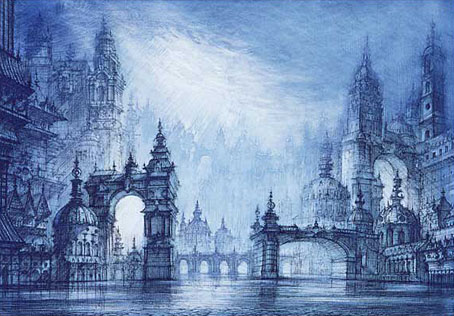
Whatever the reason, there isn’t a great deal of Clayette’s work online and biographical details are few. This page (the source of the untitled picture above) reveals that he worked as an illustrator for Planète magazine, the journal of “fantastic realism” founded by Jacques Bergier and Louis Pauwels in the early Sixties. Some readers may know that pair as the authors of a { feuilleton } cult volume, The Morning of the Magicians (1960), whose vertiginous blend of speculative and weird fiction, occultism and futurology Planète was intended to continue.

clayette3.jpg

Clayette also worked as a theatre designer and book illustrator. Le Chateau (above) is an illustration from Songes de Pierres, a 1984 portfolio depicting scenes from Pierres by Roger Caillois. That writer has his own significant Borges connection, being responsible for introducing Borges’ work to France via his editorship of the UNESCO journal, Diogenes. (Pauwels and Bergier later published Borges in Planète.)

Finally, there’s a less extravagant Flickr collection of some Clayette covers for Penguin Shakespeare editions. All of which only scratches the surface of what was evidently a prolific career; I’ll look forward to more examples of his work coming to light.

Elsewhere on { feuilleton }
• The fantastic art archive
• The illustrators archive

Previously on { feuilleton }
• The art of Michiko Hoshino
• The art of Erik Desmazières
• The art of Gérard Trignac
• The Absolute Elsewhere

Kelly McCallum’s insect art

mccallum.jpg

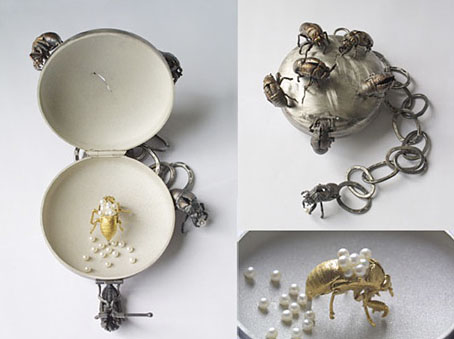
In addition to insects, Kelly McCallum also has birds filled with clockwork mechanisms, stuffed animals being eaten by gilded grubs, jewellery carved from human bones, and more. Plus a quote from the Prince of Quotation, Walter Benjamin: “The grey film of dust covering things has become their best part.”

Via 3quarksdaily.

Previously on { feuilleton }
• Walmor Corrêa’s Memento Mori
• The art of Jo Whaley
• The art of Ron Pippin
• Custom creatures
• Polly Morgan, fine art taxidermist
• Insect Lab
• The art of Jessica Joslin

The Corpus Clock

corpus_clock.jpg

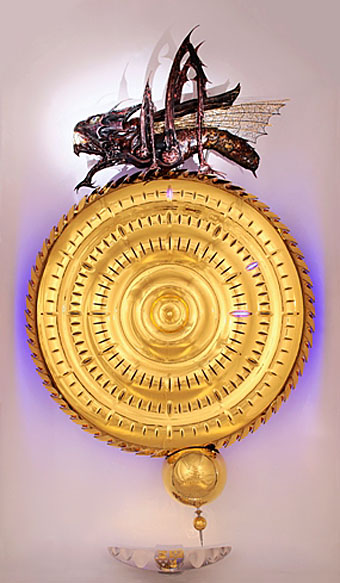
This splendid clock is unveiled by Professor Stephen Hawking later today at Corpus Christi College in Cambridge. If it hadn’t cost a million pounds to develop I’d probably be demanding that someone find me one for Christmas. The mechanical monster perched at the top is explained by its creator:

“It is terrifying, it is meant to be,” said John C Taylor, the creator and funder of an extraordinary new clock to be unveiled tomorrow by Stephen Hawking at Corpus Christi College in Cambridge. “Basically I view time as not on your side. He’ll eat up every minute of your life, and as soon as one has gone he’s salivating for the next. It’s not a bad thing to remind students of. I never felt like this until I woke up on my 70th birthday, and was stricken at the thought of how much I still wanted to do, and how little time remained.”

Unfortunately there are few decent pictures to be had of the device but the Telegraph has an article which describes its “grasshopper escapement”, while the Guardian goes one better with a video of the clock in action.

Update: Longer video at the university site with Dr Taylor explaining the clock in detail.

Previously on { feuilleton }
• Gold robots
• The art of Sergei Aparin
• The art of Almacan
• The sculpture of Christopher Conte
• The Bowes Swan

Carlo Scarpa’s Brion-Vega Cemetery

scarpa.jpg

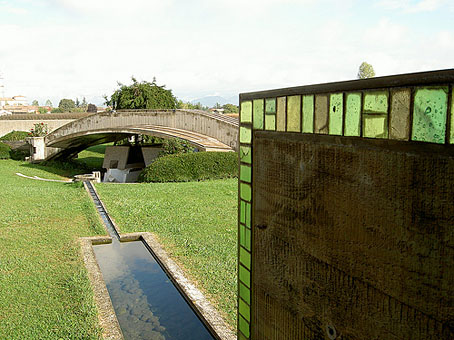
“I would like to explain the Tomba Brion…I consider this work, if you permit me, to be rather good and which will get better over time. I have tried to put some poetic imagination into it, though not in order to create poetic architecture but to make a certain kind of architecture that could emanate a sense of formal poetry….The place for the dead is a garden….I wanted to show some ways in which you could approach death in a social and civic way; and further what meaning there was in death, in the ephemerality of life—other than these shoe-boxes.” Carlo Scarpa

Dan Hill at City of Sound reminds us (okay, reminds me…) of Carlo Scarpa’s incredible private cemetery via a link to a Wallpaper* photo feature about the place. Scarpa’s final work (he’s buried in the grounds) was built for the Brion family at San Vito d’Altivole, Italy, and completed in 1978.

This construction and other Scarpa buildings often come to mind after encountering some disastrous use of concrete in architecture. Scarpa, like Frank Lloyd Wright, shows how well that meanest of building materials could be used with the application of care and imagination. And Scarpa, like Wright, also favoured attention to detail, with the cemetery providing copious examples of this, notably the motif of a pair of interlaced circles which feature as a prominent window design and recur in tiny elements elsewhere. Those paired circles and the garden itself remind me of the Jantar Mantar at Jaipur. I’m sure I read that one of Scarpa’s influences for the cemetery was Arnold Böcklin’s The Isle of the Dead but I’m unable to find any online reference. For more about that painting, there’s my earlier post on the subject.

• Flickr has a wealth of photographs of the cemetery
• A black & white photo set by Gerald Zugmann

Previously on { feuilleton }
• Hugh Ferriss and The Metropolis of Tomorrow
• The Jantar Mantar
• Arnold Böcklin and The Isle of the Dead
• Frank Lloyd Wright’s future city