The eyes of Odilon Redon

redon1.jpg

L’Oeil, comme un ballon bizarre se dirige vers l’infini from A Edgar Poe (1882).

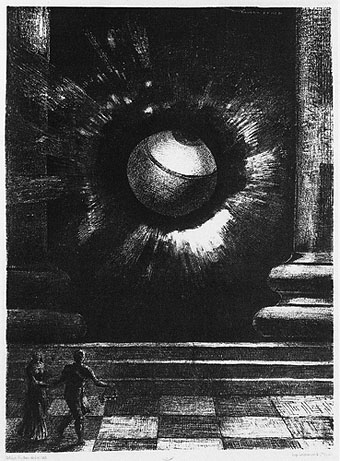
Another decently thorough Symbolist website covers the life and work of Odilon Redon (1840–1916), an artist whose pastels and prints were strange even by the standards of his contemporaries. His giant eyeballs and other floating figures are always startling and point the way inevitably to Surrealism, especially in dream lithographs like the one below.
redon2.jpg

Vision from Dans le Rêve (1879).

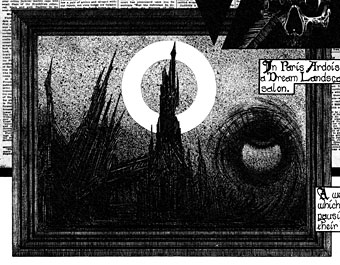
I compounded that Symbolist/Surrealist association when I was drawing The Call of Cthulhu in 1987 by showing Ardois-Boonot’s Dream Landscape (which Lovecraft doesn’t describe beyond the word “blasphemous”) as being a Max Ernst-style frottage canvas with a Redon eye rising from the murk. Cthulhu’s presence reduced to a single ocular motif like the eye of Sauron.
call.jpg

The Call of Cthulhu (1988).

And while we’re on the subject there’s Guy Maddin’s typically phantasmic short, Odilon Redon or The Eye Like a Strange Balloon Mounts Toward Infinity made for the BBC in 1995. Ostensibly based on the balloon picture above, this manages to reference a host of other Redon lithographs and charcoal drawings in the space of four-and-a-half minutes. Sublimely weird and weirdly sublime.

Elsewhere on { feuilleton }
The fantastic art archive

Previously on { feuilleton }
Arthur Zaidenberg’s À Rebours
The Heart of the World

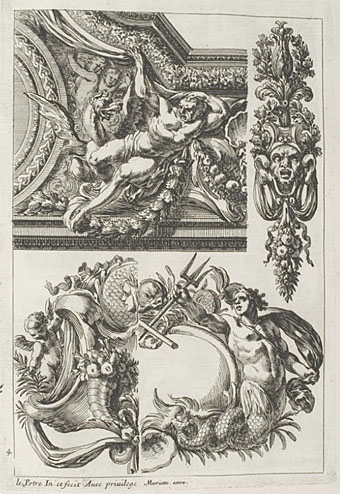
Oeuvres D’Architecture by Jean Le Pautre

lepautre.jpg

Following some print links led me once again to the University of Heidelberg and a collection of engravings by Jean Le Pautre (1618–1682), the grandly-titled Oeuvres D’Architecture De Jean Le Pautre, Architecte, Dessinateur & Graveur du Roi (Band 1): Contenant les Frises, Feuillages, Montans ou Pilastres, Grotesques, Moresques, Panneaux, Placarts, Trumeaux, Lambris, Amortissements, Plafonds, & généralement tout ce qui concerne l’Ornement. This was published in Paris in 1751 and is a splendid series of architectural details including some eye-popping friezes of Rococo turmoil with a profusion of dragons, putti, hippogriffs, mermen and many other hybrids rioting among whiplash foliage. As with other works at Heidelberg, you can either examine the prints one at a time or download the lot as a single PDF.

Elsewhere on { feuilleton }
The etching and engraving archive

Angelo Colarossi and son

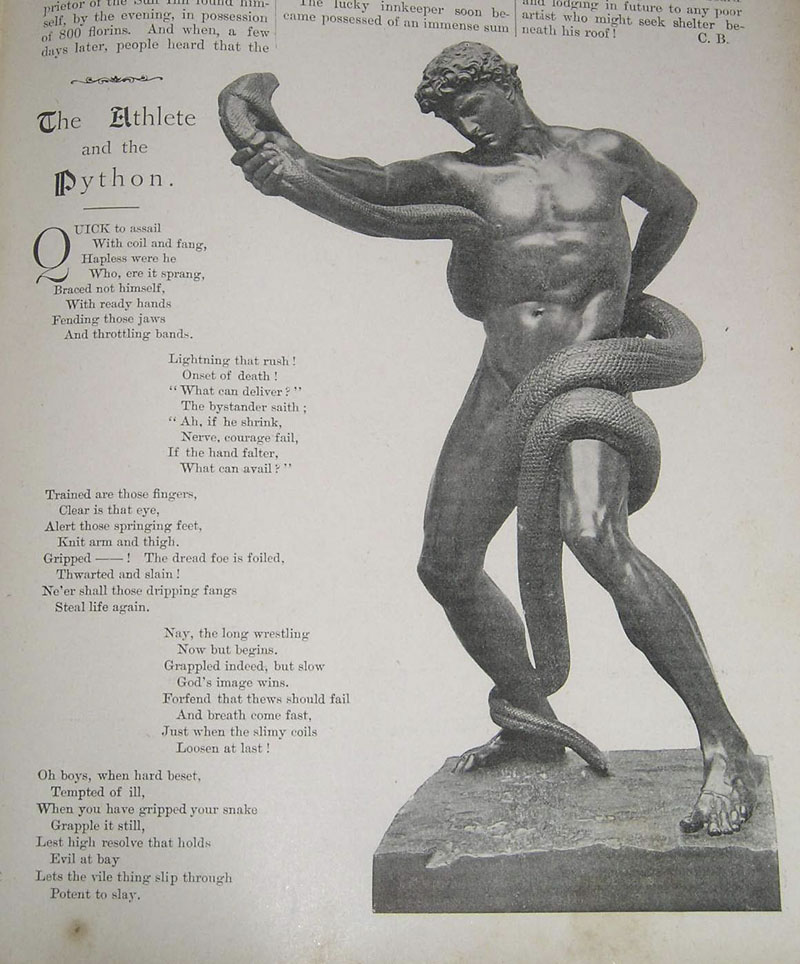
python.jpg

Callum at Front Free Endpaper sent me this photo a while ago of a page from an old boys’ book after he saw my Men With Snakes post which featured the same statue, Lord Leighton’s Athlete Wrestling with a Python (1877). Leighton’s sculpture came to mind again recently following a chance reference to another bronze figure, and one of the most famous statues in London, Alfred Gilbert’s Angel of Christian Charity (1893) aka Anteros or, as everyone now knows it, the Eros of Piccadilly Circus, patron saint of the area’s rent boys. The notable fact was the revelation that the model for Eros was one Angelo Colarossi whose father was also named Angelo Colarossi and was the model for Leighton’s python wrangler. Colarossi Snr, an Italian immigrant, was a popular artists’ model and—no doubt wisely in those days—encouraged his son to follow the same line of work.

eros.jpg

One rarely sees mention of the identities or lives of models for works such as these although they aren’t always unknown, as noted earlier in a post which touched upon American model Audrey Munson. Unknown they may often be but these two models at least have monuments beyond the dreams of any other family of Victorian immigrants. It fascinates me to think of these images of father and son lodged in different parts of London. (Leighton’s statue is now in Tate Britain.) Colarossi Snr is also believed to have posed for John William Waterhouse and an article at the Waterhouse site pursues some possible examples.

Previously on { feuilleton }
San Francisco angels
Men with snakes

The art of Elihu Vedder, 1836–1923

vedder1.jpg

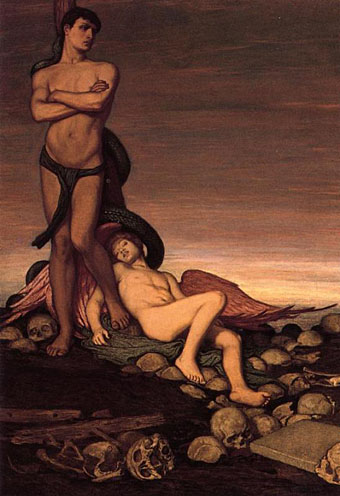
The Last Man (1886–1891).

Vedder was one of the principal American Symbolists, possibly the leading one although there wasn’t the same degree of competition in the United States as there was in Europe. Last time I was casting around the web for his work he wasn’t so visible but that’s changed recently with a dedicated website. Vedder’s 1884 edition of the The Rubáiyát of Omar Khayyám is highly-regarded and at least one of those drawings—The Cup of Death—was reworked as a painting. Compared to his Continental contemporaries he’s a particularly gloomy artist, with sombre subjects rendered in a sombre palette. The Last Man is typical as well as being curiously inexplicable; is the serpent there a Satanic presence? And why is there a dead (?) angel boy at the feet of the Last Man?

The Smithsonian American Art Museum has a set of the Rubáiyát illustrations.

vedder2.jpg

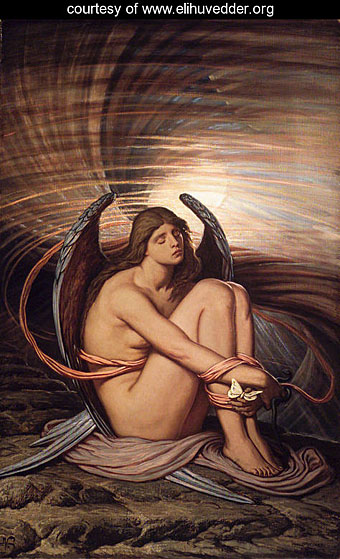
Soul in Bondage (1891–1892).

Previously on { feuilleton }
Angels 5: Angels of Death

The Great God Pan

pan_daphnis.jpg

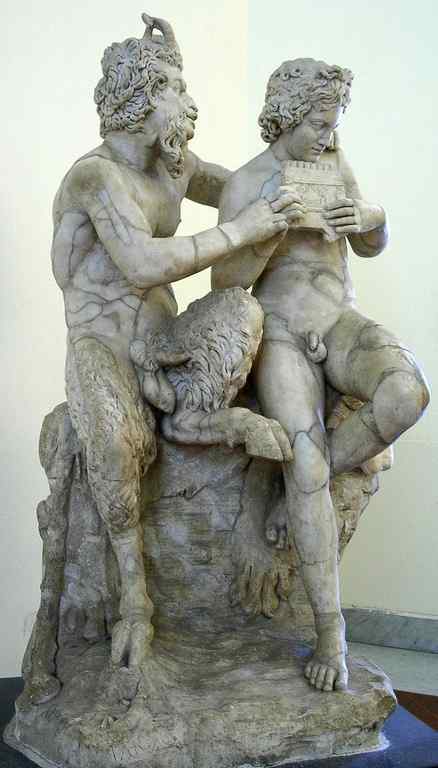
Pan teaching Daphnis to play the panpipes; Roman copy of a Greek original from the 3rd-2nd centuries BCE by Heliodoros.

“The worship of Pan never has died out,” said Mortimer. “Other newer gods have drawn aside his votaries from time to time, but he is the Nature-God to whom all must come back at last. He has been called the Father of all the Gods, but most of his children have been stillborn.”

So says a character in The Music on the Hill, one of the slightly more serious stories from Saki’s The Chronicles of Clovis (1911). Saki’s Pan is a youthful spirit closer to a faun than the goatish creature of legend. But being a gay writer whose tales regularly feature naked young men (surprisingly so, given the time they were written) I’m sure Saki would have appreciated the Roman statue above. There’s nothing chaste about this Pan with his “token erect of thorny thigh” as Aleister Crowley put it in his lascivious 1929 Hymn to Pan, a poem which caused a scandal when read aloud at his funeral some years later. The Roman statue was for a long while an exhibit in the restricted collection of the Naples National Archaeological Museum where all the more scurrilous and priapic artefacts unearthed at Pompeii were kept safely away from women, children and the great unwashed. These are now on public display and include the notorious statue of a goat being penetrated by a satyr.

Continue reading “The Great God Pan”