Michael English, 1941–2009

english1.jpg

left: The Soft Machine Turns On (1967); right: UFO Coming (1967).

This was a bitter blow coming at a time when I’ve been working on something inspired in part by Hapshash and the Coloured Coat, the 1960s design duo comprised of Michael English and Nigel Waymouth. The two artists, together with associate Martin Sharp, are indelibly associated with the London psychedelic scene of the late Sixties. Whereas Sharp’s posters were often loose and dramatically bold explosions of shape and colour, the Hapshash posters were more carefully controlled in their curating of disparate elements borrowed from Art Nouveau—especially Mucha and Beardsely—comic strips, Op Art, Pop art and fantasy illustration. Their work perfectly complemented the very distinctive atmosphere of the capital’s psychedelic scene which, for a couple of hectic years, saw an explosion of new bands (or old bands in new guises) fervently engaged in a lysergic exploration of Victoriana, childhood memories and frequent silliness. UK psychedelia is generally more frivolous than its US equivalent which had the Vietnam War and civil disorder to deal with; English and Waymouth’s graphics captured the London mood.

english2.jpg

top left: Coke (1970); top right: Toothpaste (1974).
bottom left: Leaf Falls (1972); bottom right: Red no. 3 (1978).

In the 1970s English refashioned himself as a hyper-realist painter of foodstuffs and other consumer goods, and his meticulous airbrush style led to work as an advertising artist. Those paintings are beautifully rendered but often leave me feeling slightly queasy. I much prefer his work from later in the decade which depicted equally meticulous close-up views of oil-smeared buses and trains. Paper Tiger published a book collection in 1979, 3D Eye, which gathers the best of his work from the poster art on.

• Obituaries: Guardian | Times
• Hapshash poster galleries here and here

Previously on { feuilleton }
The Look presents Nigel Waymouth
The New Love Poetry

The art of Raphaël Freida

frieda1.jpg

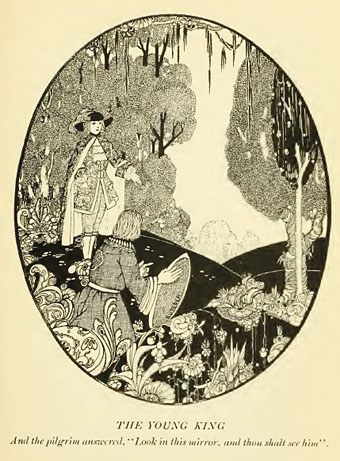
Illustrations by Raphaël Freida for a 1931 edition of Thaïs by Anatole France. I hadn’t come across Freida before and it’s impossible to say more about him or his work, information being frustratingly scant. The site where these are from has other editions of the same book illustrated by Georges Rochegrosse and Frank C Papé.

frieda2.jpg

frieda3.jpg

Elsewhere on { feuilleton }
The illustrators archive

Luke Jerram’s Glass Microbiology

jerram1.jpg

Large E-Coli.

Or art as virus…. Just because micro-organisms can make us seriously ill doesn’t mean they can’t be beautiful. Luke Jerram‘s glass renderings of some of the most deadly examples are on display at the Smithfield Gallery, London, until October 3rd.

The sculptures were designed in consultation with virologists from the University of Bristol using a combination of different scientific photographs and models. They were made in collaboration with glassblowers Kim George, Brian Jones and Norman Veitch. (More.)

jerram2.jpg

Avian flu.

Previously on { feuilleton }
Andy Paiko’s glass art
The art of Josiah McElheny
The art of Angelo Filomeno
IKO stained glass
Cristalophonics: searching for the Cocteau sound
Glass engines and marble machines
Wesley Fleming’s glass insects
The art of Lucio Bubacco
The glass menagerie

The recurrent pose 29

slimane.jpg

Taner photographed by Hedi Slimane.

No, I don’t go looking for these deliberately, they just keep turning up. This latest manifestation of the Flandrin pose is from a photo shoot by Hedi Slimane. I was going to write a bit more on this subject but haven’t had the opportunity today since the webhost has been having problems and the site was down for a few hours. Something for later. Meanwhile, a commenter recently pointed out this similar example by John Jude Palencar, a Flandrinesque painting for a book cover.

Elsewhere on { feuilleton }
The recurrent pose archive

Angels of Anarchy: Women Artists and Surrealism

fini.jpg

Le Bout du monde by Leonor Fini (1948).

Yes, I’ll definitely be going to see this one.

The first major exhibition of women artists and Surrealism to be held in Europe, Angels of Anarchy, opens this autumn at Manchester Art Gallery.

Featuring over 150 artworks by 32 women artists, the exhibition is a celebration of the crucial, but at the time not fully recognised, role that women artists have played within Surrealism. Paintings, prints, photographs, surreal objects and sculptures by well-known international artists including Frida Kahlo, Meret Oppenheim, Leonora Carrington and Lee Miller will be exhibited alongside works by artists less well-known in the UK, such as Emila Medková, Jane Graverol, Mimi Parent, Kay Sage and Francesca Woodman. Manchester Art Gallery is the only venue for this exhibition, making it a once-in-a-lifetime opportunity to see the works of so many significant women artists displayed together, with many of the works on loan from international public and private collections.

Angels of Anarchy runs from 26 September 2009–10 January 2010 at Manchester Art Gallery, and it’s a paying event with tickets at £6 (concessions £4, free entry for under 18s and Manchester Art Gallery Friends).

Elsewhere on { feuilleton }
The fantastic art archive

Previously on { feuilleton }
The art of Leonor Fini, 1907–1996
Surrealist women